Explained
Winter Parkas, Explained
After reading, you'll understand how to read a parka's down, shell and length specs and spot the gaps that matter.
In this guide
Most first-time parka buyers judge warmth by how puffy a coat looks or by a temperature claim on the tag. Neither is reliable. The real answers are in fill power, fill weight, the down-to-feather ratio and the shell rating, and many brands publish only some of them. Knowing which numbers matter, and noticing when they are missing, is most of the job.
The 30-second version
- Fill power is quality, not quantity, so a coat also needs enough down inside to be warm.
- A down ratio like 90/10 means 90% of the fill is down clusters and 10% is feather.
- Waterproof needs a number, such as 10,000 mm, or it is just a word on a page.
- Temperature ratings are claims, rarely backed by a published test method.
- Length is warmth, because a knee-length coat protects your seat and thighs from wind.
The products this guide is about
Our verdict on each, with the full reasoning on the companion review.
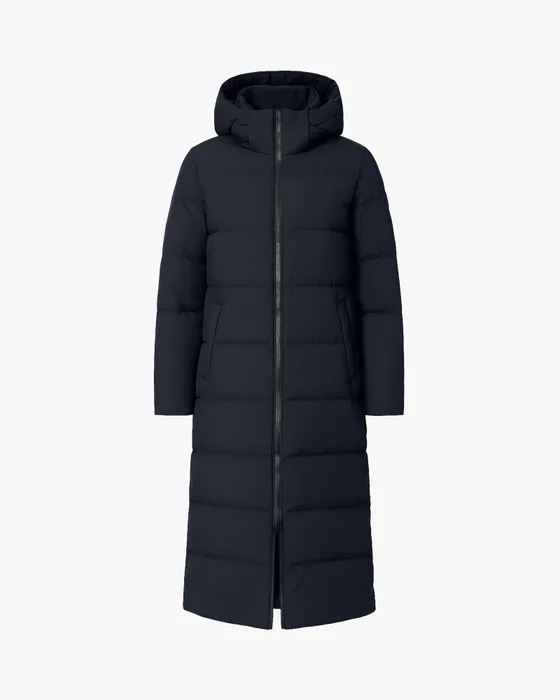
- Buy Quartz Co. SOFIA Heritage Hooded Down Winter Jacket A made-in-Canada maxi parka with a rated waterproof shell, 650 fill power down and the longest cut in this group.
- Buy Orolay 092 Universe Women's Thickened Down Jacket The viral thigh-length down coat, and on paper a better-filled one than its price suggests.
- It depends Outdoor Research Women's Coze Down Parka A light, well-built 43-inch down parka for dry cold, with an outdoor brand's lifetime guarantee.
- Skip Eddie Bauer Women's Sun Valley Down Parka A familiar mall-brand parka that leaves out the two numbers you need to judge a down coat.
What actually matters
- Fill power - This is the volume an ounce of down fills, in cubic inches. Higher numbers mean loftier, lighter down, and 600 to 700 is typical for a quality city parka.
- Fill weight - This is how many ounces or grams of down are inside the coat. It sets total warmth alongside fill power, and most makers do not publish it.
- Down-to-feather ratio - This tells you how much of the fill is down clusters rather than feathers. Feathers are heavier and insulate less, so higher down percentages are better.
- Shell waterproofing - Wet down loses its loft and most of its warmth. A rated waterproof shell protects it from wet snow and sleet.
- Breathability - A parka that traps sweat will chill you once you stop moving. A breathability figure, in g/m2 per 24 hours, shows how much moisture vapour can escape.
- Length - Coverage over the hips and thighs keeps far more heat in when you are standing still. Long coats need side zips so you can walk freely.
- Fit and size range - Down only insulates when it is not compressed. A coat that is tight over a sweater loses warmth, so check the cut and the size range.
The specs, in plain English
Green flags vs red flags
Green flags
- Fill power and down ratio both stated
- A waterproof rating in millimetres
- Length given in inches or centimetres for a stated size
- Side zips or vents on a long coat
- A down standard such as RDS named
Red flags
- No fill power anywhere on the page
- Down described only as a minimum percentage
- Waterproof claimed without a rating
- A temperature rating with no test method or context
- Product copy that contradicts its own spec list
Who's who: the brands
- Quartz Co. - A Canadian maker of long down parkas, known for made-in-Canada production and published shell ratings.
- Orolay - Known for the 092 Universe, a widely bought budget down coat with an unusually wide size range.
- Outdoor Research - An outdoor gear brand whose parkas carry detailed fabric specs and its Infinite Guarantee.
- Eddie Bauer - A long-running American outdoor apparel brand with broad Petite, Tall and Plus fit options.
How to read a listing without getting fooled
Start with the insulation line in the materials or composition section, where you should find fill power and the down-to-feather mix. If the page only says down or minimum 80% down, assume the maker had nothing worth bragging about. Next look at the shell: a waterproof figure in millimetres and a breathability figure in g/m2 are signs of a tested fabric, while DWR on its own means water resistant. Find the length for a named size, ideally center back length, and compare it to your own height. Finally, read temperature ratings last and treat them as marketing unless the maker explains how they were set.
How much should you spend?
Budget parkas can carry decent down, and some publish fill power and RDS certification, but their weather claims are often unrated and their construction details thin. Mid-range coats from mainstream brands often win on fit range and returns, yet some publish less about their insulation than the budget brands do. Premium parkas usually add rated waterproof shells, longer cuts, better zips and stronger guarantees, and the extra spend is easiest to justify in wet, cold climates where a soaked coat stops working.
Questions, answered
Is goose down better than duck down?
Not automatically. Fill power is what tells you down quality, and duck down at 700 fill lofts like goose down at 700 fill. Goose down is more common at the very high fill powers. For a city parka, a stated fill power and ratio matter more than the bird.
Can I wash a down parka at home?
Many can, but check the care label first. Eddie Bauer's instructions for the Sun Valley are typical: machine wash cold on delicate with a mild detergent, no fabric softener, then tumble dry low with a clean tennis ball to break up clumps. Never let a down coat stay damp for long, or the down can clump and smell.
Why does my parka feel cold even with good down?
Usually because of gaps rather than the fill. Wind gets in at an open collar, loose cuffs or a short hem, and compressed down at the shoulders from a backpack strap loses loft. Layering matters too: a cotton shirt that holds sweat under the coat will make you cold however good the parka is.
Should I size up in a parka?
Only if you plan to wear thick layers underneath or the maker says the coat runs small. Down needs room to loft, so a coat that is tight over a sweater will be less warm. Check the maker's own fit note, since some coats, like the Orolay, are described as running slightly big.
Or jump to the head-to-head: Quartz Co. SOFIA Heritage Hooded Down Winter Jacket vs Orolay 092 Universe Women's Thickened Down Jacket.