Explained
Beach Tents, Explained
After reading, you'll understand the four kinds of beach shelter, what a UPF rating covers, why anchoring matters more than poles, and which numbers on a listing to trust.
In this guide
First-time buyers tend to shop by people count and by the UPF 50+ badge, and both mislead. A 4-person label can mean four adults lying on towels or two in chairs, and UPF describes the fabric alone, not the shade you sit in. The spec that most affects a beach day is how the shelter is held down, and it rarely gets a headline. Most listings also leave out the two numbers you would most like to have: a wind limit and a named UPF test standard.
The 30-second version
- UPF is a fabric rating, so a UPF 50+ canopy still lets scattered and reflected UV reach you from the open sides.
- Shade area beats people count, because square feet can be compared across brands and capacity labels cannot.
- Sand needs weight, not stakes, which is why beach shelters use sandbags or sand pockets that you fill on site.
- Wind limits are rarely published, so judge wind behavior from the design and take the shelter down when gusts build.
- Packed length decides travel, since a shelter that packs under about two feet can go in luggage and a 42 inch one cannot.
The products this guide is about
Our verdict on each, with the full reasoning on the companion review.
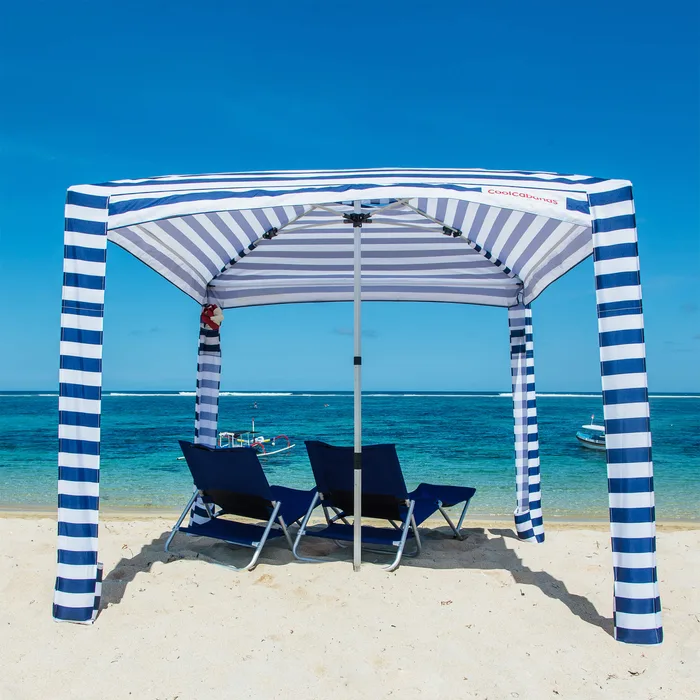
- Buy CoolCabanas CoolCabana 5 (Large) A center-pole cabana with four sand-pocket arms that gives 64 square feet of shade without depending on wind.
- Buy Neso Grande A 9 ft x 9 ft stretch-fabric canopy on two aluminum poles and four fill-it-yourself anchor bags, at 6.5 lb.
- It depends Shibumi Shade Classic with Wind Assist A single arched pole and a free-flying canopy that the wind holds up, giving a stated 150 square feet of shade from about 4 lb.
- Skip Coleman Skyshade Large Compact Beach Shade A small, low three-walled pop-up shelter with a floor, built more as a nap spot than a group shade.
What actually matters
- Shade area - The published square feet or canopy dimensions tell you how much ground is covered. It is the one size figure you can compare directly between brands.
- Anchoring method - Sand pockets, sandbags, stakes and guy lines hold very differently on a beach. A stated anchoring weight, such as 35 lb of sand, is more useful than a count of stakes.
- Carry weight - The shelters in our comparison run from about 4 lb to 16.5 lb. That gap decides whether one person can carry the shade along with chairs and a cooler.
- Packed length - Listings give this as the bag length. It matters for suitcases, small trunks and bike or bus trips.
- Wind behavior - Some designs resist wind with weight, some with tension, and one type needs wind to work. Know which you are buying, because a published wind limit is uncommon.
- UPF claim and its source - UPF 50+ on a listing is a claim about the fabric. A named test method or a linked lab report makes the claim checkable.
- Headroom and openness - Peak height and the number of open sides decide whether you can sit in a chair and feel a breeze. Low walled shelters trade both for privacy.
The specs, in plain English
Green flags vs red flags
Green flags
- The maker names a UPF test method or links a lab report.
- Shade area is given in square feet or exact canopy dimensions.
- Anchoring uses sandbags or sand pockets, ideally with a stated filled weight.
- Weight and packed length are both listed for the exact size you are buying.
- The listing is plain about limits, such as needing a breeze or a separate kit for grass.
Red flags
- UPF 50+ appears with no test method, lab or report behind it.
- The word windproof appears with no wind speed attached.
- Capacity is given only as a people count, or differs from place to place on the same page.
- The shelter relies on plain tent stakes for use on loose sand.
- Peak height is missing on a walled shelter you plan to sit inside.
Who's who: the brands
- CoolCabanas - Center-pole cabanas with sand-pocket arms, sold in Medium and Large sizes.
- Neso - Stretch-fabric sunshades anchored with fill-it-yourself bags, in sizes from the Neso 1 to the Gigante.
- Shibumi Shade - The wind-flown beach canopy on a single arched pole, sold in Classic and Mini sizes.
- Coleman - A broad camping brand that sells low-cost pop-up beach shelters with floors and walls, such as the Skyshade.
- Sun Ninja - Stretch-fabric beach tents sold by person count, in 2, 4 and 8 person sizes.
How to read a listing without getting fooled
Start with the size line and find a real measurement: square feet of shade or canopy dimensions for the exact size you are choosing, since many listings mix figures for two sizes. Then find weight and packed length, and check whether the weight in the marketing copy matches the spec table, because they sometimes differ. Look for what is in the box: poles, anchor bags, stakes, a sand spike, a carry bag, and anything sold separately such as a grass kit. For sun protection, look past the UPF 50+ badge for a named test method or a linked report. Last, search the page for a wind figure. If there is none, treat words like windproof or strong in the wind as description, not a rating.
How much should you spend?
Budget shelters are mostly small pop-ups with a floor and walls; they suit one or two people and short visits. The mid-range tier is where stretch-fabric canopies with aluminum poles sit, and it buys the most shade per pound carried. Premium shelters are the center-pole cabanas and wind-flown canopies, where you pay for a patented design, larger coverage, and in some cases a longer warranty or published fabric testing. Paying more does not buy a higher UPF label, since nearly everything is sold as UPF 50+. It buys coverage, easier setup, and better documentation.
Questions, answered
What is the difference between UPF and SPF?
SPF is a rating for sunscreen and UPF is a rating for fabric. The Skin Cancer Foundation notes that UPF accounts for both UVB and UVA, while SPF is based on UVB. A beach tent can carry a UPF claim for its fabric but not an SPF. Listings that describe a shelter as SPF 50 are using the wrong term.
Why do beach tents use sandbags instead of stakes?
Loose dry sand gives a thin stake very little to grip, so it can pull out under load. A bag or pocket filled with sand resists by weight instead. That is why cabanas and stretch canopies ship with pockets or bags, and why pop-ups that include stakes usually add sandbags too. Burying a filled bag in a shallow hole adds more hold.
Is a floor useful in a beach tent?
A floor keeps towels and a sleeping baby off hot sand and gives you a clean spot for bags. It also collects sand that has to be shaken out, and it comes with walled pop-up designs that are low and less breezy. Open canopies have no floor, so you bring a blanket or chairs. Choose by whether you mostly lie down or mostly sit in chairs.
How long does setup take?
Makers' own figures for the shelters we compared range from under three minutes to about five minutes for one person. First-time setup takes longer, and tensioned stretch canopies have a learning curve. Filling sandbags or sand pockets is usually the slowest step. Watching the maker's setup video before the first trip saves time on the sand.
Or jump to the head-to-head: CoolCabanas CoolCabana 5 (Large) vs Neso Grande.