Explained
Belay Devices, Explained
After reading, you'll understand what EN 15151 part and type numbers mean, why the certified rope diameter range is the number that matters most, and what assisted braking does and does not do.
In this guide
First-time buyers usually get tripped up by the same three things. They assume assisted braking means the device holds a fall on its own, which no manufacturer claims. They buy a device without checking their rope's diameter against the range printed on it. And they assume a belay device is generic, when the carabiner shape, the rope range and the ability to belay from an anchor all differ by model. None of that is hidden; it is printed in the manual that comes in the box.
The 30-second version
- Assisted braking is assistance, not automation, and every manual in this category says the brake hand stays on the rope.
- The certified rope range is the specification, and using a rope outside it means the device was never tested for what you are asking it to do.
- EN 15151 comes in two parts, one for braking devices with manually assisted locking and one for manual braking devices, plus numbered types inside each.
- Guide mode is a distinct capability, and some assisted-braking devices explicitly cannot belay a second directly from the anchor.
- The belay carabiner is part of the device, because the shape and the cross-section it presents to the rope change the friction the device was certified with.
The products this guide is about
Our verdict on each, with the full reasoning on the companion review.
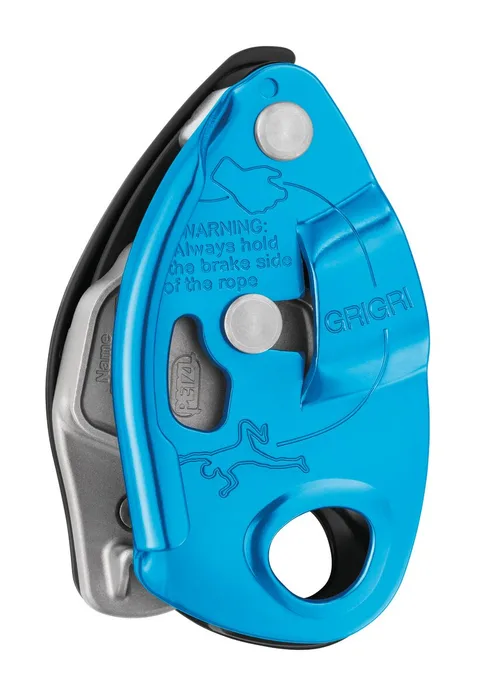
- Buy Petzl GRIGRI The cam-assisted device that most gyms and sport crags are built around, with the clearest published guidance on which ropes it likes. Amazon
- Buy Black Diamond ATC-Guide The cheap, light, do-everything tube with a guide mode, and the device that covers the widest range of ropes here. Amazon
- It depends Climbing Technology CLICK UP+ A passive assisted-braking device that is very good at the job it was designed for and explicitly not certified for the jobs it was not. Amazon
- Skip Edelrid Mega Jul II A clever stainless steel tube that claims the whole job list, and asks you to learn a device-specific technique for every part of it. Amazon
What actually matters
- Certified rope diameter range - this is the band the manufacturer tested and a notified body assessed. Outside it you are on your own, and thin ropes in particular reduce the grip an assisted-braking device can generate.
- EN 15151 part - Part 1 devices have a manually assisted locking function, Part 2 devices are manual braking devices. The part number alone does not tell you whether a device offers assisted braking, since some passive assisted devices are certified under Part 2.
- Type number - inside each part, the type describes a feature. Petzl calls the GRIGRI type 6 under Part 1 because it has no panic blocking element; Black Diamond calls the ATC-Guide Type 4 under Part 2 because it has adjustable friction.
- Guide mode - the ability to belay one or two seconds directly from an anchor, using the rope's own tension to lock. Tube devices with a second attachment hole do this; a cam device like the GRIGRI handles one second at most, and some passive assisted devices cannot belay from the anchor at all.
- Lowering method - a handle, a lever on the device body, or a threaded release hole. Each is a separate learned technique, and habits from one device do not transfer safely to another.
- Carabiner specification - EN 12275 Type H or HMS shapes are the common requirement, and some makers ban basic Type B lockers outright or supply a carabiner with an anti-cross-loading bar.
- Weight and materials - aluminum tubes are the lightest, steel bodies last longer against rope wear, and cam devices carry the mechanism's weight. This only matters once the safety questions are settled.
The specs, in plain English
Green flags vs red flags
Green flags
- The certified rope diameter range is printed on the device itself and matches the rope you actually own.
- The manufacturer publishes a downloadable instruction manual and a declaration of conformity, not just a marketing page.
- The EN 15151 part and type are stated in words, so you can see what the type actually means rather than guessing.
- The manual names a carabiner specification, whether that is EN 12275 Type H, an HMS shape, or a specific supplied carabiner.
- The maker states clearly what the device is not for, such as ruling out trad routes or belaying a second from an anchor.
Red flags
- The listing describes the device as automatic, self-locking or hands-free, which no manufacturer in this category claims.
- A rope diameter range is quoted with no indication of whether it is the certified range or a looser usable one.
- No instruction manual is available anywhere on the brand's site before you buy.
- The seller says any locking carabiner will do, when the device's own manual restricts the shape.
- The device is a copy or a lookalike of a well-known model with no named standard, no type number and no notified body.
Who's who: the brands
- Petzl - The French maker behind the GRIGRI, and unusually specific in publishing optimal rope diameter bands inside its certified ranges.
- Black Diamond - Makes the ATC family, from the plain tube through the ATC-Guide with guide mode to the geometry-assisted ATC-Pilot.
- Edelrid - The German maker of the Jul family of steel assisted-braking tubes, and of the Ohm, a resistor that clips to the first bolt and is not a belay device.
- Climbing Technology - The Italian maker of the CLICK UP family, passive assisted-braking devices sold as a matched set with their own carabiner.
- Mammut - Swiss brand whose Smart line is another widely sold passive assisted-braking design, listed on Mammut's own site.
How to read a listing without getting fooled
Start with the two numbers that constrain you: the rope diameter range and the EN 15151 part and type. Both are stamped on the device and repeated in the manual, and if a listing gives you neither, download the manual from the manufacturer before you buy anything. Then check what the manual excludes, because the exclusions are more informative than the features: Climbing Technology says the CLICK UP+ is not for trad or mountaineering and cannot belay a second from the anchor, Black Diamond says the ATC-Pilot has no guide mode and must not be used with basic Type B carabiners, Petzl says the GRIGRI is single-rope only. Finally, look at the carabiner section, because a device and its carabiner are a system and the shape you clip in changes the friction the device was tested with. Weight, colour and finish come last.
How much should you spend?
Plain tube devices sit in the budget tier and are the cheapest piece of hard climbing gear you will buy. Tubes with guide mode and two friction settings are still budget to lower mid-range, which makes something like the ATC-Guide an easy addition even if you already own an assisted device. Passive assisted-braking devices land in the mid-range, and the ones sold as a matched kit with their own carabiner push toward the upper end of it because you are buying two pieces of gear. Cam-assisted devices are the premium tier, and the versions with an anti-panic function cost more again. The gap between the cheapest and the dearest device here is smaller than the gap between a good and a bad climbing rope, so buying the right device for your terrain rather than the cheapest one is not an expensive decision.
Questions, answered
Is the Edelrid Ohm a belay device?
No. Edelrid describes it as an assisted-braking resistor for rope teams with a large weight difference, and it clips to the first bolt rather than to your harness. It adds friction to the rope so that a lighter belayer can hold a heavier leader, and Edelrid lists a rope range of 8.9 to 11 mm and a minimum belayer weight for it. You still need a real belay device on your harness as well. Do not confuse the two categories when you are shopping.
Do I need a device with an anti-panic function?
It depends on who you belay and where. An anti-panic or panic blocking element stops the descent if the user pulls the lowering handle too hard, which is a real failure mode for nervous or inexperienced belayers. Petzl distinguishes this in its type labelling: the standard GRIGRI is EN 15151-1 type 6, devices for belaying and rappelling without a panic blocking element. Gyms and instructional settings often prefer devices that have the function. An experienced belayer with good technique generally does not need it.
Can I use one device for both single and half ropes?
Only if the manufacturer lists both. Tube devices commonly do, and Petzl publishes separate single, half and twin ranges for the Reverso. Cam-assisted devices like the GRIGRI are single-rope only. Passive assisted devices vary, and Edelrid attaches a specific warning to half-rope lead belaying with the Mega Jul II, saying that thin ropes, a heavy leader or few intermediate anchors can make a fall very difficult to hold and that only trained and experienced belayers should use that variant.
How long does a belay device last?
Metal devices are not retired by age the way slings and harnesses are. Black Diamond states that the lifespan of metal gear is not limited by age, while plastic or textile products are retired ten years after manufacture even if unused. What retires a belay device is wear: grooves worn into the rope-bearing surfaces, cracks, deformation or corrosion. Inspect before and after each use, and retire immediately if anything is deformed, cracked, sharply grooved or corroded, or if you have any doubt after a serious fall.
Or jump to the head-to-head: Petzl GRIGRI vs Black Diamond ATC-Guide.