Explained
Camp Cooksets, Explained
After reading, you'll know which metal suits how you cook, why titanium scorches food, and what capacity you actually need.
In this guide
Cooksets look like a choice between brands and are really a choice between three metals. Buy the wrong one and the symptoms are specific and annoying: food that burns in a ring, a pot too heavy to carry, or a set you cannot put on the fire you were planning to cook over. The good news is that once you have picked the metal, the rest of the decision is small.
The 30-second version
- The metal is the purchase, setting weight, heat behaviour, fire tolerance and most of the price before any brand gets involved.
- Titanium is for boiling, since it saves the most weight and conducts heat so poorly that anything cooked in it catches.
- Aluminium cooks best, because it spreads heat across the base instead of concentrating it above the flame.
- Stainless is the fire metal, which is why campfire cooking carries a weight penalty you cannot design your way out of.
- Two to three litres covers two people, and a second pan is a decision to cook properly rather than to reheat.
The products this guide is about
Our verdict on each, with the full reasoning on the companion review.
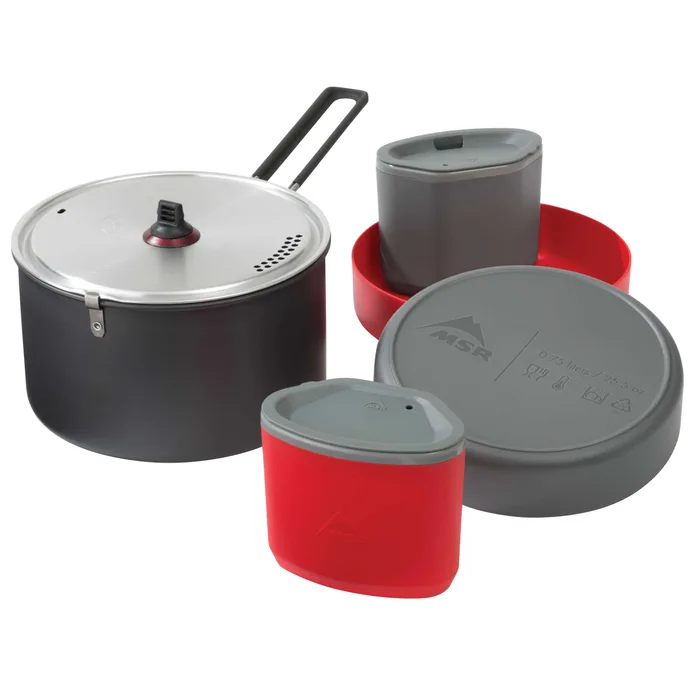
- Buy MSR Alpinist 2 Cook Set Hard-anodised aluminium at 630 grams, which is the balanced answer between titanium and steel. Amazon
- Buy GSI Outdoors Glacier 3L Cookset Stainless steel that will sit in a fire, with the weight penalty that implies. Amazon
- It depends Snow Peak Multi Compact Cookset Titanium 445 grams of Japanese titanium, which is the lightest here and the hardest to cook on. Amazon
- Skip Primus CampFire Cookset Stainless Steel Small The heaviest set here, sold on an English store that still serves its description and specs in Swedish. Amazon
What actually matters
- Material - titanium, hard-anodised aluminium or stainless steel. This single choice determines weight, how evenly the set cooks, whether it survives an open fire, and roughly what it costs.
- Thermal conductivity - how fast heat spreads sideways through the pot base. High conductivity means even cooking, low conductivity means a hot spot above the burner and scorched food around it.
- Set weight - the total for everything that goes in the bag. It spans a factor of three across materials at similar capacity, so it is the number most affected by a decision you make before comparing brands.
- Capacity - usable litres, which decides how many people the set feeds and whether you cook one pot or two. Stated capacity is the pot volume to the brim rather than a safe working volume.
- Fire tolerance - whether the set can sit on coals. Stainless sets are the ones built for it, and makers such as MSR advise against putting their aluminium or titanium cookware on an open fire, partly because of plastic parts that could melt.
- Nesting and packed size - how tightly the pieces stack and how big the bundle is. Folding handles are what make tight nesting possible, so their absence usually means a bulkier package.
- Lid design - whether the lid strains, locks or doubles as a plate. In a set with three or four pieces, a lid doing two jobs is a meaningful reduction in what you carry.
The specs, in plain English
Green flags vs red flags
Green flags
- The specific alloy or grade is named, such as 18/8 stainless or hard-anodised aluminium.
- Total set weight is published rather than just component counts.
- Fire tolerance is stated explicitly rather than implied by the product name.
- Packed dimensions are given for the nested set.
- Lid function is described, including whether it strains.
Red flags
- The material is described only as metal, steel or lightweight.
- No total weight published in a category bought by people counting grams.
- A campfire name on a set that never states it tolerates flame.
- Premium pricing attached to a page with no capacity, weight or packed size.
- Marketing copy that has not been translated into the language of the store selling it.
Who's who: the brands
- MSR - Backcountry cooking specialist whose pages carry complete specification blocks.
- GSI Outdoors - Camp kitchen brand strongest in stainless and enamel sets built for fires and groups, with precise material grades published.
- Snow Peak - Japanese brand known for titanium cookware at a premium, priced on weight saving and generally light on published specifications.
- Primus - Swedish stove and cookware maker with a long open-fire tradition, whose international pages are sometimes incompletely localised.
- Sea to Summit - Known for collapsible and hybrid designs using silicone with metal bases, aimed at packing small rather than at pure weight saving.
How to read a listing without getting fooled
Find the material first and treat everything else as a consequence of it. If a page says only lightweight or durable without naming the metal, that is a page avoiding the most important thing about the product. Next look for a total set weight, because a cookset is bought by people who care about grams and a brand that omits it is either not proud of the number or not writing for that buyer. Then check for an explicit fire statement, since stainless is the metal built for coals and a set named after a campfire is not the same as a set rated for one. Finally read the lid description, because a lid that strains is the difference between three items and four.
How much should you spend?
Price in this category tracks the metal more than the brand. Budget buys plain or hard-anodised aluminium in simple shapes, which is genuinely good cookware and the sensible starting point for most people. Mid-range buys either a better-finished aluminium set with strainer lids and folding handles, or an entry stainless set for fire cooking, and this tier covers what almost everyone actually needs. Premium is overwhelmingly titanium, where you are paying a substantial amount per gram saved and accepting worse cooking performance in exchange. That trade is rational if you carry the set on your back for days and irrational if it lives in a car. Decide how far the set travels before deciding how much to spend.
Questions, answered
Can I use a cookset on an induction hob at home?
Only the stainless ones, and not all of those. Induction requires a ferromagnetic base, which rules out titanium and aluminium entirely regardless of thickness. Most 18/8 stainless is only weakly magnetic because the nickel content changes the crystal structure, so some stainless camp pots work on induction and others do not. The reliable test is whether a fridge magnet sticks firmly to the base.
How do I stop food catching in a titanium pot?
Keep the flame low and wide, stir constantly, and add liquid. The problem is a concentrated hot spot, so anything that spreads the heat or keeps the contents moving reduces it. In practice most titanium users work around it rather than solving it, by boiling water and rehydrating food rather than cooking from raw. If you find yourself fighting it every meal, the honest answer is that you bought the wrong metal for how you cook.
Is a non-stick coating worth having on a camp pan?
It makes eggs and fish possible and it is the first thing to fail. Camp cookware gets scoured with sand and gravel, packed against other metal, and occasionally put closer to a flame than it should be, all of which destroy non-stick surfaces faster than home use does. If you want one, treat it as a consumable, carry a plastic utensil and never scour it. Bare hard-anodised aluminium is the more durable compromise.
How much does a cookset really need to weigh?
For two people on a burner, somewhere around 600 grams gets you a properly usable set in hard-anodised aluminium, which is the figure worth benchmarking against. Titanium takes that to roughly 450 at the cost of cooking performance, and stainless pushes it to 950 and up in exchange for fire tolerance and durability. If a set weighs well over a kilogram without offering fire tolerance or a much larger capacity, it is not earning the weight.
Or jump to the head-to-head: MSR Alpinist 2 Cook Set vs GSI Outdoors Glacier 3L Cookset.