

Outdoors & Fitness
The Best Camp Cooksets: 4 Compared (and One to Skip)
Four cooksets from 445 grams to about 1,240, and the weight difference is almost entirely the metal. One of them still ships its description in Swedish.
The short version
The MSR Alpinist 2 is the pick, a 2.4 litre hard-anodised set at 630 grams with a lid that doubles as a strainer and a complete published specification. The GSI Glacier 3L is the value choice, 18/8 stainless with strainer lids and dual bail handles, heavy at 964 grams and the one to take if you cook over a fire. The Snow Peak Multi Compact Titanium is the lightest thing here at 445 grams, which is the whole reason to buy titanium and comes with the hot spots that go with it. Skip the Primus CampFire Cookset Stainless Steel Small: it is the heaviest set in this comparison and its English store still serves the description in Swedish. Choose the metal first and the set follows. Best for: anyone deciding between carrying less and cooking better.
Our picks at a glance
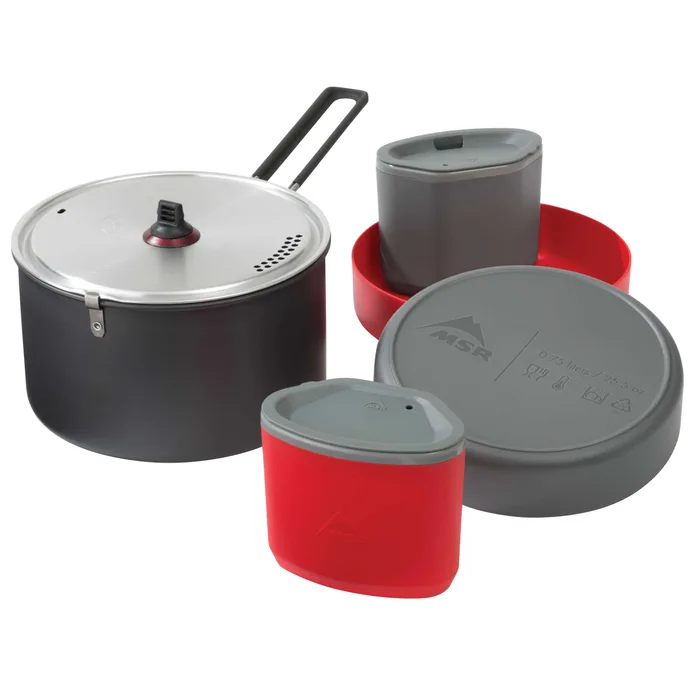
- MSR Alpinist 2 Cook Set - Buy. Hard-anodised aluminium at 630 grams, which is the balanced answer between titanium and steel.
- GSI Outdoors Glacier 3L Cookset - Buy. Stainless steel that will sit in a fire, with the weight penalty that implies.
- Snow Peak Multi Compact Cookset Titanium - It depends. 445 grams of Japanese titanium, which is the lightest here and the hardest to cook on.
- Primus CampFire Cookset Stainless Steel Small - Skip. The heaviest set here, sold on an English store that still serves its description and specs in Swedish.
The verdict in 30 seconds
What mattered most
- Material
- Set weight
- Capacity
- Packed size
- Safe over open flame
- Heat distribution
A cookset is a decision about metal. Titanium, hard-anodised aluminium and stainless steel weigh very differently, conduct heat very differently, and tolerate an open fire very differently, and everything else about a cookset follows from which one you pick. We compared four small-group sets and the weights ran from 445 grams to about 1,240, in the exact order the materials predict.
Hard-anodised aluminium at 630 grams, which is the balanced answer between titanium and steel.
Best for: Two people cooking on a gas burner who want food that heats evenly rather than in a ring.
- 2.4 litre hard-anodised aluminium pot, a material that spreads heat far more evenly than titanium and weighs far less than steel.
- 630 grams stated with a packed size of 7.2 by 4.8 inches, so both numbers a buyer needs are published.
- The pot lid doubles as a strainer, which removes a separate item from the kit.
- Complete two-person kit at that weight: the 2.4 litre pot, a strainer lid, a removable Talon pot handle, two DeepDish plates and two insulated mugs.
- Hard-anodised aluminium should not go directly on coals or in a fire, which rules out the classic campfire use.
- One 2.4 litre cooking pot means one-pot meals, since the plates and mugs are for eating rather than cooking.
- Heavier than titanium by around 40 percent for anyone counting grams.
Own the MSR Alpinist 2 Cook Set? Tell us how it held up.
Thanks. Counted, and shown once enough owners have weighed in.
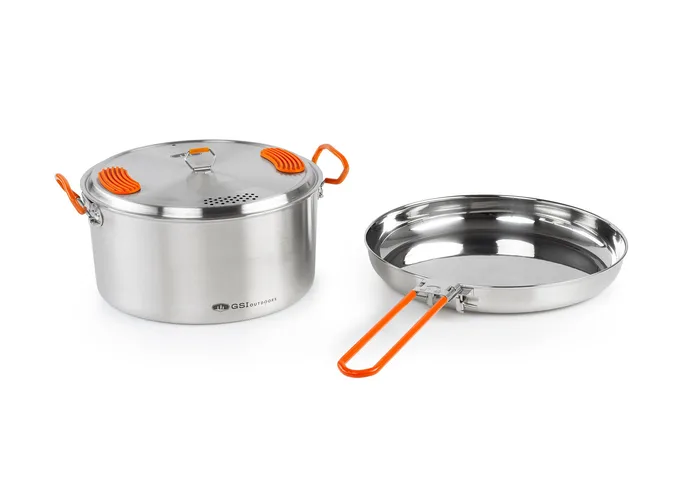
Stainless steel that will sit in a fire, with the weight penalty that implies.
Best for: Cooking over wood or coals, and anyone whose kit travels by car rather than on their back.
- 18/8 stainless steel, which GSI says is tough enough for open flame and red-hot coals.
- 3 litre capacity plus a frying pan, which is a genuine two-course setup rather than a single pot.
- Strainer lids and dual bail handles, meaning safe pouring and a secure hold over a fire.
- Materials specified precisely as 18/8 stainless, silicone and recycled PET cloth rather than described as steel.
- 964 grams, more than double the titanium set, which is a lot to carry any distance.
- Stainless conducts heat poorly compared to aluminium, so it is slower to boil and burns more easily on a burner.
- Nests to 8.4 by 8.4 by 5.7 inches, a bulkier package than the smaller sets here.
- Hand wash only, despite stainless being the easiest material here to clean.
Own the GSI Outdoors Glacier 3L Cookset? Tell us how it held up.
Thanks. Counted, and shown once enough owners have weighed in.
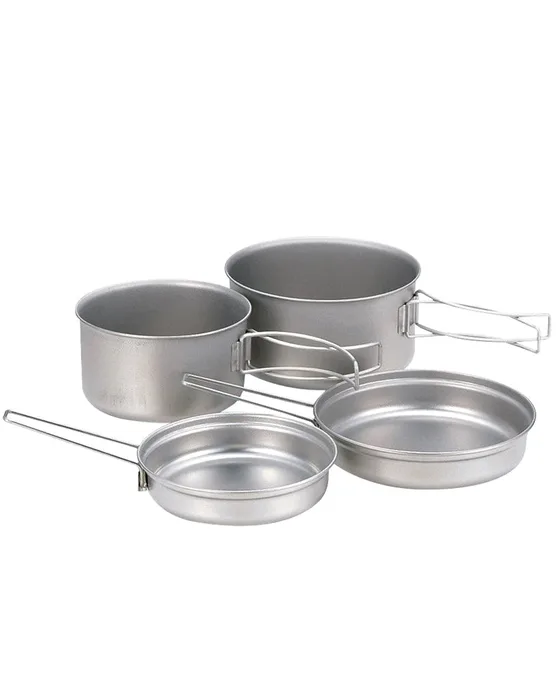
445 grams of Japanese titanium, which is the lightest here and the hardest to cook on.
Best for: Backpackers boiling water and rehydrating food, where hot spots do not matter and grams do.
- 445 grams is by a wide margin the lightest set in this comparison, and weight is the entire argument for titanium.
- Two stacking pots and frypans for two users, so it is a fuller kit than a single-pot system at half the weight.
- Foldable handles, which is what makes a nesting titanium set actually pack flat.
- Titanium does not react with food or corrode, so it survives being stored damp better than aluminium.
- Titanium conducts heat poorly and unevenly, so it develops hot spots and scorches food that aluminium would cook through.
- The product page publishes almost nothing, with no stated capacity, no packed size and no weight in the description.
- Titanium carries a large cost per gram saved.
- Thin titanium walls dent more easily than the stainless sets here.
Own the Snow Peak Multi Compact Cookset Titanium? Tell us how it held up.
Thanks. Counted, and shown once enough owners have weighed in.
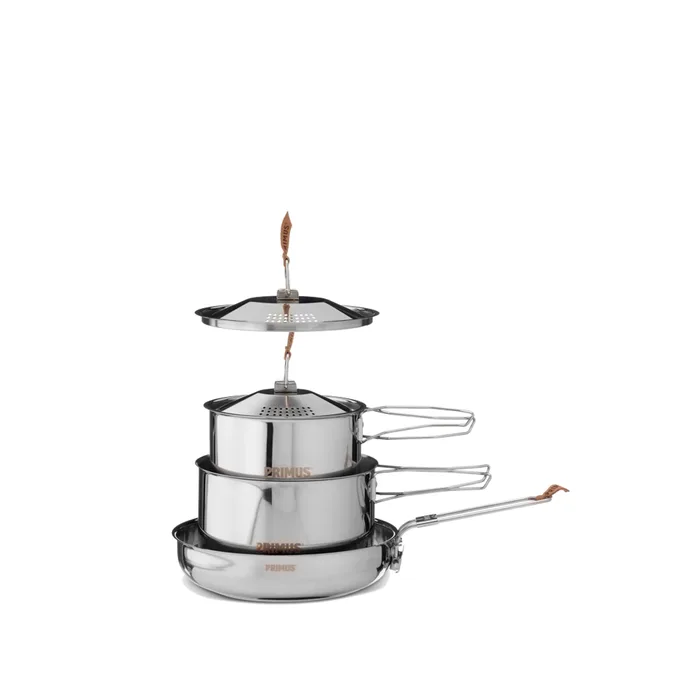
The heaviest set here, sold on an English store that still serves its description and specs in Swedish.
Best for: Very little, given that a lighter stainless set from a rival covers the same open-fire use case.
- Stainless steel construction genuinely built for cooking over an open fire, which is what the name promises.
- A three-piece set of a 1.8 litre saucepan, a 1 litre saucepan and a 21 centimetre frying pan is a properly equipped kit.
- Component dimensions and weights are published individually, which few brands bother with.
- About 1,240 grams by its published component weights makes it the heaviest set in this comparison, for less total capacity than the GSI at 964 grams.
- The product description on the English-language store is untranslated Swedish, so the buying information is unreadable for most of its audience.
- Two saucepans and a frying pan is three things to clean where the MSR needs one.
- Nothing here that the GSI stainless set does not do for over a fifth less weight.
Own the Primus CampFire Cookset Stainless Steel Small? Tell us how it held up.
Thanks. Counted, and shown once enough owners have weighed in.
| Criteria | Alpinist 2 Cook Set Top pick Buy it Buy | Glacier 3L Cookset Buy it Buy | Multi Compact Cookset Titanium It depends Buy | CampFire Cookset Stainless Steel Small Skip it Buy |
|---|---|---|---|---|
| Best for | Two people cooking on a gas burner who want food that heats evenly rather than in a ring. | Cooking over wood or coals, and anyone whose kit travels by car rather than on their back. | Backpackers boiling water and rehydrating food, where hot spots do not matter and grams do. | Very little, given that a lighter stainless set from a rival covers the same open-fire use case. |
| Price tier | $$ · mid-range | $$ · mid-range | $$$ · premium | $$ · mid-range |
| Material | Hard-anodised aluminium | 18/8 stainless steel | Japanese titanium | Stainless steel |
| Set weight | 630 g / 22.2 oz | 964 g | 445 g | About 1,240 g (sum of published parts) |
| Capacity | 2.4 L pot, plus 2 plates and 2 mugs | 3 L pot plus frying pan | Two stacking pots and frypans | 1.8 L and 1 L pans plus 21 cm pan |
| Packed size | 7.2 x 4.8 in | 8.4 x 8.4 x 5.7 in | Not published | Not published as a set |
| Safe over open flame | No, burner only | Yes, flame and coals | No, burner only | Yes, built for it |
| Heat distribution | Best here, aluminium spreads heat | Poor, steel is slow and uneven | Poor, thin titanium walls give hot spots | Poor, steel is slow and uneven |
| Strainer lid | Yes, lid doubles as strainer | Yes, strainer lids | Not published | Yes, both saucepan lids |
| Specification published | Weight, packed size, material, full contents | Size, dimensions, materials | Very little | Component weights and dimensions |
| Description language on the English store | English | English | English | Swedish, untranslated |
Which one is right for you?
- Two people cooking on a gas burner who want food that heats evenly rather than in a ring. Buy it MSR Alpinist 2 Cook Set
- Cooking over wood or coals, and anyone whose kit travels by car rather than on their back. Buy it GSI Outdoors Glacier 3L Cookset
- Backpackers boiling water and rehydrating food, where hot spots do not matter and grams do. It depends Snow Peak Multi Compact Cookset Titanium
- Very little, given that a lighter stainless set from a rival covers the same open-fire use case. Skip it Primus CampFire Cookset Stainless Steel Small
How we judged the field
Five things decide a cookset, and the first one decides the other four. The metal sets the weight, the heat behaviour, the fire tolerance and most of the price, so choosing between titanium, hard-anodised aluminium and stainless steel is the actual purchase and the rest is packaging. Second is capacity, where two to three litres covers one-pot meals for two and anything more is a choice to cook properly rather than reheat. Third is packed weight and nesting, since a cookset that does not nest tightly takes space out of everything else. Fourth is whether the set tolerates an open flame, which is a material question and rules out two of these four entirely. Fifth is the small stuff that gets used every meal, meaning strainer lids, folding handles and bail handles.
The weights in this comparison ran from 445 grams to about 1,240, and they landed in exactly the order the materials predict: titanium, then hard-anodised aluminium, then stainless, then more stainless. That is a useful thing to see laid out, because it means the weight column on a comparison table is telling you about metallurgy rather than about design cleverness. We picked these four because they cover all three materials at a comparable capacity for small groups, and because the disclosure ranged from a complete specification block down to a product page still serving its description in the manufacturer’s home language.
MSR Alpinist 2 Cook Set
Buy itThe MSR Alpinist 2 Cook Set is the pick because hard-anodised aluminium is the right default for people who cook rather than boil. Aluminium spreads heat across the base far better than titanium or steel, which is the difference between a sauce that thickens and a sauce that catches in a ring above the burner. At 630 grams with a 2.4 litre pot it sits between the titanium and stainless sets on weight, and MSR publishes both the weight and the packed size of 7.2 by 4.8 inches, along with the material, the contents and the country of manufacture. The lid doubling as a strainer is the kind of small decision that removes an item from the kit and gets used at every meal, and the set is fuller than its weight suggests: the pot, the strainer lid, a removable Talon handle, two DeepDish plates and two insulated mugs. One thing to know before buying: hard-anodised aluminium does not belong in a fire, and MSR advises against putting its aluminium cookware on an open fire because of plastic parts that could melt, so if your heat source is wood this is the wrong set regardless of how well it cooks.
GSI Outdoors Glacier 3L Cookset
Buy itThe GSI Glacier 3L Cookset is the one to own if your cooking happens over wood. It is 18/8 stainless, and GSI states that precisely rather than saying steel, which matters because 18/8 describes the chromium and nickel content that determines corrosion resistance. Stainless is the material in this comparison built to go directly on coals or in a flame, and it survives the kind of abuse that dents titanium and pits aluminium. The 3 litre pot plus a frying pan is a real two-course setup, the strainer lids do the same job as the MSR’s, and the dual bail handles give you a secure hold when lifting something heavy off a fire. The costs are all weight and thermodynamics. At 964 grams it is more than double the titanium set. Stainless also conducts heat poorly, so on a gas burner it is slower to boil than aluminium and easier to catch food in. It nests to 8.4 inches square, which is bulkier than the smaller sets. For car camping and fires, none of that matters much.
Snow Peak Multi Compact Cookset Titanium
It dependsThe Snow Peak Multi Compact Cookset Titanium exists for one reason and delivers on it completely. At 445 grams it is the lightest set here by a clear margin, and it is a fuller kit than that weight suggests, with two stacking pots and frypans for two users and foldable handles so the whole thing nests flat. Titanium also does not corrode or react with food, so it tolerates being packed away damp better than aluminium does. The trade is unavoidable and it is about heat. Titanium conducts poorly and the walls are thin, so a burner flame creates a hot spot directly above itself while the rest of the base stays cooler, and anything with sugar or dairy in it catches there. For boiling water and rehydrating a dehydrated meal, which is what most gram-counting backpackers actually do, that is irrelevant. For cooking, it is a genuine limitation. The other mark against it is the product page, which publishes no capacity, no packed size and no weight in its description.
Primus CampFire Cookset Stainless Steel Small
Skip itThe Primus CampFire Cookset Stainless Steel Small does nothing wrong as an object and quite a lot wrong as a product page. The set itself is sensible: stainless steel built for open fires, comprising a 1.8 litre saucepan, a 1 litre saucepan and a 21 centimetre frying pan, with individual component dimensions and weights published, which is more granular than most brands manage. The problem is that its published component weights add up to about 1,240 grams, making it the heaviest set in this comparison while offering less total pot capacity than the GSI at 964 grams. If you want stainless for fire cooking, a rival gives you more litres for over a fifth less weight. Then there is the page. On the English-language store, the product description is served in untranslated Swedish, running to a full paragraph about matlagning over open fire that most of its audience cannot read, and the component specifications and feature list underneath are in Swedish too. It is a small thing and an oddly revealing one, because the page was never localised for the store it sits on.
Sources
Specs in this review come from these pages.
- MSR Alpinist 2 Cook Set product page (msrgear.com)
- GSI Outdoors Glacier 3L Cookset product page (gsioutdoors.com)
- Snow Peak Multi Compact Cookset Titanium product page (snowpeak.com)
- Primus CampFire Cookset Stainless Steel Small product page (primusequipment.com)
- NIST material properties, thermal conductivity of metals (nist.gov)
MSR Alpinist 2 Cook Set vs GSI Outdoors Glacier 3L Cookset: which should you buy?
The MSR and the GSI are the two worth choosing between, and the question is what you put the pot on. If you cook on a gas burner, the MSR Alpinist 2 is the better set and it is not particularly close. Hard-anodised aluminium spreads heat across the base, so food cooks evenly instead of catching in a ring, and at 630 grams it is a third lighter than the stainless alternative. The strainer lid and the complete spec block are both points in its favour.
If you cook over wood or coals, the choice inverts completely and the MSR is disqualified rather than merely beaten. Hard-anodised aluminium does not belong in a fire, and no amount of even heating helps a pot you cannot use. The GSI Glacier 3L is stainless, it is stated as 18/8 so you know what you are getting, it has bail handles designed for lifting off a fire, and the extra 334 grams is the price of a set you can abuse for a decade. A reasonable reading is that these are not really competitors: one is a burner set and one is a fire set, and most people know which they are before they start shopping.
What to look for
- The metal, before anything else: titanium, hard-anodised aluminium and stainless differ by a factor of three in weight and behave completely differently on heat, and every other spec follows from that choice.
- A stated set weight: cooksets are bought by people counting grams, so a page that publishes a total weight is a page written for the actual buyer.
- Fire tolerance stated explicitly: of these four, only the stainless sets are built for coals, and a set that does not say so should be assumed to be burner-only.
- Packed dimensions, not just nesting claims: everything nests, so the useful figure is the size of the bundle that comes out the other end.
- A strainer lid: it removes a separate item from the kit and gets used at every meal, which is more value than most listed features deliver.
- Capacity in litres per person: two to three litres suits two people for one-pot meals, and a second pan is a decision to cook properly rather than reheat.
Our final take
Cooksets are the rare category where one specification really does determine the rest, and it is the metal. Across four sets the weights ran 445, 630, 964 and about 1,240 grams, in the exact order titanium, hard-anodised aluminium and stainless predict, which means most of what a comparison table shows you here is the periodic table. The MSR Alpinist 2 takes the pick for landing on the material that actually cooks food evenly while staying light enough to carry. The GSI Glacier 3L is the answer for fires. The Snow Peak is right if you are boiling water and wrong if you are making dinner. The Primus is a decent set behind a page its own audience cannot read.
Questions, answered
Titanium, aluminium or stainless, which should I buy?
Pick by heat source and how far you carry it. Titanium is the lightest by a wide margin and conducts heat badly, so it suits boiling water and rehydrating food and scorches anything you try to actually cook. Hard-anodised aluminium spreads heat best and sits in the middle for weight, which makes it the right default for cooking real food on a gas burner. Stainless is the heaviest and the one built to go in a fire, so it is the choice for wood, coals and long-term abuse.
Why does titanium burn food?
Because it conducts heat poorly and the walls are thin. A burner flame heats a small area of the pot base, and in aluminium that heat spreads sideways quickly to even out the temperature across the whole base. Titanium moves heat sideways far more slowly, so the spot directly above the flame gets much hotter than the rest and whatever is sitting there catches. It is a property of the metal rather than a manufacturing fault, which is why every titanium pot behaves this way.
Can I put any of these in a campfire?
Only the stainless sets. The GSI and Primus sets here are both stainless and both explicitly built for open flame and coals. Hard-anodised aluminium can be damaged by the very high, uneven temperatures of a wood fire, and titanium is thin enough that direct coal contact risks warping. If a fire is your main heat source, the material choice is made for you and the weight penalty comes with it.
Is a strainer lid actually worth having?
It removes an item from your kit, which matters more in a small cookset than it sounds. Draining pasta or rehydrated food without one means either a separate strainer or the lid-tilted-over-the-pot technique that burns fingers and loses food. Three of the four sets here publish a strainer lid. It is a small feature that gets used every meal, which is a better test of value than most specifications.
How much capacity do two people need?
Between two and three litres for one-pot meals, which is what most of this comparison offers. A single 2.4 litre pot handles pasta, rice or a stew for two comfortably. Adding a frying pan, as the GSI and Primus sets do, moves you from one-pot cooking to a main and a side, at the cost of weight, bulk and a second thing to clean. Decide whether you actually cook at camp or reheat at camp, because the honest answer changes the set.
Deciding between the top two? See our head-to-head: MSR Alpinist 2 Cook Set vs GSI Outdoors Glacier 3L Cookset.
More in Outdoors & Fitness
Camp Cooksets, Explained Plain-English guide → MSR Alpinist 2 Cook Set vs GSI Outdoors Glacier 3L Cookset Head-to-head →  The Best Camp Cutlery: 4 Compared (and One to Skip)
  The Best Camp Mugs: 4 Compared (and One to Skip)
  The Best Camp Pillows: 4 Compared (and One to Skip)
  The Best Camp Showers: 4 Compared (and One to Skip)