Explained
Camp Cutlery, Explained
After reading, you'll know which material suits your cooking, what handle length you need, and how to care for each.
In this guide
A camping utensil is a shape in a material, and the materials behave differently in ways that matter over years of use. Titanium is inert and strong with no coating to lose. Anodised aluminium is cheap and light with a surface layer that can be damaged. Plastic is cheapest and eventually stains and snaps. The shape question is mostly about how deep the container is that you are eating out of.
The 30-second version
- Handle length is the pouch question, and a standard utensil leaves your knuckles in the food.
- Titanium grade is not decoration, since Grade 5 is alloyed and much stronger than Grade 2.
- Anodising is a coating, not a property, so dishwashers and abrasives can strip it.
- A spork is worse at both jobs, which is the point, and separate ends are the better compromise.
- Weight varies by a factor of two, for utensils that look identical.
The products this guide is about
Our verdict on each, with the full reasoning on the companion review.
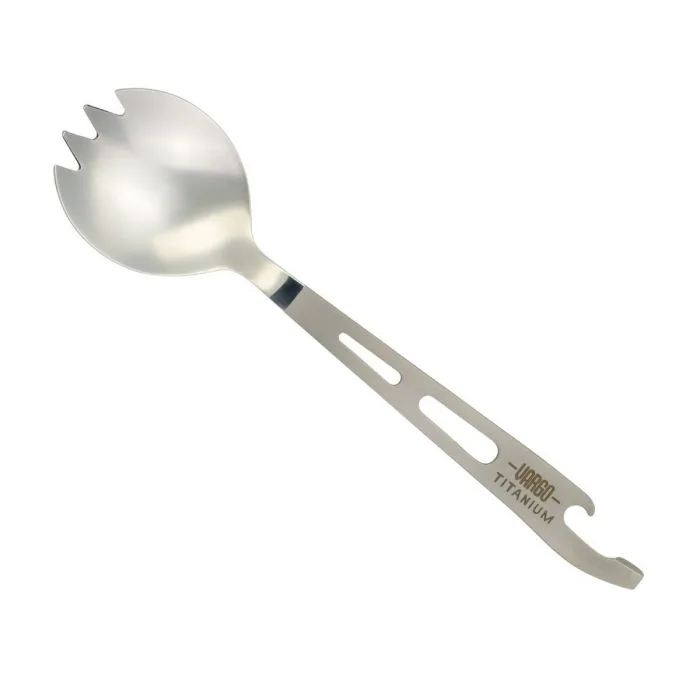
- Buy Vargo Titanium SCORK Twelve grams of Grade 5 titanium with a can opener in the handle.
- Buy Light My Fire Swedish Spork Titanium Spoon, fork and a real serrated knife on one 17 centimetre handle.
- It depends Sea to Summit Frontier Ultralight Long Spork Anodised aluminium that stacks with its siblings, under a lifetime guarantee.
- Skip Snow Peak Long Titanium Spork Called Long, and Snow Peak will not say how long it is.
What actually matters
- Material - Grade 5 or Grade 2 titanium, hard-anodised aluminium, stainless steel or plastic, each with different strength, weight and care needs.
- Weight - in grams. Good titanium sporks run from around 12 to 25 grams, which sounds trivial and is the entire reason people buy titanium.
- Length - in centimetres. Around 15 centimetres suits a bowl; 17 and above reaches into a freeze-dried meal pouch.
- Head shape - a single spork head, or a spoon at one end and a fork at the other, which works better and takes more space.
- Cutting edge - serrations along a tine, useful for bread and cheese and no substitute for a knife.
- Care requirements - whether it is dishwasher safe, which titanium generally is and anodised aluminium is not.
- Nesting and stacking - handle profiles designed so multiple pieces stack flat in a mess kit.
The specs, in plain English
Green flags vs red flags
Green flags
- Weight published in grams.
- Length published in centimetres or inches.
- Titanium grade named, or the aluminium treatment specified.
- Dishwasher guidance stated either way.
- Food-contact approvals or a warranty term.
Red flags
- A product named Long with no length published.
- Titanium claimed with no grade.
- No weight on an ultralight product.
- No cleaning guidance on a coated material.
- Lifetime durability claimed with no warranty terms.
Who's who: the brands
- Vargo - American titanium specialist publishing grade, weight and length for its utensils, with multi-function designs like the can-opener SCORK.
- Light My Fire - Swedish maker of the original Swedish Spork, a spoon-fork-knife combination offered in plastic, stainless and Grade 2 titanium.
- Sea to Summit - Australian brand whose Frontier cutlery uses hard-anodised aluminium in stacking profiles, with a lifetime guarantee and clear care warnings.
- Snow Peak - Japanese company built on titanium metalworking, with an extensive utensil range including long-handled sporks for packaged meals.
- TOAKS - Titanium cookware brand offering very light folding and long-handled sporks at low prices, widely used by ultralight backpackers.
How to read a listing without getting fooled
Look for the weight and the length first, because they are the only two numbers a utensil has and their absence tells you something. A spork with no published weight is an odd thing to sell to backpackers, and a spork called Long with no published length is odder still. Then read the material carefully: if it says titanium, look for a grade, since Grade 5 and Grade 2 differ substantially in strength, and if it says anodised aluminium, look for the care warning that goes with it. Decide about length based on how you eat, remembering that freeze-dried pouches are deep and hot. Then consider whether you want a single spork head or a spoon and fork at opposite ends, which is a more useful shape and a slightly longer object. Finally check whether it stacks, if you are buying a set, and whether it can go in a dishwasher, which is the difference between a utensil you wash and one you look after.
How much should you spend?
Camp cutlery is cheap enough that buying the right one twice costs less than most outdoor mistakes, but there is no need to. The budget tier buys anodised aluminium from a reputable brand with a lifetime guarantee, which is genuinely good and requires hand washing. The mid-range buys named-grade titanium with published weight and length, which is where the value in this category sits: it is inert, lasts indefinitely, takes a dishwasher and weighs almost nothing. The premium tier buys a brand name and matching titanium cookware, and in at least one case buys less published information than the mid-range does. Plastic sporks cost almost nothing and are fine until they snap or stain, which they will. If you are buying one utensil for years of use, the mid-range titanium is the obvious answer.
Questions, answered
Does titanium affect the taste of food?
No, and that is one of its main advantages. Titanium is chemically inert, so it does not react with acidic foods and leaves no metallic taste, which is why it is used in medical implants. Aluminium is more reactive, which is why cookware and cutlery are anodised: the oxide layer isolates the metal from the food. That is also why the anodising matters and why Sea to Summit warns against dishwashers, since a damaged coating puts bare aluminium back in contact with your dinner.
Why are titanium utensils so expensive for what they are?
Because titanium is difficult to machine. It is strong, it work-hardens, and it eats tooling, so the manufacturing cost is far higher than the same shape in aluminium or steel even though the amount of metal is tiny. You are paying for the process rather than the material. What you get for it is an object that weighs 12 to 25 grams, never corrodes, never needs a coating and will outlast every other piece of gear in the bag.
How do I keep from losing it?
Most long sporks have a hole in the handle for exactly this reason, and a short loop of cord through it clipped to the inside of a cook pot or a food bag is the standard answer. Brightly coloured plastic versions exist partly because titanium and aluminium are the colour of the ground. Putting the utensil back in the same place every time, usually inside the pot, works better than any accessory, and is also why nesting profiles like Sea to Summit's are worth having.
Can I use these on non-stick cookware?
Titanium and anodised aluminium are both harder than a non-stick coating, so yes but carefully, and never for scraping. The usual advice for non-stick pans, which is to use wood or silicone, applies just as much at a campsite. If your cook set is non-stick, a plastic spork is genuinely the better tool for eating out of the pan, and you can keep a metal one for eating out of a pouch where there is no coating to damage.
Or jump to the head-to-head: Vargo Titanium SCORK vs Light My Fire Swedish Spork Titanium.