Explained
Tourniquets, Explained
After reading, you'll understand what the CoTCCC list is, why band width and windlass design matter, how to check a unit is genuine, and why training is the part you cannot skip.
In this guide
Most people buying a first tourniquet are working from a product listing and a photograph, and every listing sounds equally confident. The vocabulary does not help: windlass, ratchet, occlusion, national stock number and CoTCCC all get thrown around without explanation. The good news is that this is one of the rare categories where a single public document does most of the sorting for you. Once you know what it is and how to read a listing against it, the field shrinks fast.
The 30-second version
- One list does most of the work, and it is the CoTCCC Recommended Devices and Adjuncts document from the Committee on Tactical Combat Casualty Care.
- Width is not cosmetic, because wider cuffs stopped arterial flow at lower pressures in published studies of surgical tourniquets.
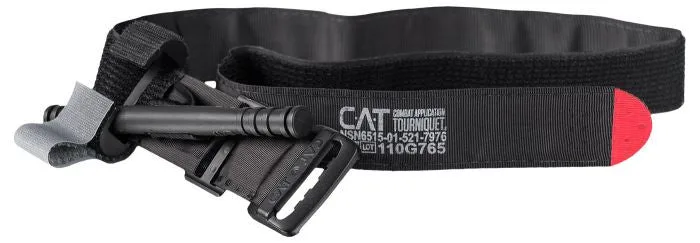
- Counterfeits are a documented federal concern, and there are specific physical checks you can perform on a Combat Application Tourniquet yourself.
- Blue does not reliably mean trainer, since one maker uses blue for a practice device and another sells a live tourniquet in high-visibility blue.
- Training changes the outcome more than the model does, with correct application rising from 16 percent to 88 percent after a single one hour course in a randomised trial.
The products this guide is about
Our verdict on each, with the full reasoning on the companion review.
- Buy North American Rescue Combat Application Tourniquet (C-A-T) Gen 7 The tourniquet on the CoTCCC list that you are most likely to have already practised on, with published guidance for confirming yours is genuine. Amazon
- Buy Safeguard Medical TMT Tourniquet (Tactical Mechanical Tourniquet) A CoTCCC-listed windlass tourniquet with a 2 inch band, two independent locks, and a manufacturer-stated 7 year shelf life. Amazon
- It depends RevMedX TX3 Ratcheting Tourniquet The widest non-pneumatic device on the CoTCCC list, built for long transport times, and the only one here its maker says you can train on and still deploy.
- Skip Rapid Medical RATS Tourniquet A compact elastic-band device that is widely sold and inexpensive, but does not appear on the CoTCCC recommended list.
What actually matters
- CoTCCC listing - The Committee on Tactical Combat Casualty Care publishes a named list of recommended limb tourniquets, and the current TCCC Guidelines tell responders to use a device from it. It is the closest thing to an official shortlist that a civilian buyer can check.
- Band width - The width of the strap that presses on the limb changes how much pressure you need to stop arterial flow. Wider bands reached occlusion at lower pressures in published surgical cuff studies, and two manufacturers on the list cite width as their design rationale.
- Tightening mechanism - A windlass is a rod you twist; a ratchet is a toothed strap you pull through a buckle. The non-pneumatic devices on the CoTCCC list use one or the other, and the two require different practised motions.
- One-handed application - A tourniquet you cannot apply to your own arm with your other hand is only half a device. Buckle routing, clip design and windlass grip all decide whether that is realistic under stress.
- Provenance - Where you buy matters because counterfeits of the most popular model are a documented problem. The manufacturer and named authorised dealers are the safe channels.
- Shelf life and storage - Makers differ: some publish a fixed number of years, some say the device does not expire, and some say it lasts indefinitely only while it stays sealed and out of heat and sun. You need to know which rule applies to yours.
- Training and refreshers - Skill decays. In a randomised trial, correct application after a one hour course was 88 percent, but only 54.5 percent of participants still got it right three to nine months later.
The specs, in plain English
Green flags vs red flags
Green flags
- The exact device name appears on the CoTCCC Recommended Devices and Adjuncts document.
- The manufacturer publishes a national stock number that matches the one on that document.
- You are buying from the manufacturer's own store or a dealer the manufacturer names as authorised.
- The maker publishes concrete numbers: band width, weight, packaged dimensions, and a shelf life or an explicit statement that there is none.
- A matching trainer version exists, or the maker states the device can be used for repeated practice and still deployed.
Red flags
- The listing says tactical or military grade but never names the CoTCCC document or the specific device entry on it.
- The price is far below what the manufacturer charges, or the item ships from outside the United States when the maker says production is US-only.
- There is no lot or batch information printed on the band, or the printing is blank or inconsistent with the stated generation.
- The seller cannot be found on the manufacturer's authorised dealer list and the packaging looks unlike the manufacturer's own.
- The listing is a multipack of a well-known model at a price that would not cover one genuine unit.
Who's who: the brands
- North American Rescue - Maker of the Combat Application Tourniquet, and the company behind published guidance on spotting counterfeit C-A-T units.
- Safeguard Medical - Sells the TMT under its Rampart hemorrhage control range, one of the CoTCCC-listed windlass devices, with a published shelf life and a 2 inch band.
- TacMed Solutions - Maker of the SOF Tourniquet family, including the SOF Tactical Tourniquet Wide on the CoTCCC list, a windlass design.
- SAM Medical - Makes the SAM XT600 on the CoTCCC list, a windlass-style device.
- RevMedX - Makes the TX2 and TX3 ratcheting tourniquets on the CoTCCC list, aimed at prolonged field care and marketed as trainable and deployable in the same unit.
How to read a listing without getting fooled
Start at the bottom of the listing, not the top. Find the exact device name and, if it is there, the national stock number, then check both against the CoTCCC Recommended Devices and Adjuncts document. Next look for hard numbers: band width, open length, weight, packaged dimensions, and whatever the maker says about shelf life. A listing that gives you all of those is usually a manufacturer or a serious dealer; a listing that gives you adjectives and a flag graphic usually is not. Then check who is selling it, because for the most-copied models the seller matters as much as the model. Finally, look for a trainer version or a statement that the device tolerates repeated practice, because that determines whether you will ever actually rehearse with it.
How much should you spend?
This is a category where the budget tier is the warning sign rather than the bargain. The CoTCCC-listed windlass and ratchet devices cluster in a mid-range band, and the differences between them are small enough that price should not be your deciding factor. Genuinely premium pricing here buys width and durability rather than brand: the wide ratcheting devices built for prolonged field care cost noticeably more and are heavier for it. At the budget end you find two different things: off-list devices sold honestly by their makers, and counterfeits of listed devices sold dishonestly by third parties. Federal guidance on counterfeit Combat Application Tourniquets specifically warns about prices that look too good to be true, so if a well-known model is being offered far below what the manufacturer charges, treat that as information about the seller.
Questions, answered
Where on the limb does a tourniquet go?
Current TCCC guidance distinguishes two situations. Under immediate threat, the tourniquet goes over the clothing as proximal as possible on the injured limb, described as high and tight, and you move to cover. Once it is safe to work, the guidance is to apply it directly to the skin two to three inches above the bleeding site. If a tourniquet was placed over the uniform, the guidance is to place a second one directly on the skin and then loosen the first.
What if one tourniquet does not stop the bleeding?
The current guidelines are explicit: if bleeding is not controlled with the first tourniquet, you apply a second one side by side with the first. That is one of the practical reasons to buy two rather than one. The guidance also says to consider additional tightening, and where there is no traumatic amputation, to check for a distal pulse to confirm you have actually achieved occlusion.
Can a tourniquet be loosened once it is on?
Not casually, and not by an untrained person. Current TCCC guidance sets three conditions before converting a tourniquet to a dressing: the casualty is not in shock, the wound can be closely monitored for bleeding, and the tourniquet is not controlling bleeding from an amputated limb. It also directs basic-trained personnel not to attempt conversion beyond two hours after application without direction from advanced medical personnel, and says not to remove one that has been in place more than six hours unless close monitoring and lab capability are available. Mark the time of application on the device.
Why do people say wider tourniquets are better?
Because a wider band spreads its force over more tissue and so needs less pressure to stop arterial flow. A 1987 study in the Journal of Hand Surgery found arterial flow was always eliminated at the lowest pressure using the widest cuff tested, and a 1993 study found wider and curved cuffs gave significantly lower arterial occlusion pressures across 26 volunteers. Both studies used inflatable surgical cuffs rather than field straps, so the principle carries better than the specific numbers. Manufacturers of the 2 inch and 3 inch field devices cite the same reasoning, particularly for cases where the tourniquet may stay on for a long time.
Or jump to the head-to-head: North American Rescue Combat Application Tourniquet (C-A-T) Gen 7 vs Safeguard Medical TMT Tourniquet (Tactical Mechanical Tourniquet).