Explained
Indoor Air Quality Monitors, Explained
After reading this you will understand what an air quality monitor actually measures, which numbers you can trust, and how to match a device to the pollutant you care about.
In this guide
An indoor air quality monitor is a small device that samples the air in your home and reports what is in it, usually as a set of numbers on a screen or in a phone app. The trap for first-time buyers is assuming every monitor measures the same things to the same standard; in reality they differ enormously in which pollutants they detect and how far you can trust the readings. This guide decodes the terms so you can tell a genuinely useful monitor from one that simply displays a lot of digits.
The 30-second version
- Decide the pollutant first. The single most important choice is which pollutant you actually need to see, because that narrows the field faster than any feature list.
- Trustworthy beats comprehensive. A monitor that reports two numbers you can rely on is worth more than one that reports ten you cannot.
- Sensor type is the real spec. An NDIR CO2 sensor and a laser particulate sensor are the marks of a device built to be accurate, not just to look busy.
- A monitor measures, it does not clean. Its whole value is telling you when and where to ventilate or filter; it changes nothing on its own.
- Cheap and untrusted changes nothing. A budget monitor you cannot believe will not change your behaviour, which makes it money spent on reassurance rather than air.
The products this guide is about
Our verdict on each, with the full reasoning on the companion review.
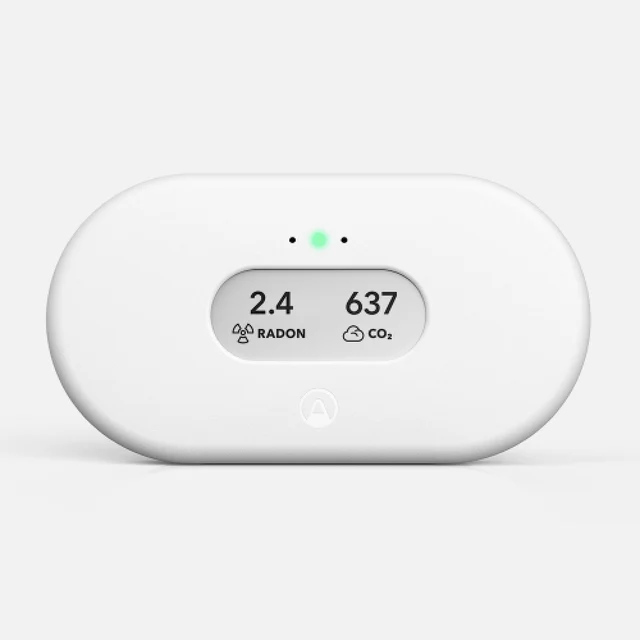
- Buy Airthings View Plus The rare consumer monitor that tracks radon alongside CO2, particulates and VOCs in one device. Amazon
- Buy Aranet4 Home A lab-grade CO2 sensor and a multi-year battery, but it measures little beyond ventilation. Amazon
- It depends IQAir AirVisual Pro Among the most accurate consumer particulate readings, tied to a wall outlet and a fiddly setup. Amazon
- Skip Temtop M100 A screen full of numbers at a low price, but the readings are indicative rather than trustworthy.
What actually matters
- What it measures - the pollutants a monitor detects define what it is for. Some track only ventilation (CO2), others add fine particles, chemicals or radon. Match this to the problem your home actually has before comparing anything else.
- Sensor accuracy - two devices can both show a CO2 number, but only one may be close to the truth. The underlying sensor technology, not the size of the display, decides whether a reading is reliable.
- Power and battery life - a battery-and-e-ink unit can move between rooms and fade into the background, while a mains-powered screen stays put but shows richer detail. This shapes how and where you will actually use it.
- Data and history - a single live number tells you little; a monitor that logs trends over days and months lets you see whether a room goes stale overnight or whether smoke season is affecting you.
- Portability and display - whether you want a glanceable traffic-light reading from across the room or a detailed touchscreen changes which device fits your life.
- Calibration and drift - sensors age and wander over time. A good monitor either self-calibrates sensibly or makes recalibration easy, so year-two readings still mean something.
The specs, in plain English
Green flags vs red flags
Green flags
- An NDIR CO2 sensor and a laser (optical) particulate sensor named explicitly in the specs
- Long-term history you can review in an app, not just a single live reading
- Clear statements about battery life and whether full sampling needs mains power
- A dedicated radon sensor if you live in a radon-prone area or use lower floors
- Honest scope: the maker says what it does not measure rather than implying it covers everything
Red flags
- A long list of measurements with no mention of the sensor types behind them
- A combined air quality index and a weather-style forecast on obviously budget hardware
- 'VOC' or 'formaldehyde' figures presented as precise concentrations from a very cheap device
- No way to see history or trends, only the current number
- Vague or absent guidance on calibration and long-term drift
Who's who: the brands
- Airthings - Known for all-in-one home monitors, and unusual in offering credible consumer radon tracking alongside CO2, particulates and VOCs.
- Aranet - Focused, reference-grade CO2 monitoring with multi-year battery life; narrow scope but highly trusted for ventilation.
- IQAir - Particulate specialists, pairing accurate indoor PM2.5 readings with local outdoor air quality context.
- Temtop - Budget-tier maker whose devices show many metrics on one bright screen, but at indicative rather than reliable accuracy.
How to read a listing without getting fooled
When you read a product listing, look past the headline count of 'what it measures' and hunt for the sensor names. A spec sheet that says 'NDIR CO2' and 'laser particulate sensor' is telling you the numbers are built to be trusted; one that lists CO2, PM2.5, PM10, VOCs and an air quality index but never names a single sensor type is often leaning on cheap hardware and a derived index to look comprehensive. Be especially wary of a combined AQI number and a weather-style 'forecast' on an inexpensive unit, since those add a veneer of precision the sensors cannot support. Check whether full-resolution sampling requires mains power, whether there is genuine long-term history rather than just a live number, and what the maker says about calibration. Finally, notice what a listing does not mention: a monitor that stays silent on radon or on how it handles sensor drift is usually silent because it does neither.
How much should you spend?
Spend according to the pollutant you most need to track, not the number of metrics on the box. The cheapest monitors are best understood as mood rings for your air: fine for a rough sense of whether a room is stuffy or dusty, but not something to base a health or ventilation decision on, because their sensors drift and rarely match reference readings. The value sweet spot sits with a monitor that carries a proper NDIR CO2 sensor and, if particulates matter to you, a laser optical sensor; this is where accuracy becomes trustworthy without paying for capabilities you will not use. Stepping up to the priciest all-in-one units is worth it only if you genuinely need their extra channels, radon above all, since that is the one pollutant you cannot detect any other way. Paying more for a broad sensor suite you never look at is simply money spent on reassurance rather than cleaner air.
Questions, answered
Do I actually need a monitor that measures radon?
Only if your home is prone to it. Radon collects in basements and ground floors within certain geological zones, and it is the one pollutant you cannot see or smell. If you live in a flagged area or spend time on lower floors, choose a monitor with a dedicated radon sensor; otherwise you can skip that channel and save the cost.
Is CO2 or particulate matter more important to track?
Both matter, for different reasons. CO2 signals poor ventilation and tracks with stuffiness and reduced focus, while PM2.5 reflects smoke, dust and combustion particles that reach deep into your lungs. If you can only prioritise one, pick the problem your home actually has: stale air in bedrooms and offices points to CO2, while wildfire smoke or nearby pollution points to particulates.
Are budget air quality monitors accurate?
Treat their numbers as directional rather than precise. Inexpensive units show useful trends, such as whether a room is getting stuffier, but their sensors drift and seldom match reference readings, and a derived index can imply more precision than the hardware supports. For any decision you plan to act on, a monitor with a proper NDIR CO2 sensor is worth the step up.
Does an air quality monitor clean the air?
No. A monitor only measures pollutants; it does not remove them. Its value is telling you when and where to act, so pair it with ventilation, source control or an air purifier to actually lower the readings. Buying a monitor and expecting cleaner air by itself is a common and costly misunderstanding.
How often do these sensors need calibrating?
It depends on the sensor. Good NDIR CO2 sensors often self-calibrate against fresh outdoor air over time, while cheaper sensors drift and may never be recalibrated at all, which is one reason their long-term readings become unreliable. Check the maker's guidance before you buy, and favour devices that make recalibration straightforward.
Can I rely on these readings for health decisions?
This is general information, not medical advice; for any health concern, consult a qualified professional. A monitor is a helpful tool for spotting trends and deciding when to ventilate or filter, but its readings, especially from budget hardware, are not a diagnosis. Use it to inform your habits, not to replace guidance from a doctor or an accredited testing service.
Or jump to the head-to-head: Airthings View Plus vs Aranet4 Home.