Explained
Balance Boards, Explained
After reading this you'll know which balance board type matches your actual goal, and how to read a listing without falling for vague marketing terms.
In this guide
"Balance board" is a catch-all term for several genuinely different tools that just happen to share a category page. A gentle rocker, a 360-degree wobble disc and a deck-on-roller board train different things in different ways, and buying the wrong type for your goal is the single most common mistake. This guide breaks down what each type actually does before you look at price or brand.
The 30-second version
- Motion type matters more than brand. a rocker, a wobble board and a roller board train different movement patterns, so start by picking the motion, not the label.
- Predictable isn't a downgrade. a single-axis rocker's simple side-to-side tip is a feature for desk use and beginners, not a lesser version of a harder board.
- Deck material and grip decide daily comfort. hardwood decks with a real anti-slip surface hold up to repeated use far better than thin, painted or laminated ones.
- Weight capacity should clear your body weight with real margin. a rating that just barely covers you leaves no room for dynamic movement or added load like weights.
- Progression potential separates a toy from a training tool. boards with adjustable difficulty or an ecosystem of add-ons keep working for you as your balance improves; fixed-tilt boards plateau fast.
The products this guide is about
Our verdict on each, with the full reasoning on the companion review.
- Buy StrongTek Professional Wooden Balance Board A sturdy single-axis rocker that's the most useful first balance board for a desk, core work or early rehab.
- Buy Indo Board Original The gold-standard roller board for people who actually want to train dynamic, skate- and surf-style balance.
- It depends Yes4All Wooden Wobble Balance Board A round 360-degree wobble board that's excellent for ankle rehab and balance drills - and not much else.
- Skip FluidStance Level A beautifully made standing-desk board whose subtle, limited motion is hard to justify at flagship money.
What actually matters
- Motion type - a single-axis rocker, a 360-degree wobble dome, and a deck-on-roller board each move differently and suit different goals, so this is the first decision, not the last.
- Deck surface and grip - a textured or anti-slip top layer keeps bare or socked feet planted mid-wobble; a smooth or worn surface turns every session into a slip risk.
- Weight capacity - the manufacturer's stated load limit, which should sit comfortably above your body weight since dynamic movement and added resistance both increase the real-world load.
- Difficulty and learning curve - how forgiving the board is on day one, and whether it stays interesting once your balance improves or gets boring in a week.
- Build material - solid hardwood, molded plastic, or cast metal bases all age differently under repeated flexing and impact; cheaper composites tend to develop wobble or cracks over time.
- Footprint and portability - flat decks are versatile but bulkier to store; discs and compact rollers tuck away easily but do a narrower job.
- Intended use case - desk fidgeting and light core work, focused ankle rehab, or dedicated skate/surf-style balance training each point toward a different board entirely.
The specs, in plain English
Green flags vs red flags
Green flags
- A clearly stated weight capacity with meaningful margin above your body weight
- Owner reports specifically mentioning long-term durability, not just first-week impressions
- A textured or anti-slip deck surface described or shown in close-up photos
- A stated axis of motion (single-axis, 360-degree, roller) rather than vague words like 'dynamic' or 'active'
- Solid wood or a rigid molded base with no flex or creak reported at normal loads
- A clear stated use case (desk, rehab, training) that matches what you actually need
Red flags
- No weight capacity listed at all, or one suspiciously close to an average adult's body weight
- Marketing copy that calls a board 'good for everything' without naming the motion type
- Reports of the deck surface becoming slick or the coating wearing off after light use
- Thin, hollow-sounding plastic construction on a board marketed for daily standing
- No way to see or adjust difficulty, sold as a training tool without stating a fixed tilt angle
- Reviews clustering around 'looks nice but barely moves' for a board marketed as a fitness trainer
Who's who: the brands
- Indo Board - Best known for roller-style boards built around a deck-and-cylinder system, popular with surfers and skaters who want progressable, dynamic training.
- StrongTek - Makes straightforward wooden rocker boards aimed at general use: desk standing, core work and light stability training.
- Yes4All - A budget-focused fitness brand with a simple wooden wobble board built for ankle work and balance drills rather than all-day use.
- FluidStance - A design-forward standing-desk brand known for premium materials and subtle, gentle multi-directional motion rather than training intensity.
- Fitterfirst - A physical-therapy-oriented brand with wobble and rocker boards commonly used in clinical and rehab settings.
- Revbalance - Focuses on standing-desk balance boards with softer, low-intensity tilt aimed at office use over athletic training.
How to read a listing without getting fooled
Product listings lean hard on words like 'dynamic,' 'active,' or 'core-engaging' that sound meaningful but describe almost any board. Skip the adjectives and look for three concrete facts: the axis of motion (one-way rocker, 360-degree wobble, or free-rolling deck), the stated weight capacity, and what the deck surface is actually made of. A listing that names all three plainly is usually a board the seller is confident in; one that leans entirely on lifestyle photos and vague claims is worth a closer look at the actual spec sheet or owner questions section before buying.
How much should you spend?
Cost on a balance board mostly tracks material and mechanism, not marketing. A simple wooden rocker is inexpensive to make and tends to sit at the low end, and that's genuinely enough board for most everyday goals: desk standing, core work, gentle stability drills. Wobble discs are similarly cheap since they're a single molded piece. Roller-style boards cost more because you're buying two separate, precision-made components (deck and roller) plus a system designed to be extended over time, and that premium is worth it specifically if you want serious, progressable training. Where spending more stops paying off is in boards that charge a premium purely for finish or design, standing-desk boards especially, where a costlier option might move barely more than a basic rocker. Match the spend to the mechanism you're actually getting, not the price tier alone.
Questions, answered
What's the actual difference between a rocker, wobble and roller board?
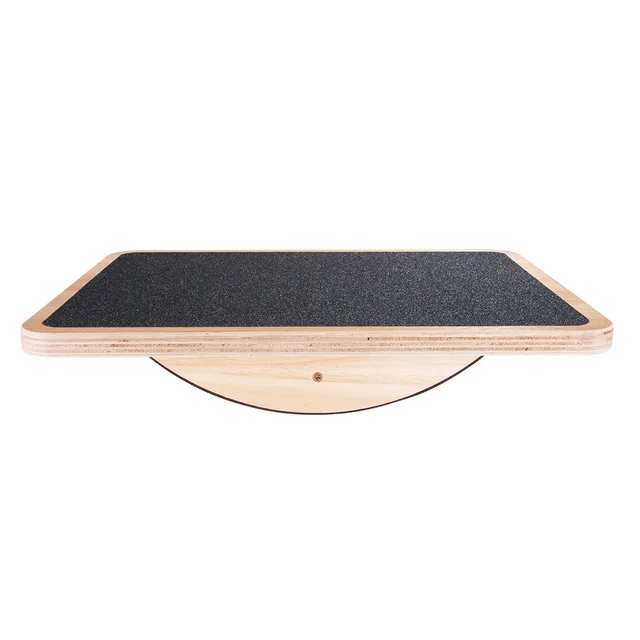
A rocker board sits on a fixed curved base and tips on one axis only, side to side, which makes it predictable and easy for beginners or all-day desk use. A wobble board balances on a dome and tilts a full 360 degrees, so it's harder and more demanding, which is exactly why it's used for ankle and balance rehab. A roller board separates the deck from a loose cylinder underneath, producing true multi-directional motion that mimics skating or surfing and offers the deepest room to progress.
Which type of balance board should a beginner start with?
A single-axis rocker is the most forgiving starting point because the motion is simple and stays close to the ground. A wobble board is manageable with practice but takes more focus. A roller board has a genuine early fall risk and is best attempted near a wall, with a spotter, on a clear floor, once you already have some balance base to work from.
Are balance boards good for ankle rehab or physical therapy?
This is general product information, not medical or physical-therapy advice; for any injury or rehab program, follow the specific guidance of a qualified professional. In general terms, wobble-style boards are a common proprioception and ankle-stability tool in clinical settings, and gentle rocker boards can suit early, low-intensity stability work, but the right board and drill progression depend on your specific situation.
What weight capacity should I look for?
Look for a stated capacity with real margin above your own body weight, not one that barely clears it. Dynamic movement, added resistance like holding weights, or simply losing and regaining balance all add load beyond your static weight, so a board rated close to your limit has less safety margin than the number alone suggests.
Can one balance board handle desk use and serious training?
Generally not well. Boards built for all-day desk movement use gentle, controlled motion so they don't pull focus from work, while boards built for serious balance training deliberately use unpredictable, demanding motion. A board that does one job well is usually a poor fit for the other, so it's worth picking based on your primary use rather than looking for one board to do both.
Does deck material actually matter, or is it just marketing?
It matters for durability and feel. Solid hardwood decks and rigid molded or cast bases hold up better to repeated flexing and impact than thin plastic or laminated composites, which can develop wobble, cracking, or a slick surface faster under regular use. Grip surface matters just as much day to day, since a board that feels great in a photo but gets slippery underfoot quickly becomes one you stop using.
Or jump to the head-to-head: StrongTek Professional Wooden Balance Board vs Indo Board Original.