Explained
Blood Pressure Monitors, Explained
After reading, you will know why clinical validation outranks every other feature and be able to read a monitor's spec sheet without being fooled by marketing.
In this guide
A home blood pressure monitor is a measuring instrument, so its whole value rests on giving you a number you can trust. The trouble is that most listings lead with app features, memory slots, and color displays, while the one thing that decides whether the reading is real, clinical validation, is buried or missing entirely. This guide sorts the signal from the noise so a first-time buyer can shop by accuracy first.
The 30-second version
- Validation beats everything. A monitor that has passed a recognized accuracy protocol against a reference standard is the only kind worth buying, and most models on sale have never been validated.
- Upper-arm, not wrist. For routine tracking, arm cuffs are consistently more reliable than wrist units, which are highly sensitive to position and posture.
- Cuff fit changes the reading. A cuff that is too small reads high and one too loose reads low, so measuring your arm and matching the range is not optional.
- Averaging smooths out noise. Monitors that automatically take several readings and report the average give a number closer to your true resting pressure than any single measurement.
- Apps are convenience, not accuracy. Bluetooth sync, memory, and multi-user support are nice, but they do nothing for the number itself, so weight them last.
The products this guide is about
Our verdict on each, with the full reasoning on the companion review.
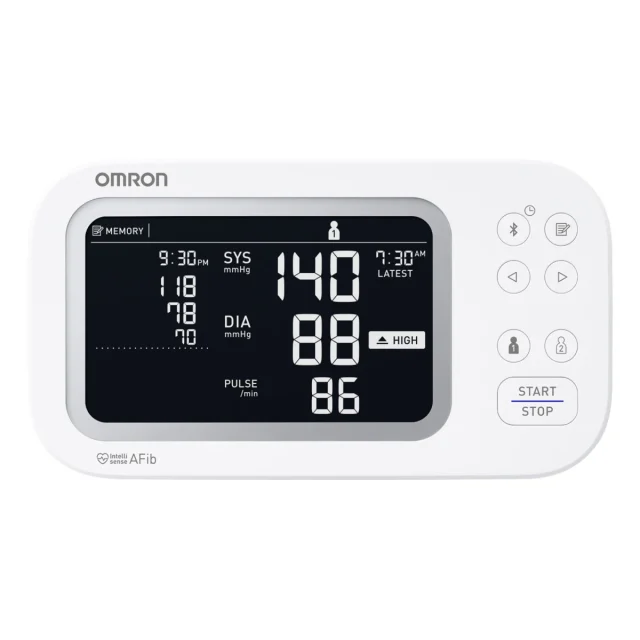
- Buy Omron Platinum (BP5465) Automatic three-reading averaging and validated accuracy make this the number you can trust with the least effort. Amazon
- Buy A&D Medical UA-651BLE A no-frills, twice-validated upper-arm monitor that nails the fundamental and skips the extras. Amazon
- It depends Withings BPM Connect An all-in-one arm monitor that logs itself over Wi-Fi, held back by uneven real-world accuracy reports. Amazon
- Skip Omron 7 Series Wireless Wrist (BP6350) A comfortable, portable wrist unit undercut by the accuracy limits inherent to the wrist form factor. Amazon
What actually matters
- Clinical validation is the whole ballgame: it confirms the exact model was tested against a reference standard and reads within an accepted margin, and without it every other spec is decoration.
- Cuff type and fit decide day-to-day reliability, because an upper-arm cuff sized to your arm reproduces a clinic-style measurement while a mismatched or wrist-based one introduces error.
- Reading averaging matters if you track regularly, since automatically combining multiple readings cancels out the movement, timing, and nerve-driven blips that skew a single shot.
- Irregular-heartbeat or AFib detection is a useful prompt, flagging patterns worth raising with a clinician, though it is a screening cue and never a diagnosis.
- Display clarity affects whether you actually use the device, so a large, backlit, easy-to-read screen matters more than most buyers expect.
- Memory and multi-user support help households share one unit and keep a history, which is convenient when you bring a log to a clinician.
- Connectivity through Bluetooth or Wi-Fi keeps the record for you, raising the odds you maintain a consistent log, but treat it as a bonus rather than a buying reason.
The specs, in plain English
Green flags vs red flags
Green flags
- The exact model number appears on an independent validated-device list, not just the product family
- It is an upper-arm cuff with a stated range that fits your measured arm
- It offers automatic multi-reading averaging if you plan to track daily
- The display is large, backlit, and readable at a glance
- It clearly separates screening features (like AFib flags) from any claim of diagnosis
Red flags
- No mention of validation, or vague claims like 'clinically accurate' with no protocol named
- A wrist monitor marketed for routine daily tracking rather than travel exceptions
- One cuff size sold as fitting everyone, with no stated circumference range
- Marketing that leads with app features and memory slots while burying accuracy
- Reviews describing readings that consistently run high or low versus a clinic cuff
- A cuff that is clearly too small or too large for your arm as sold
Who's who: the brands
- Omron - The most widely recommended home blood pressure brand, known for validated upper-arm monitors and features like automatic averaging and AFib detection.
- A&D Medical - A measurement-instrument maker with a reputation for no-frills, clinically validated monitors that focus on accuracy over extras.
- Withings - A connected-health brand whose monitors emphasize automatic Wi-Fi and app syncing, appealing to buyers who want the log to keep itself.
- Beurer - A German health-device maker offering a broad range of home monitors, with validation varying by specific model.
- iHealth - A smartphone-first brand built around app-connected monitors, so confirm the specific model's validation before relying on it.
How to read a listing without getting fooled
Start at the bottom of the marketing and work up. The headline features, big display, memory for two users, app graphs, are the easiest to advertise and the least important, so do not let them anchor your decision. First find the exact model number and confirm it appears on a recognized validated-device list; a validated product line can include non-validated variants, so the model number is what counts. Next check the form factor and cuff range: choose upper-arm, then measure the middle of your upper arm and make sure it lands inside the stated span. Only after those two checks pass should you weigh averaging, irregular-heartbeat detection, and connectivity as tie-breakers. If a listing makes accuracy claims without naming a validation protocol, treat that as a gap, not a detail.
How much should you spend?
Spend on accuracy, not on gadgetry. The good news is that clinical validation is not a premium tier: capable, validated upper-arm monitors exist at modest cost, and paying more does not buy a more accurate number, it buys features around the number. The value sweet spot is a validated upper-arm cuff that fits your arm and, if you track daily, adds automatic averaging. Stepping up in price is reasonable when you genuinely want dual-user memory, hands-free Wi-Fi syncing, or AFib pattern detection you will act on. It is not worth it to pay extra for a large color display, deep app integration, or a compact wrist form factor if that spending comes at the expense of validation or proper cuff fit. Cheapest is a false economy only when it means an unvalidated device; beyond that, matching the monitor to how you will actually use it beats chasing the top of the range.
Questions, answered
What is the single most important thing to check before buying?
Clinical validation of the exact model. It means the specific unit passed a recognized accuracy protocol, such as AAMI, ESH, or ISO 81060-2, against a reference standard. Because most monitors on sale are never validated, confirming that your model number appears on an independent validated-device list matters more than any other feature.
Are wrist blood pressure monitors as good as arm cuffs?
For routine home tracking, no. The wrist's artery sits shallower and is highly sensitive to position, so small posture changes skew the number. Upper-arm cuffs are the standard for reliable everyday measurement. A wrist unit makes sense only when an arm cuff is genuinely not an option, such as certain travel or comfort situations.
Does automatic reading averaging really matter?
Yes, meaningfully, if you track regularly. A single reading can be thrown off by movement, timing, or nerves. A monitor that takes several readings and reports the average smooths out that noise and lands closer to your true resting pressure. It is the feature to prioritize right after validation and correct cuff fit.
How do I know the cuff will fit?
Measure around the middle of your upper arm with a soft tape and compare it to the cuff range in the product's specifications, usually given in inches or centimeters. Fit is not a minor detail: a cuff that is too small tends to read high and one too loose tends to read low, so an accurate device with the wrong cuff still gives a wrong number.
Is this medical advice?
No. This guide provides general information to help you shop for a home blood pressure monitor; it is not medical advice and does not replace guidance from a qualified professional. Any home reading is a data point to share with a clinician, not a diagnosis. For questions about your blood pressure, target ranges, medication, or how to interpret your readings, consult a doctor or pharmacist.
Or jump to the head-to-head: Omron Platinum (BP5465) vs A&D Medical UA-651BLE.