

Health & Wellness
The Best Tourniquets: 4 Compared (and One to Skip)
We judged limb tourniquets against one primary document: the Committee on Tactical Combat Casualty Care list of recommended devices. We also checked band width, published shelf life, and how a buyer can confirm a unit is genuine.
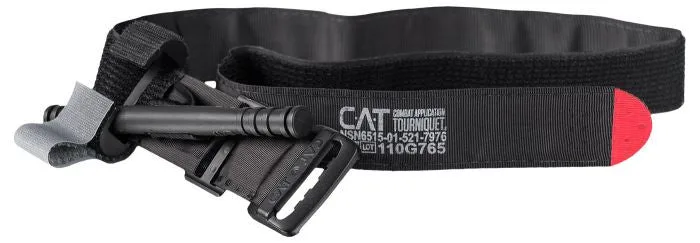
The short version
The Combat Application Tourniquet (C-A-T) Gen 7 from North American Rescue is the pick, because it is on the CoTCCC recommended list, it is a device many training courses hand you, and guidance exists on spotting a fake. The value pick is the TMT Tourniquet from Safeguard Medical, also on the list, with a 2 inch band that the manufacturer says reaches occlusion at lower pressures and a stated 7 year shelf life. The RevMedX TX3 is the depends pick: at 3 inches it is the widest non-pneumatic device on the list and it is built for long transport times, but it is heavier and bulkier than anything you will carry in a pocket. Skip the RATS Tourniquet from Rapid Medical: it does not appear on the CoTCCC list, and its maker describes it as a different design from traditional windlass tourniquets rather than claiming a place on that list. None of this matters much without training, and that is not a slogan: in a randomised trial published in JAMA Surgery in 2018, only 16 percent of untrained laypeople applied a tourniquet correctly, against 88 percent after a one hour in-person bleeding control course. Buy from the manufacturer or an authorised dealer, then go and take a class. Best for: anyone assembling a car, range, workshop, or home trauma kit who wants a device that matches what responders are actually taught to use.
Our picks at a glance
- North American Rescue Combat Application Tourniquet (C-A-T) Gen 7 - Buy. The tourniquet on the CoTCCC list that you are most likely to have already practised on, with published guidance for confirming yours is genuine.
- Safeguard Medical TMT Tourniquet (Tactical Mechanical Tourniquet) - Buy. A CoTCCC-listed windlass tourniquet with a 2 inch band, two independent locks, and a manufacturer-stated 7 year shelf life.
- RevMedX TX3 Ratcheting Tourniquet - It depends. The widest non-pneumatic device on the CoTCCC list, built for long transport times, and the only one here its maker says you can train on and still deploy.
- Rapid Medical RATS Tourniquet - Skip. A compact elastic-band device that is widely sold and inexpensive, but does not appear on the CoTCCC recommended list.
The verdict in 30 seconds
What mattered most
- On the CoTCCC recommended list
- Stock number on that list
- How it tightens
- Band width
- Weight
- Packaged size
A tourniquet is one of the few things you can buy that has a real chance of keeping someone alive before an ambulance arrives, and it is also one of the few where a bad unit can kill. The US military body that sets battlefield trauma doctrine, the Committee on Tactical Combat Casualty Care, publishes a short list of limb tourniquets it recommends, and the current Tactical Combat Casualty Care Guidelines dated 01 May 2026 tell responders to use a device from that list. That list is the spine of this comparison: we only recommend devices that appear on it. We also cover the counterfeit problem, which is documented by US federal agencies and is specific enough that you can check your own unit against it.
The tourniquet on the CoTCCC list that you are most likely to have already practised on, with published guidance for confirming yours is genuine.
Best for: Almost anyone building a first trauma kit, especially if you plan to take a bleeding control course and want to own the device the course will hand you.
- Listed by name on the CoTCCC Recommended Devices and Adjuncts document, under the same national stock number North American Rescue prints on the band.
- A common device in civilian bleeding control classes, so the muscle memory you build in a course transfers to the unit in your kit.
- North American Rescue sells a blue trainer version of the same Gen 7 design, so you can practise repeatedly without wearing out the one you carry.
- At 1.5 inches the band is the narrowest of the devices here, and wider cuffs are associated with occlusion at lower pressure in the surgical literature.
- It is a heavily counterfeited tourniquet, so where you buy it matters as much as which model you buy.
- North American Rescue publishes no fixed shelf life, only conditions, which means you have to inspect it yourself rather than read a date.
- It is a single-use device, so a unit you have deployed on a casualty is not one you put back in the kit.
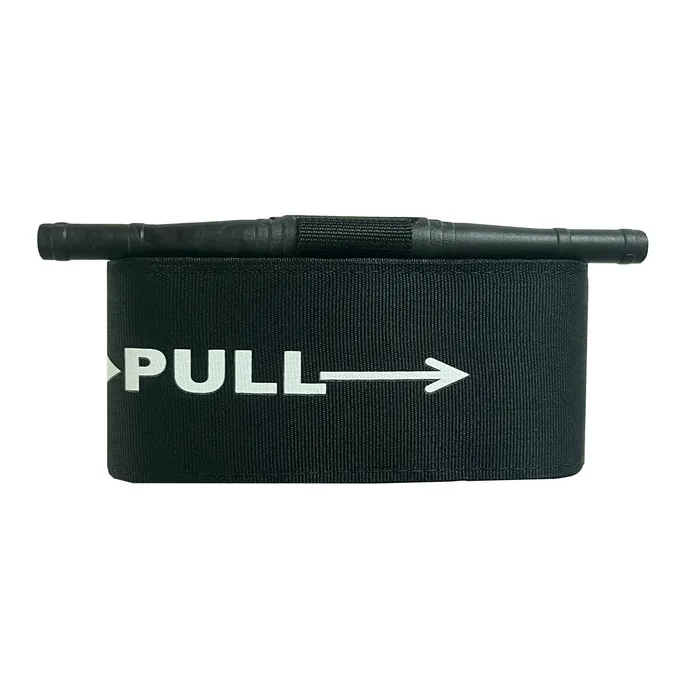
A CoTCCC-listed windlass tourniquet with a 2 inch band, two independent locks, and a manufacturer-stated 7 year shelf life.
Best for: A buyer who wants a wider band and a printed expiry date to work from, and who is happy to seek training on a device that is not the default in every class.
- On the CoTCCC recommended list as the Tactical Mechanical Tourniquet, matching the national stock number Safeguard Medical publishes.
- The 2 inch strap is wider than the C-A-T band, and Safeguard Medical states it achieves occlusion at lower pressures.
- Safeguard Medical publishes a 7 year shelf life and a UV-protective additive, which makes an unopened unit easier to manage in a kit you rarely check.
- It is less commonly used in civilian classes than the C-A-T, so you may have to seek out instruction specific to it.
- Safeguard Medical does not list a separate trainer version, so practice means either buying a second unit or borrowing one.
- The wider band and quick-disconnect buckle make it a slightly thicker package than a flat-folded C-A-T in a narrow pouch.
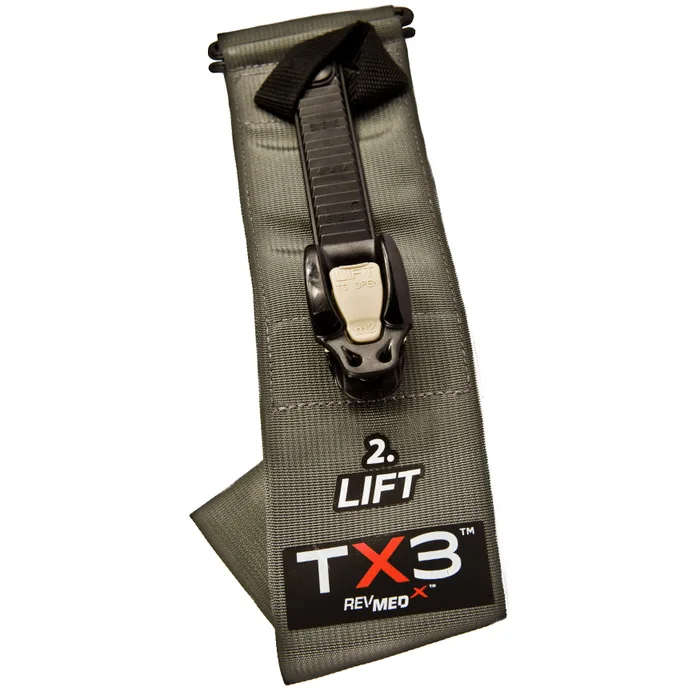
The widest non-pneumatic device on the CoTCCC list, built for long transport times, and the only one here its maker says you can train on and still deploy.
Best for: Backcountry, marine, rural, or remote-work settings where help is hours away and the priority is holding occlusion at lower pressure for a long time.
- On the CoTCCC recommended list as the TX3, and RevMedX states it is the widest non-pneumatic tourniquet on that list at 3 inches.
- RevMedX states it has no expiration date and uses UV-resistant MILSPEC webbing with a high-density polymer ladder that keeps working in sand and dirt.
- RevMedX states the construction allows repeated use in training without loss of function, so one device covers both practice and carry.
- At 0.5 lb and a 60 inch band it is several times the bulk and weight of a folded C-A-T, which rules it out of a pocket or an ankle kit.
- The ratchet is a different motor skill from a windlass, so training on it does not transfer to the windlass device most classes use.
- RevMedX positions it for prolonged field care, which is a use case most home and car kits will never encounter.
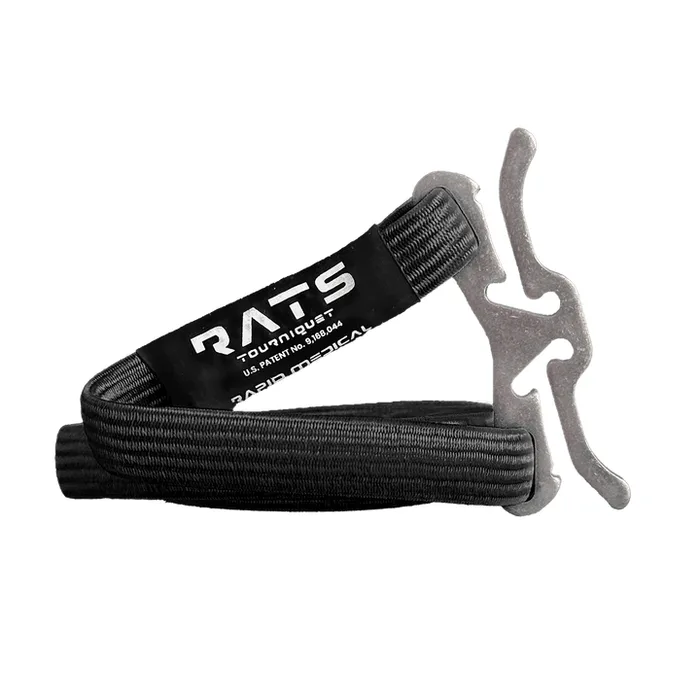
A compact elastic-band device that is widely sold and inexpensive, but does not appear on the CoTCCC recommended list.
Best for: Hard to justify for a primary trauma kit. If you already own one, treat it as a backup and buy a listed device as the one you actually rely on.
- Genuinely small and light, which is why it appeals to people who want something in a pocket rather than a pouch.
- Priced in the budget tier, which is its main draw.
- The one-piece design has nothing to route through a buckle, so there is no misrouting error to make.
- It does not appear on the CoTCCC list of recommended limb tourniquets, and Rapid Medical does not claim that it does.
- Rapid Medical describes it as a much different design from traditional windlass tourniquets, with a rubber core rather than a windlass or a ratchet.
- We could not confirm a published band width, weight, or shelf life, so there is little to compare against the listed devices.
- The non-pneumatic devices on the CoTCCC list use a windlass or a ratchet, so practice on this one does not transfer to the devices responders carry.
| Criteria | Combat Application Tourniquet (C-A-T) Gen 7 Top pick | TMT Tourniquet (Tactical Mechanical Tourniquet) | TX3 Ratcheting Tourniquet | RATS Tourniquet |
|---|---|---|---|---|
| Verdict | Buy it | Buy it | It depends | Skip it |
| Best for | Almost anyone building a first trauma kit, especially if you plan to take a bleeding control course and want to own the device the course will hand you. | A buyer who wants a wider band and a printed expiry date to work from, and who is happy to seek training on a device that is not the default in every class. | Backcountry, marine, rural, or remote-work settings where help is hours away and the priority is holding occlusion at lower pressure for a long time. | Hard to justify for a primary trauma kit. If you already own one, treat it as a backup and buy a listed device as the one you actually rely on. |
| Price tier | $$ · mid-range | $$ · mid-range | $$$ · premium | $ · budget |
| On the CoTCCC recommended list | Yes, as Combat Application Tourniquet (CAT) Gen 7 | Yes, as Tactical Mechanical Tourniquet (TMT) | Yes, as TX3 Tourniquet | No |
| Stock number on that list | 6515-01-521-7976 | 6515-01-656-6191 | 6515-01-667-6208 | Not listed |
| How it tightens | Windlass rod, clip and retention strap | Windlass torsion bar with double-routed speed buckle | Self-locking non-slip ratchet | Elastic band and locking clip |
| Band width | 1.5 in | 2 in | 3 in | Not published by the manufacturer |
| Weight | 2.7 oz | 3.5 oz | 0.5 lb | Not published by the manufacturer |
| Packaged size | 6.5 x 2.4 x 1.5 in | 4.5 x 2.5 x 2 in | 8.5 x 3 x 1.6 in | Not published by the manufacturer |
| Manufacturer shelf life statement | No shelf life while unused, packaged and stored dry, dark and climate controlled | 7 years | No expiration date | Not published by the manufacturer |
| Practice version | Separate blue trainer sold under a training stock number | No separate trainer listed | Maker says train on the same device | No separate trainer listed |
Which one is right for you?
- Almost anyone building a first trauma kit, especially if you plan to take a bleeding control course and want to own the device the course will hand you. Buy it North American Rescue Combat Application Tourniquet (C-A-T) Gen 7
- A buyer who wants a wider band and a printed expiry date to work from, and who is happy to seek training on a device that is not the default in every class. Buy it Safeguard Medical TMT Tourniquet (Tactical Mechanical Tourniquet)
- Backcountry, marine, rural, or remote-work settings where help is hours away and the priority is holding occlusion at lower pressure for a long time. It depends RevMedX TX3 Ratcheting Tourniquet
- Hard to justify for a primary trauma kit. If you already own one, treat it as a backup and buy a listed device as the one you actually rely on. Skip it Rapid Medical RATS Tourniquet
How we judged the field
Five things decide whether a limb tourniquet is worth owning. First, whether it appears on the CoTCCC Recommended Devices and Adjuncts list, because that is the only public, government-maintained list of limb tourniquets and the current Tactical Combat Casualty Care Guidelines dated 01 May 2026 tell responders to use a device from it. Second, band width, because wider cuffs are associated with stopping arterial flow at lower pressure: a 1987 study in the Journal of Hand Surgery found arterial flow was always eliminated at the lowest pressure using the widest cuff, and a 1993 study in Clinical Orthopaedics and Related Research found wider and curved cuffs gave significantly lower arterial occlusion pressures in 26 volunteers. Both used pneumatic surgical cuffs rather than field straps, so treat the principle as sound and the exact numbers as not transferable. Third, whether you can verify the unit is genuine, because counterfeiting of the C-A-T is documented by US federal agencies. Fourth, what the maker actually publishes about shelf life and storage. Fifth, whether you can practise on it, or on an identical trainer, often enough to keep the skill.
The field splits cleanly. The CoTCCC non-pneumatic list holds eight entries, and they are all windlass or ratchet devices: the C-A-T Gen 7 and Gen 6, the Ratcheting Medical Tourniquet Tactical, the SAM Extremity Tourniquet, the SOF Tactical Tourniquet Wide, the Tactical Mechanical Tourniquet, and the TX2 and TX3. Two pneumatic devices, the Emergency Medical Tourniquet and the Tactical Pneumatic Tourniquet 2 inch, sit on a separate line. Everything else sold to consumers sits off the list. So we picked three from the list that cover the range a civilian buyer faces, from the default classroom device to the widest option built for long transport times, and one popular off-list device to explain why the list is the line we draw. Note that the committee names no specific product at all for junctional bleeding, which tells you how narrowly it scopes its recommendations.
North American Rescue Combat Application Tourniquet (C-A-T) Gen 7
Buy itThe C-A-T Gen 7 is the default for a reason that has little to do with marketing: it is on the CoTCCC list, and it is a device many bleeding control classes put in your hands, so training and equipment line up. North American Rescue publishes the numbers plainly. The band is 1.5 inches wide and 37.5 inches open, the unit weighs 2.7 ounces, and the packaged size is 6.5 by 2.4 by 1.5 inches. It uses a single routing buckle and a free-moving internal band, and the windlass clip locks from either side, which matters when your dominant arm is the injured one. There is no printed expiry: North American Rescue says the device has no shelf life while it stays unused, packaged, and stored dry, dark and climate controlled, and tells you to replace it if you see sun-related discolouration, fraying or loose stitching. The catch is that its popularity has made it a counterfeit target, so buy from the manufacturer or an authorised dealer. For most people building a first kit, this is the one.
Safeguard Medical TMT Tourniquet (Tactical Mechanical Tourniquet)
Buy itThe TMT is the pick if you want a wider band without leaving the CoTCCC list. Safeguard Medical publishes a 2 inch strap and states directly that the extra width achieves occlusion at lower pressures, which is the same principle the surgical cuff literature points at. It runs a windlass torsion bar into two independent locks, a double-routed speed buckle plus hook and loop, and the buckle quick-disconnects so you can get the band around a trapped limb without rethreading. There is a click when the torsion bar seats, which is a genuinely useful confirmation under stress. It weighs 3.5 ounces, packs to 4.5 by 2.5 by 2 inches, and fits limb circumferences from 5.75 to 38 inches. Uniquely among the devices here it carries a stated 7 year shelf life and a UV-protective additive that Safeguard Medical says makes it durable enough to store outside its packaging. The trade is that fewer classes teach it and no separate trainer is listed, so you will have to go looking for instruction.
RevMedX TX3 Ratcheting Tourniquet
It dependsThe TX3 is the one to buy when the ambulance is hours away rather than minutes. RevMedX states it is the widest non-pneumatic device on the CoTCCC list at 3 inches, and positions it explicitly for prolonged field care where tissue and nerve damage are a major concern. Instead of a windlass it uses a self-locking, non-slip ratchet with a mechanical release, which lets you make small adjustments rather than the coarse half-turn steps of a windlass. RevMedX states there is no expiration date, that the webbing is UV-resistant MILSPEC material, and that the high-density polymer ladder keeps working in sand and dirt. It also says the construction survives repeated training use without loss of function, so one device does both jobs. What you pay for that is size: the band is 60 inches long, the packaged unit is 8.5 by 3 by 1.6 inches, and it weighs half a pound. That is a pack item, not a pocket item, and the ratchet skill does not transfer to a windlass device. For remote work, marine, or backcountry use it is the strongest case here.
Rapid Medical RATS Tourniquet
Skip itThe RATS is widely sold, cheap, and genuinely small, and none of that is the problem. The problem is the one thing that matters most in this category: it does not appear on the CoTCCC list of recommended limb tourniquets, and Rapid Medical does not claim that it does. Rapid Medical describes a rubber core with a locking mechanism, and states plainly that it is a much different design from traditional windlass tourniquets. That is an accurate description rather than a criticism, but it puts the device outside the shape of everything the committee has recommended: the non-pneumatic entries on that list use a windlass or a ratchet. We could not confirm a published band width, weight, or shelf life, so there is little to line up against the listed devices. Rapid Medical points to outside research it says supports the design, and we are not calling this a counterfeit or a fake. It is simply not the one we would stake a life on.
Sources
Specs in this review come from these pages.
- Committee on Tactical Combat Casualty Care, CoTCCC Recommended Devices and Adjuncts (15 December 2021) (learning-media.allogy.com)
- Joint Trauma System, Committee on TCCC Guidelines (jts.health.mil)
- US International Trade Commission, general exclusion order on blood flow restriction devices with rotatable windlasses (Inv. No. 337-TA-1364), Federal Register notice (federalregister.gov)
- North American Rescue, Combat Application Tourniquet (C-A-T) product information (narescue.com)
- Safeguard Medical, TMT Tourniquet product page (safeguardmedical.com)
- American College of Surgeons, Stop the Bleed (stopthebleed.org)
North American Rescue Combat Application Tourniquet (C-A-T) Gen 7 vs Safeguard Medical TMT Tourniquet (Tactical Mechanical Tourniquet): which should you buy?
The choice between the C-A-T Gen 7 and the TMT comes down to one honest question: are you going to train, and on what? If the answer is that you will book a Stop the Bleed or equivalent class in the next few months, buy the C-A-T. It is a device many instructors hand you, North American Rescue sells an identical blue trainer so you can practise a hundred times without touching the unit you carry, and the alignment between practice and carry is worth more than two extra tenths of an inch of band. The evidence that this alignment matters is strong: correct application went from 16 percent untrained to 88 percent after a single one hour course in the 2018 JAMA Surgery trial, and fell back to about 55 percent within a year, so what you want is a device you can rehearse on cheaply and often.
If you are stocking a kit that will sit in a vehicle or a workshop for years and be checked rarely, the TMT has the better paperwork. A stated 7 year shelf life gives you a date to work from instead of an inspection you have to remember to do, the UV-protective additive means the manufacturer is comfortable with it stored outside packaging, and the 2 inch band is wider than the C-A-T at the point where width helps. Two independent locks and an audible click on the torsion bar are also easier to get right when you are not fresh from a class. Either way, buy from the manufacturer or a named authorised dealer, and buy two: the current guidelines say that if bleeding is not controlled with the first tourniquet, you apply a second side by side with it.
What to look for
- Check the list first: find the device by name on the CoTCCC Recommended Devices and Adjuncts document before you compare anything else, because that single check eliminates most of what is sold to consumers.
- Match the stock number: the CoTCCC document prints a national stock number next to each device, and the good manufacturers print the same number on their product page or on the band itself, which gives you a two-point verification a counterfeit listing rarely survives.
- Favour a wider band: wider cuffs stopped arterial flow at lower pressures in the surgical literature, and Safeguard Medical and RevMedX both state width as the reason for their 2 and 3 inch designs.
- Buy from the maker or a named authorised dealer: the National Intellectual Property Rights Coordination Center advises exactly this for Combat Application Tourniquets, warns against prices that look too good to be true, and notes that authentic units are produced only in the United States.
- Read the listing for the word trainer: a blue device may be a training unit or a high-visibility live one depending on the brand, so the colour alone will not tell you which you are buying.
- Budget for training and a second unit: a tourniquet you have never applied is not much use, and the current guidelines direct a second tourniquet side by side if the first does not stop the bleeding.
Our final take
Buy the C-A-T Gen 7 from North American Rescue or an authorised dealer, buy a second one, and book a Stop the Bleed class. That combination is boring and it is what the evidence supports: a listed device, bought through a channel that keeps counterfeits out, in the hands of someone who has applied one under supervision. If your kit lives in a truck and gets opened once a year, the TMT and its stated 7 year shelf life is the easier thing to manage, and the wider band is a real advantage. If help is genuinely hours away, the TX3 earns its bulk. And if you already own a RATS, keep it if you like, but do not let it be the only tourniquet you have.
Questions, answered
Does the tourniquet I buy really have to be on the CoTCCC list?
Nothing forces you to buy from it, but there is no better public yardstick. The Committee on Tactical Combat Casualty Care publishes a document called Recommended Devices and Adjuncts, and the version we read is dated 15 December 2021. The Tactical Combat Casualty Care Guidelines dated 01 May 2026 then instruct responders to use a CoTCCC-recommended limb tourniquet for bleeding that is amenable to a tourniquet. Absence from that list is not the same as a finding that a device fails, and the committee itself has noted the shortage of unbiased comparative data. For a purchase where the failure mode is someone bleeding to death, though, we would not go outside the list.
How do I check that a C-A-T is genuine?
The National Intellectual Property Rights Coordination Center has published an officer safety bulletin on counterfeit Combat Application Tourniquets, and it lists physical checks you can do yourself. A genuine unit has printed branding and lot information on the band, where counterfeits are often blank or carry wrong information. The back of the genuine windlass plate has CAT embossed on Gen 7 units. The genuine Gen 7 windlass clip strap is grey with TIME printed to the left, and the Gen 7 windlass rod has raised grip rings rather than recessed ones. The bulletin also says to buy only from the manufacturer or an authorised dealer, to be wary of prices that look too good to be true, and notes that authentic units are produced only in the United States.
Is training really necessary, or can I read the instructions on the day?
The evidence on this is unusually clear and it is not encouraging for the read-it-on-the-day plan. A randomised trial of 465 laypeople published in JAMA Surgery in 2018 found 16 percent of the untrained control group applied a tourniquet correctly, against 88 percent of those who had taken a one hour in-person bleeding control course. A separate 2018 study found roughly half of laypeople succeeded using just-in-time printed instructions alone, rising to about three quarters when they had done a short web-based lesson beforehand. The same JAMA Surgery trial found only 54.5 percent still applied correctly three to nine months later, so refreshers matter too. Stop the Bleed, run by the American College of Surgeons under licence from the Department of Defense, teaches exactly this and lists classes at stopthebleed.org.
Does a blue tourniquet always mean it is a trainer?
No, and assuming it does can go wrong in both directions. North American Rescue sells a blue C-A-T that it describes as a fully functioning Gen 7 device coloured blue to identify it as a training device and to give a distinct visual means of separating training devices from operational ones. TacMed Solutions likewise offers a Trainer Blue colour for the SOF Tourniquet. But SAM Medical sells its live SAM XT600, which is on the CoTCCC list, in a Hi-Viz Blue colour intended for real use. Read the listing for the word trainer or training rather than trusting the colour, and keep practice units physically separate from the one you stage.
Do tourniquets expire, and how should I store one?
It depends on the maker, and the answers differ enough that you should check the one you own. Safeguard Medical publishes a 7 year shelf life for the TMT and says a UV-protective additive makes it durable enough to store outside its packaging. RevMedX states the TX series has no expiration date and uses UV-resistant webbing. North American Rescue takes a third approach: it says the C-A-T has no shelf life while it stays unused, in its protective packaging, and stored somewhere dry, dark and climate controlled, and that once it has been used or exposed to heat, cold, sand or dirt that no longer holds. North American Rescue specifically tells you to look for colour change from sun exposure, fraying at the band edges, loose stitching, and a windlass that is still intact, and to replace the unit if you see any of it.
Deciding between the top two? See our head-to-head: North American Rescue Combat Application Tourniquet (C-A-T) Gen 7 vs Safeguard Medical TMT Tourniquet (Tactical Mechanical Tourniquet).
More Health & Wellness reviews
 The Best Under-Desk Walking Treadmills: 4 Compared (and One to Skip)
  The Best Weighted Blankets: An Honest Comparison
  The Best Infrared Sauna Blankets: 4 Compared (and One to Skip)
  The Best Acupressure Mats: 4 Compared (and One to Skip)
  The Best Balance Boards: 4 Compared (and One to Skip)
  The Best Indoor Air Quality Monitors: What's Worth Buying in 2026