Explained
Tent Footprints, Explained
After reading, you'll know why fit beats fabric, when a footprint is worth its weight, and how to improvise one safely.
In this guide
A tent footprint is a protective layer between the ground and your tent floor, and it is the one piece of camping kit that can actively cause the problem it is sold to prevent. Get the size wrong and it collects rain running off the fly and channels it under you. Get it right and it protects the most expensive part of the tent to replace, and on some models lets you pitch without the inner body at all.
The 30-second version
- It must be smaller than the tent floor, because anything past the fly's drip line collects runoff and guides it underneath.
- Fit beats fabric, which is why a fitted footprint at 141 grams is a better buy than a universal rectangle at 227.
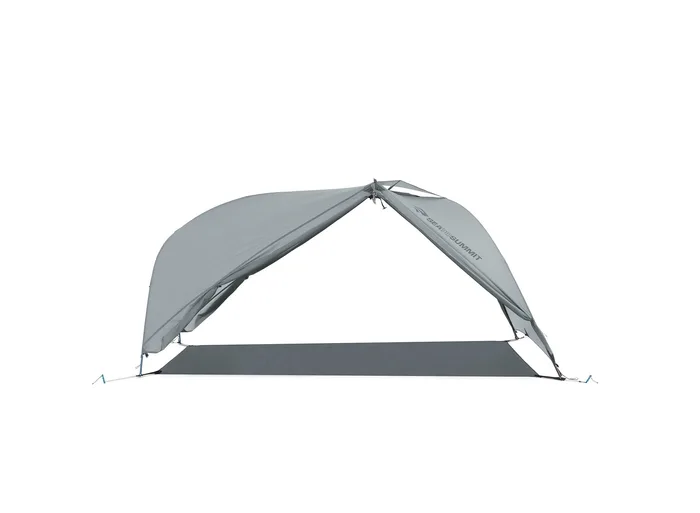
- A fly-only pitch needs a fitted footprint, since the footprint has to carry the tent's own pole and stake attachment points.
- Denier and hydrostatic head are the fabric specs, and most makers in this category publish neither.
- Corners fail first, so bartacked hypalon attachment patches are worth more than they look.
The products this guide is about
Our verdict on each, with the full reasoning on the companion review.
- Buy Sea to Summit Telos Lightfoot Footprint The only footprint here that publishes its fabric, its waterproof rating and the fact that its shape was drawn to stop water pooling.
- Buy Big Agnes Copper Spur UL2 Footprint A stated 141 grams, cut for one tent, and the key that unlocks pitching the fly without the tent body.
- It depends NEMO Equipment Hornet OSMO Footprint An abrasion-resistant polyester tarp cut to the tent it belongs to, described clearly and specified thinly.
- Skip MSR Universal Footprint A generic rectangle in eight sizes, which is convenient, heavier than a fitted footprint, and the one shape this product should not be.
What actually matters
- Fitted shape - whether the footprint is cut for your specific tent. It determines whether the edges stay inside the fly's drip line, which is the whole point of the product.
- Fly-only capability - sometimes called Fast Fly or Fly Only. Pitching with footprint, fly, poles and stakes, leaving the inner body behind, at a large weight saving.
- Denier - yarn thickness in the fabric. Higher resists abrasion better and weighs more. A 68D footprint is a durable one; ultralight sheets run far thinner.
- Hydrostatic head - waterproofness in millimetres of water column. 1200mm is a genuine waterproof rating; without a figure, waterproof is just a word.
- Weight - the cost of the protection. Worth comparing against a fitted alternative rather than in isolation, since generic sheets are often heavier.
- Attachment points - grommets, webbing tabs or bonded hypalon patches at the corners. These take the load from stakes and poles and are the usual failure point.
- Coverage area - some makers offer both a minimal cut and a larger one that extends into the vestibule, trading weight for a clean place to put boots.
The specs, in plain English
Green flags vs red flags
Green flags
- Cut for a named tent and size rather than sold as universal.
- A fly-only or fast pitch configuration described explicitly.
- A denier figure and a hydrostatic head in millimetres.
- Reinforced corner attachments described by material and stitch type.
- A stated weight you can compare against the tent's own.
Red flags
- Sold as universal or one-size for a product whose job depends on shape.
- No fabric information beyond the word waterproof.
- No weight published.
- No mention of how it attaches to the tent or poles.
- A footprint whose published dimensions match or exceed the tent floor.
Who's who: the brands
- Sea to Summit - Publishes denier, hydrostatic head and attachment hardware, and states that its footprints are shaped to avoid water pooling.
- Big Agnes - Light fitted footprints that enable the Fast Fly pitch, published with a weight but without fabric figures.
- NEMO Equipment - Abrasion-resistant polyester footprints sized per tent and per capacity, described qualitatively rather than numerically.
- MSR - Sells fitted footprints for its own tents plus a universal rectangle in eight sizes, with the fullest published size table in the category.
How to read a listing without getting fooled
Start by checking whether the footprint names your tent. If it does not, you are looking at a general ground sheet, and the rest of the specification matters less than the fact that you will need to trim or tuck it. If it does, look next for a fly-only or fast pitch mention, because that is the feature that turns a protective layer into a weight-saving option and it is only possible with the right attachment points. Then look for a denier and a hydrostatic head, and treat their absence as buying on brand rather than on fabric. Compare the weight against the fitted alternative rather than against nothing, since universal sheets are frequently heavier. Finally, look at the corners in the photographs.
How much should you spend?
The cheapest option is a cut sheet of polycryo or builder's plastic, which weighs almost nothing and works fine provided you cut it smaller than the tent floor. Mid-range buys the maker's fitted footprint, which is the right purchase for most people because it brings the correct shape and, on many tents, the fly-only pitch. The premium end buys better fabric, published waterproof ratings and reinforced attachment hardware, which is worth it if you camp on rock, gravel or desert ground where abrasion is the real threat. Since the footprint protects the most expensive and least repairable part of the tent, spending at the middle of the range is easy to justify.
Questions, answered
Should the shiny side face up or down?
For a coated fabric footprint it makes little practical difference, and makers rarely specify. The more useful habit is to keep the same side down every time, so the face that collects grit and abrasion stays the same and the clean side keeps contacting your tent floor. Shake it out and let it dry before packing regardless of orientation.
Can I use a footprint from a different tent?
Only if it is smaller than your tent floor in both directions, which is the usual reason it does not work. A footprint from a larger tent will protrude and collect runoff, and one from a smaller tent leaves the floor edges unprotected, which is less harmful but less useful. The attachment points will not line up either, so a fly-only pitch is out.
Do I still need a footprint with a thick tent floor?
Less so, and it becomes a question about ground rather than fabric. Thick floors on car camping tents cope well with grass and dirt, so a footprint is optional. On sharp gravel, granite slabs or desert crust, a footprint is worth carrying regardless of floor thickness, because a puncture in the tent floor is the failure that ends a trip and a puncture in a footprint is not.
How do I stop the footprint sliding around?
Stake it with the tent rather than separately. Fitted footprints have attachment points that share the tent's stakes or pole ends, which locks everything together. For an improvised sheet, fold the edges under the tent floor rather than letting them lie flat and loose, which also removes the risk of catching runoff.
Or jump to the head-to-head: Sea to Summit Telos Lightfoot Footprint vs Big Agnes Copper Spur UL2 Footprint.