Explained
Tent Stakes, Explained
After reading, you'll know which stake shape suits your ground, how many to carry, and what to do when a stake will not go all the way in.
In this guide
Tent stakes look interchangeable and are not. The shape of the shaft decides how much ground the stake grips, the length decides how much of that shape is buried, and the head decides whether you can still use the stake when the ground refuses to take it. Weight is the price of the first two, which is why the lightest stake in a shop is usually the one sold to a rider counting grams rather than to somebody pitching in wind.
The 30-second version
- Shape decides holding power, because grip comes from the surface the stake presses against, not from the metal it is made of.
- Weight is the price of that surface, which is why one maker's sand-and-snow stake weighs nearly twice its general-purpose one.
- Sand and snow need a different shape, wide or V-sectioned, or a stake buried sideways as a deadman anchor.
- A half-driven stake is a lever, so tie the guy line low on the shaft rather than at the head.
- Most packs contain fewer stakes than a shelter needs, once you count corners, vestibules and guy lines.
The products this guide is about
Our verdict on each, with the full reasoning on the companion review.
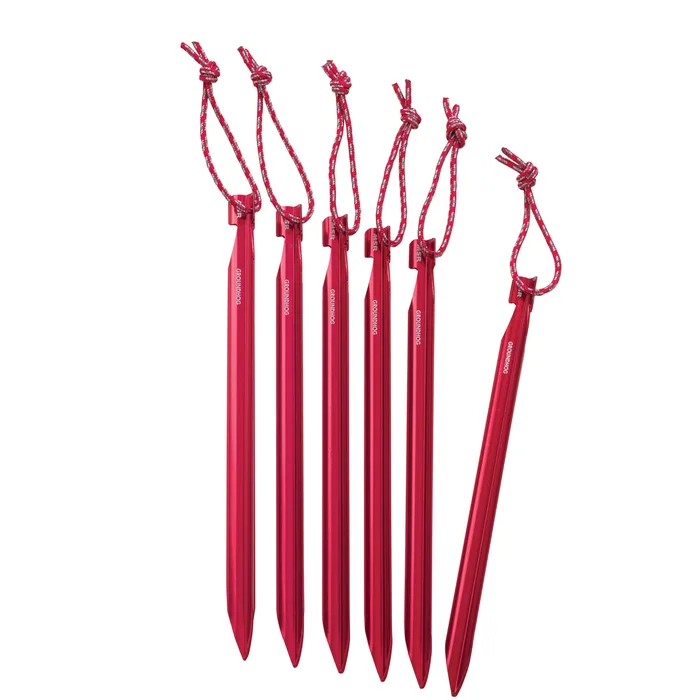
- Buy MSR Groundhog Tent Stakes The Y-beam that most other stakes are measured against, at a stated 14 grams and 19cm, sold six to a kit.
- Buy Sea to Summit Ground Control Tent Pegs A three-sided anodised peg with guy points at several heights, which is the only design here that plans for ground it cannot fully penetrate.
- It depends Vargo Titanium Ascent Tent Stake Ten grams of V-shaped titanium that Vargo specifies for sandy soil or snow, which is precise about what it is for and about what it is not.
- Skip NEMO Equipment Airpin Ultralight Stakes The smartest head in the category attached to the least holding surface, at roughly five grams a stake.
What actually matters
- Cross section - Y-beam, three-sided, V, or round pin. This is the single biggest determinant of holding power, because it sets how much surface is in contact with the ground.
- Length - how deep the stake can go. Longer stakes reach past loose surface material into firmer ground, which is why sand and snow models are longer as well as wider.
- Stated ground type - the conditions the maker designed the stake for. Where a page names sand, snow, soft soil or a wide range, that sentence is the most useful thing on it.
- Weight per stake - the figure to compare, which some makers publish per stake and others only for a set. Watch which one you are reading.
- Head and guy attachment - a loop, a hook, a notch, or multiple guy points at different heights. Multiple heights let you tie off low when the stake cannot be fully driven.
- Material and grade - aluminium alloys such as 7000-series and 7075, or titanium. Titanium resists bending at a given weight; shape still buys more holding power than metal does.
- Visibility and extraction - reflective cord and luminescent tabs are not decoration. A stake you cannot find is a stake you leave behind.
The specs, in plain English
Green flags vs red flags
Green flags
- A weight published per stake, with the units stated.
- A named ground type, such as soft soil, sand or snow, rather than a general claim.
- A published length, so you can judge how deep the stake reaches.
- More than one guy attachment height on the shaft.
- The same maker offering the shape in more than one weight, which shows they expect conditions to vary.
Red flags
- Weight given only for a set, with no per-stake figure.
- No cross section described or shown clearly in the photographs.
- A single very low weight presented as the main selling point of a general-purpose stake.
- No material grade stated beyond the word aluminium.
- A pack quantity that does not match any common shelter's needs.
Who's who: the brands
- MSR - Sells the same problem at three weights, with the ground each stake is for named on the page, which makes its range the easiest reference in the category.
- Sea to Summit - Anodised alloy pegs with multi-height guy points, designed around ground that will not take a stake to full depth.
- Vargo - Titanium specialist whose stakes are named for the conditions they suit, including V-sections for sand, snow and soft ground.
- NEMO Equipment - Ultralight designs that build guyline tensioning into the stake head, aimed at thru-hikers rather than at general camping.
- Big Agnes - Makes I-beam section ultralight stakes sold in larger packs, a middle ground between pin stakes and full Y-beams.
How to read a listing without getting fooled
Start with the photograph and look at the end of the stake rather than the whole thing, because the cross section is what you are buying. Then find the weight and check whether it is per stake or for the set, since both are quoted and they differ by a factor of six or eight. Next look for a sentence naming the ground, and treat that as the most reliable statement on the page: a maker who writes sandy soil or snow is telling you where it will not work as well. Check the length against how deep your usual ground lets you drive a stake. Finally look at the head, because a single loop at the top and a set of guy points down the shaft behave completely differently on a pitch where the stake will only go halfway in.
How much should you spend?
The budget tier is the hooked pins that arrive free with tents, and their real cost is that they rotate, bend and pull out, so most people replace them. The mid-range is where the useful shapes live, aluminium Y-beams and three-sided pegs sold in kits, and it is where almost everyone should buy. The premium tier is titanium and specialist designs, which buy weight savings and clever heads rather than more holding power for the money. Since a set of stakes is a small share of what a shelter costs, and since it is the part that fails first, the sensible split is to spend in the middle and buy more of them rather than fewer lighter ones.
Questions, answered
How do I drive a stake without bending it?
Push with the palm or a boot heel where the ground allows, and use a rock or a flat stone as a mallet when it does not, striking squarely on the head rather than at an angle. If a stake stops dead, it has found a rock, so pull it and move a few inches rather than hitting harder. That single habit prevents most bent stakes.
What angle should a stake go in at?
Lean it away from the tent at roughly forty-five to sixty degrees from the ground, so the load pulls it further into the soil rather than straight out. Driving a stake vertically and pulling horizontally on it is the fastest way to lever it free. The guy line should run to the stake at close to a right angle to the shaft.
Can I use the same stakes in winter?
General stakes work in frozen ground, which is often easier than soft soil, but they are poor in fresh snow because there is nothing solid to grip. For snow, use wide or V-sectioned stakes, or bury any stake horizontally as a deadman anchor and let the snow consolidate over it. That method holds better than anything driven vertically.
How do I stop losing stakes?
Buy the ones with reflective cord or bright anodising, count them into the bag rather than into a pocket, and walk the pitch once before you leave. Most stakes are lost by being pulled and put down in grass rather than by being left in the ground, so the habit of putting every stake straight into the bag is worth more than the reflective cord.
Or jump to the head-to-head: MSR Groundhog Tent Stakes vs Sea to Summit Ground Control Tent Pegs.