Explained
Ski Touring Backpacks, Explained
After reading, you'll understand which features a ski touring pack needs and how to spot a hiking pack posing as one.
In this guide
Touring packs use a lot of shorthand, and first-time buyers often assume any 30 litre pack will do. The features that matter are how the pack holds skis, where the shovel and probe go, and how you reach your layers. Marketing language can blur this, so the spec list on the maker page is the best guide. This guide walks through the terms so you can read it with confidence.
The 30-second version
- Ski carry matters, so check whether a pack lists diagonal, A-frame, or both.
- A separate tool pocket is faster, so look for one before you buy.
- Back access saves time, because you can reach layers without unloading the pack.
- Airbag packs are a separate category, so ask whether the maker sells one.
- A hiking pack is not a ski pack, even if it is the right size.
The products this guide is about
Our verdict on each, with the full reasoning on the companion review.
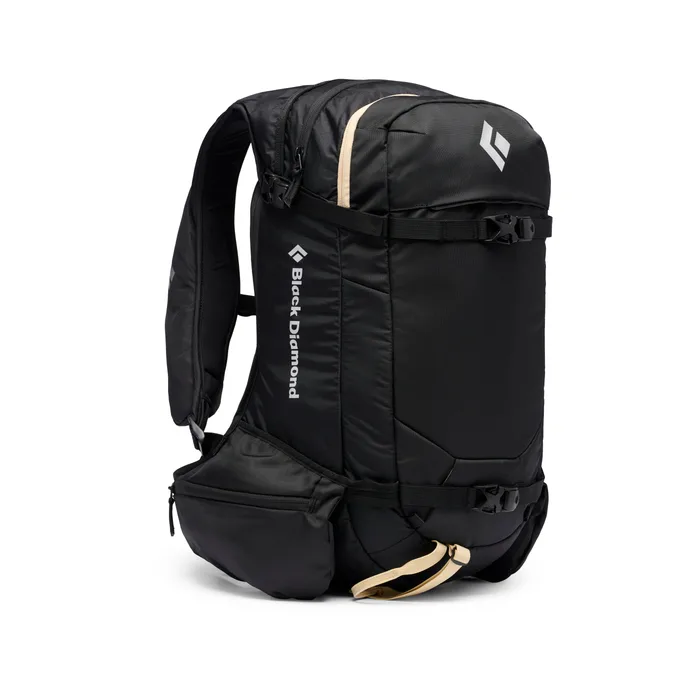
- Buy Black Diamond Dawn Patrol 32 A 32 litre touring pack built around the things you touch every lap: a tuck-away diagonal ski carry, a separate snow safety pocket, and back-panel access.
- Buy Mammut Aenergy ST 32 A lightweight 32 litre touring pack that offers both diagonal and A-frame ski carry, an integrated helmet carrier, and full-zip access to the main compartment.
- It depends Dakine Poacher 32L A snowboard-friendly 32 litre pack with every carry and safety feature, but at 1.79 kg it is heavy for long skin tracks.
- Skip Arc'teryx Aerios 35 A well-made day-hiking and overnight pack that has no ski carry, no shovel pocket, and no back access, so it is the wrong tool for the skin track.
What actually matters
- Ski carry - This is how the pack holds skis on your back. It decides how quickly you switch between skinning and boot-packing.
- Avalanche tool pocket - This is where the shovel and probe live. A dedicated pocket makes them quick to grab.
- Back access - This is a zipper on the back panel or a full-zip opening. It lets you reach the main compartment without unloading.
- Helmet carry - This holds a helmet on the outside of the pack during the climb. It frees your head and keeps the helmet secure.
- Hydration compatibility - This is support for a bladder, tube, or flask. Insulated routing helps in cold weather.
- Airbag option - This is a version of the pack, or a compatible system, with an avalanche airbag. It adds weight and cost.
- Fit and frame - A torso-length range and a frame or back panel decide how well the load carries. A pack that fits poorly feels heavier on a long climb.
The specs, in plain English
Green flags vs red flags
Green flags
- The maker lists a named shovel or snow safety pocket.
- Both ski carry and snowboard carry are listed.
- A zippered back panel or full-zip opening is listed.
- Weight and volume appear on the product page.
- A hydration sleeve is described as insulated.
Red flags
- The page describes the pack for hiking and lists no ski carry.
- Only a roll-top closure is described.
- No shovel or avalanche tool pocket is listed.
- The listing cites only a bungee cord for external carry.
- The pack has no weight listed.
Who's who: the brands
- Black Diamond - A mountain-gear maker whose Dawn Patrol, Cirque, and Helio lines are built for backcountry skiing.
- Mammut - A Swiss mountain brand whose Aenergy ST line is made for ski touring.
- Dakine - Known for snow packs aimed at riders, including the Poacher, Mission Pro, and Heli Pro lines.
- Deuter - A German pack maker with Freerider, Alproof, and Updays lines for freeride and ski touring.
- Arc'teryx - Known for climbing and hiking packs, with a separate ski and snowboard category on its site.
How to read a listing without getting fooled
Start with the volume and weight, then scan for the named features: ski carry type, a snow safety or shovel pocket, back access, helmet carry, and hydration. If a feature is not on the product page, assume it is missing instead of hoping it is there. Check the torso-length range for your size, because fit changes how heavy the pack feels. Also check the stock and size information, since touring packs can sell out in season.
How much should you spend?
Touring packs run from mid-range to premium. The lightest, most refined packs sit at the premium end, while packs with the same core features but a few more grams cost less. Airbag versions are a step up again, because the system adds cost as well as weight. A budget-minded buyer should look for the key features (carry, tool pocket, back access) rather than the lowest weight.
Questions, answered
What size pack do I need for a day tour?
Most day tours fit in 25 to 35 litres. The packs in this review are all around 32 litres, which fits layers, food, water, and rescue gear. If you ski long days or carry extra gear, go larger. A smaller pack is lighter but may leave no space for a helmet or spare layers.
Is a lighter pack always better?
Not necessarily. A lighter pack can use thinner fabric and fewer features. Look at what you give up for each gram saved, such as pocket layout or durability. For regular use, a few extra grams are often a fair trade for a better layout.
What goes in the avalanche tool pocket?
It holds your shovel and probe. The avalanche.org encyclopedia lists a probe, shovel, and transceiver as gear entries. Your beacon is worn on your body and not stored in the pack, so see our avalanche beacons review for that piece.
Can I use a ski bag as a touring pack?
No. Ski bags protect gear for travel and are covered in our ski bags review. A touring pack is something you wear on the climb and ski in. They solve different problems.
Or jump to the head-to-head: Black Diamond Dawn Patrol 32 vs Mammut Aenergy ST 32.