Explained
Snorkel Sets, Explained
After reading, you'll understand what the lens, skirt, snorkel top and fin terms on a snorkel set listing mean and which ones to check before you buy.
In this guide
Snorkel sets look alike in photos, which is why first-time buyers end up choosing on colour. The real differences are in a few words of the description: what the lens is made of, what the skirt is made of, and how the snorkel top handles water. Makers that use good materials say so plainly, and makers that do not tend to stay vague. Learn the handful of terms below and most listings sort themselves into worth a look or not.
The 30-second version
- Check the lens first, because tempered glass is stated by makers that use it and plastic lenses scratch more easily.
- Read the skirt wording closely, since silicone, TPR, PVC and blended trade names are different materials.
- Know your snorkel top, as a dry-top seals underwater while a splash guard only deflects waves.
- Fit beats features, so prefer sets with more fin sizes and a mask that seals on your face.
- Treat full-face masks with caution, because Hawaii's Department of Health says their safety is still being studied.
The products this guide is about
Our verdict on each, with the full reasoning on the companion review.
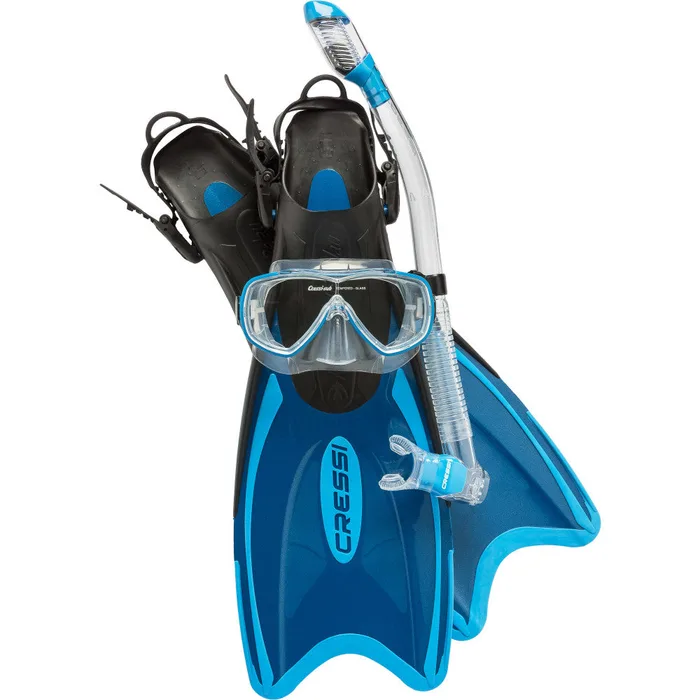
- Buy Cressi Palau Set A complete mask, dry snorkel and open-heel fin set with a tempered glass lens, a silicone skirt and four fin sizes.
- Buy U.S. Divers Bonaire Adult Snorkel Set A lower-tier complete set that still states tempered glass, a silicone skirt and a dry-top snorkel.
- It depends Seavenger Hanalei Anti-Fog Snorkeling Set A compact four-piece kit with an anti-fog film on tempered glass and short fins, but a snorkel that deflects splash instead of sealing.
- Skip Wildhorn Outfitters Seaview 180 V3 Full Face Snorkel Mask A full-face mask with a wide view and an action camera mount, in a product category whose safety public health bodies are still studying.
What actually matters
- Lens material - Tempered glass resists scratches and is the norm on better masks. Polycarbonate lenses appear on cheaper sets and on full-face masks.
- Skirt material - The skirt is the soft part that seals against your face. Silicone is the usual choice for comfort; TPR and PVC cost less to make.
- Snorkel top design - This decides how much water gets into the tube. A dry-top closes underwater, a splash guard only helps with waves, and an open tube does neither.
- Purge valve - A one-way valve below the mouthpiece drains water when you exhale. It makes clearing the snorkel less effort.
- Fin type and length - Open-heel fins adjust with a strap; full-foot fins fit like a slipper. Shorter fins pack smaller, longer fins have more blade.
- Size range - A set with four fin sizes fits more closely than one with two. Makers warn that feet at the edges of a range may fit poorly.
- Mask style - Conventional masks cover eyes and nose with a separate snorkel. Full-face masks cover the whole face, and public health bodies are still studying them.
The specs, in plain English
Green flags vs red flags
Green flags
- The description says tempered glass, and ideally it is printed on the lens.
- The skirt is described as silicone with no qualifiers.
- The maker explains how the snorkel top works, for example a valve that seals when submerged.
- Fins come in three or more sizes with a shoe-size chart.
- The product is sold on the maker's own site with a stated warranty or return policy.
Red flags
- Lens described as polycarbonate, shatter-resistant plastic, or not described at all.
- Skirt described as TPR, PVC, or a blended trade name instead of silicone.
- A snorkel called dry with no explanation of the valve.
- One-size-fits-all fins for adults.
- A full-face mask sold as final sale, so a poor fit cannot be returned.
Who's who: the brands
- Cressi - Italian dive equipment maker founded in 1946 whose snorkel sets state lens, skirt and snorkel details clearly.
- U.S. Divers - Long-running snorkel brand with a wide range of sets, from tempered glass and silicone models to cheaper polycarbonate ones.
- Seavenger - Southern California brand selling compact travel snorkel sets, wetsuits and water shoes direct.
- Wildhorn Outfitters - Outdoor gear company founded in 2015 and known in snorkelling for its Seaview 180 full-face masks.
How to read a listing without getting fooled
Start with the mask sentence and look for two phrases: tempered glass and silicone skirt. If either is missing or replaced by polycarbonate, TPR or PVC, you know the set's level. Next find the snorkel sentence and see whether it describes a valve that seals when submerged, a splash guard or deflector, or nothing; then check whether a purge valve is mentioned. For fins, note whether they are open-heel, how many sizes there are, and whether a shoe-size chart is shown, since makers such as U.S. Divers warn that feet at the ends of a range fit less well. Ignore viewing-angle claims and words like panoramic, which have no standard definition. Finally check the return terms, because a mask that leaks on your face is useless however good the materials.
How much should you spend?
Budget sets usually save money on the lens and skirt, which is where polycarbonate and TPR show up, and often come in one or two sizes. Mid-range sets are where tempered glass, silicone skirts and dry-top snorkels become standard, and this tier suits most holiday use. Premium sets from dive brands add more fin sizes, better bags and fuller specifications, which pays off if you snorkel regularly. Spending more than that mostly buys scuba-grade gear that casual snorkellers do not need. A clearance price is no bargain if the item is final sale and does not fit.
Questions, answered
Can I wear a snorkel mask with a beard or moustache?
Facial hair under the skirt can break the seal and let water seep in. A moustache is the usual problem because the skirt crosses the upper lip. Trimming the area just under the nose can help. Try the mask on dry before your trip: press it to your face without the strap, inhale gently through your nose, and see whether it stays put.
How should a snorkel mask fit?
The skirt should rest evenly on your face with no gaps at the temples or under the nose, and the strap should sit on the crown of your head, snug but not tight. Hawaii's ocean safety guidance says to make sure the mask fits properly and does not leak, and that fins fit snugly. Overtightening the strap tends to distort the skirt and cause leaks. If a mask only seals when cranked tight, it is the wrong shape for your face.
Do children need a different set?
Yes, adult masks are too wide for most children and will leak. U.S. Divers, Cressi and Seavenger all sell junior or kids' sets with smaller masks, shorter snorkels and smaller fins. The open safety questions about full-face masks, including carbon dioxide buildup, apply to children too, so a conventional mask and snorkel is the cautious choice. Supervise children closely in the water whatever they wear.
How do I look after a snorkel set?
Rinse everything in fresh water after each use and let it dry out of direct sun. Keep sand out of the dry-top valve and purge valve, since grit can stop them sealing. Store the mask where the skirt is not squashed; Wildhorn also advises keeping silicone away from black rubber, which can stain it. Follow the maker's instructions for any anti-fog coating or film.
Or jump to the head-to-head: Cressi Palau Set vs U.S. Divers Bonaire Adult Snorkel Set.