Explained
Sergers, Explained
After reading, you'll understand what a serger does, which specs matter for home sewing and how to tell a thin spec sheet from a complete one.
In this guide
First-time serger buyers are often unsure what a serger does that a sewing machine cannot, and the spec sheets add jargon like differential feed, lay-in tension and 4-thread overlock. Makers also publish different numbers, so two sheets can be hard to compare. A serger sews, trims and finishes an edge in one pass with two loopers working beneath the fabric. Knowing a handful of terms is enough to read any sheet.
The 30-second version
- A serger finishes edges, it does not replace a sewing machine for buttonholes and zippers.
- Differential feed is the key knit feature, so look for a printed range on the spec sheet.
- 2/3/4 thread machines are the flexible choice, while 3/4 and 4-thread only machines do less.
- Threading is the hard part, and color-coded paths or air threading make it easier.
- A page that skips the basics is a warning, because unpublished specs cannot be checked.
The products this guide is about
Our verdict on each, with the full reasoning on the companion review.
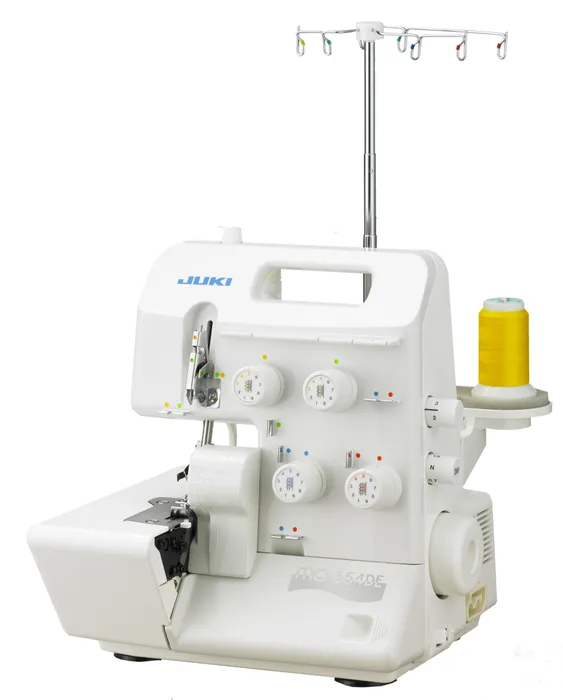
- Buy Juki MO-654DE A 2/3/4 thread overlock with differential feed and a 1,500 stitch per minute top speed from a maker that also builds industrial machines. Amazon
- Buy Brother Pacesetter PS3734T A 3/4 thread serger with differential feed, 1,300 stitches per minute and three feet included, from the most familiar name in home sewing. Amazon
- Buy bernette b44 FUNLOCK A compact Swiss-designed overlocker with 15 stitches, 2/3/4 thread sewing and a manual needle threader. Amazon
- It depends Elna eXtend 664PRO A mechanical overlocker with 12 stitch programs, a program display panel and a 0.5 to 2.25 differential feed range. Amazon
- It depends Singer Professional 5 14T968DC A 2/3/4/5 thread serger that also sews coverstitch hems, with 14 built-in stitches and a self-adjusting tension system. Amazon
- Skip American Home AH100 A 4-thread beginner serger whose maker page names color-coded threading and adjustable stitch settings but little else. Amazon
What actually matters
- Thread count - the number of threads decides which stitches you can sew. More options mean more finishes.
- Differential feed - it changes the fabric movement under the foot. It matters most on knits and sheers.
- Top speed - it is listed in stitches per minute. It is a tie-breaker, not a buying reason.
- Threading system - it covers color-coded paths, looper threaders and air threading. It decides how often you will dread changing colors.
- Cutting width and overlock width - they set how much fabric is trimmed and how wide the finish is. A wider range suits thicker fabric.
- Stitch count - makers publish it differently. It is useful if you want flatlock and wrapped overlock.
- Weight and voltage - a heavier machine is steadier on the table but harder to move. Voltage should match your outlet.
The specs, in plain English
Green flags vs red flags
Green flags
- The page prints a differential feed range.
- Thread count is stated clearly, such as 2/3/4.
- Weight, voltage and included feet are listed.
- The maker states warranty terms.
- Threading aids such as color-coded paths are described.
Red flags
- No differential feed is mentioned.
- No top speed or stitch count appears.
- The page uses only marketing phrases.
- Weight and voltage are missing.
- Warranty terms are not published.
Who's who: the brands
- Juki - Known for industrial sewing machines and for fast, sturdy home sergers.
- Brother - A widely sold home sewing brand with budget and mid-range sergers.
- bernette - The Swiss-designed sister line to Bernina, offering compact overlockers.
- Elna - A Swiss-founded brand now owned by Janome, selling mechanical overlockers.
- Singer - A long-running American brand that shares a family with Husqvarna Viking and Pfaff.
How to read a listing without getting fooled
Start with thread count and differential feed, because they decide what the machine can sew. Then check speed, weight, voltage, included feet and warranty. Treat a blank as a missing answer, not a zero: some makers publish a stitch count and some do not, and some print differential feed as a ratio while others print millimeters. If two machines look alike on paper, the one that prints more specs is easier to trust.
How much should you spend?
Entry sergers sit at the budget tier and cover the basics: 3/4 thread sewing, differential feed and a few feet. Mid-range machines add more stitches, 2-thread sewing, settings panels or coverstitch. Air-threading models sit at the premium tier. Spend where it matters to you, such as threading ease or stitch variety, rather than on top speed.
Questions, answered
What fabrics suit a serger?
Sergers suit knits, jersey, fleece and woven cloth that frays. Differential feed and the knife handle most weights, and heavier makers' pages mention heavyweight cutting. Very thick layers need a machine whose page says it handles them. Check the presser foot lift and needle size on the spec sheet.
Can a serger sew a normal seam?
Yes, an overlock seam joins fabric, trims the edge and finishes it in one pass. It does not make buttonholes or sew zippers on most machines. Many sewists keep a regular sewing machine for those jobs.
How long does it take to learn?
Threading is the learning curve, and color-coded paths help. Plan some time with scrap fabric to set tension and stitch length. Video tutorials from the maker are often included or linked on the product page.
Is coverstitch the same as serging?
No. Coverstitch sews hems with parallel lines on top and a chain underneath, while overlock wraps an edge. A few machines, such as the Singer Professional 5, offer both. Others need a separate coverstitch machine.
Or jump to the head-to-head: Juki MO-654DE vs Brother Pacesetter PS3734T.