Explained
Robotic Pool Cleaners, Explained
After reading, you'll understand the corded and cordless trade, how to size a cleaner to your pool, and which published numbers actually predict performance.
In this guide
Pool robot listings are built around two kinds of number: the impressive one and the useful one. Suction rates in gallons per hour are impressive. Runtime paired with a coverage area is useful. The same is true of feature names, where waterline cleaning is a capability that some machines have and some do not, and marketing language rarely makes the difference obvious. A short vocabulary makes the category much easier to shop.
The 30-second version
- Floor, walls and waterline are three capabilities, and a cleaner that omits the waterline leaves the ring you can actually see.
- Runtime only means something with a coverage area, because minutes alone do not tell you whether your pool will be finished.
- Corded never runs out, and cordless never tangles, which is the whole of the trade.
- Two filter stages beat one, with a coarse cartridge for leaves and a fine layer for the silt that clouds water.
- The warranty is the maker's own estimate of how long a machine submerged in chlorine will last.
The products this guide is about
Our verdict on each, with the full reasoning on the companion review.
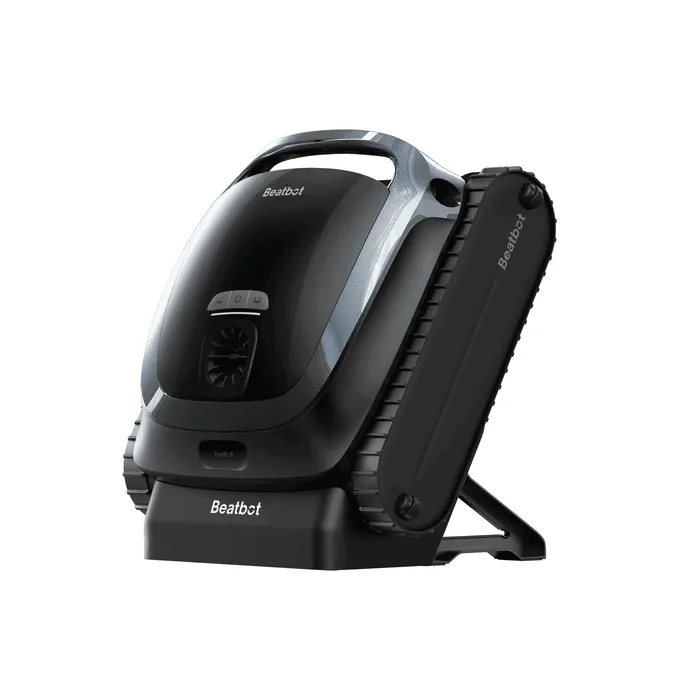
- Buy Beatbot AquaSense 2 Cleans all three surfaces, runs four hours, and is backed by the longest warranty here.
- Buy WYBOT C2 The cordless cleaner that publishes the numbers everyone else leaves out.
- It depends Dolphin Nautilus CC Plus with Wi-Fi Mains powered, with no battery to degrade and the longest track record in the category.
- Skip Dreame Z1 Leads on a suction number and then declines to publish anything else.
What actually matters
- Surfaces cleaned - whether the robot does the floor only, floor and walls, or floor, walls and the waterline. Maytronics lists waterline scrubbing as an explicit yes or no field, which is the honest way to present it.
- Runtime and coverage - on a cordless unit, the minutes it runs and the square footage it claims to cover. WYBOT publishes 180 minutes and 2,152 square feet together; a runtime with no area attached cannot be checked against your pool.
- Rated pool length - on a corded unit, the maximum pool dimension the cable and cycle are designed for. The Nautilus CC Plus is rated to 40 feet where Maytronics' own larger models reach 50.
- Suction rate - gallons per hour through the robot's own pump. It is a real figure but a partial one, since a powerful pump on a short battery finishes less of the pool than a modest pump that runs for hours.
- Filter micron rating - the smallest particle the filter holds. A coarse-only filter passes the fine dust that makes water cloudy, and a fine-only filter clogs fast in a pool under trees.
- Retrieval method - whether the machine surfaces on command, parks at the pool edge, or has to be hooked off the bottom. On a twenty pound unit this is a weekly quality-of-life difference.
- Warranty - length and what it covers. Full machine replacement is a materially different promise from a repair, particularly on a sealed unit with a battery.
The specs, in plain English
Green flags vs red flags
Green flags
- Surfaces are listed as separate yes or no fields, including the waterline.
- A runtime is paired with a coverage area, or a corded unit states a maximum pool length.
- Filter stages are given with micron ratings.
- The warranty length is stated and says what it covers.
- The machine's weight is published, since you will lift it out of water regularly.
Red flags
- A suction rate in the headline and no runtime anywhere on the page.
- Coverage described as maximised or full rather than given in square feet.
- A filter described as fine or ultra-fine with no number attached.
- No warranty length mentioned on a several-hundred-dollar submerged appliance.
- Cleaning surfaces implied by photographs rather than listed.
Who's who: the brands
- Maytronics (Dolphin) - The long-established name in robotic pool cleaning, with a corded range from the Nautilus CC up to the Titan and a detailed published specification for each.
- Beatbot - Cordless specialist whose AquaSense line covers floors, walls and waterline and carries a three year warranty with full machine replacement.
- WYBOT - Cordless maker that publishes coverage areas and filter micron ratings, with a range from the entry A1 up to the S series and solar-charged models.
- Dreame - Better known for robotic floor vacuums, now selling the Z1 pool cleaner on an 8,000 gallon per hour suction figure.
- Aiper - Cordless brand with the Scuba and Surfer lines, covering both submerged cleaners and surface skimmers.
How to read a listing without getting fooled
Start with the surfaces list and treat it literally. If waterline cleaning is not named, assume it is not there, because makers that have it say so. Next find the endurance figure and check what it is attached to: on a cordless unit you want minutes and square feet together, and you should assume the minutes are an eco-mode number unless the page says otherwise; on a corded unit you want a maximum pool length. Then look at the filter, where two stages with micron ratings is the sign of a machine designed for real water rather than a demo. Check how the robot comes out of the water, since surface parking is worth more in practice than most of the feature list. Finally read the warranty, and note whether it promises replacement or repair. A page that leads with a suction rate and omits runtime has chosen which number flatters it.
How much should you spend?
Robotic pool cleaners run from mid-range to flagship money and the tiers correspond fairly closely to capability. The mid-range buys a floor-and-walls machine, corded or cordless, with basic filtration and a one to two year warranty, and for a small pool with a cover that is genuinely enough. The premium tier adds waterline cleaning, app control with selectable paths, two-stage rated filtration and longer runtime, which is where most owners of an uncovered pool should be looking. The flagship tier buys the longest warranty, the best retrieval behaviour and the most sensor-driven navigation, and on a machine that will be submerged for five seasons a third year of full replacement cover is a rational thing to pay for. What is never good value is a high suction figure attached to an unpublished runtime.
Questions, answered
Can I leave a robotic cleaner in the pool all the time?
You should not. Continuous immersion shortens seal and cable life, and on cordless units it keeps the battery warm and charged, which ages it faster. Most makers intend the robot to run a cycle and then come out. That is also why retrieval behaviour matters: a machine that surfaces on command gets taken out, and one that has to be fished off the bottom tends to get left in.
Will a pool robot pick up fine sand and silt?
Only if its filter is rated for it. A cartridge rated at 180 microns will hold leaves, insects and grit and pass anything finer straight back into the water. A second stage around 10 microns is what captures the silt and pollen that make water look cloudy after a cleaning cycle. If a listing describes its filter only as fine or ultra-fine, you cannot tell which of those it does.
How does a cordless robot know where it has been?
Through a combination of sensors and path planning rather than a map you can see. Beatbot quotes sixteen sensors feeding a path optimisation routine, and WYBOT offers six selectable path patterns so you can choose the coverage shape yourself. Neither builds a map you can inspect the way a robot vacuum does. The practical test is whether the robot leaves an untouched border at the edges and corners, which is what guide wheels are for.
Does a pool robot replace my skimmer?
No, and the two do different jobs. A skimmer catches floating debris before it sinks; a submerged cleaner removes what has already settled and scrubs the surfaces. Several makers now sell separate surface skimmer robots alongside their cleaners for exactly this reason, and buying one expecting it to vacuum the floor is a common and expensive mistake. If leaves are your main problem, a skimmer plus a cleaner is the combination, not one or the other.
Or jump to the head-to-head: Beatbot AquaSense 2 vs WYBOT C2.