Explained
Ring Lights, Explained
After reading this, you'll be able to look at any ring light listing and know instantly whether it will actually make you look good on camera - or just glow in your peripheral vision.
In this guide
A ring light is a circular lamp that surrounds your camera and floods your face with even, shadow-free light - the single fastest upgrade for looking good on video calls and in content. The catch is that the market is full of undersized selfie rings and dated designs dressed up with big brightness claims, and the specs that actually matter (size, color adjustability, color accuracy) are the ones listings talk about least.
The 30-second version
- Size decides everything: an 18-inch-class ring is the minimum for lighting a full face at desk distance - small clip-on and 10-inch rings are for phone-in-hand selfies only.
- Bi-color beats brightness: the ability to dial the light from warm to daylight so it matches your room matters more than raw output, and it's what separates current designs from obsolete ones.
- Color accuracy is the skin-tone spec: a CRI rating in the mid-90s or higher is what keeps your face looking like your face instead of a waxwork.
- The kit matters as much as the ring: a tall stand, phone holder, camera mount, and remote are the difference between a usable setup and a light propped on books.
- Pay for a battery only if you move: cordless rings cost roughly double, and if your light lives at a desk the cable costs you nothing.
The products this guide is about
Our verdict on each, with the full reasoning on the companion review.
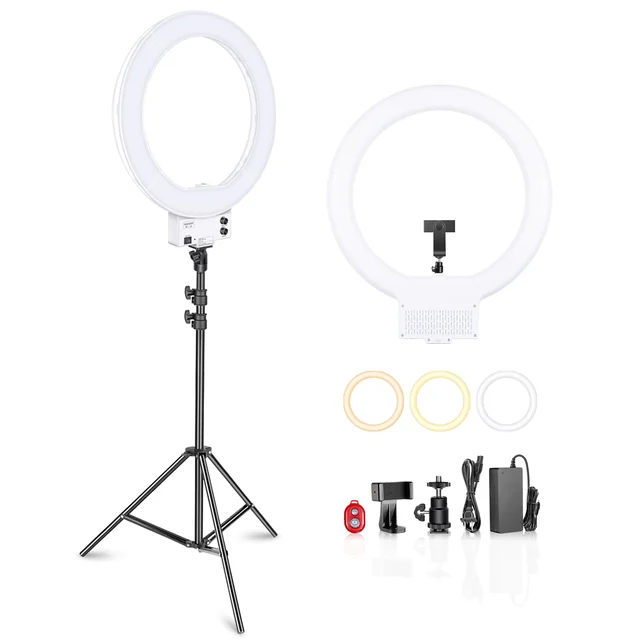
- Buy NEEWER 18" Dimmable Bi-Color LED Ring Light Kit The complete 18-inch bi-color kit that does everything most people need for the least money.
- Buy Lume Cube Cordless Ring Light Pro A battery-powered, edge-lit 18-inch ring that goes anywhere and looks the most professional doing it. Amazon
- It depends Lume Cube Ring Light 18" A well-built corded 18-inch ring that is lovely to own but undercut on value by cheaper bi-color kits.
- Skip NEEWER RL-18 New Version 18" LED Ring Light A dated white-only design that makes you snap plastic filters over the ring to change color - in 2026, don't. Amazon
What actually matters
- Ring diameter - the physical size of the circle. Bigger rings produce softer, more flattering light and can sit further back while still lighting your whole face; 18 inches is the class to buy for webcam and filming work.
- Bi-color adjustment - LEDs that sweep from warm indoor tones to cool daylight with a dial, so the light blends with windows and household bulbs instead of fighting them. Fixed-color rings that rely on clip-on plastic filters are an outdated design worth avoiding.
- Color accuracy (CRI) - how faithfully the light renders colors, especially skin. Mid-90s or better is the bar; unrated lights are a gamble your face takes.
- Light quality and diffusion - exposed-LED rings are the norm, but edge-lit designs that fire LEDs through a diffusion ring produce a noticeably softer glow and a gentler reflection in eyes and glasses.
- Power source - corded (AC) rings are cheaper and fine for a fixed desk; built-in batteries free you from outlets but add real cost and run down quickly at full brightness.
- Included mounting kit - look for a floor stand that reaches eye level or above, a phone holder, and ideally a hot shoe or camera mount. A great ring on a flimsy or too-short stand is a bad light.
- Remote control - brightness and color you can adjust from your chair. It sounds like a luxury until the light is positioned and you have to get up mid-call to tweak it.
The specs, in plain English
Green flags vs red flags
Green flags
- 18-inch-class ring with true bi-color adjustment across roughly the warm-to-daylight range
- CRI stated plainly at 95 or above
- Complete kit in the box: tall stand, phone holder, hot shoe adapter, and a remote
- USB-C charging on battery models, plus the option to run corded
- Owner reports that specifically praise skin tones and even light, not just brightness
Red flags
- White-only LEDs with clip-on colored filter shells to change temperature - a design the category has outgrown
- No CRI figure anywhere in the listing, or vague claims like 'studio quality' with no numbers
- Ten-inch or smaller rings marketed for video calls - they can't produce enough soft light at desk distance
- A desktop tripod pictured at flattering angles that would actually sit well below your eye level
- Battery models priced at a big premium with no stated runtime at full brightness
Who's who: the brands
- NEEWER - The value workhorse of photo and video lighting - its 18-inch bi-color kits define the sensible mid-range, though its older white-only designs are still on sale and worth avoiding.
- Lume Cube - A premium creator-lighting brand known for build quality and its edge-lit cordless ring, the polished upgrade pick for people who film in more than one place.
- Elgato - The streaming-gear brand - its lights lean toward key-light panels and app-controlled desk setups rather than classic rings, popular with streamers already in its ecosystem.
- GVM - A budget-to-mid studio lighting maker with app-controlled bi-color rings and panels, a common alternative in the same price band as NEEWER.
- UBeesize / Sensyne and similar - The interchangeable budget selfie-ring tier sold under many names - fine for handheld phone use, generally too small and dim for webcam framing.
How to read a listing without getting fooled
Start with the diameter, because listings bury it under brightness claims: if it isn't an 18-inch-class ring, it isn't a video-call light, whatever the photos imply. Next find the color spec - you want a stated bi-color range (roughly warm 3200K to daylight 5600K, wider is a bonus) adjusted by a dial or remote, and a CRI number in the mid-90s. If the listing shows orange and white plastic shells clipped over the ring, that's a fixed-color light wearing a costume; move on. Then read the kit contents like a receipt: stand height (it should reach your eye level when seated or standing, so roughly six feet of extension), phone holder, camera shoe, remote. Finally, treat glamour shots skeptically - product photos are lit by lights other than the one being sold, so weight owner reports about skin tones and evenness far more than the hero image.
How much should you spend?
What drives cost in ring lights is, in order: size, bi-color capability, color accuracy, battery power, and brand polish. The value sweet spot is a corded 18-inch bi-color kit from an established lighting brand - that tier buys everything that shows up on camera, including accurate color and a full mounting kit, and adding money beyond it mostly buys convenience rather than better-looking light. The cheapest tier of small selfie rings is a false economy for video calls, because no amount of savings helps a light that can't reach your face with enough soft output. Spending up to the premium tier makes sense in exactly one case: you genuinely film in multiple rooms or on location, where a built-in battery and softer edge-lit diffusion earn their keep. If your light will live beside a desk, the premium buys you a nicer object, not a better result.
Questions, answered
What size ring light do I need for video calls?
An 18-inch-class ring. At typical desk distance - behind a laptop or webcam, a couple of feet from your face - smaller rings simply can't deliver enough soft light to be your main source. Ten-inch and clip-on rings are built for phone-in-hand selfie distance and underdeliver the moment you lean back.
What does bi-color actually do for me?
It lets the ring match the light already in your room. Window daylight is cool and blue-ish; household bulbs are warm and orange. If your face light doesn't match the background light, you look tinted. A bi-color ring fixes this with a dial in seconds; a fixed-color ring can only approximate it with clip-on filters that owners consistently describe as fiddly and color-degrading.
Will a ring light glare in my glasses?
Probably, at least a little - the ring reflects as a distinctive circular glare in lenses and as a ring-shaped catchlight in your eyes. Raising the light above eye level and angling it down helps a lot, and edge-lit rings are gentler than exposed-LED ones. If you wear glasses on every call, an off-center key light or monitor light bar may suit you better than any ring.
Is a battery-powered ring light worth it?
Only if you actually move. Cordless rings cost roughly double a capable corded kit, and full-brightness runtime is short enough that long desk sessions end up plugged in anyway. They're transformative for filming in different rooms, at events, or anywhere outlets are scarce - and an unnecessary premium for a light that never leaves your desk.
Ring light or key light panel - which should I get for working from home?
A ring is the easiest all-in-one: your phone or camera mounts dead center, and the light is even and shadow-free with zero technique required. A panel off to the side looks more natural and avoids glasses glare, but takes more positioning skill. If you both take calls and create content, the ring is the more versatile single purchase.
Do I need an app to control a modern ring light?
No, and you shouldn't have to. Good rings have onboard dials for brightness and color, and better kits add a physical wireless remote or a Bluetooth receiver as an option rather than a requirement. Treat 'app required for basic controls' as a mild warning sign - it adds a pairing step to every session for no on-camera benefit.
Or jump to the head-to-head: NEEWER 18" Dimmable Bi-Color LED Ring Light Kit vs Lume Cube Cordless Ring Light Pro.