Explained
Sling Bags, Explained
After reading, you'll understand how to judge a sling from its spec block instead of its photographs.
In this guide
The word sling covers bags that differ by a factor of four in capacity, which is why so many people buy one and find it holds less than they pictured. Product photography makes this worse, because an empty sling on a hook looks the same size whether it is 2.5 or 9 litres. The way out is to read the specification block, where volume, dimensions, weight and sleeve sizes are usually printed, and to know what the fabric numbers next to them mean.
The 30-second version
- Volume is the headline spec, and the gap between a 2.5 L and a 9 L sling is the difference between a pouch and a day bag.
- Denier describes yarn thickness, so a higher number generally means a tougher, heavier fabric, not a waterproof one.
- A laptop sleeve is a separate spec, and most slings that mention screens mean tablets rather than laptops.
- Empty weight matters on one shoulder, because a sling puts the whole load on one side of your body.
- Lifetime warranties cover defects, and the exclusions list is where the real difference between brands shows up.
The products this guide is about
Our verdict on each, with the full reasoning on the companion review.
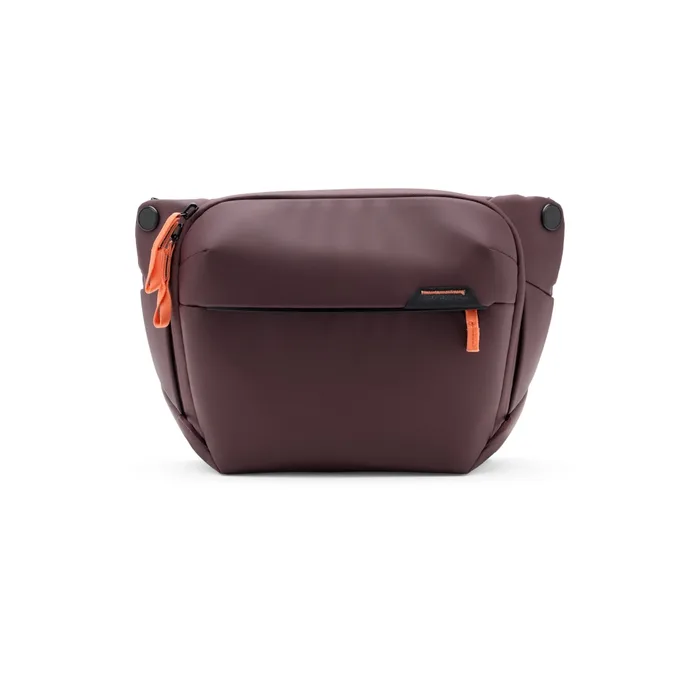
- Buy Peak Design Everyday Sling 6L Six litres of reconfigurable space with folding dividers, the best-organised sling here and the lightest for its volume.
- Buy Chrome Industries Kadet 9L Sling The most capacity here by a wide margin, fully specified, in fabrics built for people who ride in weather.
- It depends WANDRD ROGUE 6L Sling The only sling here that will take a 16 inch laptop, with the deepest organisation and no published weight.
- Skip Aer Day Sling 4 A genuinely lovely 2.5 litre pouch that is sold and priced as a day bag, which is not the same thing.
What actually matters
- Stated volume in litres - the single most useful number in the category, and the one photographs cannot convey. Under 3 L is an essentials pouch, 5 to 7 L is a genuine small bag, 9 L and up starts replacing a backpack for a day.
- External dimensions - volume alone does not tell you the shape, and a 9 L bag that is wide and flat wears very differently from a 6 L bag that is deep. Check width across the back and depth away from it.
- Device sleeve size - the only reliable way to know what electronics fit. Look for actual measurements or a named device, not a claim that it fits most tablets.
- Empty weight - slings carry on one shoulder, so their starting weight is felt more than a backpack's. The range across serious slings runs from around three quarters of a pound to around a pound and a half.
- Strap adjustment range - a sling is worn anywhere from high on the chest to low on the hip, and over a coat it needs more length than you think. A published range removes the guesswork.
- Fabric stack - most good slings use different fabrics for the shell, the base and the liner. A maker who lists all three by denier is telling you where the abrasion resistance is.
- Closure type - zippers are secure and slow, magnetic and buckle closures are fast and less secure, and a seatbelt-style buckle is fast, tough and loud. Match it to where you will be opening the bag.
The specs, in plain English
Green flags vs red flags
Green flags
- Volume in litres and full external dimensions both printed in the spec block.
- An empty weight given, and separately if accessories are fitted.
- Device sleeve given as a measurement or a named device.
- Fabrics listed by denier for the shell, base and liner.
- A published strap adjustment range.
Red flags
- No volume figure anywhere, only photographs of the bag in use.
- A claim that it fits most tablets with no dimensions attached.
- No materials listed at all on a bag at a premium price.
- A lifetime warranty headline with no exclusions page behind it.
- Product shots that show the bag stuffed with items the volume figure cannot support.
Who's who: the brands
- Peak Design - Camera-first carry brand known for folding dividers, magnetic hardware and a lifetime warranty.
- Chrome Industries - Comes out of bike messenger culture, with heavy denier fabrics and the seatbelt buckle closure as a signature.
- WANDRD - Photography travel bags with deep internal organisation and tarpaulin shells, and the rare sling that takes a full-size laptop.
- Aer - Minimalist San Francisco brand focused on clean lines and precise construction, with a lifetime warranty on manufacturing defects.
How to read a listing without getting fooled
Read the specification block first and the description last. Find the volume in litres and hold it in your head while you look at the photographs, because the pictures will otherwise set your expectations. Then read the external dimensions and picture them against something on your desk, since shape matters as much as volume for how a sling wears. Next look for the device sleeve: a measurement or a named device means the maker has tested it, a phrase like fits most tablets means they have not. Check the empty weight and note whether it is quoted with or without included dividers. Finally open the warranty page rather than trusting the badge, and read what is excluded.
How much should you spend?
Budget slings are simple single-compartment bags with unnamed fabrics and short warranties, and they are a reasonable way to discover whether you like carrying a sling at all. The mid-range is where the category gets good: published fabric stacks, real dimensions, lifetime warranties on defects, and capacities from about 6 to 9 litres. Most people should buy here. Premium pricing buys dividers, laminated fabrics and finer hardware, and it is worth it if you carry a camera or a drone and want the inside of the bag to change shape. What premium pricing does not reliably buy is capacity, and a small expensive sling and a large affordable one are easy to confuse when both are photographed empty.
Questions, answered
Which shoulder should a sling be worn on?
Either, and the good ones let you swap. Most slings have a strap that can be reversed or a buckle that lets you flip the bag, so the body of the bag sits on your left or right hip. Because the whole load sits on one shoulder, alternating sides on longer days is worth doing. If you cycle, wear it on the side away from the traffic so you can swing it forward at a stop without stepping into the road.
Are slings secure in crowded places?
More secure than a backpack, because the bag can be swung round to sit in front of you where you can see it, which is the main reason travellers like them. Zippered main compartments are better than magnetic or buckle closures for this, and a hidden back panel pocket that sits against your body is the right place for a passport. No bag is pickpocket-proof, but a sling worn in front is a much harder target than a pack worn behind.
Will a sling hurt my back or shoulder?
It can if it is heavy and always on the same side, because unlike a backpack there is no way to split the load. The usual advice is to keep a sling under a few pounds loaded, swap shoulders regularly, and step up to a backpack once you are carrying a laptop and a lunch and a jacket. Wider straps with a shoulder pad distribute the pressure better than thin webbing. If you have existing neck or shoulder problems, treat sling capacity as a limit rather than a target.
What is the difference between a sling and a crossbody bag?
Mostly shape and how they are meant to be moved. A sling is designed to be worn across the back or chest and rotated forward for access without taking it off, so the strap geometry and the zipper placement assume that motion. A crossbody bag typically hangs at the hip and is opened where it sits. In practice the names overlap, and the more useful distinction is whether the bag has a single adjustable strap designed to swing, which is what makes a sling convenient.
Or jump to the head-to-head: Peak Design Everyday Sling 6L vs Chrome Industries Kadet 9L Sling.