Explained
Pill Organizers, Explained
After reading this you will know why lid security decides whether a pill organizer gets used, and how to match slots, capacity, and opening effort to your actual routine.
In this guide
A pill organizer exists to answer one question reliably: did you already take today's dose? Almost everything that goes wrong with these boxes comes down to a lid that pops open in a bag and mixes Tuesday into Friday, which is exactly the answer the box was supposed to give you. The listings, though, talk about days, colors, and apps rather than the latch, so it is easy to buy on the wrong criteria.
The 30-second version
- Lid security is the whole category. A latch, a locking bar, or a sealing cap survives a handbag. A plain hinged flip-top held shut by friction does not, and no amount of capacity makes up for a box that empties itself.
- Count your real dose times before counting days. Most listings are seven days by two slots. If you genuinely take something four times a day, squeezing that into an AM/PM box defeats the purpose of having compartments at all.
- Compartment volume matters more than compartment count. Fish oil, calcium, and magnesium fill a well far faster than a small tablet, so check stated capacity against the physically largest thing you take rather than the number of pills.
- Detachable day pods decide whether the organizer leaves the house. A one-piece weekly slab is fine on a nightstand and awkward everywhere else. Pop-off pods let you carry one day instead of the whole week.
- Easy opening is an accessibility spec, not a nicety. The people who most need a weekly organizer are the most likely to have arthritis, tremor, or reduced grip, so push-button and flexible-lid designs and a genuine ease-of-use certification are worth seeking out.
The products this guide is about
Our verdict on each, with the full reasoning on the companion review.
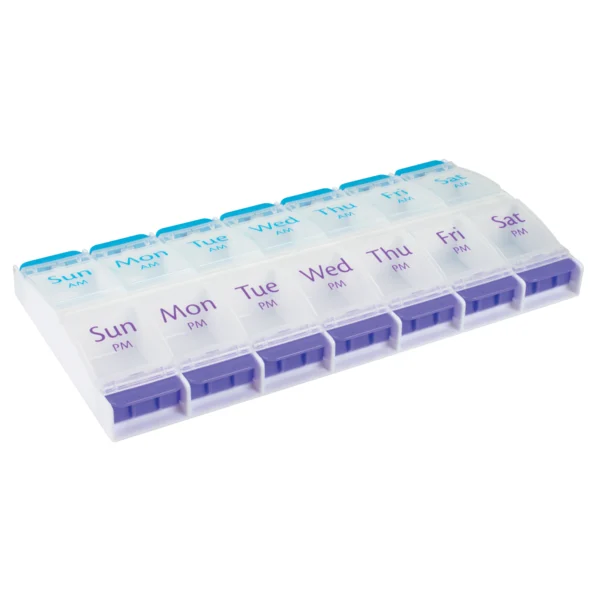
- Buy Ezy Dose Push Button Weekly AM/PM Pill Organizer (XL) Push-button lids that stay latched until you press them, XL compartments, and a real accessibility commendation, at the lowest price here. Amazon
- Buy Sagely SMART XL Weekly Pill Organizer Fourteen detachable pods on a magnetic base, so one day's dose goes in your bag instead of the whole week. Amazon
- It depends MedMinder Pill Dispenser A rented dispenser with lights, beeps, calls and texts, an optional locked unit, and caregiver alerts, which is either exactly right or wildly excessive.
- Skip Ezy Dose Portable Smart Pill Reminder A battery-powered Bluetooth carousel that charges more for an alarm your phone already has. Amazon
What actually matters
- Lid mechanism. This is the single feature that separates an organizer you keep from one that ends up in a drawer. Push-button catches, sliding locking bars, and gasketed screw or press caps all hold shut under pressure because something other than friction is doing the work. Thin hinged lids that clip over a molded lip disengage when a zip or a book presses on the edge, and the hinge loosens further with every open.
- Dose slots per day. Count the separate times each day you actually take something, then buy at least that many slots. Twice a day (usually printed as AM/PM) covers most people. Four-times-daily models exist and are wider, and they are worth the extra footprint if your schedule genuinely needs morning, noon, evening, and bedtime.
- Compartment capacity. Stated capacity is usually given in aspirin-sized tablets, which flatters the number. What matters is whether the compartment closes over your bulkiest item. Softgels and large mineral tablets are the ones that blow out capacity, so read any capacity figure quoted in softgels or capsules rather than the aspirin figure.
- Detachable day cases. Pods or pop-out day sections are a categorically different capability rather than a nicer version of the same box. If your doses go to work, to dinner, or on weekend trips, this is the feature that determines whether you take them. Check whether the detached piece keeps its own lid shut on its own, because some day cases rely on the base to stay closed.
- Opening force and one-handed use. Look for large buttons you can press with a knuckle, flexible lids that flex open instead of needing to be pried, non-slip feet so the box does not slide while you work one-handed, and the Arthritis Foundation Ease-of-Use Commendation, which is a real certification rather than a marketing claim.
- Visibility. Large, high-contrast day lettering and translucent lids let you see that a compartment is empty without opening it. That is literally how the organizer answers the question it exists to answer.
- Cleaning and drying. Powder and residue build up, and moisture is the enemy of most tablets. Wide-mouth compartments and removable pods dry properly. Fixed wells with tight corners trap water after a wash.
The specs, in plain English
Green flags vs red flags
Green flags
- A named lid mechanism in the listing: push-button, locking bar, or gasketed cap, rather than just the word 'secure'
- Capacity quoted for bulky items such as softgels or capsules, not only for aspirin-sized tablets
- Day sections that detach and keep their own lids closed once separated from the base
- The Arthritis Foundation Ease-of-Use Commendation, plus non-slip feet and large buttons
- Translucent lids with large, high-contrast day and AM/PM lettering
- Reminder features that are optional, so the box still works fine if you never install the app
Red flags
- Thin hinged flip-top lids with no separate catch, especially on very cheap multi-packs
- Owner reports describing the box opening in a bag or the lids loosening after a few months
- Listings that lead on colors, app screens, or 'smart' branding but never describe how the lid stays shut
- Battery-powered organizers where a flat battery is a silent failure, with no mechanical backup
- Dosage rings or subdivided wedges presented as extra capacity when they actually reduce usable volume per dose
- A recurring subscription or rental for reminders you would get free from an alarm on the phone you already carry
Who's who: the brands
- Ezy Dose - The mainstream pharmacy-aisle name, with a wide range from plain weekly boxes to push-button latching and XL capacity models, plus some battery-powered gadgets that are less convincing.
- Sagely - Known for detachable pod trays with flexible lids, aimed at people whose doses travel.
- MedMinder - Automatic dispensers offered as a rental, with lights, beeps, calls and texts, an optional locked unit, and caregiver alerts. A medical adherence device rather than an organizer.
- Hero Health - Countertop automatic dispensers aimed at complex multi-medication routines; check the maker's current terms.
- Apex / Acu-Life - Long-standing pharmacy accessory brands offering budget weekly boxes, pill splitters, and travel cases, with quality that varies model to model.
- Store and pharmacy own-brands - Cheap and widely available, usually plain hinged lids. Fine as a spare or a travel throwaway, weak on the one spec that matters most.
How to read a listing without getting fooled
Start by finding out how the lid stays shut, because listings rarely lead with it. If the description only says 'secure' or 'snap-tight' without naming a mechanism, assume a friction-held hinged lid. Photos help: look for a visible button, a sliding bar, or a separate cap. Next, translate the format code. Seven-day AM/PM means fourteen compartments, not seven, while a plain seven-day box is one dose time only. Treat capacity claims skeptically, since a figure like sixty tablets almost always refers to small aspirin-sized tablets, and the useful number is the one quoted for softgels or capsules. Check dimensions rather than adjectives, because XL-capacity boxes are genuinely large and some pod trays are over a foot long. If the listing advertises detachable sections, confirm that a detached piece stays closed on its own. Finally, discount 'smart' features when comparing prices. An onboard alarm or an app does not fix lid security, and a free recurring alarm on your phone travels with you and does not need a battery.
How much should you spend?
This is a category where the good answer is cheap. A well-latched weekly organizer from a mainstream brand costs a rounding error next to the medication going into it, and the jump from a bargain multi-pack to a push-button latching model with proper capacity is small in absolute terms while fixing the one failure that ruins the product. Spend a little more, not a lot, and spend it specifically on the latch, the compartment volume, and easy opening. Stepping up to a mid-range pod tray is worth it only for a real need, which is doses that leave the house with you, since that buys a capability rather than a finish. Paying a premium for onboard alarms and Bluetooth is usually poor value, because the reminder duplicates a free phone alarm while the electronics eat the space your pills need. The one genuinely expensive tier, rented or subscribed locking dispensers with caregiver alerts, carries an ongoing cost, so it is worth being certain the household actually has an adherence or safety problem before taking on a cost that does not end. Buying two inexpensive organizers, one for the nightstand and one that travels, is often better value than a single costly device.
Questions, answered
Is any of this medical advice?
No. This is general product information about storage containers, not medical advice. Follow your pharmacist or prescriber on how to store your medication, whether a tablet can be split, and how to schedule doses. Some medicines should not be removed from their original packaging at all: blister-packed drugs, moisture-sensitive or light-sensitive tablets, effervescent tablets, and some capsules can degrade once they are decanted into a plastic compartment. Ask your pharmacist before transferring anything into an organizer, and keep the original labelled container so you always have the dosing instructions and the expiry date.
Why do cheap pill organizers pop open in a bag?
Most budget organizers use a thin hinged lid held closed by friction from a small molded lip. Any flex in the box body, or pressure from a zip or a book on the lid edge, disengages that lip. The hinge is a wear point too, so after a few hundred openings it loosens and the lid stops seating firmly. Designs that use a separate mechanism to hold the lid shut, such as a push-button catch, a sliding locking bar, or a gasketed cap that seals rather than clips, do not depend on friction and do not fail this way.
How many dose slots per day should I buy?
Count the separate times each day you actually take something, then buy at least that many slots. Twice a day covers most people and is the most common format. Four-times-daily models are wider but worth it if your routine genuinely spans morning, noon, evening, and bedtime, because cramming four dose times into two compartments removes the at-a-glance answer you bought the box for. Also check stated capacity against the physically largest item you take, since fish oil, calcium, and magnesium fill a compartment far faster than a small tablet does.
Do I need detachable day cases?
Only if doses leave the house. If everything you take happens at home, a one-piece weekly box with good lids is simpler, cheaper, and usually holds more. If you work shifts, eat out often, or travel regularly, detachable pods change your behaviour rather than just your convenience, because carrying one day in a pocket is realistic and carrying a full weekly slab is not. Check that a detached pod holds its own lid shut, and if pods sit on a magnetic base, carry the pod rather than the whole tray.
Do I need a smart organizer or an automatic dispenser?
For most people a latching organizer plus a recurring alarm on the phone you already carry covers the same ground for far less. That alarm is louder, travels with you, and never needs a fresh battery, while battery-powered smart boxes shrink usable compartment volume to make room for electronics and still do nothing about lid security. Locking automatic dispensers are a separate case and earn their cost when someone is genuinely missing doses or taking them twice, or when a remote caregiver needs to know a dose was taken. Those units can keep compartments shut until the scheduled time (sometimes as an option) and combine lights, beeps, calls and texts, but they need a wall outlet, permanent counter space, setup, and usually a rental or subscription that keeps running. Be sure the adherence problem is real first, and ask the prescriber or pharmacist whether a simplified schedule or pharmacy-prepared blister packs would solve it without a device.
How do I keep pills from crumbling or picking up moisture?
Fill about a week ahead rather than a month, keep the organizer somewhere cool and dry rather than a bathroom or a windowsill, and let the compartments dry completely after washing before refilling. Powder and residue accumulate, so wipe the wells between fills. Removable pods and wide compartments are much easier to dry properly than fixed wells with tight corners. If a medicine is labelled moisture-sensitive, or comes in a blister pack or a bottle with a desiccant, leave it in its original packaging and ask your pharmacist how to manage it alongside the rest of your routine.
Or jump to the head-to-head: Ezy Dose Push Button Weekly AM/PM Pill Organizer (XL) vs Sagely SMART XL Weekly Pill Organizer.