

Health & Wellness
The Best Pill Organizers: 4 Compared (and One to Skip)
We compared four pill organizers and reminder cases on lid security, compartment capacity, detachable day cases, and arthritis-friendly opening.
The short version
Lid security is what separates a pill organizer that gets used from one that ends up in a drawer, because a box that pops open in a bag mixes the days and destroys the only thing it was meant to tell you. The Ezy Dose Push Button Weekly AM/PM Pill Organizer (XL) is the best pick for most people: every compartment stays latched until you press its button, capacity is the largest here, and it carries the Arthritis Foundation Ease-of-Use Commendation while costing very little. The Sagely SMART XL Weekly Pill Organizer is worth the step up if doses leave the house, since its fourteen pods detach individually and keep their lids shut in a bag. The MedMinder Pill Dispenser can lock compartments until dose time (as an option) and combines lights, beeps and caregiver phone calls, which is the right answer for genuine adherence problems and far too much appliance and ongoing rental cost for simple organization. The Ezy Dose Portable Smart Pill Reminder is the one to skip: it shrinks your usable capacity to fit electronics and charges a premium for an alarm your phone already gives you. Best for: buy the Ezy Dose push-button organizer for the nightstand, add the Sagely pods if your medication travels, and only consider a locking dispenser if someone is actually missing doses.
Our picks at a glance
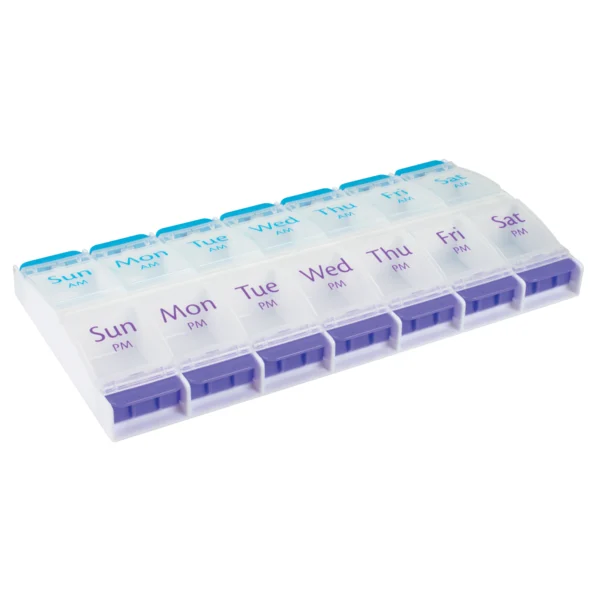
- Ezy Dose Push Button Weekly AM/PM Pill Organizer (XL) - Buy. Push-button lids that stay latched until you press them, XL compartments, and a real accessibility commendation, at the lowest price here.
- Sagely SMART XL Weekly Pill Organizer - Buy. Fourteen detachable pods on a magnetic base, so one day's dose goes in your bag instead of the whole week.
- MedMinder Pill Dispenser - It depends. A rented dispenser with lights, beeps, calls and texts, an optional locked unit, and caregiver alerts, which is either exactly right or wildly excessive.
- Ezy Dose Portable Smart Pill Reminder - Skip. A battery-powered Bluetooth carousel that charges more for an alarm your phone already has.
The verdict in 30 seconds
What mattered most
- Lid security
- Doses per day
- Compartment capacity
- Detaches for travel
- Arthritis-friendly opening
- Reminders
A pill organizer has one job: give you a reliable at-a-glance answer to whether you already took today's dose. The thing that breaks that job is a lid that pops open in a bag and mixes Tuesday into Friday, which is why lid security matters more than any other feature on the box. We looked at four current options across the range, from a budget weekly organizer to a locking subscription dispenser. Two are easy recommendations, one depends entirely on whether missed doses are a safety issue in your household, and one charges a premium for a reminder your phone already gives you free.
Push-button lids that stay latched until you press them, XL compartments, and a real accessibility commendation, at the lowest price here.
Best for: Almost anyone filling a week at home who wants secure lids and generous capacity without spending much
- Each compartment stays latched until its button is pressed, so lids do not spring open under pressure in a bag
- XL compartments are rated to hold up to 60 aspirin-sized tablets each, with plenty of room for large supplements
- Carries the Ease-of-Use Commendation from the Arthritis Foundation, and four silicone feet grip the counter for genuine one-handed opening
- Contoured scoop bottoms plus large bold lettering and translucent lids make it easy to see and retrieve a dose
- One-piece design, so you carry the whole week or transfer a dose into something else
- Two dose times a day only, so four-times-daily regimens need a different model
- Physically large, which is the cost of the capacity
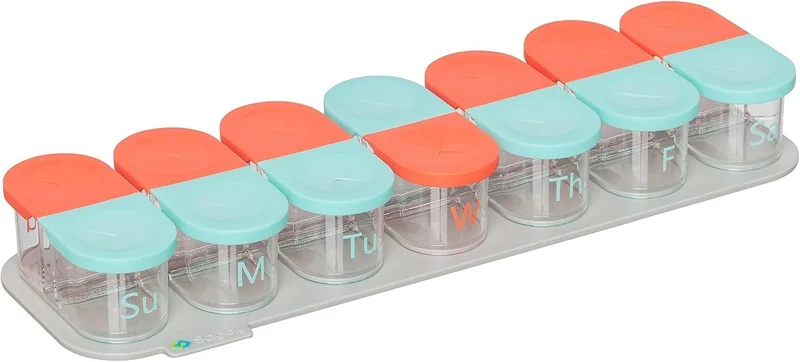
Fourteen detachable pods on a magnetic base, so one day's dose goes in your bag instead of the whole week.
Best for: People whose doses leave the house: shift workers, frequent travellers, and anyone who eats out often
- Pods pop off the base individually and keep their lids shut, so a single day travels in a pocket or bag
- Large pods that suit big supplements, though check the maker's stated capacity for your pills
- Flexible lids and a push-through loading design are meant to be easier on arthritic hands and cut down on misdrops while filling
- Can double as a 14-day organizer if you take pills once a day, and any reminder app is optional rather than required
- Pods hold to the base magnetically rather than locking, so carrying the whole tray loose in a bag can shake one free
- Long, so it takes real nightstand space
- Strongly coloured supplements such as turmeric may stain the lids
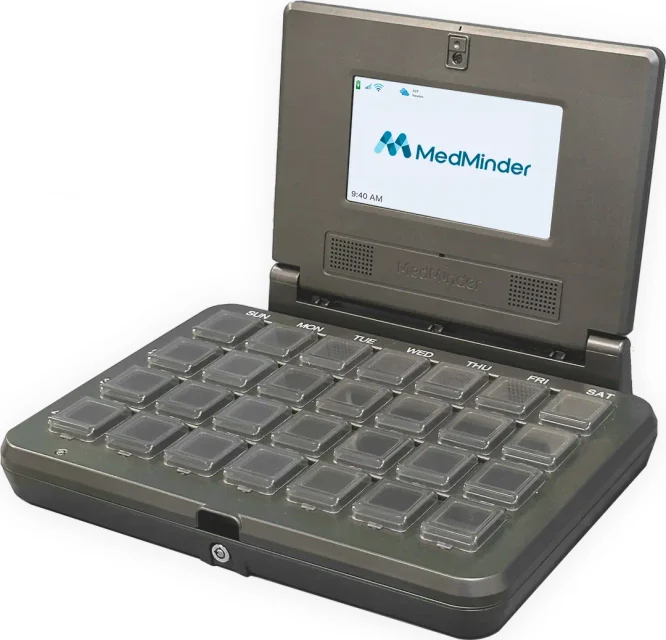
A rented dispenser with lights, beeps, calls and texts, an optional locked unit, and caregiver alerts, which is either exactly right or wildly excessive.
Best for: Households where someone is genuinely missing or doubling doses and a remote caregiver needs to know
- Compartments can lock until the scheduled dose time (MedMinder offers a locked unit as an option), which helps prevent double-dosing as well as missed doses
- Reminders combine flashing lights, beeps, phone calls, texts, and emails, and you or a caregiver choose which are active
- Large cups and compartments are easy to feel and remove, which helps with low vision or reduced dexterity
- Lights, beeps, and locking keep working on power alone if wireless coverage drops, with messaging resuming afterwards
- Offered as a rental, so you may never own it and the spending does not stop
- Needs a wall outlet and permanent counter space, and device-only renters set it up through an online portal
- The locking behaviour that makes it valuable for cognitive decline is an irritation for anyone who just wants tidier vitamins
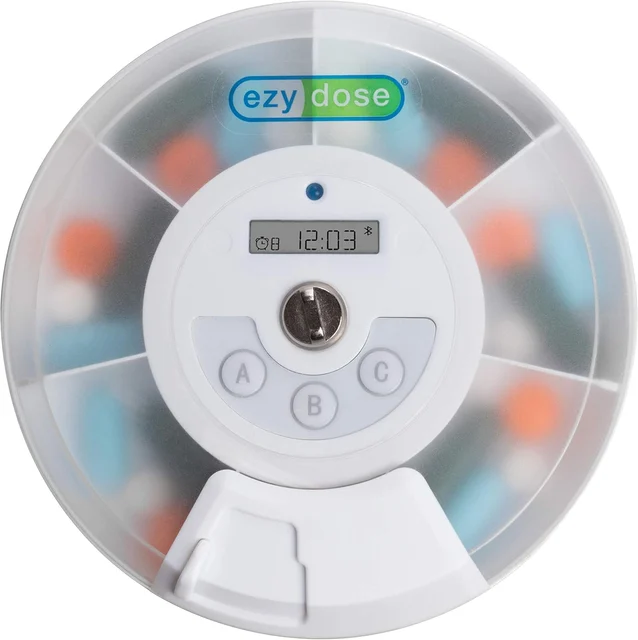
A battery-powered Bluetooth carousel that charges more for an alarm your phone already has.
Best for: Very few people. A latching organizer plus a recurring phone alarm covers the same ground for less
- Onboard alarm works without a phone if you want it to
- Bluetooth app lets you set schedules and track doses, and included dosage rings can subdivide compartments
- Seven wedge compartments on a disc likely give less usable volume than a conventional weekly box of similar footprint, and dosage rings shrink each dose further
- Runs on AAA batteries, so a flat battery is a silent failure a plastic box cannot have
- The rotating carousel design makes loading slower and means no day detaches for travel
- Costs more than a plain organizer without improving lid security, the thing that actually fails in this category
| Criteria | Ezy Dose Push Button Weekly AM/PM Pill Organizer (XL) Top pick | Sagely SMART XL Weekly Pill Organizer | MedMinder Pill Dispenser | Ezy Dose Portable Smart Pill Reminder |
|---|---|---|---|---|
| Verdict | Buy it | Buy it | It depends | Skip it |
| Best for | Almost anyone filling a week at home who wants secure lids and generous capacity without spending much | People whose doses leave the house: shift workers, frequent travellers, and anyone who eats out often | Households where someone is genuinely missing or doubling doses and a remote caregiver needs to know | Very few people. A latching organizer plus a recurring phone alarm covers the same ground for less |
| Price tier | $ · budget | $ · mid-range | $$ · flagship | $ · mid-range |
| Lid security | Push-button latch on every compartment, the most positive seal here | Flexible lids that stay shut on detached pods, pods held magnetically to the base | Compartments can lock until the scheduled dose time (optional locked unit) | Rotating carousel, no per-day latching |
| Doses per day | 2 (AM and PM) | 2 (AM and PM), or 1 a day across 14 days | Multiple per day | 1 a day, or more using the included dosage rings |
| Compartment capacity | XL, rated up to 60 aspirin-sized tablets per compartment | Large pods | Large cups, sized for a full multi-pill dose | Small wedges, reduced further if you use dosage rings |
| Detaches for travel | No, single piece | Yes, 14 individual pods pop off the base | No, it is a mains-powered countertop unit | No, the carousel is one sealed unit |
| Arthritis-friendly opening | Yes, Arthritis Foundation Ease-of-Use Commendation plus non-slip feet | Yes, flexible lids and push-through filling | Yes, large cups that are easy to feel and lift out | Mixed, small buttons and a fiddly rotating door |
| Reminders | None, use a phone alarm | Optional reminder app | Lights, beeps, phone calls, texts, and emails | Onboard alarm plus Bluetooth app |
| Ongoing cost | None | None | Rental for as long as you use it | AAA batteries |
| Price tier | $ · budget | $ · mid-range | $$ · flagship | $ · mid-range |
Which one is right for you?
- Almost anyone filling a week at home who wants secure lids and generous capacity without spending much Buy it Ezy Dose Push Button Weekly AM/PM Pill Organizer (XL)
- People whose doses leave the house: shift workers, frequent travellers, and anyone who eats out often Buy it Sagely SMART XL Weekly Pill Organizer
- Households where someone is genuinely missing or doubling doses and a remote caregiver needs to know It depends MedMinder Pill Dispenser
- Very few people. A latching organizer plus a recurring phone alarm covers the same ground for less Skip it Ezy Dose Portable Smart Pill Reminder
How we judged the field
We do not run a lab. What we do is read across manufacturer specifications, accessibility ratings, and the pattern of owner reports that build up over years of a product being on shelves, then weigh what actually decides whether a pill organizer gets used or abandoned.
Four things separate the good from the frustrating.
Lid security is the whole game. An organizer that pops open in a handbag, a backpack, or a suitcase does not simply spill pills. It mixes Tuesday into Friday, which destroys the one thing the organizer exists to give you: a reliable at-a-glance answer to “did I take it?” Cheap hinged lids are the most common failure point in the category. Owners commonly describe the same sequence: the box gets tossed into a bag, one lid catches on a zip or a seam, and the week is ruined. A lid that latches, seals, or locks is worth more than any other feature on the box.
Compartment size has to match the real regimen, not the marketing photo. Two dose slots a day is enough for most people. Four is what many older adults on multiple prescriptions actually need. Capacity matters just as much: fish oil, calcium, and large-format multivitamins fill a small compartment fast, and a box that technically has seven days of space but cannot close over a full day of pills is useless.
Detachability decides whether the organizer leaves the house. A one-piece weekly slab is fine on a nightstand and awkward everywhere else. Designs where the day sections pop off let you carry one day rather than the whole week, which is the difference between taking your evening dose out to dinner and skipping it.
Opening effort is an accessibility question. Arthritis, tremor, neuropathy, and reduced grip strength are common in the exact population that needs a weekly organizer most. Push-button and flexible-lid designs exist for this reason, and the Arthritis Foundation’s Ease-of-Use Commendation is a genuine, verifiable signal rather than a marketing badge.
We treated automatic dispensers as a separate class. They solve a different problem (a person who forgets doses entirely, or who should not have unsupervised access to a full week of medication) and they carry costs a plastic box never does: subscriptions, power, counter space, and setup.
This is the one to buy if you are buying one organizer and want it to keep working for years.
The design solves lid security without adding cost. Each compartment stays latched until you press a dedicated button, so the lid does not spring open from pressure on the outside of the box. That single detail is why this design survives a bag, and why owners tend to keep it long after the flip-lid boxes in the same drawer have been thrown out.
Capacity is the other reason it earns the pick. The XL compartments are rated to hold up to 60 aspirin-sized tablets each, which is generous headroom for anyone taking several prescriptions plus supplements at each of two daily doses. The compartments are contoured with a scoop bottom, so you can get the last capsule out with a fingertip instead of tipping the whole box over your palm.
Accessibility is not an afterthought here. The organizer carries the Ease-of-Use Commendation from the Arthritis Foundation, the buttons are large enough to press with a knuckle or the side of a thumb, and four silicone feet grip the counter so the box does not slide while you open it one-handed. The lettering is large and bold, and the lids are translucent, so you can see at a glance whether Thursday PM is still full.
The trade-offs are real but narrow. It is one piece, so you either carry the whole week or transfer a dose into something else. It handles two dose times a day, not four, so a complex four-times-daily regimen needs a different model in the same line. And it is physically large, which is the price of the capacity.
Buy this one if your medication has to travel with you.
The structure is different from a conventional weekly box: fourteen clear pods sit on a magnetized base, seven for AM and seven for PM. Pull a pod off the base and it goes in a pocket or a bag on its own, with its lid staying shut, which means you can take a single day out for a trip rather than carrying the whole week. Used the other way, if you take pills once a day, the same fourteen pods become a two-week organizer.
Capacity is a strength, with large pods that suit big supplements (check the maker’s stated capacity for your own pills). The whole tray is long, which is the honest cost of that capacity: it takes up more nightstand than a standard box.
The lids are flexible silicone-style caps that flex open rather than snapping, which is easier on arthritic hands than prying a rigid lid. Sagely also uses a push-through loading design: you press pills through an opening in the lid into the pod below, which cuts down on the misdrops that happen when you are filling fourteen small compartments in a row. Any reminder app is optional rather than a requirement for the box to function.
Two cautions. The pods hold to the base magnetically rather than locking to it, so if you carry the full tray loose in a bag rather than carrying individual pods, a pod can come away from the base. And strongly coloured supplements such as turmeric may stain the lids, which is worth knowing before you load them into a box you intend to keep for years.
This is not a competitor to a plastic organizer. It is a different intervention, and whether it makes sense depends entirely on whether missed or doubled doses are an actual safety problem in your household.
The device is a weekly tray of individual cups under a lid, with compartments that can lock until the scheduled dose time (MedMinder describes the locked unit as an option). Reminders combine flashing lights, beeps, phone calls, text messages, and emails, and you or a caregiver choose which are active. The compartments and cups are large and easy to feel, which matters for someone with low vision. Setup runs through an online portal, and the lights, beeps, and locking keep working on power alone even if wireless coverage drops, with the messaging features resuming when connectivity returns.
The reasons to hesitate are structural, not quality problems. It is offered as a rental, so you may never own it and the spending does not end. It needs a wall outlet and a permanent home on a surface. It is significantly more setup than filling a box on a Sunday evening. And the locking behaviour that makes it valuable for cognitive decline is an irritation for anyone who simply wants a tidier way to sort vitamins.
Buy it when a person is genuinely missing doses or double-dosing and a remote caregiver needs to know. Skip it if the problem is only organization, because a plastic box and a phone alarm cover that for a fraction of the ongoing cost.
This is the product that best illustrates why “smart” is not the same as “better”.
It is a round, battery-powered carousel about 5.7 inches across with seven wedge compartments, an onboard alarm, and Bluetooth pairing to a phone app. You rotate the carousel to bring one compartment to the access point. Included dosage rings let you subdivide compartments if you take pills more than once a day.
The problems compound. Seven wedges on a disc likely give you less usable volume than a standard weekly organizer of similar footprint, and subdividing them with rings shrinks each dose further, which is exactly backwards for the multi-pill regimens that most need a reminder. Loading it means rotating to each wedge in turn rather than opening a row of lids. It runs on AAA batteries, so a dead battery is a silent failure mode a plastic box does not have. The app adds a dependency on an app being maintained. And the central mechanism means it does not travel well: this is not a box you detach a day from.
Most of all, it costs more than a plain organizer to deliver a reminder that a free phone alarm already delivers, and it does not solve the actual failure this category suffers from. Buy a well-latched organizer and set a recurring alarm on the phone you already carry.
Ezy Dose Push Button Weekly AM/PM Pill Organizer (XL) vs Sagely SMART XL Weekly Pill Organizer: which should you buy?
These two are not really fighting over the same buyer, and once you see the split the choice gets easy.
The Ezy Dose is the better home organizer. Its push-button lids are the most positive latch of anything here at this price: nothing opens unless a button is pressed, which is precisely the failure mode that ruins weeks. The compartments are the largest of the two, the arthritis commendation is earned, and the silicone feet make it genuinely one-hand operable, which matters if you have use of only one hand or you fill it while holding something else. It is also by far the cheaper of the two, which means replacing it after a few years of daily opening costs almost nothing.
The Sagely is the better travelling organizer. Detachable pods are a categorically different capability, not a nicer version of the same thing. If you regularly eat out, work shifts, take weekend trips, or simply want your evening dose in your bag rather than the whole week, the pods change your behaviour in a way the Ezy Dose cannot. Capacity per pod is excellent, the flexible lids are kind to sore hands, and the push-through filling reduces mistakes.
Choose the Ezy Dose if the organizer will live on a counter or nightstand and lid security plus capacity are your priorities. Choose the Sagely if doses leave the house with you. If your budget stretches, owning both is not extravagant: the Ezy Dose as the weekly base, the Sagely pods for days you are out.
What to look for
- A latching, locking, or sealing lid. Push-buttons, locking bars, and gasketed caps all work. Plain hinged flip-tops are the design that fails, and no amount of capacity makes up for a box that empties itself into a bag.
- Enough dose slots for the real schedule. Count the times a day you actually take something, then buy that many slots. AM/PM covers most people; four-times-daily models exist and are worth the extra width if you need them.
- Compartment volume, not just compartment count. Check the stated capacity against the physically largest thing you take. Fish oil, calcium, and magnesium fill a compartment far faster than a small tablet does.
- Detachable day sections if the doses travel. Pods or pop-out day cases are the single feature that determines whether an organizer works outside the house.
- Genuine one-handed, low-force opening. Look for push-button or flexible-lid designs, non-slip feet, and the Arthritis Foundation Ease-of-Use Commendation, which is a real certification rather than a claim.
- Large, high-contrast labelling and translucent lids. Being able to see that a compartment is empty without opening it is how an organizer answers “did I take it?”
- Reminders you will actually notice. A phone alarm is free, loud, and travels with you. Pay for onboard alarms or locking only when a person genuinely cannot self-manage.
- A design you can clean and dry properly. Powder residue and moisture build up. Removable pods and wide-mouth compartments are far easier to keep dry than fixed wells with tight corners.
Our final take
Lid security is the axis this whole category turns on, and it is the axis the cheapest products ignore. The Ezy Dose Push Button Weekly AM/PM Pill Organizer (XL) is the best answer for most people because it fixes that problem with a mechanism rather than a promise, adds the largest compartments here, and does it at a price where buying the wrong one costs you almost nothing. The Sagely SMART XL Weekly Pill Organizer wins for anyone whose medication travels, because detachable pods change what you can do rather than just how it feels.
The MedMinder Pill Dispenser belongs in a different conversation. It is the right call when missed doses are a safety issue and a caregiver needs visibility, and it is an expensive rented appliance when the problem is only tidiness. Be clear about which situation you are in before you commit to an ongoing cost.
The Ezy Dose Portable Smart Pill Reminder is the one to leave on the shelf. It charges a premium for an alarm your phone already has, shrinks your usable capacity to make room for the electronics, and adds a battery you can forget to change. Spend the difference on a well-latched organizer and set a recurring alarm.
Questions, answered
Is any of this medical advice?
No. This is general product information about storage containers, not medical advice. Follow your pharmacist or prescriber on how to store your medication, whether a tablet can be split, and how to schedule doses. Some medicines should not be removed from their original packaging at all: blister-packed drugs, moisture-sensitive or light-sensitive tablets, effervescent tablets, and some capsules can degrade once they are decanted into a plastic compartment. Ask your pharmacist before transferring anything into an organizer, and keep the original labelled container so you always have the dosing instructions and expiry date.
Why do cheap pill organizers pop open in a bag?
Most budget organizers use a thin hinged lid that is held closed by friction from a small moulded lip. Any flex in the box body, any pressure from a zip or a book pressing on the lid edge, and that lip disengages. The hinge itself is also a wear point: after a few hundred openings it loosens and the lid no longer seats firmly. Designs that use a separate mechanism to hold the lid shut, a push-button catch, a sliding locking bar, or a gasketed cap that seals rather than clips, do not depend on friction and do not fail this way.
Do I need an automatic dispenser with alarms, or is a plain organizer enough?
For most people a plain organizer plus a recurring alarm on the phone they already carry is enough, and it costs nothing extra. Automatic dispensers earn their keep in a narrower case: when a person is genuinely missing doses or taking them twice because of memory problems, when unsupervised access to a full week of medication is a risk, or when a caregiver living elsewhere needs to know a dose was actually taken. Those devices usually carry a subscription or rental, need mains power, and take up permanent counter space, so it is worth being clear that you have the problem before you take on the cost.
How many dose slots per day should I buy?
Count the separate times each day you actually take something, then buy at least that many slots. Twice a day covers most people and is the most common format. Four times a day models exist and are worth the extra width if your schedule genuinely needs morning, noon, evening, and bedtime, because trying to squeeze four dose times into two compartments defeats the point. Also check the stated capacity against the physically largest item you take, since fish oil, calcium, and magnesium fill a compartment far faster than a small tablet does.
How do I keep pills from crumbling or picking up moisture in an organizer?
Fill only about a week ahead rather than a month, keep the organizer somewhere cool and dry rather than a bathroom or a windowsill, and let the compartments dry completely after washing before you refill them. Powder and residue build up over time, so wipe the wells out between fills. Designs with removable pods or wide compartments are much easier to dry properly than fixed wells with tight corners. If a medicine is specifically labelled as moisture-sensitive or comes in a blister pack or a bottle with a desiccant, leave it in its original packaging and ask your pharmacist how to manage it alongside the rest of your routine.
Deciding between the top two? See our head-to-head: Ezy Dose Push Button Weekly AM/PM Pill Organizer (XL) vs Sagely SMART XL Weekly Pill Organizer.
More Health & Wellness reviews
 The Best Bed Pillows: 4 Compared (and One to Skip)
  The Best Posture Correctors: 4 Compared (and One to Skip)
  The Best Pulse Oximeters: 4 Compared (and One to Skip)
  The Best Radon Detectors: 4 Compared (and One to Skip)
  The Best Reading Glasses: 4 Compared (and One to Skip)
  The Best At-Home Red Light Therapy Devices: 4 Compared (and One to Skip)