Explained
OTC Hearing Aids, Explained
After reading this you will understand how over-the-counter hearing aids are fitted, which specs actually change your day-to-day experience, and how to match a device to how and where you listen.
In this guide
Over-the-counter (OTC) hearing aids let adults with perceived mild-to-moderate hearing loss buy and set up a device themselves, without a clinic visit or prescription. The category has grown fast since it became FDA-regulated, which means a lot of new brands, features, and marketing claims to sort through. Most first-time buyers get tripped up by two things: how the device is fitted to their hearing (a real self-guided check versus fixed presets), and whether it streams phone calls and media over Bluetooth.
The 30-second version
- Fitting method matters more than the feature list. A device that shapes sound to your own hearing profile will outperform a one-size-fits-all preset gadget, even if the spec sheet looks similar.
- Speech in noise is the real test. Almost anything amplifies sound in a quiet room; the gap between good and bad devices shows up in restaurants, groups, and busy rooms.
- Decide up front whether you need Bluetooth. Some of the most discreet in-canal models drop streaming entirely, so if you take a lot of calls that is a dealbreaker to know before you buy.
- OTC is for adults 18+ with mild-to-moderate loss. If your loss is severe, sudden, one-sided, or unclear, an OTC device is the wrong starting point and a hearing professional is the right one.
- Use the trial window on purpose. Hearing aids take days or weeks of real-world wear to judge, so a return period is part of the product, not a formality.
The products this guide is about
Our verdict on each, with the full reasoning on the companion review.
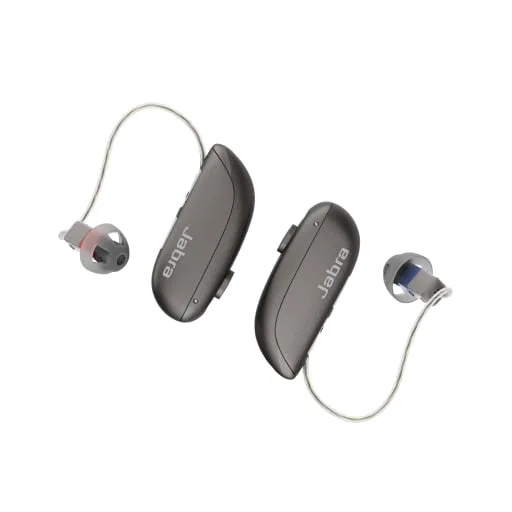
- Buy Jabra Enhance Select M3 The closest an OTC device gets to the clinic experience, with 3 years of audiology services built in. Amazon
- Buy ELEHEAR Beyond Surprisingly capable tech at a fraction of the flagship price. Amazon
- It depends Sony CRE-C20 Nearly invisible and long-lasting, but you give up Bluetooth to get there.
- Skip Audien Atom Pro 2 Cheap and comfortable, but too basic to recommend over stronger value picks. Amazon
What actually matters
- Fitting method - whether the device runs an app-based hearing check (or adds remote professional tuning) versus relying on fixed presets. This is the single biggest driver of how natural and useful the aid sounds for your specific loss.
- Speech-in-noise performance - how clearly you can follow a conversation when there is background chatter. This is where cheap devices fall apart and where better ones earn their price.
- Bluetooth streaming - whether calls and media play directly through the aids. Convenient and clarifying for phone-heavy users, but omitted on some discreet models.
- Form factor and discretion - behind-the-ear (with a thin wire into the canal) versus fully in-canal. This is a trade-off between visibility, comfort, and often battery and features.
- Battery and charging - rechargeable versus disposable batteries, and how long a charge really lasts, especially if you stream audio for hours a day.
- Durability rating - an IP rating that tells you how well the device shrugs off sweat, moisture, and dust.
- Post-purchase support - whether you are on your own with an app or can get help from a hearing professional after the sale if the fit is not right.
The specs, in plain English
Green flags vs red flags
Green flags
- The device runs a real in-app hearing check and lets you adjust settings later, not just pick a preset
- The brand offers a clearly stated trial period and return window
- Owner reports specifically praise its clarity in noisy settings, not just in quiet
- There is a real support path after purchase (app support, and ideally access to hearing professionals)
- The spec sheet matches your priorities: streaming if you take calls, or an in-canal design if invisibility is your goal
- A published IP rating and rechargeable battery with realistic stated runtime
Red flags
- It is sold as a 'sound amplifier' or 'PSAP' rather than a regulated OTC hearing aid, with no way to tune it to your hearing
- Only fixed presets, with no in-app hearing test or personalization
- No stated trial period, return policy, or warranty
- Marketing leans on vague claims ('crystal clear', 'military grade') with nothing specific about speech-in-noise performance
- No published battery runtime, or runtime that collapses once you stream audio
- Claims it can treat severe hearing loss or is suitable for children
Who's who: the brands
- Jabra Enhance - Online-care brand that pairs self-fit devices with remote follow-up from hearing professionals.
- Sony - Consumer-electronics maker focused on very discreet, in-canal OTC designs, sometimes trading away Bluetooth for size.
- ELEHEAR - Value-focused newcomer offering app-based self-fitting and Bluetooth streaming at prices well below the flagships.
- Audien - Budget brand built around very low prices and tiny, comfortable devices, with simpler features and little app-based personalization on some models.
- Sennheiser / Sonova (Sontro) - Audio and hearing specialists with OTC aids; check each model's current availability and specifications.
- Jabra / GN, Eargo - Established hearing-industry names; check each model's current availability and specifications.
How to read a listing without getting fooled
Start by confirming the listing actually says 'OTC hearing aid', not 'personal sound amplifier' or 'PSAP', which are unregulated and cannot be tuned to your hearing. Next, look for how it is fitted: a product that mentions an in-app hearing test or professional tuning is personalizing sound to you, while one that only lists 'modes' or 'presets' is not. Treat glossy phrases like 'AI noise reduction' or 'crystal-clear sound' as marketing until you see specifics, especially about performance in noise. Check three concrete things that are easy to verify: whether Bluetooth streaming is included, the stated battery life (and whether that number assumes streaming), and the IP rating. Finally, read the fine print on the trial period, return window, and warranty, because those terms vary a lot by brand and seller and are the safety net that makes a self-fit purchase low-risk.
How much should you spend?
Think of OTC hearing aids as a ladder rather than a single price. At the bottom are bare-bones devices that amplify sound with little or no personalization; they are tempting on cost but often a false economy, because weak performance in noise is exactly the problem most people are trying to solve. The middle of the range is where the value tends to sit: capable self-fitting devices that include Bluetooth streaming and adjustable noise handling for far less than the flagships. At the top are premium and professionally supported models that add the best speech-in-noise performance and real human follow-up after the sale, which is worth paying for if you are often in demanding listening situations or want the reassurance of expert help. In this category, stepping up even slightly from the cheapest option usually buys a meaningful jump in clarity and support, so let how and where you listen, not just the sticker, decide how far up the ladder you go.
Questions, answered
Are OTC hearing aids right for my hearing loss?
This is general information, not medical advice, so see a hearing professional or audiologist before deciding. OTC hearing aids are intended for adults 18 and older with perceived mild-to-moderate hearing loss. They are not appropriate for children or for severe loss, and if you have ear pain, drainage, sudden or one-sided loss, or ringing, you should get a professional evaluation rather than self-treating.
What is the difference between OTC hearing aids and cheap 'sound amplifiers'?
OTC hearing aids are FDA-regulated devices designed to compensate for hearing loss and can be tuned to your hearing. Personal sound amplifiers (PSAPs) simply make everything louder and are meant for people with normal hearing in specific situations, like birdwatching. If a product cannot be adjusted to your hearing profile, it is not really doing the job of a hearing aid.
Do I really need Bluetooth streaming?
It depends on how you listen. If you take a lot of phone calls or watch a lot of video, streaming audio straight into the aids is a genuine daily benefit and worth prioritizing. If your main goal is following conversations in person and you care most about a device being invisible, a discreet in-canal model without Bluetooth can be the better fit.
Why is self-fitting such a big deal?
Hearing loss is not the same at every pitch, and it differs from person to person. A self-fitting device uses an app-based hearing check to raise the right frequencies for you, which sounds far more natural than a preset that boosts everything equally. Preset-only devices are simpler and cheaper but tend to be a coarser match to your actual hearing.
How long before I know if a device works for me?
Give it real time. Your brain needs days to weeks to adjust to amplified sound, so first impressions can be misleading in either direction. This is exactly why the trial period matters: wear the aids in the situations you actually struggle with, tweak the settings, and confirm the return window and warranty before you buy so you can send them back if they are not right.
Or jump to the head-to-head: Jabra Enhance Select M3 vs ELEHEAR Beyond.