Explained
Fish Spatulas, Explained
After reading, you'll understand why a fish spatula is shaped the way it is, which words on a product page are real claims, and when a silicone head is the right answer instead.
In this guide
First-time buyers usually shop this category on size and looks, which is the one approach that cannot work. Two turners can have identical published dimensions and behave completely differently, because the number that decides everything, the thickness of the front edge, is almost never printed. The second trap is assuming premium means low maintenance: some of the most expensive tools here are hand wash only while commercial ones are dishwasher rated. The third is buying steel for a kitchen full of nonstick pans without reading the maker's own warning about it.
The 30-second version
- The edge is the product, and everything else on the spec sheet is secondary to how thin the front of the blade is.
- Flex is a claim, not a given, so look for the maker to actually say the blade flexes rather than assuming it from the shape.
- Slots do two jobs, draining fat and breaking the suction that forms under a solid blade against wet food.
- Offset buys knuckle clearance, which is why the handle sits above the plane of the blade instead of level with it.
- Silicone is a trade, not an upgrade, since a moulded polymer edge protects coatings but can never be ground as thin as steel.
The products this guide is about
Our verdict on each, with the full reasoning on the companion review.
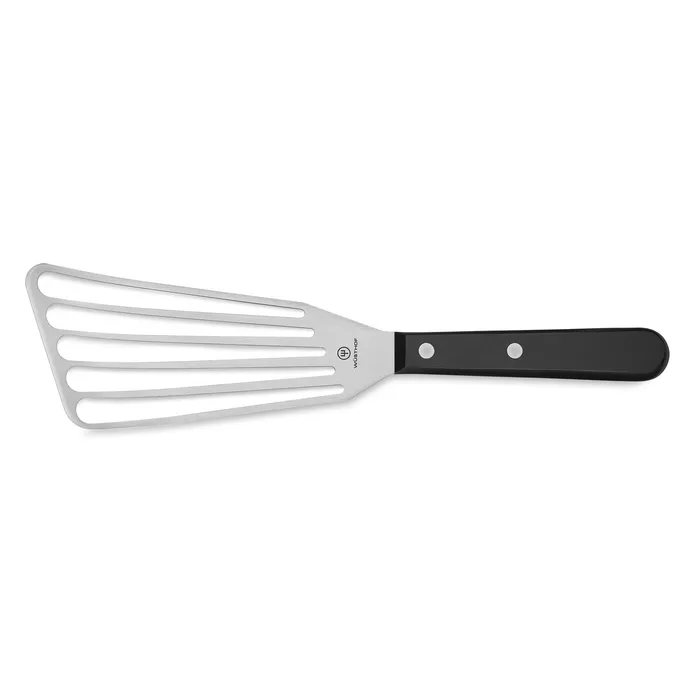
- Buy Wüsthof 7" Slotted Fish Spatula The one in this group whose maker actually promises an ultra-thin, flexible blade, with a slight upward curve at the tip that makes lifting feel controlled.
- Buy Winco TKP-60 Fish Spatula A commercial-kitchen fish spatula with a 6-3/4 by 3-1/4 inch satin stainless blade and a moulded polypropylene handle, NSF listed and dishwasher safe. Amazon
- It depends OXO Steel Silicone Flexible Turner A silicone-headed flexible turner that OXO says will not scratch nonstick, which is exactly right for a nonstick-only kitchen and exactly wrong if you want the thinnest possible edge. Amazon
- Skip Victorinox BBQ Accessories Slotted Fish Turner (7.6259.26-X1) A barbecue utensil wearing a fish turner's name: the page sells the vented cool-touch handle, and never once claims the blade is thin or flexible.
What actually matters
- Leading edge thickness - this is the wedge that separates food from pan, and a thick front edge will push a fillet instead of getting under it. It is the defining feature of the category and the one makers are least likely to quantify.
- Blade flex - a blade that bends follows the curve of a skillet and stays in contact across the whole piece of food. A stiff blade lifts from one corner and the food folds or breaks at the far edge.
- Slot pattern - slots let rendered fat and liquid drain away and stop a vacuum forming between blade and food. The angle they are cut at affects how cleanly food releases as you tilt the blade to plate it.
- Offset - the step between handle and blade sets how far your knuckles sit above a hot pan rim and whether the blade can lie flat while your wrist stays neutral. It is rarely published, so judge it from a side-on photo.
- Blade material - stainless takes the most heat and holds the thinnest edge, but it will scratch nonstick coatings. Silicone and nylon protect coatings at the cost of a thicker, less capable edge.
- Handle attachment and material - riveted, welded, and moulded handles all exist, and the material sets the heat ceiling. A polymer handle with no published temperature rating is a stovetop tool, not a grill tool.
- Stated care and heat limits - dishwasher guidance varies by brand rather than by price, and any composite or silicone part should carry a temperature limit before you use it near high heat.
The specs, in plain English
Green flags vs red flags
Green flags
- The maker's own copy uses a word like thin, ultra-thin, tapered, or bevelled about the leading edge.
- The blade is described as flexible, not just slotted.
- A side-on photo shows a clear offset between the handle and the plane of the blade.
- The page publishes blade length and width separately from overall length, so you know the actual working surface.
- Care instructions are explicit, including a temperature limit for any silicone or composite part.
Red flags
- The listing describes only size, finish, and handle colour, and never mentions the edge.
- It is sold from a barbecue or grill line and the headline feature is the handle rather than the blade.
- The published weight is high for the size, which points to a heavier, stiffer sheet.
- A silicone or nylon head is marketed as equivalent to steel rather than as a coating-safe alternative.
- The same page contradicts itself on material or country of origin.
Who's who: the brands
- Wüsthof - German cutlery house from Solingen whose slotted fish spatula is one of the few that explicitly claims an ultra-thin, flexible blade.
- Winco - Foodservice supplier whose fish spatulas are built for commercial kitchens, published by blade size and usually NSF listed and dishwasher safe.
- OXO - Consumer housewares brand that sells both a bevelled stainless fish turner and silicone-headed flexible turners for nonstick pans.
- Victorinox - Swiss cutlery maker best known for knives, with turners currently sold through its BBQ accessories line and a vented cool-touch handle.
- Made In - Direct-to-consumer cookware brand whose fish spatula is 304 stainless with a moulded POM handle and published outside dimensions.
How to read a listing without getting fooled
Start by separating the numbers that are published from the ones that are not. Most listings give you overall length, blade length and width, and sometimes weight, and almost none give you edge thickness, blade gauge, or offset. That means the useful reading is verbal: look for the maker to make an explicit claim about the edge and about flex, and treat silence as a no. Then check the material line and the care line together, because they interact. A steel blade with a warning about nonstick tells you the maker knows the edge is hard and thin. A silicone head marketed as safe on all cookware tells you the opposite trade has been made. Finally, look at the side-on photograph rather than the hero shot: it is the only place you will reliably see the offset and the slot angle, and the only way to judge how gradually the blade tapers toward the front.
How much should you spend?
Budget tier gets you the correct shape from foodservice suppliers, usually with published blade dimensions, an NSF listing, a moulded polymer handle, and a dishwasher rating. It is a genuinely good place to shop in this category, because the geometry is conventional and the makers are selling to people who use these all day. Mid-range buys consumer-brand construction, cushioned handles, and better published care guidance, plus most of the silicone and nylon options for nonstick pans. Premium tier gets you a named cutlery house, a stated country of origin, and, on the best examples, an explicit written claim about how thin and flexible the blade is. That claim is the only thing premium reliably buys here, and it is worth paying for only if you cook delicate food often. Nothing at any tier reliably tells you the edge thickness in a number.
Questions, answered
Does a fish spatula only work for fish?
No, and most owners end up using it for everything else. Anything that tears or sticks benefits: fried eggs, pancakes, crab cakes, latkes, roasted vegetables coming off a sheet pan, smash burgers where you want to scrape up the crust. The combination of a thin front edge and a flexible blade is useful any time you need to get under something without breaking it. The name comes from the hardest version of the job, not the only one.
Left-handed or right-handed, does it matter?
Sometimes. Many fish spatulas have an asymmetric blade, with a longer leading corner on one side so you can enter the pan at an angle and sweep across. On those, using it in the other hand means entering with the trailing corner first, which is less comfortable. Symmetrical designs exist and are hand-neutral. Look at the head shape in the product photo before you buy if you are left-handed.
How do I stop the edge from scratching my pans?
If the pan is nonstick or ceramic, you cannot fully, and the maker will usually tell you so. Wüsthof warns that its stainless blade should be used with care on nonstick surfaces to avoid damaging the coating. Practical mitigation is to slide in flat rather than stab at an angle, and to avoid dragging the edge sideways across the coating. If you want a real answer, keep a silicone or nylon turner for the coated pans and the steel one for stainless, carbon steel, and cast iron.
Are wooden handles worth avoiding?
Not avoiding, but they change the care instructions. Wood handles are common on foodservice turners and comfortable in the hand, but they generally should not go through a dishwasher, where heat and water will dry them out and loosen the fit. Moulded polymer handles are the usual dishwasher-safe choice, and some are rated for high heat. Decide based on how you actually wash things, because that is where wooden handles fail rather than in use.
Or jump to the head-to-head: Wüsthof 7" Slotted Fish Spatula vs Winco TKP-60 Fish Spatula.