

Home & Kitchen
The Best Fish Spatulas: 4 Compared (and One to Skip)
We compared four slotted flexible turners on the things that actually decide whether a fillet survives the flip: how thin the leading edge is, how much the blade flexes, how the slots are cut, and what the maker says about nonstick and heat.
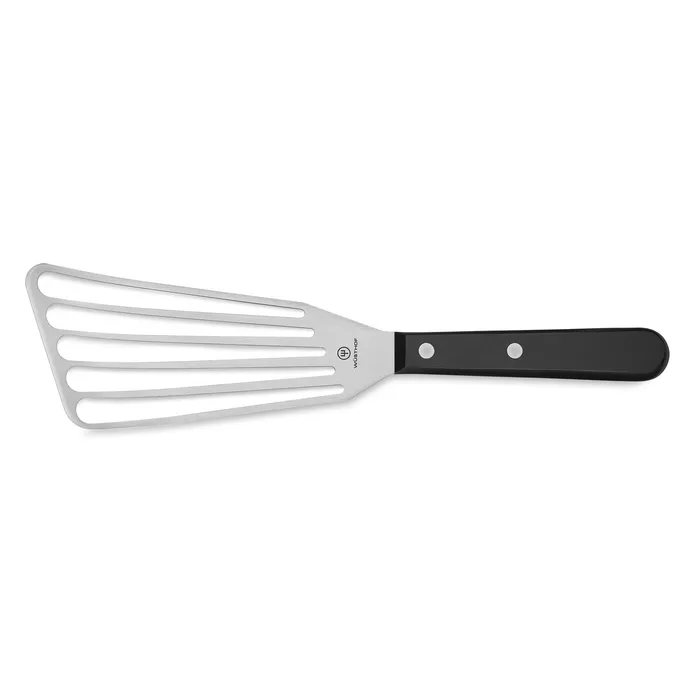
The short version
The Wüsthof 7 inch Slotted Fish Spatula is our overall pick, because it is the one in this group whose maker explicitly claims an ultra-thin, flexible stainless blade and a slotted head that drains fat, plus a subtle upward curve mentioned in the product details. The catch is that Wüsthof's own product Q&A says its knives and tools should be hand washed, never put in the dishwasher. The Winco TKP-60 is the value pick: a 6-3/4 by 3-1/4 inch satin stainless blade on a moulded polypropylene handle, NSF listed and dishwasher safe, sold into commercial kitchens where nobody is precious about a turner. The OXO Steel Silicone Flexible Turner is the depends pick, and it is the right answer only if your pans are all nonstick, because a silicone head cannot be ground as thin as steel. We would skip the Victorinox BBQ Accessories Slotted Fish Turner: it is a barbecue tool whose page sells the vented handle rather than the blade, and at a listed 6.4 ounces it is on the heavy side for this job. Best for: anyone who cooks fish, eggs, or anything else that tears when you push it.
Our picks at a glance
- Wüsthof 7" Slotted Fish Spatula - Buy. The one in this group whose maker actually promises an ultra-thin, flexible blade, with a slight upward curve at the tip that makes lifting feel controlled.
- Winco TKP-60 Fish Spatula - Buy. A commercial-kitchen fish spatula with a 6-3/4 by 3-1/4 inch satin stainless blade and a moulded polypropylene handle, NSF listed and dishwasher safe.
- OXO Steel Silicone Flexible Turner - It depends. A silicone-headed flexible turner that OXO says will not scratch nonstick, which is exactly right for a nonstick-only kitchen and exactly wrong if you want the thinnest possible edge.
- Victorinox BBQ Accessories Slotted Fish Turner (7.6259.26-X1) - Skip. A barbecue utensil wearing a fish turner's name: the page sells the vented cool-touch handle, and never once claims the blade is thin or flexible.
The verdict in 30 seconds
What mattered most
- Blade material
- Published size
- Edge described as thin or bevelled
- Flex claim
- Slots
- Listed weight
A fish spatula is a slotted, flexible turner with a thin bevelled front edge, and every part of that description is doing a job. The edge is the wedge that gets under a piece of fish without shearing it off the pan. The flex lets the blade follow the curve of the pan and the shape of the food instead of fighting both. The slots cut suction and let fat fall away so the food releases cleanly. We looked at what four manufacturers actually publish about those features, and picked the field from what is on their own product pages rather than what the marketing photos imply.
The one in this group whose maker actually promises an ultra-thin, flexible blade, with a slight upward curve at the tip that makes lifting feel controlled.
Best for: Someone who sears fish, eggs, and delicate vegetables often enough that a genuinely thin, flexible blade earns its keep, and who does not mind hand washing.
- Wüsthof describes the blade as ultra-thin and flexible, which is the single feature that separates a fish spatula from a general turner.
- The slotted head is described as draining excess fat and liquid, and the product details mention a subtle upward curve at the tip.
- Part of Wüsthof's Gourmet line, with a 4.9 inch handle.
- Wüsthof's own product Q&A says its knives and tools should always be hand washed and never go in the dishwasher.
- Wüsthof warns that the stainless blade should be used with care on nonstick surfaces to avoid damaging the coating.
- The product page publishes a handle length of 4.9 inches but no blade thickness or weight figure, so you are trusting the word ultra-thin. Its origin is also unclear: the specs say Germany but the page Q&A says China.
- Premium tier for a utensil, which is a lot to spend if you cook fish twice a year.
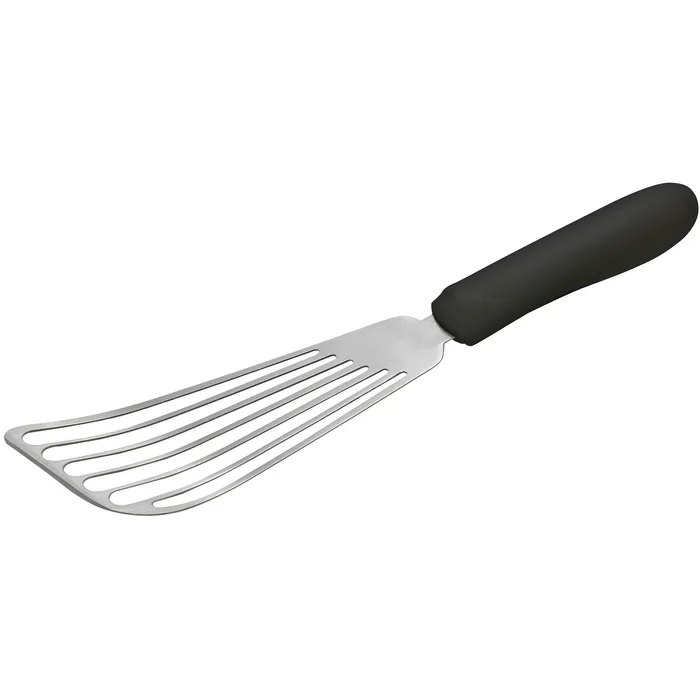
A commercial-kitchen fish spatula with a 6-3/4 by 3-1/4 inch satin stainless blade and a moulded polypropylene handle, NSF listed and dishwasher safe.
Best for: Anyone who wants the real tool shape without the premium, and who would rather put a turner in the dishwasher than baby it.
- Winco publishes the blade size, 6-3/4 by 3-1/4 inches, which is a generous working surface for a whole fillet.
- Stated as dishwasher safe and NSF listed, so it is built for a kitchen that runs it through a machine every night.
- Budget tier, which makes it easy to own two or to keep one for the grill.
- The product page does not state blade thickness, flex, or an offset figure, so you are buying on the category convention rather than a spec.
- The moulded polypropylene handle has no published heat rating, so treat it as a stovetop tool rather than a grill tool.
- Satin stainless will scratch nonstick coatings, and Winco gives no guidance either way.
- Foodservice styling: functional, not something you display on a rail.
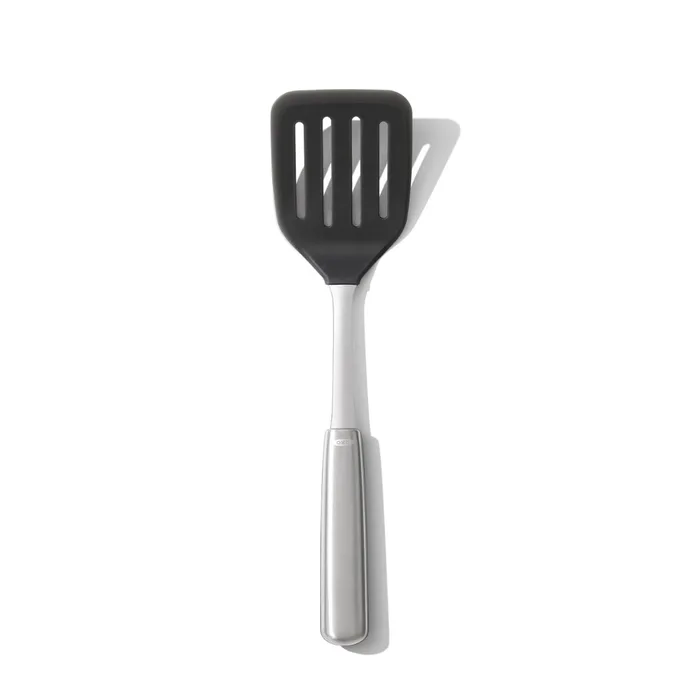
A silicone-headed flexible turner that OXO says will not scratch nonstick, which is exactly right for a nonstick-only kitchen and exactly wrong if you want the thinnest possible edge.
Best for: A kitchen where every pan is nonstick or ceramic and protecting the coating matters more than getting under a fillet by the last half millimetre.
- OXO states the heat-safe silicone head is safe with all cookware and will not scratch nonstick surfaces.
- Described as flexible enough to slide under fragile foods such as eggs, pancakes, and crepes, but strong enough to carry them to the plate.
- Stated as dishwasher safe, with a shaped handle and non-slip touchpoints.
- A silicone edge is necessarily thicker than a ground steel one, so it gives up the main advantage a fish spatula has over an ordinary turner.
- OXO's page for it does not publish a temperature limit for the silicone, which matters if you cook hot.
- No published blade dimensions, and the page does not describe it as slotted, so treat it as a flexible turner rather than a true fish spatula.
- If you own carbon steel, cast iron, or stainless pans, you are paying for a restriction you do not need.
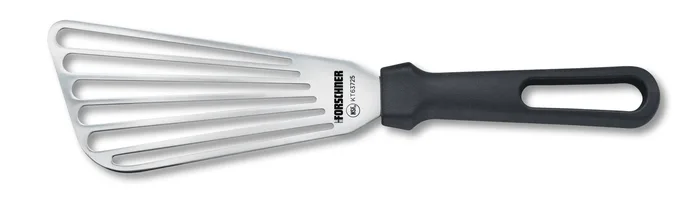
A barbecue utensil wearing a fish turner's name: the page sells the vented cool-touch handle, and never once claims the blade is thin or flexible.
Best for: Someone who specifically wants a grill utensil with a heat-tolerant vented handle and is not counting on it to lift a delicate fillet.
- The handle is described as self-ventilating and able to withstand 450 degrees Fahrenheit, which is a real advantage over a grill.
- Victorinox lists it as dishwasher safe and NSF certified, and covers it under their lifetime warranty.
- Listed at 6.5 inches long and 3 inches wide, so the head is a sensible size.
- Victorinox's product page states no blade thickness and never describes the blade as thin or flexible, which is the feature the category exists for.
- It is listed at 6.4 ounces, and the Wüsthof page publishes no weight to compare it with, but heft is not what you want in a tool meant to bend.
- The page is written entirely around barbecuing, and the headline feature is the handle rather than the edge.
- The key features call it a Swiss made stainless steel spatula while the details block lists the country of origin as Taiwan and the material as polyamide, which is confusing on a page you are meant to buy from.
Amazon had no buyable listing for this when we last checked. The link still works if it returns.
Check price on Amazon Read our detailed assessment| Criteria | 7" Slotted Fish Spatula Top pick | TKP-60 Fish Spatula | OXO Steel Silicone Flexible Turner | BBQ Accessories Slotted Fish Turner (7.6259.26-X1) |
|---|---|---|---|---|
| Verdict | Buy it | Buy it | It depends | Skip it |
| Best for | Someone who sears fish, eggs, and delicate vegetables often enough that a genuinely thin, flexible blade earns its keep, and who does not mind hand washing. | Anyone who wants the real tool shape without the premium, and who would rather put a turner in the dishwasher than baby it. | A kitchen where every pan is nonstick or ceramic and protecting the coating matters more than getting under a fillet by the last half millimetre. | Someone who specifically wants a grill utensil with a heat-tolerant vented handle and is not counting on it to lift a delicate fillet. |
| Price tier | $$$ · premium | $ · budget | $$ · mid-range | $$ · mid-range |
| Blade material | Stainless steel | Stainless steel, satin finish | Silicone head | Stainless steel head, polyamide listed as material |
| Published size | 7 in in the product name, handle 4.9 in | Blade 6-3/4 in x 3-1/4 in | Not published | Length 6.5 in, width 3 in |
| Edge described as thin or bevelled | Yes, ultra-thin | Not stated | Not stated | Not stated |
| Flex claim | Flexible, with upward curve at tip | Not stated | Flexible enough for fragile foods | Not stated |
| Slots | Slotted, drains fat and liquid | Not stated on the page | Not stated | Slotted, per the product name |
| Listed weight | Not published | Not published | Not published | 6.4 oz |
| Dishwasher guidance | Hand wash only, per maker Q&A | Dishwasher safe | Dishwasher safe | Dishwasher safe |
| Nonstick guidance | Use with care on nonstick | Not stated | Will not scratch nonstick | Not stated |
Which one is right for you?
- Someone who sears fish, eggs, and delicate vegetables often enough that a genuinely thin, flexible blade earns its keep, and who does not mind hand washing. Buy it Wüsthof 7" Slotted Fish Spatula
- Anyone who wants the real tool shape without the premium, and who would rather put a turner in the dishwasher than baby it. Buy it Winco TKP-60 Fish Spatula
- A kitchen where every pan is nonstick or ceramic and protecting the coating matters more than getting under a fillet by the last half millimetre. It depends OXO Steel Silicone Flexible Turner
- Someone who specifically wants a grill utensil with a heat-tolerant vented handle and is not counting on it to lift a delicate fillet. Skip it Victorinox BBQ Accessories Slotted Fish Turner (7.6259.26-X1)
How we judged the field
Five things decide whether a fish spatula works. First, the leading edge: it has to be thin and bevelled, because the tool is a wedge and the wedge either gets under the crust or tears it. Second, flex along the blade, so it can conform to a curved pan floor and to the food instead of levering against both. Third, the slots, which let rendered fat drain and break the suction a solid blade creates against a wet fillet. Fourth, the offset between handle and blade, which sets how much knuckle clearance you get over a hot pan rim and whether the blade can sit flat while your wrist stays neutral. Fifth, the material and what the maker says about it: stainless is the classic and takes the most heat, but it will scratch a nonstick coating, and a silicone or nylon head trades edge thinness for coating safety.
The field splits cleanly along those lines. On one side sit steel turners that are genuinely built as fish spatulas, where the maker commits to the thin flexible blade in writing; Wüsthof is the clearest example and Winco’s foodservice version is the same idea at a fraction of the money. On the other side sit two kinds of near-miss. There are polymer-headed turners sold for nonstick pans, which are a legitimate choice for a specific kitchen but cannot be as thin as steel, and there are stiffer utensils from grill and barbecue lines that carry the fish turner name without any claim about the edge. We picked one of each so the trade-offs are visible side by side rather than argued in the abstract.
Wüsthof 7” Slotted Fish Spatula
Buy itWüsthof’s 7 inch Slotted Fish Spatula is the only tool in this group whose maker puts the important claim in plain language: an ultra-thin, flexible stainless steel blade that slides under delicate foods. The product details also mention a subtle upward curve at the end of the blade, though the page Q&A describes the end as flat, and a slotted design that lets excess fat and liquid drain. The published specs are thinner than the marketing: handle length 4.9 inches and the Gourmet series. No thickness or weight figure, which is a fair complaint at this price, and the page is inconsistent on origin (specs say Germany, Q&A says China). The maker’s page also showed it as sold out at last check, so availability may vary. The bigger surprise is care. Wüsthof’s own product Q&A says its knives and tools should always be hand washed and never go in the dishwasher, and the page separately warns to use the steel blade with care on nonstick. So this is a tool that asks something of you. If you cook fish regularly, that is a reasonable trade for the thinnest, most compliant blade here.
Winco TKP-60 Fish Spatula
Buy itWinco’s TKP-60 is what a fish spatula looks like when it is bought by the case for a working kitchen. The blade is 6-3/4 by 3-1/4 inches of satin-finish stainless, big enough to carry a whole fillet without folding it, and the handle is moulded black polypropylene with a slip-free grip. Winco lists it as dishwasher safe and NSF listed, which tells you it is designed to be washed at commercial temperatures and to meet a sanitation standard rather than to sit on a display rail. What you do not get is a spec sheet that discusses the edge. Winco publishes the blade dimensions and the material and stops there, so the thinness and the flex are category convention rather than a stated claim. The handle also carries no published heat rating, so treat it as a stovetop tool and keep it off the grill. For the money, the shape and the size are right, and the dishwasher answer is better than the premium pick’s.
OXO Steel Silicone Flexible Turner
It dependsOXO’s Steel Silicone Flexible Turner is the honest compromise for a kitchen where every pan is coated. OXO says the head is heat-safe silicone, safe to use with all cookware, and will not scratch nonstick surfaces, and describes it as flexible enough to slide under fragile foods like eggs, pancakes, and crepes while still supporting them to the plate. It is dishwasher safe, and the handle has shaped non-slip touchpoints. The problem is geometry, not quality. Silicone has to be moulded thick enough to hold its shape, so the leading edge cannot approach what a ground steel blade manages, and OXO does not describe this one as slotted or publish its dimensions. There is also no temperature limit stated on the page, which is the number you most want for a silicone head. So the trade is real and it points one way: coating safety in exchange for the very thing that makes a fish spatula special.
Victorinox BBQ Accessories Slotted Fish Turner (7.6259.26-X1)
Skip itVictorinox’s BBQ Accessories Slotted Fish Turner is a grill tool that borrowed the name. The whole product page is written around barbecuing, and the headline feature is the self-ventilating handle that Victorinox says withstands 450 degrees Fahrenheit. That is genuinely useful over coals. What the page never says is anything about the blade being thin, bevelled, or flexible, and it publishes no thickness figure. It does publish a weight of 6.4 ounces, and heft is the opposite of what you want from a blade meant to bend. The listing is also internally muddled: the key features call it a Swiss made stainless steel spatula while the details block gives the country of origin as Taiwan and the material as polyamide. It is NSF certified, dishwasher safe, and covered by Victorinox’s lifetime warranty, so it is not a bad object. It is just the wrong object if you bought it to turn fish.
Sources
Specs in this review come from these pages.
- Wüsthof - 7" Slotted Fish Spatula product page (wusthof.com)
- Winco - TKP-60 Fish Spatula product page (wincous.com)
- OXO - Steel Silicone Flexible Turner product page (oxo.com)
- OXO - Fish Turner product page (oxo.com)
- Victorinox - BBQ Accessories Slotted Fish Turner product page (victorinox.com)
- Made In - Fish Spatula product page (madeincookware.com)
Wüsthof 7” Slotted Fish Spatula vs Winco TKP-60 Fish Spatula: which should you buy?
The Wüsthof and the Winco are the same tool separated by a large amount of money and one meaningful commitment. Wüsthof states that the blade is ultra-thin and flexible and adds an upward curve at the tip; Winco states the blade size and the finish and leaves the edge to your imagination. If you have ever lost the skin off a piece of salmon because the turner shoved instead of sliding, that written commitment is worth something, and the Wüsthof is the one to buy. Neither maker publishes a blade thickness or a weight for this comparison, so the edge claim is the only written difference.
The Winco wins on everything that is not the edge. It gives you a bigger published working surface at 6-3/4 by 3-1/4 inches, it is NSF listed, it is explicitly dishwasher safe, and it costs a fraction of the German tool. Wüsthof, by contrast, says its knives and tools should always be hand washed. So the decision is really about how you cook. Sear fish or eggs several times a week and want the most compliant blade you can get, buy the Wüsthof and accept hand washing. Cook fish occasionally, want a big honest turner you can throw in the machine, or want two of them, buy the Winco and spend the difference on the fish.
What to look for
- Read the edge language: if the maker never uses a word like thin, bevelled, or tapered about the leading edge, assume it is an ordinary turner with slots.
- Check for a flex claim: a fish spatula should be described as flexible along the blade, not just slotted, since flex is what keeps the blade in contact under the whole fillet.
- Look at the slots from the side: slots angled across the blade let fat run off and break suction as you slide in, and they show in a good side-on product photo even when the spec sheet is silent.
- Find the offset in the photo: the step between handle and blade is what keeps your knuckles off a hot pan rim, and almost nobody publishes it as a number.
- Match the material to your pans: steel is the only choice that takes very high heat, but makers like Wüsthof explicitly warn to use steel with care on nonstick, so a coated-pan kitchen may want silicone or nylon instead.
- Check care and heat separately: dishwasher answers vary by brand rather than by price, and any silicone or composite part should come with a stated temperature limit before you trust it near a grill.
Our final take
This is a category where one feature does almost all the work, and it is the feature makers are least willing to quantify. Nobody in this group publishes a blade thickness, so you are reading wording and looking at photographs. Wüsthof at least commits to ultra-thin and flexible, which is why it is our pick despite asking to be hand washed. Winco gives you the right shape and size, NSF listing, and a dishwasher answer for far less, and for most kitchens that is the sensible buy. Go silicone only if every pan you own is coated, and understand what you are giving up. And be careful with grill-line tools that borrow the fish turner name without ever claiming a thin blade.
Questions, answered
What actually makes a fish spatula different from a regular turner?
Three things, and the first one matters most. The leading edge is ground thin and bevelled so it works like a wedge, sliding into the gap between food and pan instead of shoving the food along. The blade flexes, so it can follow the curve of a skillet and stay in contact under the whole piece rather than lifting from one corner. And the head is slotted, so fat drains and the vacuum that forms under a flat blade never gets a chance to build. A general turner is usually thicker at the front and stiffer through the blade, which is fine for a burger and bad for a fillet.
Do manufacturers publish an actual edge thickness figure?
Mostly no. Across the product pages we read for this piece, none of the makers gave a blade thickness in millimetres or thousandths of an inch. Wüsthof says ultra-thin, OXO says bevelled edge on its stainless Fish Turner, and Winco and Victorinox say nothing about the edge at all. That means you are usually buying on language rather than a number, which is why the maker's own wording is worth reading closely. If a page describes a fish spatula only by its size and finish, treat the edge as an unknown.
Will a stainless fish spatula ruin my nonstick pans?
It can, and at least one maker says so plainly. Wüsthof's page for its slotted fish spatula warns that because the blade is stainless steel, the tool should be used with care on nonstick surfaces to avoid damaging the coating. That is the honest position for any steel turner. If your pans are all nonstick or ceramic, a silicone or nylon head is the safer choice, and OXO says its silicone flexible turner is safe with all cookware and will not scratch nonstick. You just have to accept that a moulded polymer edge cannot be as thin as a ground steel one.
Is the offset between handle and blade actually important?
Yes, and it is the feature people notice last and appreciate most. The offset is the step where the handle rises above the plane of the blade, and it does two things: it keeps your knuckles clear of a hot pan rim when you reach across, and it lets the blade lie flat on the pan floor while your hand stays at a comfortable angle. Without it you end up tipping your wrist, which lifts the front edge exactly when you want it flat. Very few makers publish an offset measurement, so this is one to judge from the side-on product photo.
Can I put a fish spatula in the dishwasher?
It depends on the maker, and the answer is not what you would guess from the material. Winco says the TKP-60 is dishwasher safe, and Victorinox and OXO both list their tools as dishwasher safe too. Wüsthof takes the opposite line: its product Q&A says its knives and tools should always be hand washed and never put in the dishwasher, because the heat and water pressure can damage handles and dull blades faster. So a premium German tool can be the fussy one and a commercial foodservice tool the easy one. Check the page rather than assuming.
Deciding between the top two? See our head-to-head: Wüsthof 7" Slotted Fish Spatula vs Winco TKP-60 Fish Spatula.
More Home & Kitchen reviews
 The Best Flannel Sheets: 4 Compared (and One to Skip)
  The Best Fondue Sets: 4 Compared (and One to Skip)
  The Best Food Dehydrators: 4 Compared (and One to Skip)
  The Best Food Processors: 4 Models Compared (and One to Skip)
  The Best Food Storage Containers: 4 Compared (and One to Skip)
  The Best Nonstick Frying Pans: 4 Compared (and One to Skip)