Explained
Fire Blankets, Explained
After reading, you'll understand which standard to look for, why a metre square is not the same product as a 1.8 by 1.2 metre blanket, what fibreglass and silica each do well, and why fire researchers now warn about blankets on battery fires.
In this guide
Fire blankets look like the simplest product in the safety aisle, which is exactly why the listings get away with so much. Almost every one is woven glass fibre, almost every one is a square, and the differences that matter are buried in a certification line and a dimension. First-time buyers usually get tripped by three things: assuming any blanket can cover a person, assuming a blanket can be shaken out and reused, and assuming a certification logo means the blanket was tested against the fire they have in mind. None of those three are safe assumptions.
The 30-second version
- Two consumer standards exist, EN 1869:2019 in Europe and ASTM F1989-05(2020) in the United States, and both involve a real cooking oil fire test.
- Size decides capability, because a blanket that covers a pan is not the same product as one that can be wrapped around a person.
- EN 1869:2019 is written for blankets that are not reusable, so a maker who promises reuse is contradicting the standard it cites.
- UL does not certify consumer fire blankets, and UL 1709, which some listings invoke, is a rapid rise fire test for structural steel protection.
- A blanket does not stop lithium-ion thermal runaway, and fire research bodies now warn that gases can build up underneath and explode when air returns.
The products this guide is about
Our verdict on each, with the full reasoning on the companion review.
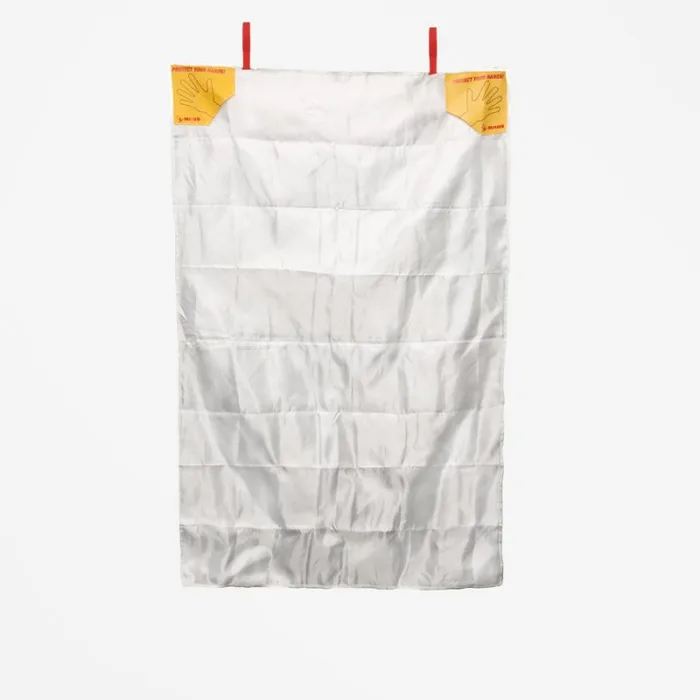
- Buy MAUS Portable Fire Blanket 72 in x 48 in The one blanket here whose own instruction sheet names both ASTM F1989 and EN 1869:2019, at the size fire bodies actually recommend.
- Buy Prepared Hero Emergency Fire Blanket The 40 inch square everyone already owns: a good fabric lid for a small contained fire, and honest about very little else. Amazon
- It depends Steiner Industries Steiner 371 Silica Welding Blanket, 18 oz A genuine 1,800 F silica blanket for a workshop or a fire pit, sold to a completely different buyer than the one shopping for a kitchen blanket.
- Skip Li-Fire E-Bike Fire Cover A premium priced cover sold for lithium battery fires, backed by three standards that between them test cooking oil, building materials and curtains.
What actually matters
- EN 1869:2019 - the European fire blanket standard, published 31 August 2019 and current. Its scope is blankets that are not reusable, intended for use by one person, and it sets performance, construction, marking and packaging requirements.
- ASTM F1989 - the American equivalent, active as F1989-05(2020), Standard Specification for Cooking Fire Suppression Blankets. It covers size and shape, mass, hand holding devices, fraying and tearing, flexibility, ease of removal, electrical resistance and fire performance.
- Size - the Fire Industry Association lists three BS EN 1869 sizes and says 1.8 m by 1.2 m should ideally be selected if clothing being worn may need to be smothered. Smaller blankets are assigned to pans, bins and bench spills.
- Hand hold devices - the tabs or pockets you grip. Both standards include requirements for them, and in practice they are the difference between holding the blanket at arm's length and improvising with the edge.
- Single use - a blanket that has been over a fire has been heat cycled and possibly contaminated. Makers following EN 1869:2019 tell you to discard it, and the FIA's condemning criteria include fire damage and contamination of the blanket material.
- Fibre type - consumer kitchen blankets are woven fibreglass, sometimes silicone coated. Silica cloth appears in industrial heat blankets at far higher ratings, wool turns up in some US industrial blankets that are washable and reusable, and aramid such as Kevlar or Nomex is used for protective clothing rather than smothering blankets. We found no consumer fire blanket in this field made of aramid.
- Fire type - a blanket smothers by cutting off oxygen. That works on a cooking oil fire in a container. It does not work on a chemistry that supplies its own oxidiser, which is why lithium-ion battery claims collapse under scrutiny.
The specs, in plain English
Green flags vs red flags
Green flags
- The listing names a standard and its edition year, and the edition is EN 1869:2019 or ASTM F1989-05(2020).
- The blanket is offered at 1.8 m by 1.2 m, or the maker explains clearly which size is for which job.
- There are sewn-in hand pockets or dedicated hand hold tabs rather than a plain hemmed edge.
- The maker states plainly that the blanket is single use and should be discarded after any deployment.
- The instructions tell you to leave the blanket in place and call the fire service rather than lifting it to check.
Red flags
- The only certification quoted is "EN 1869:1997" or a bare "CE" with no standard number attached.
- The same brand cites two different editions of the same standard on two different pages, or quotes a standard number that does not exist, such as "EN 1896".
- The maker says the blanket is reusable and also says it meets EN 1869:2019.
- The listing claims the blanket works on "any" fire smaller than itself, including electrical fires, with no test cited.
- It is sold for e-bike, EV or lithium battery fires and the standards listed are for cooking oil, curtains or building materials.
Who's who: the brands
- MAUS - Swedish fire safety brand whose blankets ship with an instruction sheet naming both ASTM F1989-2005 and EN 1869:2019, and which states single use in plain type.
- Prepared Hero - Direct-to-consumer American brand behind the 40 inch fibreglass square that dominates the US market, and unusually candid in its support pages about what it is not certified to.
- Steiner Industries - Long established US maker of welding and heat blankets in fibreglass, silica and carbonized fibre, aimed at workshops rather than kitchens.
- Kidde and First Alert - Familiar home safety brands that sell fire blankets mainly outside the US, which is why American shoppers may not see a familiar name.
- Firechief - British fire equipment maker that sells blankets to BS EN 1869; check the listing for independent third party certification.
How to read a listing without getting fooled
Start at the bottom of the listing, not the top. Find the certification line and check whether it names a standard and a year, then check the year against the current edition, which is 2019 for EN 1869 and 2020 for the ASTM F1989 reapproval. Next find the dimensions and convert them: 39 or 40 inches is about a metre and is a pan-and-bin blanket, while 72 by 48 inches is 1.8 by 1.2 metres and is the size fire bodies name for clothing fires. Then look for the words single use or reusable, because that single word tells you whether the seller understands the standard they are quoting. Temperature ratings like 1,076 F sound authoritative but are self-declared and not part of either standard, so treat them as a tiebreaker at most. Finally, ignore anything about electrical fires, battery fires or camping unless a cited test backs it.
How much should you spend?
Budget buys you the ubiquitous fibreglass square, roughly a metre on a side, in a hanging pouch. That tier is genuinely useful next to a hob and is where most households should put their first blanket, but the certification claims in it are inconsistent and you should not assume a third party verified anything. Mid-range buys a properly sized 1.8 by 1.2 metre blanket from a maker that names a current standard, includes hand pockets and tells you to discard it after use. That is the tier worth paying for if you are only buying one. Premium is split between industrial heat blankets, where the money goes into silica cloth, size and real temperature ratings for workshop use, and lithium-specific covers, where the money buys marketing rather than tested suppression performance.
Questions, answered
Do fibreglass blankets shed fibres that irritate skin?
Yes, and the makers admit it. Prepared Hero's support pages say there can be some loose fibreglass with fire blankets and that it can cause itchiness, especially on sensitive skin, and recommend wearing gloves when handling the blanket. Some blankets add a silicone coating specifically to reduce this. It is a nuisance rather than a hazard, but it is a reason to store a cheap pair of gloves with the blanket instead of finding out during an emergency.
How long does a fire blanket last if I never use it?
There is no expiry stamped on consumer blankets, and some makers advertise that they never expire. The Fire Industry Association takes a more cautious line for managed premises and lists age as a reason to condemn a blanket, suggesting that if the manufacturer gives no instruction you consider replacing it more than seven years after commissioning. It also recommends monthly visual checks that the blanket is in place, unobstructed, undamaged and with its tamper indicator intact.
Where should I mount it?
The FIA's guidance is specific and worth copying at home. Put it in the room where it will be needed, mounted on the wall, clearly visible, with the hand hold devices around 1.5 metres from the floor and no more than 10 metres from the likely hazard. Do not put it above or close to a heating appliance, behind a door, inside a cupboard or drawer, or anywhere a fire could block your route to it. You should not have to pass through a doorway to reach it.
Is a blanket better than a small extinguisher?
They solve different problems and neither replaces getting out. A blanket is silent, has no expiry pressure gauge, leaves no residue and is usable by someone who cannot handle an extinguisher, which is the argument its makers make. An extinguisher reaches further and can finish a fire the blanket has only contained. The FIA notes this directly, listing situations where a blanket creates a lid over a fire in a small container and an extinguisher may still be needed afterwards to fully put it out.
Or jump to the head-to-head: MAUS Portable Fire Blanket 72 in x 48 in vs Prepared Hero Emergency Fire Blanket.