Explained
Firewood Racks, Explained
After reading, you'll understand how firewood racks are rated, why the cover design matters as much as the steel, and how to tell an outdoor seasoning rack from a hearth rack.
In this guide
First-time buyers usually compare racks on length and price, then find the rack bowing, the wood staying damp or the stack holding far less than expected. Capacity ratings mix full cords and face cords, steel is described as heavy duty without a gauge, and many racks ship with covers that wrap the sides of the pile. A few specs, read carefully, sort the good racks from the rest.
The 30-second version
- Cover the top, not the sides, because EPA guidance says side covers trap moisture in the woodpile.
- A face cord is not a cord, and with 16 inch logs it holds about a third as much wood.
- A stated steel gauge beats the words heavy duty, since thin tubing is what bends under a full load.
- Hearth racks and outdoor racks do different jobs, with one holding a few days of wood indoors and the other storing and seasoning a winter's supply.
- Warranty length tells you about the frame, and racks here range from one year to lifetime structural.
The products this guide is about
Our verdict on each, with the full reasoning on the companion review.
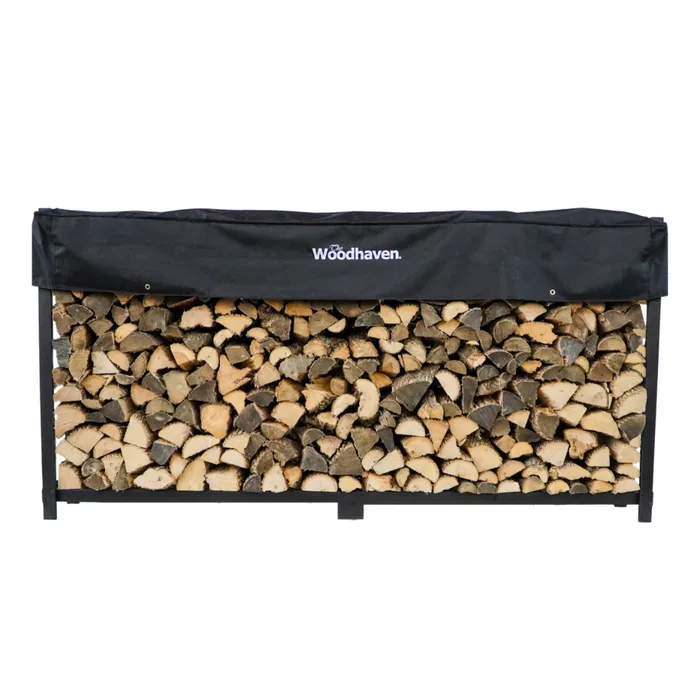
- Buy The Woodhaven 8 ft Steel Firewood Rack A US-made 8 ft rack of 16-gauge square steel tubing with stainless hardware, a half-cord capacity and a lifetime structural warranty.
- Buy ShelterLogic Heavy Duty Firewood Rack 8 Ft. with Cover A powder-coated steel 8 ft rack rated for half a cord, with a polyester cover that slides down the rack as you burn through the stack.
- It depends Enclume Large Rectangle Fireplace Log Rack, Hammered Steel A hand-forged, US-made hearth rack of 3/8 inch solid steel that holds a few days of wood beside the fireplace.
- Skip Sunnydaze Outdoor Firewood Log Rack with Cover Combo (8-Foot) A cheap covered rack made of 1 mm wall tubing whose cover drapes most of the way down the sides of the stack.
What actually matters
- Frame material - Steel gauge or wall thickness and tube shape decide how the rack handles a full load. A maker that publishes the gauge gives you something to compare.
- Capacity rating - Ratings come in cords, face cords or pounds. Check the log length the maker assumes before comparing racks.
- Cover design - A cover should shed rain from the top of the stack while leaving the sides open. Side-wrapping covers trap moisture, per EPA guidance.
- Ground clearance - The rack's job is to keep wood off damp ground. Feet that sink into soil bring the bottom row closer to moisture and invite rust.
- Finish and hardware - Powder coat and stainless or coated hardware slow rust outdoors. Bare or thin coatings fail first at welds and bolt holes.
- Footprint - An 8 ft rack needs a long, level site with room to reach the wood. Hearth racks need to fit safely beside the fire.
- Warranty - The frame warranty shows how long the maker expects the rack to last. Covers are usually excluded or treated as consumables.
The specs, in plain English
Green flags vs red flags
Green flags
- A published steel gauge or wall thickness
- Capacity given in cords with the assumed log length
- A cover that sits on top of the stack and leaves the sides open
- Stainless or coated hardware and a powder-coat finish
- A multi-year or lifetime structural warranty
Red flags
- Heavy duty claims with no gauge or load rating
- Capacity given only in face cords next to cord-rated competitors
- A cover that drapes most of the way down the sides
- Conflicting dimensions or weights on the same product page
- A one-year warranty on a rack meant to sit outdoors for years
Who's who: the brands
- The Woodhaven - A Kansas maker of US-made 16-gauge steel firewood racks with lifetime structural warranties.
- ShelterLogic - Known for portable garages and canopies, with a range of covered firewood racks from Heavy Duty to Ultra Duty.
- Enclume - A Pacific Northwest forge making hand-forged fireplace log racks and hearth accessories.
- Sunnydaze - A large online outdoor-decor brand selling budget racks and cover combos.
How to read a listing without getting fooled
Start with the frame: look for a steel gauge or wall thickness, the tube shape and the hardware, and treat a heavy-duty label with no numbers as missing information. Next read the capacity carefully, noting whether it is in cords or face cords and what log length it assumes. Then look at the cover's dimensions against the rack's height, because a cover nearly as tall as the rack wraps the sides. Check the warranty for the frame and whether the cover is excluded. Finally, compare every figure on the page; if the overview, spec table and drawings disagree, plan around the largest size and treat the gap as a warning.
How much should you spend?
Budget racks with covers are common, and the savings usually come from thinner tubing, shorter warranties and side-wrapping covers. Mid-range racks add better cover designs and sturdier frames, though their spec sheets can still be thin. Premium outdoor racks buy heavier stated steel, stainless hardware, US manufacture and long warranties, which pays off if you stack wood every year. Forged hearth racks sit in the premium tier for their size because you are paying for craftsmanship and appearance, not capacity.
Questions, answered
How far should a firewood rack be from my house?
Many fire and pest guidelines suggest keeping stored firewood away from the house walls rather than stacked against them, both to reduce fire risk and to keep insects out. Check your local fire authority for a specific distance, especially in wildfire-prone areas. A rack also needs room behind it for air to move. Bring only a few days of wood indoors at a time.
Do I need a rack if I stack wood on pallets?
Pallets keep wood off the ground, which is the most important part. A rack adds end supports so the stack does not lean or topple, and a fitted cover. Pallets can rot and hold moisture over time. If you burn a lot of wood, a rack is the tidier long-term option.
Why does my rack say 1/2 cord but my delivery does not fit?
Ratings often assume a particular log length, such as Woodhaven's 24 inch splits. If your delivery is a full cord, it will not fit in a half-cord rack. Loosely stacked wood also takes more space than a neat stack. Measure the rack and the wood before ordering.
Should firewood be stacked bark up or bark down?
Practices vary, and EPA guidance does not specify it. What matters more is that the wood is split, stacked off the ground with air moving through it and covered only on top. Stack tightly enough to be stable but not so tight that air cannot pass. Rotate older wood to the front so it burns first.
Or jump to the head-to-head: The Woodhaven 8 ft Steel Firewood Rack vs ShelterLogic Heavy Duty Firewood Rack 8 Ft. with Cover.