Explained
Ethernet Cables, Explained
After reading, you'll understand what the letters and numbers on an Ethernet cable jacket mean, which of them affect your network and which are marketing, and how to spot the one construction shortcut that is genuinely unsafe.
In this guide
Ethernet cable looks like the easiest purchase in networking and is quietly one of the easiest to get wrong. The category number is printed in large type, the things that determine safety and reliability are printed in small type or not at all, and a cheap cable can look identical to a good one. First-time buyers usually overspend on a category they cannot use while missing a conductor material that can overheat under Power over Ethernet. Once you know which four lines on the spec sheet to read, the whole category gets simple.
The 30-second version
- Copper is not optional, and copper-clad aluminium is the single construction shortcut worth actively avoiding.
- Cat 6 is enough for most homes, carrying 1, 2.5 and 5 Gigabit across a full 100 metre channel.
- Cat6A is the sensible ceiling, because it is the category that carries 10 Gigabit the full 100 metres.
- Cat8 is a data-centre part, specified for 25 and 40 Gigabit over a 30 metre two-connector channel.
- Jacket letters are fire code, so CMR and CMP tell you where a cable may legally be installed, not how fast it runs.
The products this guide is about
Our verdict on each, with the full reasoning on the companion review.
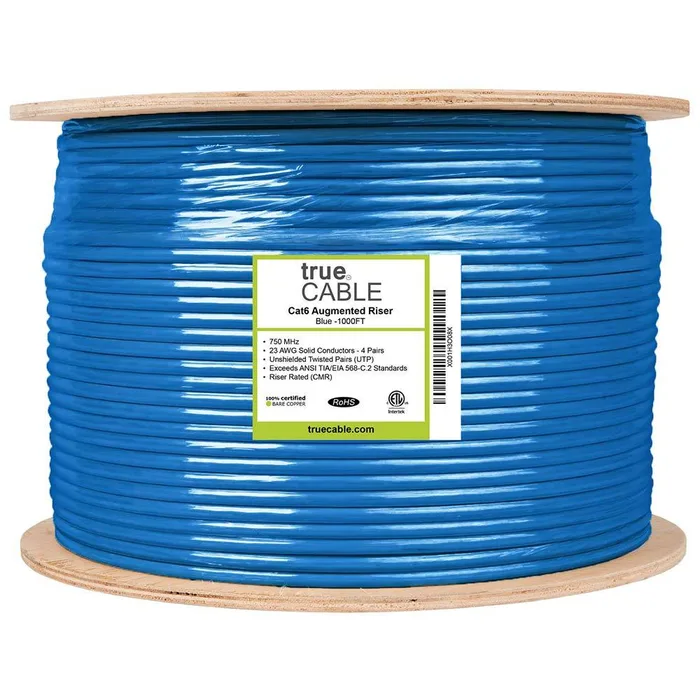
- Buy trueCABLE Cat6A Riser Ethernet Cable, Unshielded A bulk box of 23 AWG solid bare copper Cat6A with a riser jacket and third-party certification, which is exactly what a permanent house run should be. Amazon
- Buy Cable Matters Snagless Cat 6 Ethernet Cable The ordinary patch lead done properly: 24 AWG bare copper, snagless boots, and a claim set that matches what Cat 6 actually is. Amazon
- It depends Ubiquiti UniFi Patch Cable (UACC-Cable-Patch) An ultra-thin 34 AWG stranded copper lead with bendable RJ45 boots that untangles a crowded rack, sold without a stated category number. Amazon
- Skip Cable Matters Cat 8 S/FTP RJ45 Patch Cable A well-made cable answering a question no house asks, since Cat8 is specified for a 30 metre two-connector data-centre channel. Amazon
What actually matters
- Conductor material - The wire has to be copper. Copper-clad aluminium has substantially higher DC resistance, fails category testing, and the industry trade association says it cannot legitimately hold third-party certification.
- Conductor gauge - Lower AWG numbers mean thicker wire and lower resistance. Thicker conductors reach further and shed Power over Ethernet heat better, which is why in-wall cable is 23 or 24 AWG rather than the ultra-thin gauges used in short patch leads.
- Category - The category sets the tested frequency and the speeds the cable supports over a standard channel. It is a floor, not a promise, and a category number printed on a cable that was never tested to it means nothing.
- Solid versus stranded - Solid conductor cable is for permanent runs terminated into jacks and panels. Stranded is for flexible patch cords, and it should stay short because the air gaps between strands raise resistance and attenuation.
- Shielding - Foil or braid around the pairs blocks external interference, but only when it is bonded to ground through shielded connectors and jacks along the entire path. Installed half-heartedly, it can make things worse.
- Jacket fire rating - CM, CMR and CMP are National Electrical Code ratings that decide where a cable may be installed. Riser cable must never go in a plenum space, and unrated patch leads should not go inside a wall.
- Third-party listing - A cETLus or UL listing means an independent lab verified construction and fire performance. It is the most efficient single filter a buyer has, because the worst cables cannot honestly carry one.
The specs, in plain English
Green flags vs red flags
Green flags
- The listing states bare copper or solid bare copper conductors, in words, on the spec sheet.
- A cETLus or UL listing number is published, not just a generic claim of compliance.
- The maker publishes a tested bandwidth figure in MHz rather than only a category name.
- The jacket carries a printed NEC rating such as CMR or CMP if it is bulk cable meant for walls.
- The cable is sold in the length you need, so you are not stuffing coiled slack behind equipment.
Red flags
- The conductor material is not mentioned anywhere, or the cable is described only as high purity metal.
- A very high category number on a very cheap cable, especially Cat7 or Cat8 sold for household use.
- Weight that is noticeably light for the length, which is a practical tell for aluminium under the copper.
- Claims of a UL mark with no listing number, since a copper-clad aluminium cable cannot honestly hold one.
- Bulk cable with no fire rating printed on the jacket being sold for in-wall installation.
Who's who: the brands
- trueCABLE - Bulk installation cable with unusually detailed public spec sheets, published Fluke test results and cETLus certification.
- Cable Matters - Broad range of finished patch leads and bulk cable at accessible prices, with conductor material stated on many products and UL listings on some.
- Belden - Long-established premium cable manufacturer sold mainly through distributors and specified in commercial installations.
- Ubiquiti - Networking hardware maker whose UniFi accessories include ultra-thin patch leads designed around its own racks and switches.
- Monoprice - Value-focused direct seller with a wide catalogue of patch cables including very thin slim-profile leads.
How to read a listing without getting fooled
Read a cable listing from the bottom up. Find the conductor line first and check that it says copper, ideally bare copper, and note the AWG; if that information is absent from a bulk cable listing, that absence is the answer. Next find the jacket rating, because CM, CMR or CMP tells you where the cable may legally live and an unrated cable belongs on a desk rather than in a wall. Then check the shielding notation and ask yourself honestly whether you will install shielded jacks and bond the shield, because if you will not, unshielded is the better cable. Only then look at the category, and match it to what your equipment actually does rather than to the biggest number available. Finally, look for a listing number from an independent lab, which quietly verifies most of what came before it.
How much should you spend?
Budget tier buys perfectly good finished patch leads in Cat 6 or Cat6A from established brands with bare copper conductors, and for short indoor jumpers there is genuinely no reason to spend more. Mid-range in this category usually means either shielded construction, a higher category number, or a specialist jacket for outdoor or direct-burial use, and it is worth paying only if your situation calls for one of those specifically. Premium is where bulk installation cable sits, and the money buys solid bare copper, a certified fire-rated jacket, published test data and consistent manufacturing across a thousand-foot box. That premium is worth it exactly once, when the cable is going inside a wall and you do not want to open that wall again. Paying premium for a patch lead that sits on a desk is the most common way to overspend here.
Questions, answered
Will a better Ethernet cable make my internet faster?
Only if your current cable is the bottleneck, which is uncommon. If a working Cat 5e or Cat 6 cable is already carrying your connection speed without errors, replacing it with a higher category changes nothing. Cable upgrades pay off when you are moving to faster local hardware, running longer distances, or fixing a cable that is actually damaged or badly terminated.
Can I use Cat5e that is already in my walls?
Often yes. Cat5e handles Gigabit across a full channel and generally supports 2.5 Gigabit as well, which covers most home internet connections and most home gear. If the existing runs test clean and your speeds are inside that range, there is no need to open walls. Upgrade the in-wall cable when you are actually moving to 10 Gigabit locally, or when the existing runs fail testing.
Is it safe to run Ethernet cable next to electrical wiring?
Running parallel to mains wiring for any distance is one of the situations where interference genuinely shows up, and it is one of the cases where shielded cable is worth considering. The simpler fix is separation: keep distance between the two, and cross at right angles rather than running alongside. If you do choose shielded cable, commit to shielded jacks and proper bonding, because an unbonded shield can pick up more than it rejects.
Why do some cables say Cat7 when Cat7 is not a TIA category?
Cat7 comes from international ISO/IEC cabling classes rather than the TIA categories used in North American structured cabling, and TIA went from Cat6A straight to Cat8. Cables sold as Cat7 with ordinary RJ45 plugs are usually just shielded cable with a bigger number printed on it. For a home or office using RJ45 gear, Cat6A is the meaningful top of the range and Cat7 branding is not a reason to pay more.
Or jump to the head-to-head: trueCABLE Cat6A Riser Ethernet Cable, Unshielded vs Cable Matters Snagless Cat 6 Ethernet Cable.