

Tech & Gadgets
The Best Ethernet Cables: 4 Compared (and One to Skip)
We compared four Ethernet cables on the things a listing photo cannot show you: conductor material, gauge, shielding, jacket fire rating, and whether anyone independent has verified the claims.
The short version
For wiring a house, the trueCABLE Cat6A Riser Ethernet Cable, Unshielded is the pick: 23 AWG solid bare copper, a CMR riser jacket, cETLus certification, and tested bandwidth published on the page. For the leads between your router, switch and computer, the Cable Matters Snagless Cat 6 Ethernet Cable does the job with 24 AWG bare copper and costs a fraction as much. The Ubiquiti UniFi Patch Cable is a genuinely clever 34 AWG ultra-thin lead that solves cable congestion in a rack, but Ubiquiti gives no category number for it and that gauge is not what you want feeding a PoE camera. Skip Cat8 patch leads such as the Cable Matters Cat 8 S/FTP RJ45 Patch Cable: TIA specifies Cat8 for a 30 metre two-connector channel in data centres, and few home networks benefit from it. The real trap is not in this lineup at all, it is unbranded bulk cable with copper-clad aluminium conductors, which the Communications Cable and Connectivity Association says cannot legitimately carry third-party certification and which heats up dangerously under PoE. Buy solid bare copper for in-wall runs and stranded copper for patch leads, and the rest is mostly noise. Best for: anyone wiring a home or replacing a handful of leads who wants the cable to still be fine in ten years.
Our picks at a glance
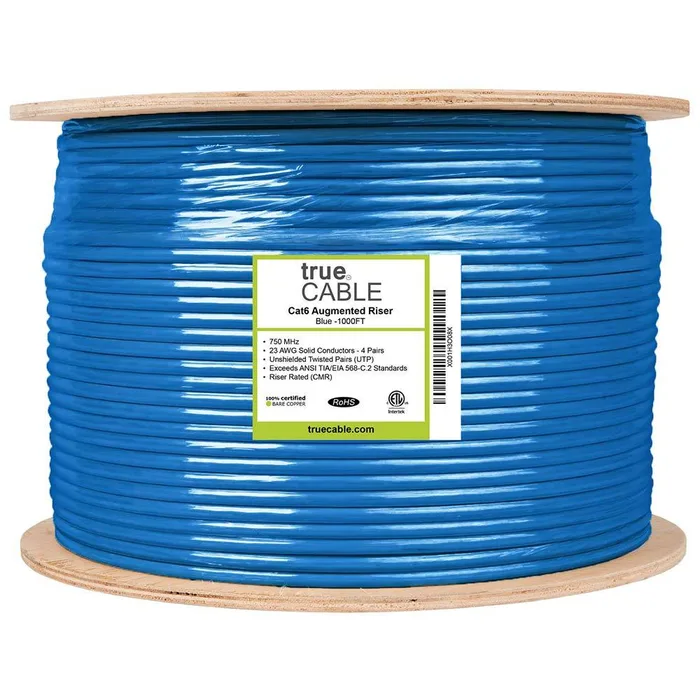
- trueCABLE Cat6A Riser Ethernet Cable, Unshielded - Buy. A bulk box of 23 AWG solid bare copper Cat6A with a riser jacket and third-party certification, which is exactly what a permanent house run should be.
- Cable Matters Snagless Cat 6 Ethernet Cable - Buy. The ordinary patch lead done properly: 24 AWG bare copper, snagless boots, and a claim set that matches what Cat 6 actually is.
- Ubiquiti UniFi Patch Cable (UACC-Cable-Patch) - It depends. An ultra-thin 34 AWG stranded copper lead with bendable RJ45 boots that untangles a crowded rack, sold without a stated category number.
- Cable Matters Cat 8 S/FTP RJ45 Patch Cable - Skip. A well-made cable answering a question no house asks, since Cat8 is specified for a 30 metre two-connector data-centre channel.
The verdict in 30 seconds
What mattered most
- Category
- Conductor
- Shielding
- Jacket rating
- Tested bandwidth
- Third-party verification
Ethernet cable is the rare product where the important facts are invisible. Two cables can look identical, carry the same category number on the jacket, and behave completely differently once you put a camera on the far end and start pushing power down the pairs. The two things that separate a good cable from a bad one are what the conductors are actually made of and whether the category on the print matches what the cable was tested to. We picked four cables that publish enough detail to check, covering bulk cable for permanent runs and finished patch leads for the gear on your desk.
A bulk box of 23 AWG solid bare copper Cat6A with a riser jacket and third-party certification, which is exactly what a permanent house run should be.
Best for: Anyone running permanent cable inside walls who wants it to still be adequate when 10 Gigabit gear gets cheap.
- 23 AWG pure solid bare copper conductors, stated plainly on the product page rather than left vague.
- cETLus certified and marked CMR, so it is legal riser cable for in-wall and between-floor runs.
- Tested to 750 MHz and rated for 10 Gigabit to 328 feet, with PoE, PoE+ and PoE++ 4PPoE up to 100 W.
- Sold only in 500 ft and 1000 ft boxes, so it is overkill if you need two cables.
- You have to terminate it yourself into keystone jacks or a patch panel, which needs tools and practice.
- Cat6A is thicker and stiffer than Cat6, which makes tight conduit bends and jack termination harder.
- Unshielded, so it is the wrong choice if the run parallels mains wiring or goes outdoors.
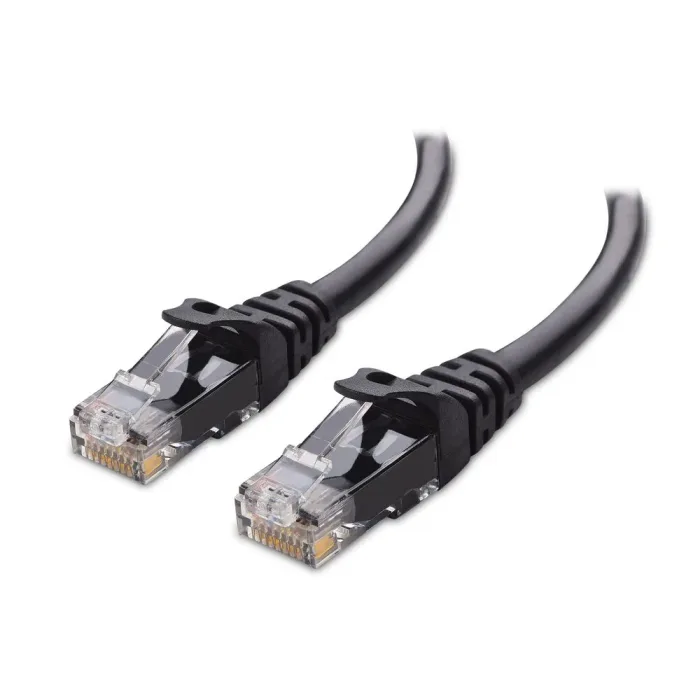
The ordinary patch lead done properly: 24 AWG bare copper, snagless boots, and a claim set that matches what Cat 6 actually is.
Best for: Replacing the anonymous leads behind your router, switch and desk with something whose conductors you can actually verify.
- 24 AWG bare copper conductors, which rules out the copper-clad aluminium problem in cheap leads.
- Snagless moulded boots stop the retention clip snapping off when you pull it out of a switch.
- Sold in more than twenty lengths from 1 ft to 200 ft in six colours, so you can stop coiling slack.
- The product page cites TIA/EIA 568-C.2, which is an older revision than the current 568.2 series.
- Marketed as 10 Gbps, but Cat 6 only reaches 10 Gigabit over shorter distances, not a full channel.
- No UL or ETL listing is stated for the patch cord itself on the product page.
- Unshielded and indoor only, so it is not a candidate for outdoor or high-interference runs.
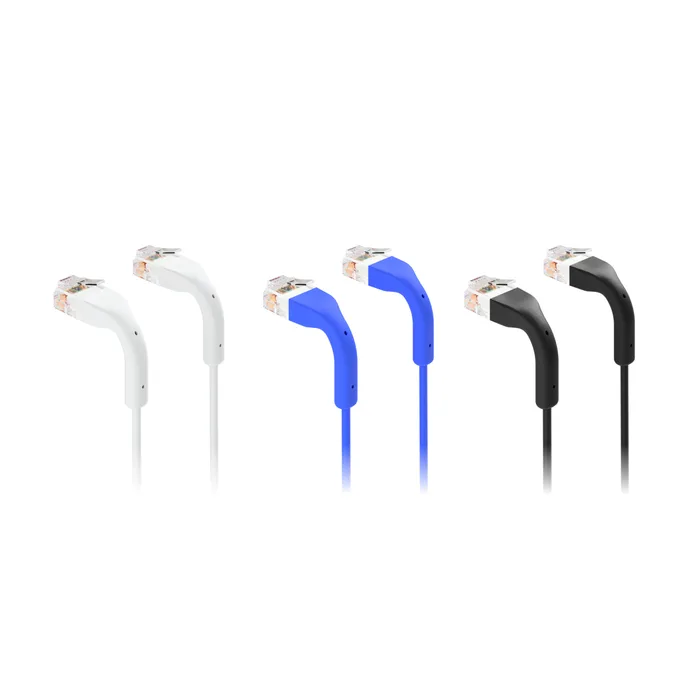
An ultra-thin 34 AWG stranded copper lead with bendable RJ45 boots that untangles a crowded rack, sold without a stated category number.
Best for: Someone patching a dense rack or routing behind furniture over short distances, not someone feeding a PoE camera down a long run.
- At 34 AWG it is dramatically thinner than a normal patch lead, which unclogs a 24-port patch field.
- Bendable booted RJ45 connectors flex up to 90 degrees vertically and 45 degrees horizontally for tight cabinets.
- Nine lengths from 0.2 m to 15 m, including very short jumpers that most brands do not bother making.
- Ubiquiti cites TIA/EIA-568-B.2 but gives no category number, so there is nothing specific to hold the cable to.
- 34 AWG conductors have much higher resistance than 23 or 24 AWG, which matters for both reach and PoE heat.
- The page lists a VW-1 (UL1581) flame rating but no UL or ETL listing and no NEC CM or CMR rating, so it is not a candidate for in-wall use.
- Unshielded, and the thin TPE jacket is built for flexibility rather than abuse.
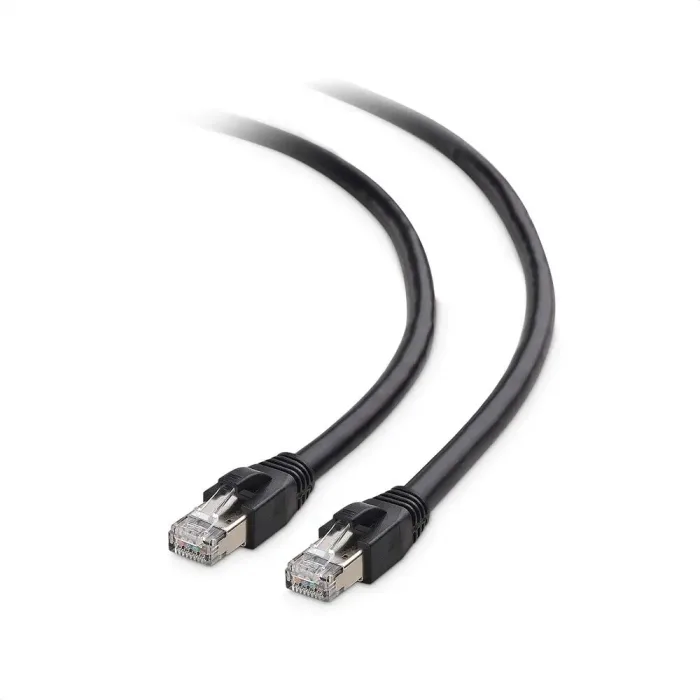
A well-made cable answering a question no house asks, since Cat8 is specified for a 30 metre two-connector data-centre channel.
Best for: A short run between switches in a rack that genuinely does 25 or 40 Gigabit, which is a data-centre situation rather than a home one.
- 24 AWG bare copper with S/FTP construction, so foil around each pair plus an overall braid.
- UL Listed under E485863 and CM rated, which is more third-party backing than most patch leads carry.
- Metal RJ45 connectors and moulded strain relief make it physically robust.
- The listing itself states the 25 and 40 Gigabit performance applies within a 30 metre two-connection channel.
- Almost nothing in a normal house runs 25 or 40 Gigabit Ethernet, so the extra performance goes unused.
- S/FTP shielding only helps when it is bonded to ground at both ends through shielded jacks and hardware.
- The braid and dual shields make it stiff and fat compared with a Cat 6 or Cat 6A lead of the same length.
| Criteria | Cat6A Riser Ethernet Cable, Unshielded Top pick | Snagless Cat 6 Ethernet Cable | UniFi Patch Cable (UACC-Cable-Patch) | Cat 8 S/FTP RJ45 Patch Cable |
|---|---|---|---|---|
| Verdict | Buy it | Buy it | It depends | Skip it |
| Best for | Anyone running permanent cable inside walls who wants it to still be adequate when 10 Gigabit gear gets cheap. | Replacing the anonymous leads behind your router, switch and desk with something whose conductors you can actually verify. | Someone patching a dense rack or routing behind furniture over short distances, not someone feeding a PoE camera down a long run. | A short run between switches in a rack that genuinely does 25 or 40 Gigabit, which is a data-centre situation rather than a home one. |
| Price tier | $$$ · premium | $ · budget | $ · budget | $$ · mid-range |
| Category | Cat6A | Cat 6 | Not stated by maker (cites TIA/EIA-568-B.2) | Cat 8 |
| Conductor | 23 AWG solid bare copper | 24 AWG bare copper | 34 AWG stranded copper (32 AWG at 12 m to 15 m) | 24 AWG bare copper |
| Shielding | U/UTP unshielded | Unshielded | UTP unshielded | S/FTP foil per pair plus braid |
| Jacket rating | CMR riser | Not stated | No NEC rating (TPE jacket, VW-1 flame rating) | CM general purpose |
| Tested bandwidth | 750 MHz | 550 MHz rated | Not stated | Not stated |
| Third-party verification | cETLus certified | Not stated on page | Not stated on page | UL Listed E485863 |
| Form | Bulk box, you terminate it | Finished patch lead | Finished patch lead | Finished patch lead |
| Lengths offered | 500 ft and 1000 ft | 1 ft to 200 ft | 0.2 m to 15 m | 3, 5, 10 and 25 ft |
Which one is right for you?
- Anyone running permanent cable inside walls who wants it to still be adequate when 10 Gigabit gear gets cheap. Buy it trueCABLE Cat6A Riser Ethernet Cable, Unshielded
- Replacing the anonymous leads behind your router, switch and desk with something whose conductors you can actually verify. Buy it Cable Matters Snagless Cat 6 Ethernet Cable
- Someone patching a dense rack or routing behind furniture over short distances, not someone feeding a PoE camera down a long run. It depends Ubiquiti UniFi Patch Cable (UACC-Cable-Patch)
- A short run between switches in a rack that genuinely does 25 or 40 Gigabit, which is a data-centre situation rather than a home one. Skip it Cable Matters Cat 8 S/FTP RJ45 Patch Cable
How we judged the field
Five things decide whether an Ethernet cable is any good, and four of them are invisible in a photo. First, conductor material: it has to be copper, not copper-clad aluminium, because CCA has far higher resistance and the industry trade association says it cannot legitimately carry third-party certification. Second, gauge, because a thinner conductor means more resistance, less reach and more heat under Power over Ethernet. Third, the category and whether the maker publishes a tested bandwidth figure to back it up. Fourth, the jacket fire rating, because CM, CMR and CMP decide where the cable is legal to install rather than how fast it runs. Fifth, whether anyone independent has looked: a cETLus or UL listing is a real check on the first four claims.
The field splits cleanly into bulk cable you terminate yourself and finished patch leads you plug in. Those are different products for different jobs, and pretending one list covers both does readers a disservice, so we picked from each. For bulk we wanted a maker that prints conductor material, gauge, tested MHz and a fire rating on the page, which narrows the field fast. For patch leads we wanted the same honesty at the other end of the price range. We also included one ultra-thin lead that solves a real problem with a real trade-off, and one Cat8 lead to make the point that a good cable can still be the wrong purchase.
trueCABLE Cat6A Riser Ethernet Cable, Unshielded
Buy ittrueCABLE’s Cat6A Riser Ethernet Cable, Unshielded is what a house run should look like on paper. Pure solid bare copper at 23 AWG, U/UTP construction, a CMR riser jacket so it is legal between floors and inside walls, bandwidth tested to 750 MHz, and cETLus certification backing it. The page states 1 and 10 Gigabit to 328 feet and support for PoE, PoE+ and PoE++ 4PPoE up to 100 W, and it has an internal spline plus sequential footage markings every two feet so you know how much you have pulled. The catch is that this is a commitment. It comes in 500 ft and 1000 ft boxes, you supply the keystone jacks or patch panel, and Cat6A is thicker and less forgiving to terminate than Cat6. It is also unshielded, which is right for most interior runs and wrong if the cable parallels mains wiring or heads outdoors. For anyone wiring a home properly and once, it is the pick.
Cable Matters Snagless Cat 6 Ethernet Cable
Buy itThe Cable Matters Snagless Cat 6 Ethernet Cable is the boring, correct answer for the leads you actually plug in. It uses 24 AWG bare copper conductors, which is the single fact that separates it from the pile of anonymous cables that ship with routers, and it is rated to 550 MHz with snagless moulded boots that keep the retention clip from snapping off in a switch port. It comes in more than twenty lengths from 1 ft to 200 ft in six colours, which sounds trivial until you stop stuffing three feet of coiled slack behind a cabinet. Two honest caveats. The page cites TIA/EIA 568-C.2, an older revision than the current 568.2 series, and it markets 10 Gbps without noting that Cat 6 only reaches 10 Gigabit over shorter distances rather than a full channel. No UL or ETL listing is stated for the cord itself. For short indoor jumpers at 1 or 2.5 Gigabit, none of that changes the outcome.
Ubiquiti UniFi Patch Cable (UACC-Cable-Patch)
It dependsThe Ubiquiti UniFi Patch Cable exists to solve congestion, and it does. At 34 AWG stranded copper for lengths from 0.2 m to 8 m, it is dramatically thinner than a standard patch lead, and the bendable booted RJ45 connectors flex up to 90 degrees vertically and 45 degrees horizontally, which is the difference between a tidy 24-port patch field and a bird’s nest. Nine lengths starting at 0.2 m means you can actually get short jumpers. The trade-off is real and worth stating plainly: Ubiquiti’s page cites TIA/EIA-568-B.2 but gives no category number, so there is nothing specific to hold it to, and 34 AWG has far higher resistance than the 23 or 24 AWG you would find in ordinary cable. That matters for reach and it matters for heat when Power over Ethernet is flowing. The only flame rating given is VW-1 (UL1581), with no UL or ETL listing and no NEC jacket rating, so it is not in-wall cable. Perfect in a rack, wrong down a long PoE run.
Cable Matters Cat 8 S/FTP RJ45 Patch Cable
Skip itThe Cable Matters Cat 8 S/FTP RJ45 Patch Cable is not a bad cable. It is 24 AWG bare copper, S/FTP with foil around each pair and an overall braid, UL Listed under E485863, CM rated to 75 degrees C, with metal RJ45 connectors and moulded strain relief. It is better built than most leads on the market. The problem is what Cat8 is for. The listing itself says the 25 and 40 Gigabit performance applies within a 30 metre two-connection channel, which is the TIA definition and describes a short switch-to-switch hop in a data centre rack. Almost nothing in a house runs 25 or 40 Gigabit Ethernet, so you are paying for headroom that few devices on a home network can use. You also get a stiffer, fatter cable, and the shielding only earns its keep if it is bonded to ground through shielded jacks and hardware at both ends, which a home network almost never has. For a home run, Cat 6 or Cat6A does the job better.
Sources
Specs in this review come from these pages.
- Communications Cable and Connectivity Association - Counterfeit and Non-Compliant Cable (cccassoc.org)
- trueCABLE Cable Academy - Copper Clad Aluminum vs Copper: Fluke DSX CableAnalyzer test (truecable.com)
- trueCABLE Cable Academy - Cat8 vs Fiber: Which One Is Best For You (truecable.com)
- trueCABLE Cable Academy - Facts About Ethernet Cable Jacket Ratings (truecable.com)
- trueCABLE Cable Academy - Shielded vs Unshielded Cable (truecable.com)
- Cable Matters - Cat 8 S/FTP RJ45 Patch Cable product specifications (cablematters.com)
trueCABLE Cat6A Riser Ethernet Cable, Unshielded vs Cable Matters Snagless Cat 6 Ethernet Cable: which should you buy?
These two picks are not really competing, which is the most useful thing to say about them. The trueCABLE Cat6A riser box is infrastructure: solid 23 AWG copper you pull through walls, terminate into jacks and never touch again. The Cable Matters snagless Cat 6 lead is the flexible jumper that connects a wall plate to a computer or a router to a switch. A properly wired house uses both, and using either in the other’s role goes badly. Solid conductor cable is not meant to be flexed repeatedly and will fatigue and break at the plug, while stranded patch cable has higher resistance and worse PoE heat behaviour over distance.
So the choice is really about which job you are doing. If you are opening walls, running conduit or wiring a new office, buy the bulk Cat6A, buy the jacks and the tool, and do it once. If you are simply replacing the cables that came in the box with your gear, the Cat 6 patch leads are all you need and Cat6A patch leads would be a waste at 1 or 2.5 Gigabit. If you are somewhere in the middle and want one rule: solid bare copper Cat6A for anything permanent, stranded bare copper Cat 6 for anything you can see.
What to look for
- Conductor material first: the spec sheet should say bare copper or solid bare copper, and a listing that stays silent about it or says CCA is one to walk away from.
- Gauge tells you about heat: 23 or 24 AWG is normal, and anything much thinner has higher resistance, shorter usable reach and worse behaviour when Power over Ethernet is running through it.
- Match the category to the job: Cat 6 carries 1, 2.5 and 5 Gigabit across a full 100 metre channel, Cat6A carries 10 Gigabit that far, and Cat8 is specified for 30 metre data-centre channels.
- Read the jacket rating, not the marketing: CM and CMG are general purpose, CMR is riser rated for vertical runs between floors, and CMP is the only one acceptable in an air-handling plenum space.
- Shielding is a decision, not an upgrade: F/UTP and S/FTP only help when bonded to ground through shielded connectors and jacks end to end, and an unbonded shield can behave like an antenna.
- Look for a real listing: a cETLus or UL listing means somebody independent tested the construction, and a CCA cable cannot legitimately carry one, which makes the mark a useful filter.
Our final take
Most of the money and confusion in this category sits at the top of the spec sheet, in category numbers nobody’s hardware can use, while the fact that actually decides whether a cable is safe sits three lines further down. Get the conductor right and the fire rating right, and you are almost done. For permanent wiring that means solid bare copper Cat6A in a riser or plenum jacket, with a certification mark you can look up. For everything you plug in and out, it means a stranded bare copper Cat 6 lead in the length you actually need. Cat8 in a house is a solution looking for a data centre, and copper-clad aluminium is the one thing genuinely worth being afraid of.
Questions, answered
What is copper-clad aluminium and why does everyone warn about it?
CCA is aluminium wire with a thin copper skin, used to make bulk cable cheaper. It is not an accepted conductor material for twisted-pair data cable, and the Communications Cable and Connectivity Association states that CCA cannot legitimately achieve third-party certification, which means a UL mark on a CCA box is a counterfeit mark. The practical failure is resistance: in one Fluke DSX analyser test a CCA Cat6 run measured 31.08 ohms against a 21.00 ohm limit, and it also failed insertion loss, near-end crosstalk and return loss. Higher resistance means more voltage drop and more heat when you run Power over Ethernet, and the CCCA calls CCA conductors an even worse hazard in PoE cable because they heat up more than copper when data and power are applied together. You cannot see any of this in a listing photo, which is why the conductor line on the spec sheet is the first thing to read.
Do I need Cat8 at home?
No. Cat8 is specified for 25 and 40 Gigabit Ethernet over a channel of up to 30 metres with two connectors, which describes a switch-to-switch hop inside a data centre rack rather than anything in a house. Beyond that distance it does not give you more than Cat6A does. Home internet connections and home network gear are running 1 Gigabit and increasingly 2.5 Gigabit, and Cat 6 already carries both across a full 100 metre channel. Buying a Cat8 patch lead for a home router does not make anything faster; it just gets you a stiffer, thicker cable. If you want headroom for a future 10 Gigabit switch, Cat6A is the sensible ceiling.
Should I buy shielded or unshielded cable?
Unshielded is the right default for a normal house. Shielded cable earns its place when the run parallels mains wiring, passes near motors, generators or other high-voltage equipment, goes outdoors where static and lightning induction are a risk, or sits in a large bundle of PoE cables in conduit. The catch is that shielding only works if it is bonded to ground properly, using shielded connectors and shielded jacks along the whole path. An unbonded shield has nowhere to dump the energy it collects and can behave like an antenna, and bonding at both ends across different ground potentials can create a ground loop that causes packet loss. If you are not going to install shielded hardware end to end, unshielded cable is the better outcome.
What is the difference between solid and stranded cable, and which do I need?
Solid conductors are one continuous wire per conductor and are meant for permanent structured cabling inside walls, terminated into keystone jacks or a patch panel with an insulation displacement tool. Stranded conductors are made of many fine wires, which makes the cable far more flexible and is what finished patch cords use. Stranded has small air gaps between the strands, so it attenuates more over distance and carries higher DC resistance, which also makes it less good at shedding PoE heat. That is why patch leads are meant to be short: trueCABLE recommends staying under 75 feet with stranded and notes the official maximum for 28 AWG stranded is 50 feet. Use solid for the run and stranded for the jumpers at each end.
What do CM, CMG, CMR and CMP on the jacket actually mean?
They are NEC fire ratings for communications cable, and they describe where the cable is legal to install, not how fast it is. CM and CMG are general purpose indoor cable with no added fire protection. CMR is riser rated, meaning it is acceptable in vertical shafts that pass between floors. CMP is plenum rated, made with materials such as FEP that resist flame and emit less smoke, and it is the only one acceptable in air-handling spaces like the void above a dropped ceiling or below a raised floor. The ratings work upward only: plenum cable can go where riser cable goes, but riser cable must never be installed in a plenum space. If the listing does not print a rating, treat it as a patch lead and keep it out of the walls.
Deciding between the top two? See our head-to-head: trueCABLE Cat6A Riser Ethernet Cable, Unshielded vs Cable Matters Snagless Cat 6 Ethernet Cable.
More Tech & Gadgets reviews
 The Best External Hard Drives: 4 Compared (and One to Skip)
  The Best Galaxy Projectors: 4 Compared (and One to Skip)
  The Best Gaming Controllers: 4 Compared (and One to Skip)
  The Best Gaming Mechanical Keyboards: 4 Compared (and One to Skip)
  The Best Gaming Laptops: 4 Compared (and One to Skip)
  The Best Gaming Mice in 2026: Four Flagships Tested, One to Skip