

Tech & Gadgets
The Best Galaxy Projectors: 4 Compared (and One to Skip)
From POCOCO's optical disc starfield to BlissLights' viral nebula sphere - which ceiling-filler actually projects stars, and which $33 dome is just a lava lamp with a remote.
The short version
Want actual stars: POCOCO's disc projector ($100) is the only real planetarium here. Want vibe: BlissLights Sky Lite Evolve ($40) is the nebula king. Galaxy Lamps 2.0 ($60) only wins on battery placement. Skip Encalife's Northern Lights - a $33 LED ring pretending to be the sky.
Our picks at a glance
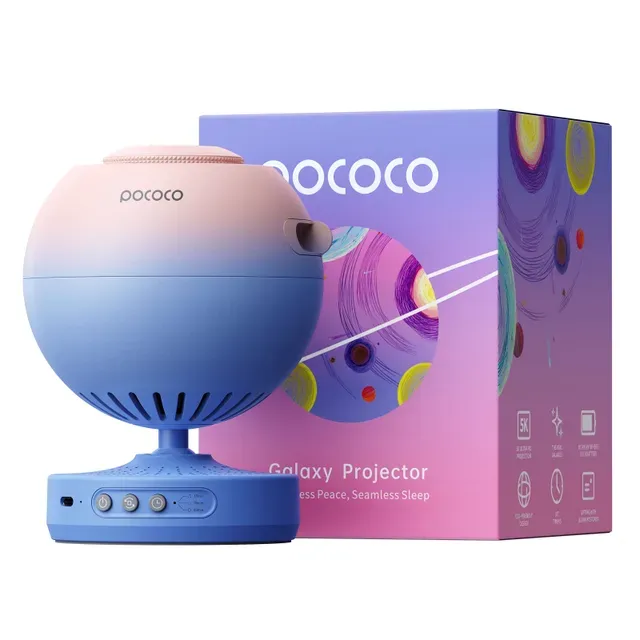
- POCOCO Galaxy Projector - Buy. Real optical star projection through swappable film discs - actual constellations, not blobs.
- BlissLights Sky Lite Evolve - Buy. The viral nebula sphere - best-in-class cloud effects plus laser stars for $40.
- Galaxy Lamps Galaxy Projector 2.0 - It depends. Competent LED nebula + speaker in a black cylinder - fine, but outclassed on both sides.
- Encalife Northern Lights Projector - Skip. The archetypal dropship dome - one blurry LED ring, a remote, and no stars at all.
The verdict in 30 seconds
What mattered most
- Price (street)
- Projection tech
- Real star field
- Controls
- Verdict
Galaxy projectors split into two species that share a name: optical star projectors that shine real star fields through film discs, and LED mood lamps that smear colored clouds across the ceiling. Both have their place - a nursery wants different light than a home theater - but knowing which species you're buying is the whole game. We tested four at $33 to $145.
Real optical star projection through swappable film discs - actual constellations, not blobs.
Best for: Astronomy-leaning giftees, nurseries that need real stars, and anyone who finds LED blobs tacky.
- Film-disc optical system - projects a genuine star field with pinpoint stars, like a mini planetarium.
- 2-million-pixel class lens renders sharp points at ceiling distance instead of LED smear.
- Silent slow rotation + auto-off timer - engineered for falling asleep under it.
- Disc library (nebulae, planets, deep sky) keeps it fresh past the novelty phase.
- $99.99 with one disc included - extra disc sets run ~$45 and the collection tempts you.
- Fixed color per disc - no rainbow LED effects or app gimmicks (a pro for purists).
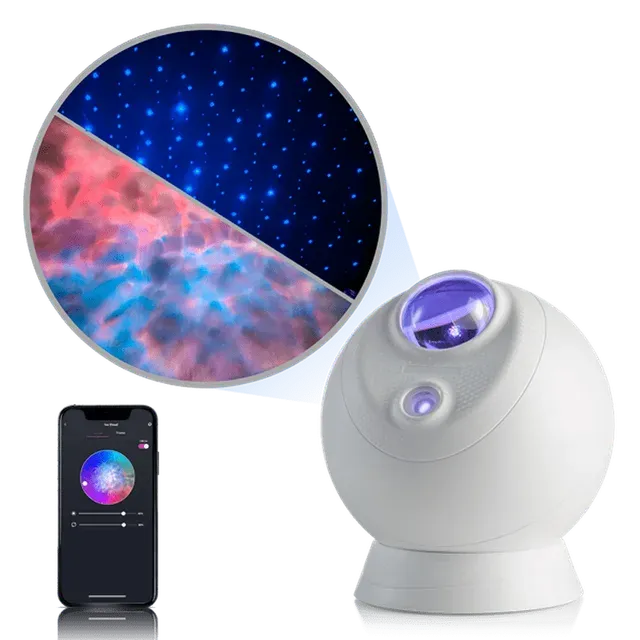
The viral nebula sphere - best-in-class cloud effects plus laser stars for $40.
Best for: Teens, dorm rooms, gamers, and anyone wanting max vibe per dollar.
- Patented color-blending LED nebula - the drifting cloud effect that made it famous.
- Ultra-sharp green laser starfield layered over the nebula.
- Spherical housing rotates to aim anywhere; app + voice control, timers, brightness.
- $39.99 - the effect-per-dollar leader by a wide margin.
- Stars are laser dots, not constellations - it's mood lighting, not astronomy.
- Requires the BlissLights app for full control; remote-less physical controls are basic.
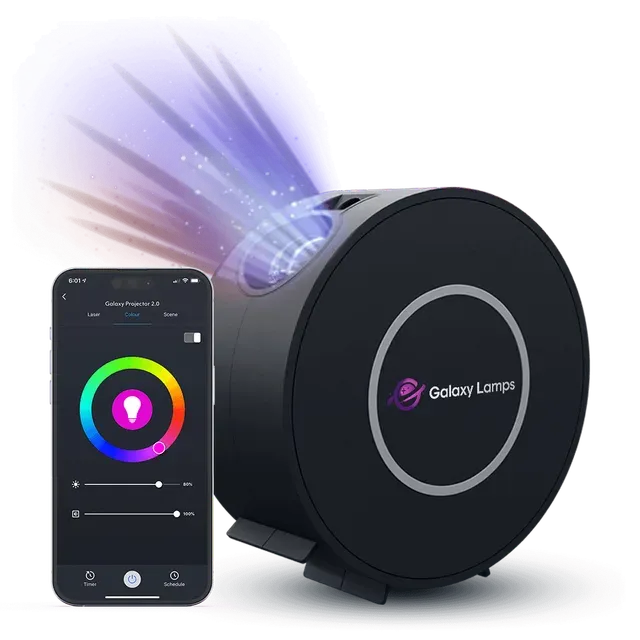
Competent LED nebula + speaker in a black cylinder - fine, but outclassed on both sides.
Best for: Cord-free placement needs - camping, bathrooms, outlets-less corners.
- 360-degree projection from the cylinder form - covers more ceiling than spheres.
- Built-in speaker and app control - an all-in-one nightlight.
- Rechargeable battery - usable in tents and bathrooms with no outlet.
- $59.99 buys a nebula that's noticeably softer-focus than the $40 BlissLights.
- Speaker quality is laptop-tier - fine for white noise, not music.
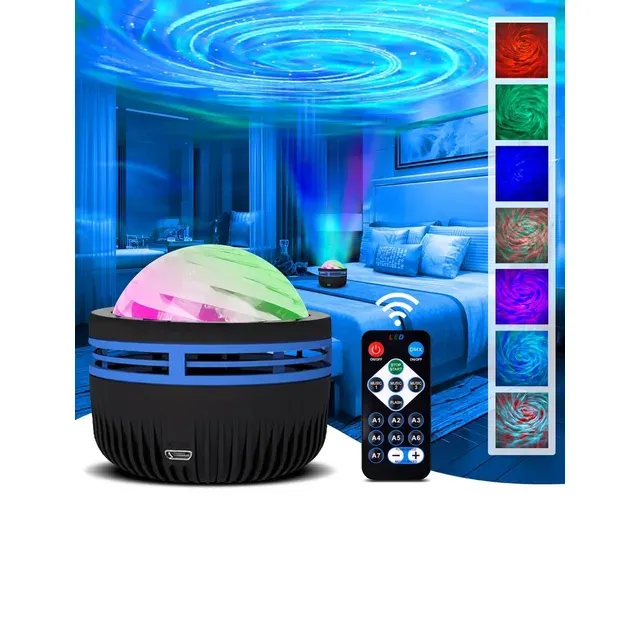
The archetypal dropship dome - one blurry LED ring, a remote, and no stars at all.
Best for: Nobody - spend the extra $7 and get the Sky Lite Evolve.
- $32.99 and widely cloned - at least it's cheap.
- Simple remote, plug-in-and-go - no app required.
- No laser stars - it's one rotating LED ring behind diffuser plastic, more lava lamp than galaxy.
- Single soft aurora smear - the room looks like a screensaver, not the sky.
- Generic hardware sold under many names; support and longevity are coin flips.
| Criteria | POCOCO Galaxy Projector Top pick | BlissLights Sky Lite Evolve | Galaxy Lamps Galaxy Projector 2.0 | Encalife Northern Lights Projector |
|---|---|---|---|---|
| Verdict | Buy it | Buy it | It depends | Skip it |
| Best for | Astronomy-leaning giftees, nurseries that need real stars, and anyone who finds LED blobs tacky. | Teens, dorm rooms, gamers, and anyone wanting max vibe per dollar. | Cord-free placement needs - camping, bathrooms, outlets-less corners. | Nobody - spend the extra $7 and get the Sky Lite Evolve. |
| Price tier | $$ · mid-range | $ · budget | $$ · mid-range | $ · budget |
| Price (street) | $99.99 (+$45 disc sets) | $39.99 | $59.99 | $32.99 |
| Projection tech | Optical film discs (planetarium-style) | LED nebula + green laser dots | 360-degree LED nebula, no laser | Single LED ring behind diffuser |
| Real star field | Yes - constellation-accurate discs | Laser dots, not constellations | No - nebula only | No - aurora smear only |
| Controls | On-unit + timer | App + voice + timers | App + speaker + battery | Remote only |
| Verdict | Buy - the only real stars under $150 | Buy - best nebula per dollar | It depends - fine but midpack | Skip - lava lamp in disguise |
Which one is right for you?
- Astronomy-leaning giftees, nurseries that need real stars, and anyone who finds LED blobs tacky. Buy it POCOCO Galaxy Projector
- Teens, dorm rooms, gamers, and anyone wanting max vibe per dollar. Buy it BlissLights Sky Lite Evolve
- Cord-free placement needs - camping, bathrooms, outlets-less corners. It depends Galaxy Lamps Galaxy Projector 2.0
- Nobody - spend the extra $7 and get the Sky Lite Evolve. Skip it Encalife Northern Lights Projector
How we judged the field
We split the market the way it’s actually built: optical disc projectors that show real stars versus LED mood lamps that make colored clouds. Each was judged on ceiling coverage, star sharpness, controls, and whether a gift recipient would still use it in month three.
POCOCO is the only sub-$150 projector here that works like a planetarium: an LED behind a photographic film disc, focused through a glass lens, throwing a true star field onto the ceiling. The stars are sharp points in real constellation arrangements - not dots where the software felt like putting them. It rotates slowly and silently, has a real auto-off timer, and the disc library (Milky Way, planets, deep-sky objects) is the retention engine most galaxy lamps lack. The catch is the model: $99.99 gets one disc, and the $45 disc sets are where the hobby expands. If the giftee owns a telescope or names constellations unironically, this is the one.
The Evolve is the product that made “galaxy projector” a phrase: a sphere that blends red, blue, pink and purple LEDs into a drifting nebula, then layers green laser stars on top. Nothing else at $40 produces clouds this smooth - the patented color blending avoids the harsh band edges cheaper lamps show. It’s a mood light, full stop: the stars are laser dots, not constellations, and full control lives in the app. For dorms, game rooms, and kids who want their room to look like the internet, this is the answer.
The 2.0 is a competent middle option that got squeezed from both sides. Its cylinder throws nebula 360 degrees around the room - more coverage than the Evolve’s directional sphere - and it adds a speaker and battery, making it the only one that works unplugged in a tent or bathroom. But the nebula itself is visibly softer and less saturated than BlissLights’, and $60 is a hard price when the class leader costs $40. The honest niche: cord-free placement.
This is the category’s warning label: a generic dome lamp (sold under half a dozen brand names) that projects one rotating LED ring through diffuser plastic. There are no laser stars, no discs, no real color separation - just a blurry aurora smear that turns a bedroom into a screensaver. At $33 it costs within $7 of the BlissLights that does ten times more. This is what people buy, use twice, and put in a drawer.
POCOCO vs Sky Lite Evolve: which should you buy?
They’re not actually competing - they do different jobs. The POCOCO is for someone who wants to look at stars: real constellations, planetarium-style, quiet and sleepy. The Evolve is for someone who wants their room to feel like a vibe: swirling nebula color, app scenes, laser sparkle. Astronomer or aesthetic - pick by that question alone, and the price difference becomes irrelevant.
What to look for in a galaxy projector
- Projection mechanism first. Film-disc optical systems show real stars; LED-rgb units show clouds. The listing photos always hide this - read for the word “disc.”
- Laser stars vs no laser. Laser dots are the sharpest “stars” LED lamps get, but they’re speckle, not constellations. Some people love them; know which you’re buying.
- Timers. A galaxy projector is a fall-asleep device; a real auto-off timer is mandatory. App-only timers fail the “kid can use it” test.
- Content retention. The best units (POCOCO’s discs, BlissLights’ app scenes) keep novelty past week two; one-effect domes are drawer-bound by March.
Our final take
The POCOCO is the gift for anyone with genuine sky interest - real stars, real constellations, silently rotating overhead. The Sky Lite Evolve is the crowd-pleaser: $40, instant wow, zero astronomy required. Buy the Galaxy Lamps 2.0 only if an outlet-free room demands it, and leave the Encalife dome on the shelf where the entire dropship category belongs.
Questions, answered
What's the difference between a star projector and a galaxy projector?
A true star projector (like POCOCO or the old Sega Homestar line) shines pin-sharp constellations through a film disc. Most 'galaxy projectors' are LED mood lamps that project colored nebula clouds plus laser dots - pretty, but not the real sky.
Are laser stars safe for kids' rooms?
The lasers in BlissLights and similar are low-power Class 1/2 and safe for a ceiling, but any laser product shouldn't be pointed at eyes. If that makes you uneasy, disc projectors like POCOCO use plain LED light with no laser at all.
Can you leave a galaxy projector on all night?
Use the timer. All the LED units here have auto-off; falling asleep with the projector running nightly is fine, but run it on the timer to spare the LEDs.
Do the discs in optical projectors wear out?
Film discs don't degrade with normal use - the LED light source behind them will outlast your interest in the product. The discs themselves are scratchable film, so handle by the edges.
Deciding between the top two? See our head-to-head: POCOCO Galaxy Projector vs BlissLights Sky Lite Evolve.
More Tech & Gadgets reviews
 The Best Gaming Controllers: 4 Compared (and One to Skip)
  The Best Gaming Mechanical Keyboards: 4 Compared (and One to Skip)
  The Best Gaming Laptops: 4 Compared (and One to Skip)
  The Best Gaming Mice in 2026: Four Flagships Tested, One to Skip
  The Best Graphics Cards: 4 Compared (and One to Skip)
  The Best Graphics Tablets: 4 Compared (and One to Skip)