Explained
Dust Collectors, Explained
After reading, you'll understand the specs that decide which dust collector fits your shop.
In this guide
Dust collector listings are packed with numbers, and the biggest one, CFM, is the easiest to misread. First-time buyers often compare CFM across brands without noticing that each maker measures it differently, or buy a bag collector without checking its amp draw against their circuit. Filtration ratings are another trap, because a bag rated at 5 microns and a canister rated at 98% of 2 microns are not the same level of capture. This guide explains the terms in plain English.
The 30-second version
- CFM is worded differently by each maker, so compare figures only when the wording matches.
- Static pressure shows how well it pulls through hose, and not every maker publishes it.
- Bag, canister and cartridge filters differ, and the stated micron rating or percentage tells you which.
- Amp draw decides your circuit, so check it before you buy.
- Read the manual in full, because the maker's safety instructions are the authority.
The products this guide is about
Our verdict on each, with the full reasoning on the companion review.
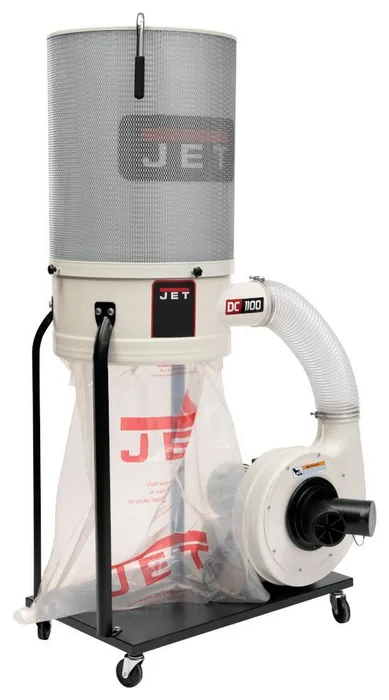
- Buy JET DC-1100VX-CK 1-1/2 HP Dust Collector with 2-Micron Canister Kit A 1-1/2 HP collector with a canister filter rated at 98% of 2 micron particles and a 5 year warranty.
- Buy Rikon 60-150 1.5 HP Dust Collector A 1.5 HP collector that lists 1,046 CFM at a 4 inch inlet and a 5 year warranty at a mid-range tier. Amazon
- Buy Laguna C|Flux 1 Cyclone Dust Collector A 1.5 HP cyclone with a 1 micron cartridge, a 25 gallon drum and a remote, for shops that want chips kept out of the filter. Amazon
- It depends Shop Fox W1685 1-1/2 HP Dust Collector Lists 1,280 CFM and a 40 gallon bag capacity, with a 16 amp draw at 110 V.
- It depends WEN DC3401 5.7-Amp 660 CFM Rolling Dust Collector with 12-Gallon Bag A compact 5.7 amp unit that lists up to 660 CFM, weighs 17 lb and can mount on a wall. Amazon
- Skip POWERTEC DC5372 Portable Dust Collector with 1 Micron Filter Bag Lists 560 CFM from a 1 HP motor drawing 12 amps at 120 V, with a maker note that debris can clog the intake grate. Amazon
What actually matters
- CFM - Cubic feet of air per minute, the headline airflow figure. Makers state it under different conditions, so a bare number is only a starting point.
- Static pressure - How hard the impeller can pull against resistance from hose and fittings, listed in inches of water. A higher number helps with longer runs.
- Micron rating - The particle size a filter is designed to catch. A percentage at a stated size, such as 98% of 2 micron, is more informative than a bare micron figure.
- Single-stage versus cyclone - A single-stage unit passes air and chips through the impeller into the bag. A cyclone separates chips into a drum before air reaches the filter.
- Amp draw - How much current the motor pulls at a given voltage. It decides whether the collector suits your shop circuit.
- Inlet size - A 4 inch port suits one machine, and a 6 inch inlet with a Y fitting can serve two.
- Collection volume - Bag or drum capacity decides how often you empty it.
The specs, in plain English
Green flags vs red flags
Green flags
- The maker lists CFM with clear wording, such as the inlet size it was measured at
- A filter rating that includes a percentage at a stated micron size
- A listed amp draw and voltage that match your shop circuit
- A stated warranty period and downloadable manual
- Static pressure, weight and collection volume are all published
Red flags
- A CFM number with no inlet size or test condition
- A bare micron rating with no efficiency percentage
- No amp draw or electrical rating on the listing
- No warranty or weight stated
- Priced above a comparable unit while listing lower airflow
Who's who: the brands
- JET - A woodworking and metalworking brand that sells through distributors and lists a 5 year warranty on woodworking machinery.
- Rikon - Known for 1 to 2 HP bag collectors and a 5 year warranty on the 60-150.
- Laguna - Makes the C|Flux cyclone line and the DC:15 bag collector.
- Shop Fox - A Grizzly-family brand, sold on Grizzly's site, with 1-1/2 HP collectors like the W1685.
- WEN - Budget-tier collectors from compact portables to a 1,300 CFM bag unit.
How to read a listing without getting fooled
Start with the motor line and note both voltage and amps, since that is what your circuit must supply. Then find the airflow figure and read the wording around it, because a maximum figure and a measured-at-the-inlet figure differ. Next check the filter: look for a micron rating and, ideally, an efficiency percentage. Finish with inlet size, collection volume, weight and warranty, and compare only figures the maker states. A missing figure is information too.
How much should you spend?
Compact portables sit at the budget tier, and 1 to 1-1/2 HP bag collectors sit in the mid-range. Canister kits and cyclones sit at the premium tier. A higher tier buys finer filtration, a cyclone drum or a longer warranty, not always more airflow. Compare listed airflow and filtration, not just the tier, and be wary of a higher tier that lists less airflow than a cheaper unit.
Questions, answered
Do I need a 6 inch inlet?
A 6 inch inlet suits larger machines and longer runs, and several collectors here pair it with a Y fitting that splits to two 4 inch ports. A single 4 inch port, as on the WEN DC3401, serves one small machine. Match the inlet to your machine's dust port.
What is the difference between a dust collector and a shop vacuum?
A dust collector moves a large volume of air at lower suction through a wide hose, while a shop vacuum moves less air at higher suction through a narrow one. Makers sell them for different jobs. This guide covers collectors that makers sell as dust collectors.
Can I add a cyclone to a single-stage collector?
Some makers sell separator kits, and POWERTEC lists a cyclone separator kit that connects to a shop vacuum and tool ports. Check the kit's stated hose sizes and your collector's inlet before buying.
How do I know what circuit I need?
Use the amp figure the maker lists at your voltage and compare it with your circuit. The units here range from 5.7 amps to 18.8 amps at 110 V. If unsure, ask an electrician and follow the manual.
Or jump to the head-to-head: JET DC-1100VX-CK 1-1/2 HP Dust Collector with 2-Micron Canister Kit vs Rikon 60-150 1.5 HP Dust Collector.