Explained
Drill Presses, Explained
After reading, you'll understand what swing, travel, taper and speed range mean and how to compare machines fairly.
In this guide
Drill press spec sheets mix inches, millimeters, horsepower and amps, and makers define some terms differently. First-time buyers often compare swing numbers that mean different things or skip the warranty line. This guide explains the terms in plain English so you can compare machines from different makers.
The 30-second version
- Swing is a width, so a 15 in. swing reaches about 7-1/2 in. in from the edge.
- Spindle travel is depth, the distance the bit can move in one pass.
- Speed range matters more than speed count, because a wide range lets you drill both wood and metal.
- The chuck and taper set your bit choices, so check both before you buy accessories.
- A missing spec is information, so a page that omits travel or warranty deserves caution.
The products this guide is about
Our verdict on each, with the full reasoning on the companion review.
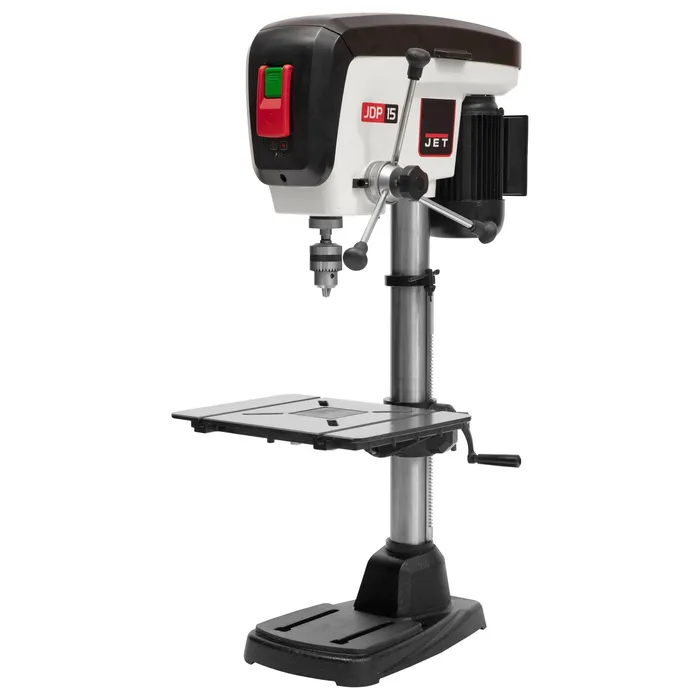
- Buy JET JDP-15B 15-Inch Benchtop Drill Press The biggest swing and table here, with a 5-year warranty badge and a one-handed belt change. Amazon
- Buy WEN 4214T 12-Inch Variable Speed Drill Press Mechanical variable speed with a digital RPM readout, laser and light, at a mid-range tier.
- Buy Grizzly T33901 14-Inch Benchtop Drill Press A 3/4 HP, 14 in. swing machine with 12 speeds and the longest spindle travel of the belt-drive group.
- It depends Rikon 30-120 13-Inch Benchtop Drill Press A 16-speed, 1/2 HP benchtop with a round swiveling table and a 5-year warranty.
- It depends NOVA Viking 16-Inch DVR Benchtop Drill Press A direct-drive electronic variable speed machine with a 4.5 in. quill stroke, an electronic depth stop and no belts.
- Skip SKIL DP9505-00 10-Inch Benchtop Drill Press A compact 5-speed press with laser and light, but a thin spec sheet and a small table. Amazon
What actually matters
- Swing - the distance from the chuck center to the column, doubled. It decides how wide a piece you can drill through its middle.
- Spindle travel - how far the quill moves down in one pass. Deeper holes need longer travel or a table you can lower.
- Speed range - the slowest and fastest RPM. Large bits and metal want slower speeds, small bits in wood want faster ones.
- Chuck size - the biggest shank the chuck holds, such as 1/2 in. or 5/8 in. A bigger chuck accepts bigger bits.
- Spindle taper - the cone, such as MT2 or JT3, that the chuck seats on. It sets which chucks and accessories fit.
- Table size and tilt - the working surface and how far it tips. A big table clamps work easily, and tilt allows angled holes.
- Warranty - the time the maker covers the machine. Terms differ, so read the maker's warranty page.
The specs, in plain English
Green flags vs red flags
Green flags
- The maker lists swing, travel, speed range, motor and warranty on the page
- A 5/8 in. chuck and a stated spindle taper
- A table with T-slots or edge lip for clamping
- A manual and parts list linked from the product page
- A stated warranty with a clear length
Red flags
- No speed range or number of speeds listed
- No stated spindle travel or taper
- A swing figure labeled only as capacity
- No warranty on the page
- A product page that shows the model as sold out
Who's who: the brands
- JET - Part of JPW with Powermatic, known for benchtop and floor drill presses with 5-year warranty badges.
- WEN - Sells mid-range benchtop presses with lasers and lights and a 2-year warranty.
- Grizzly - Sells many drill presses, with Shop Fox in the same family, and often lists detailed specs.
- Rikon - Lists a range from 8 in. to 34 in. radial models with a 5-year warranty.
- NOVA - The Teknatool brand known for DVR electronic variable-speed drill presses.
How to read a listing without getting fooled
Start with swing, spindle travel and the speed range, then check the motor, chuck and spindle taper. Next look at the table size and whether it tilts. Finish with the warranty and the manual link. If a figure is missing, assume the maker did not publish it rather than that it is good. Compare inches to inches and watch for terms such as capacity that are not swing.
How much should you spend?
Compact budget presses sit at the lowest tier, and the mid-range tier covers most 12 in. to 14 in. benchtop machines with lasers and lights. Premium tiers add larger tables, longer warranties or electronic speed and depth control. Extra money buys capacity and polish, not necessarily a better hole, so match the tier to how often you drill.
Questions, answered
Can a drill press drill metal?
Makers such as WEN and SKIL describe drilling wood, metal and other materials, and Grizzly lists a 5/8 in. mild steel capacity. Metal wants slower speeds and secure clamping. Follow the manual's speed chart and use the cutting guidance it gives.
Benchtop or floor model?
A benchtop press sits on a bench and takes less floor space, while a floor model stands on its own and usually has a longer column. Some makers sell both, such as NOVA with its Viking line. Choose by where you will put it.
What does DVR mean on the NOVA?
NOVA calls its motor technology Digital Variable Reluctance. The maker describes a direct-drive motor with no belts or pulleys, with speed controlled electronically. That is the feature that sets NOVA apart from belt-drive presses.
Do I need a laser guide?
A laser shows where the bit will land, which some people like. JET, WEN, Grizzly, NOVA and SKIL list one, while Rikon's feature list does not. It is a convenience, so choose on swing, speed and warranty first.
Or jump to the head-to-head: JET JDP-15B 15-Inch Benchtop Drill Press vs WEN 4214T 12-Inch Variable Speed Drill Press.