Explained
Drafting Chairs, Explained
After reading, you'll understand exactly which numbers to look for on a tall chair's spec sheet, why the footring matters more than the upholstery, and when a drafting chair is the wrong product entirely.
In this guide
Most people buy a drafting chair after buying a tall desk or bench and discovering their office chair does not go high enough. Then they buy on looks, get something that reaches, and find their legs go numb after an hour. The reason is almost always the same: nothing supports their feet. Once you know which three or four numbers to check, the category becomes easy to shop and the marketing becomes easy to ignore.
The 30-second version
- Height range is the whole product, so if a seller will not publish it in inches, that is the answer to your question.
- The footring must adjust, because a ring welded at one height fits one leg length and gets in everyone else's way.
- Aim for the middle of the range, since a cylinder at full extension leaves you no room to fine tune later.
- Casters are floor-specific, with hard casters made for carpet and soft roll-control casters made for hard floors and chair mats.
- A standing desk may not want a drafting chair, because a perch or lean stool is a different, and often better, tool for that job.
The products this guide is about
Our verdict on each, with the full reasoning on the companion review.
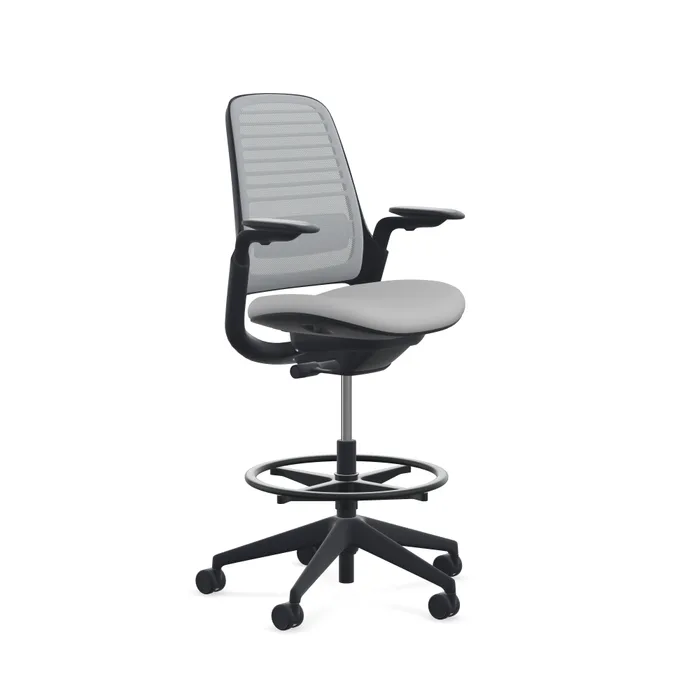
- Buy Steelcase Series 1 Stool A contract task stool with a genuinely adjustable foot ring and specs Steelcase actually publishes. Amazon
- Buy HON Ignition Task Stool The tallest stool here, with an adjustable footring and a lifetime warranty, for a fraction of the contract-premium price. Amazon
- It depends UPLIFT Desk Engage Stool Not a drafting chair at all, but a perch stool that suits standing desk users better than a drafting chair does.
- Skip Modway Edge Drafting Chair A mesh task chair on a tall cylinder, sold as a drafting chair, with almost none of the numbers that matter published. Amazon
What actually matters
- Seat height range - the pair of numbers that decides whether the chair reaches your surface at all. Take your surface height, subtract roughly 10 to 12 inches, and check the result falls inside the range with room to spare.
- Cylinder stroke - the total travel of the gas lift, which is what gives you fine adjustment once you are roughly right. Steelcase publishes 7.75 inches for the Series 1 Stool and HON publishes 9.75 inches for the Ignition Task Stool.
- Footring adjustability - the difference between a stool you can sit in all day and one you cannot. A ring that unlocks and slides on the column fits your leg length; one that is fixed fits whoever the factory had in mind.
- Base width - a tall seat raises your centre of gravity, so the footprint matters more than it does on a standard chair. Look for an overall width or base diameter in the specs and be suspicious when neither appears.
- Weight capacity - useful as a rough sizing signal, but read it alongside a named test standard rather than buying on the load rating alone.
- Caster type - hard casters roll on carpet, soft roll-control casters are the option for hard floors and chair mats, and glides are for when you do not want the chair to move at all.
- Named test standard - a maker that states conformance to ANSI/BIFMA X5.1 has had the chair tested as a complete assembly, which tells you more than any single number on the page.
The specs, in plain English
Green flags vs red flags
Green flags
- The seat height range is published in inches by the manufacturer, not just described as "drafting height".
- The listing or spec guide explicitly says the footring is height-adjustable, and ideally gives its diameter.
- A weight capacity is stated, alongside a named test standard such as ANSI/BIFMA X5.1.
- Caster options are offered and described by floor type, with hard casters for carpet and soft roll-control casters for hard floors.
- There is a real warranty with a stated term, and replacement cylinders, casters and footrings are available as parts.
Red flags
- No seat height range anywhere on the page, or a range that only appears in a marketplace listing title.
- A footring shown in photos but never described in the specs, which usually means nobody is claiming it adjusts.
- No weight capacity published, which makes it impossible to tell who the chair was designed for.
- Marketing that leans on "ergonomic" and "lumbar support" while omitting every dimension.
- A chair sold in both standard and drafting versions where the only stated difference is the cylinder, with no footring and no wider base.
Who's who: the brands
- Steelcase - Publishes full specification guides for its seating, including foot ring diameter and how it unlocks, which makes its stools the easiest in the category to shop on facts.
- HON - Contract-grade seating at lower prices, with the Ignition Task Stool listed as reaching 33 inches and covered by HON's lifetime warranty program.
- Humanscale - Makes the Freedom Saddle Stool, a saddle-seat option for raised work surfaces.
- UPLIFT Desk - Best known for standing desks, and its own-brand perch stools such as the Engage cover the sit-stand end of the category rather than true drafting height.
- Modway - Sells a large range of low-cost drafting chairs; dimensions are usually published but capacity, warranty and test standards generally are not.
How to read a listing without getting fooled
Start at the specification table, not the bullet points. Find the seat height range first and compare it against your surface height minus 10 to 12 inches; if that number is missing, stop there, because the seller is describing a chair rather than specifying one. Next look for the word adjustable next to footring, and be aware that photos showing a ring prove nothing about whether it moves. Then check for a weight capacity and a named test standard such as ANSI/BIFMA X5.1, and for a base or overall width that tells you how wide the footprint is. Note which caster is standard and whether an alternative is offered for your floor type. Finally, read the warranty for a stated term and check whether the maker sells cylinders, casters and footrings as spare parts, because a chair you can re-cylinder in five years is a different purchase from one you cannot.
How much should you spend?
Budget tier buys you a tall cylinder, a footring of unknown adjustability and usually no published capacity or test standard; it is fine for a chair that gets used an hour a week and disappointing for anything more. Mid-range is where the category becomes worth buying, with contract makers selling stool versions of their mainstream task chairs, published height ranges, adjustable footrings, 300 pound capacities and warranties measured in decades rather than months. Premium buys documentation and longevity more than extra reach: fully published specification guides, a wider choice of casters and bases, third-party certifications and a genuine spare parts supply. Perch and lean stools sit near the budget end because they are simpler objects, and if perching is what you actually want, that is money well spent rather than a compromise.
Questions, answered
What is the difference between a drafting chair and a bar stool?
A bar stool is usually a fixed-height seat with no cylinder, no swivel mechanism worth the name and no adjustment, designed for short sits. A drafting chair is a task chair on a long gas cylinder with a five-star rolling base, a footring and the same seat, back and arm adjustments you would expect at a desk. The distinction matters because working at a bench for hours needs the adjustment; leaning at a counter for twenty minutes does not.
Are drafting chairs bad for your back?
Not inherently, but sitting high with unsupported feet is, because your legs hang from the underside of your thighs and your pelvis loses a stable reference. That is what the footring fixes. A drafting chair with an adjustable footring set to your leg length, with the seat set so your forearms are roughly level with the work surface, is no worse than a good desk chair. One with no ring, or a ring at the wrong height, is considerably worse.
Can I convert my office chair into a drafting chair?
You can usually fit a longer cylinder, and kits exist that add a footring to a standard base, but you should think about what you end up with. The base was sized for a lower seat, the footring may not adjust, and whatever test standard the chair was certified to no longer describes the assembly you are sitting on. If your chair's manufacturer sells a factory stool version, that is a much better route. Otherwise buy a stool designed as one.
What if two people of different heights share the chair?
Look for the longest cylinder stroke you can find and, more importantly, a footring that is quick to adjust rather than one that needs a tool. Steelcase's Series 1 foot ring, for example, unlocks by rotating it counterclockwise, which takes seconds. Aim to set the chair up so both users land somewhere in the middle of the seat height range, not with one at the very bottom and one at the very top.
Or jump to the head-to-head: Steelcase Series 1 Stool vs HON Ignition Task Stool.