Explained
Fire Safe Ratings, Explained
After reading, you'll understand exactly what a fire rating on a safe promises, who tested it, and what it deliberately leaves out.
In this guide
Fire safe listings are written to sound interchangeable and are not. One safe's "1 hour fire protection" comes with a UL class number and a furnace curve behind it. Another's comes from the company that built it. First-time buyers usually compare the hours, which is the least informative number on the page, and never look at who signed off or what temperature the inside is allowed to reach. Those two details decide whether your passports, your deeds and your drives come out usable.
The 30-second version
- The class number is the interior ceiling, so Class 350 means the inside stays below 350 degrees Fahrenheit and Class 125 means below 125.
- The hours come with a furnace temperature, with FireKing publishing up to 1550 F for a half hour, 1700 F for one hour and 1850 F for two.
- UL Listed and ETL Verified are not the same thing, because Intertek presents its Verified mark as a symbol of performance integrity for a specific claim, not as a UL fire class.
- Paper and media need different safes, since UL 72 adds Class 150 and Class 125 with humidity limits specifically for tapes, film and disks.
- A safe is a one-fire product, which is why manufacturers offer after-fire replacement instead of telling you to keep using it.
The products this guide is about
Our verdict on each, with the full reasoning on the companion review.
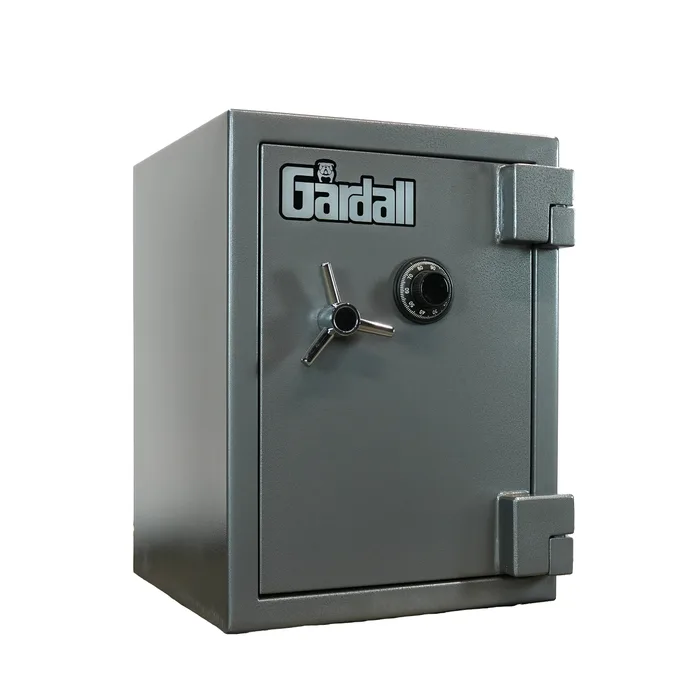
- Buy Gardall FB2013 Fire/Burglary Safe One of the few home-office-sized safes whose maker names a U.L. 1 hour fire label and a U.L. RSC burglary label on the specific model.
- Buy SentrySafe STW123GTC Digital Fire/Water Safe The value pick: a UL Classified 2 hour fire rating plus an ETL Verified water claim, in a box you can place without a safe dealer. Amazon
- It depends Hollon HDS-500E Data Safe Built around a 125 degree F interior instead of 350, which is the only reason to buy it and the only reason it costs what it does. Amazon
- Skip FireKing 1-Hour Fire-Rated Safe (KF0915-1WHE) A capable steel box from a serious records brand, sold with a fire rating that FireKing's own ratings page files under "Manufacturer's Ratings".
What actually matters
- Issuing body - UL, Intertek and the manufacturer are three different levels of assurance for identical-sounding words. Check whether the listing names a lab or just says the safe was tested.
- Class number - This is the maximum interior temperature the unit is allowed to reach during the test. Without it, a duration tells you how long and not what survives.
- Rated duration - A half hour, one hour and two hour rating each correspond to a different furnace temperature curve, so longer is genuinely hotter, not just longer.
- Explosion test - UL 72 includes a test where a cold unit goes into an already-hot furnace to confirm it does not burst from trapped steam.
- Impact rating - The fire and impact test drops a heated unit 30 feet onto brick and concrete, then reheats it, which is the only test that models a floor collapsing under the safe.
- Water rating - UL 72 fire classes say nothing about water, so water claims are verified against a stated depth and time rather than certified to a fire class.
- Anchoring - Bolting down is a theft control and plays no part in any fire rating, but an unanchored safe is a safe someone can carry to a quieter place and open at leisure.
The specs, in plain English
Green flags vs red flags
Green flags
- The listing names a class and a duration together, such as UL Class 350 1-hour, rather than hours alone
- The fire label is tied to a specific model number rather than to a whole product family
- A water claim is stated as ETL Verified with a depth and a time attached
- The maker publishes an impact rating if the safe is meant for an upper floor
- There is a center bolt-down hole with anchoring hardware included in the box
Red flags
- "Fireproof" with no duration, no class and no lab named anywhere on the page
- "Tested to UL standards" or "meets UL requirements" instead of UL Listed or UL Classified
- Drive, phone and memory card storage promoted on a safe with only a paper-level rating
- Water resistance described as designed or intended rather than tested or verified
- A rating badge that uses the brand's own name as the verifying authority
Who's who: the brands
- Gardall - A US safe maker that lists which specific models carry a U.L. fire label and which carry only a foreign standard label, which is unusually transparent.
- FireKing - An office records brand that publishes its UL, Intertek ETL and in-house rating tiers side by side, so the badge on a product tells you which tier it sits in.
- SentrySafe - The mainstream retail brand, generally pairing a UL Classified fire duration with an ETL Verified water claim on its fire and water models.
- Hollon - Known for data and media safes built to 125 degree interior targets, with fire ratings credited to a KSG certification rather than UL.
- Honeywell - A licensed consumer safe line sold through mainstream retailers.
How to read a listing without getting fooled
Start at the bottom of the listing, not the top. Find the sentence that names a testing body and read exactly what it covers, because a page will often carry a UL fire claim, an ETL water claim and a marketing sentence about digital media that has no lab behind it at all. Then look for two numbers together: a duration and a class. A duration on its own is a marketing figure. Next check whether the rating is attached to the model you are buying or to the series, since some makers label only certain models in a family. Finally, scan the specification table for an anchoring hole, a weight, and any mention of an impact rating, and treat anything phrased as "designed to" or "intended to" as a description of intent rather than a test result.
How much should you spend?
Budget units get you a steel box, an hour or so of insulation, and a rating the manufacturer wrote. That is fine for a spare set of copies and poor value for anything you would grieve. The mid-range is where the market actually is: a UL Classified fire duration, an ETL Verified water claim, bolt-down hardware, and a weight you can place without a safe dealer. That combination covers most home offices and it is where we would spend. Premium buys you two things and you should know which one you are paying for: either a model-specific UL fire label alongside a UL burglary label, or a media-class interior target of 125 or 150 degrees. Those are different products for different fears, and paying premium money for a vague rating gets you neither.
Questions, answered
What is the difference between UL Listed, UL Classified and "tested to UL standards"?
UL Listed means UL tested the product against a published standard and it appears in UL's directory. UL Classified means UL evaluated it for specific properties or hazards rather than everything about it, which is the wording most consumer fire safes use. "Tested to UL standards", "meets UL requirements" and similar phrases are written by the manufacturer and mean UL was not necessarily involved at all. The first two put a lab's name on the claim and the third does not.
Why do fire ratings mention furnace temperatures like 1700 F when the rating is 350?
Those are two different sides of the same test. The furnace temperature is what the outside of the safe is exposed to, following a rising curve, and the class number is the ceiling for what the inside is allowed to reach. FireKing publishes the pairing on its own ratings page: up to 1550 F outside for a half hour rating, 1700 F for one hour and 1850 F for two hours, with the interior held below 350 F throughout. A longer rating is therefore a hotter test as well as a longer one.
Do fire safes keep water out?
Only if they say so specifically, and even then the claim is narrower than "waterproof" suggests. A verified water claim comes with its own stated limits: SentrySafe's STW123GTC states 8 inches of water for up to 24 hours, and FireKing describes its ETL water rating as a sprinkler spray test. Anything phrased as designed or intended to resist water may have no test behind it. This matters because the fire gets extinguished with water, so heat protection alone can leave you with pulped documents.
What is the 30-foot impact test for?
It models the safe falling through a floor while a building burns. In UL's fire and impact test the unit is heated, dropped 30 feet onto a base of brick and concrete, then inverted and reheated for at least another half hour, and the contents still have to come out usable. It is an optional add-on to a fire rating rather than part of every one, so most consumer safes do not carry it. If your safe will sit anywhere above ground level, it is worth looking for.
Or jump to the head-to-head: Gardall FB2013 Fire/Burglary Safe vs SentrySafe STW123GTC Digital Fire/Water Safe.