

Office & WFH
The Best Fire Rated Safes: 4 Compared (and One to Skip)
We compared four safes on the thing the marketing rarely spells out: who issued the fire rating, what interior temperature it guarantees, and how long.
The short version
The Gardall FB2013 is the pick if you want the rating to mean something: Gardall publishes a U.L. 1 hour fire label plus a U.L. RSC burglary label on this exact model, which is a rare combination in a safe you can put in a home office. The SentrySafe STW123GTC is the value choice, with a UL Classified 2 hour rating at up to 1850 degrees F and an ETL Verified water claim of 8 inches for 24 hours, without a dealer delivery. The Hollon HDS-500E is the one to consider only if you are storing drives and cards, because it targets a 125 degree F interior instead of 350, though Hollon cites a KSG certification rather than UL. Skip the FireKing 1-Hour Fire-Rated Safe: FireKing's own ratings page separates UL ratings, Intertek ETL ratings and "Manufacturer's Ratings", and this safe sits in the third group while the brand's file cabinets carry UL Class 350. Whatever you buy, assume the safe is spent after one fire and that water is a separate problem from heat. Best for: anyone who wants to buy a fire rating they can actually verify rather than a word on a sticker.
Our picks at a glance
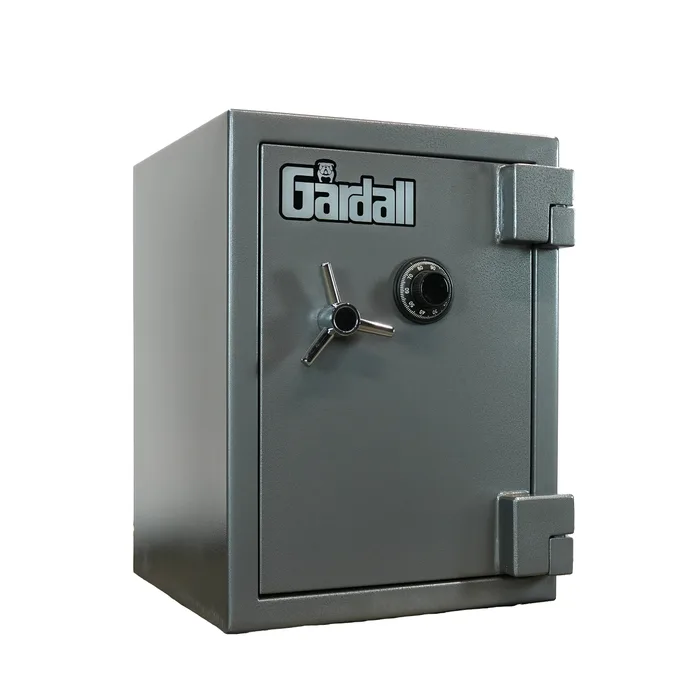
- Gardall FB2013 Fire/Burglary Safe - Buy. One of the few home-office-sized safes whose maker names a U.L. 1 hour fire label and a U.L. RSC burglary label on the specific model.
- SentrySafe STW123GTC Digital Fire/Water Safe - Buy. The value pick: a UL Classified 2 hour fire rating plus an ETL Verified water claim, in a box you can place without a safe dealer.
- Hollon HDS-500E Data Safe - It depends. Built around a 125 degree F interior instead of 350, which is the only reason to buy it and the only reason it costs what it does.
- FireKing 1-Hour Fire-Rated Safe (KF0915-1WHE) - Skip. A capable steel box from a serious records brand, sold with a fire rating that FireKing's own ratings page files under "Manufacturer's Ratings".
The verdict in 30 seconds
What mattered most
- Rated fire duration
- Who issued the fire rating
- Interior temperature ceiling
- Furnace temperature stated
- Impact (30 ft drop) rating
- Water rating
Almost every safe sold today says "fire rated" somewhere on the box, and almost none of those words mean the same thing. A UL 72 Class 350 label is a specific furnace test with a specific interior temperature ceiling. "ETL Verified" is a third party confirming a claim the manufacturer wrote. And a brand's own "verified" badge is the brand testing itself. We picked four currently sold safes that sit in four different spots on that ladder, and judged them on the rating language their own makers publish.
One of the few home-office-sized safes whose maker names a U.L. 1 hour fire label and a U.L. RSC burglary label on the specific model.
Best for: Someone who wants the fire rating and the burglary rating to both come from UL, and has a ground floor or slab to bolt it to.
- Gardall's own series page lists a U.L. 1 hour fire label for the FB2013 by model number, not as a family-wide claim
- Also carries a U.L. RSC burglary label, so the theft claim is third party too
- Center bolt-down hardware included, and a 2 inch door and 3 inch body in composite construction
- Gardall does not list a water rating for the FB series, so sprinkler and hose water is on you
- Its heavy composite body makes placement a job for a dealer or a team
- No impact rating is listed, so an upper-floor install has no tested fall protection
- Typically sold through safe dealers rather than general retail, which makes it harder to buy on impulse
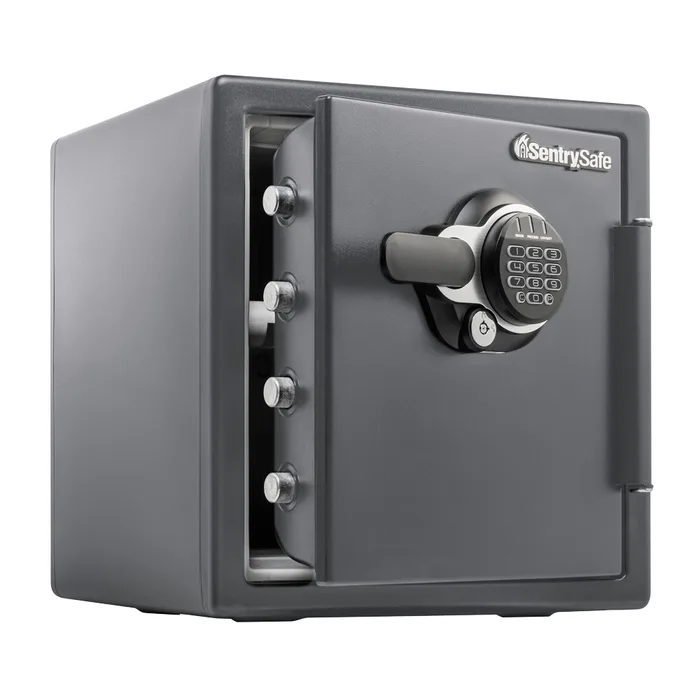
The value pick: a UL Classified 2 hour fire rating plus an ETL Verified water claim, in a box you can place without a safe dealer.
Best for: A home office that wants a long rated duration and a real water rating without paying dealer prices or moving a dealer-delivered safe.
- SentrySafe states UL Classified protection for 2 hours in up to 1850 degrees F, which SentrySafe calls its longest lasting fire protection
- ETL Verified water resistance in up to 8 inches of water for up to 24 hours, which most fire safes do not claim at all
- 128.2 lb with bolt-down hardware included and four 1 inch live-locking bolts
- SentrySafe publishes the duration and furnace temperature but not the UL class number, so you cannot read the interior ceiling off the listing
- The listing promotes storage of drives, memory cards and phones without a separate media class rating
- Some owners report problems with the digital keypad, so keep the backup key somewhere you can reach
- 1.19 cu ft fills up fast once binders and a document box go in
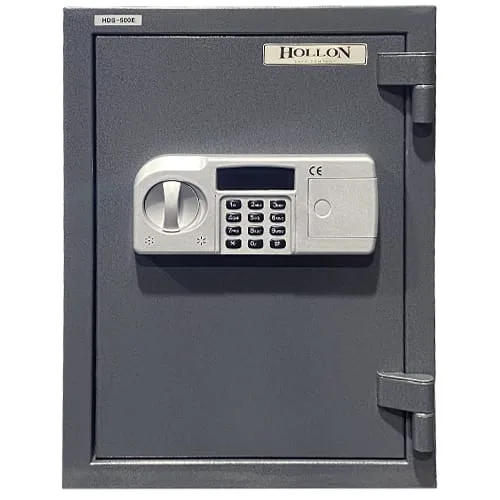
Built around a 125 degree F interior instead of 350, which is the only reason to buy it and the only reason it costs what it does.
Best for: Someone whose irreplaceable data lives on drives, cards or tapes and who has no usable offsite backup.
- Hollon rates it to hold a 125 degree F interior for one hour with 1850 degrees F outside, the threshold that matters for drives and cards
- Hollon lists 30 foot impact protection, which covers a fall through a burned floor
- Hollon lists protection against sprinklers, water and humidity, not just heat
- Hollon cites a KSG certification rather than a UL 72 Class 125 label, so the number is right but the issuing body is not UL
- Published interior is 11.25 by 4.75 by 7.25 inches, a very small usable space for 141 lb of safe
- Hollon's data safe feature list states no center bolt-down hole
- Paper documents do not need this much insulation, so most of the cost is wasted if drives are not the point
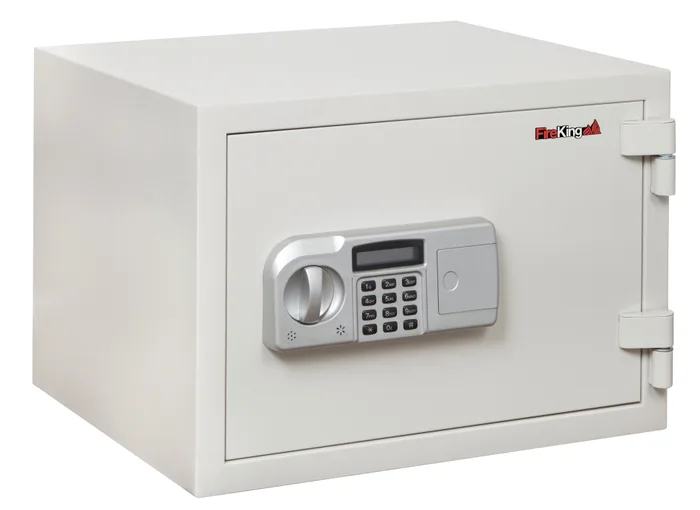
A capable steel box from a serious records brand, sold with a fire rating that FireKing's own ratings page files under "Manufacturer's Ratings".
Best for: Almost nobody at this price. If you want FireKing's insulation and after-fire guarantee, its UL Class 350 file cabinets carry the label this safe does not.
- Heavy steel body and bolt work, 125 lb, with live bolts and deadbolts rather than a privacy latch
- Covered by FireKing's free after-fire replacement guarantee, which is unusual at this size
- 0.97 cu ft, and a four-user programmable lock with manager override
- FireKing's product listing badges it "FireKing Verified 1-Hour Fire Rated", and the page says only that the safes were "tested to meet a UL 1-hour fire rating", with no lab named and no UL class line, while the brand's Turtle file cabinets are sold as 1-Hour UL
- FireKing's ratings page defines a separate "Manufacturer's Ratings" tier alongside its UL and Intertek ETL tiers, and describes its own water resistance as "designed to prevent water damage from sprinklers" rather than tested
- The published spec sheet lists no UL class, no impact rating and no interior temperature
- You are paying near the price of a UL-labeled unit for a rating with no named outside issuer
| Criteria | FB2013 Fire/Burglary Safe Top pick | STW123GTC Digital Fire/Water Safe | HDS-500E Data Safe | 1-Hour Fire-Rated Safe (KF0915-1WHE) |
|---|---|---|---|---|
| Verdict | Buy it | Buy it | It depends | Skip it |
| Best for | Someone who wants the fire rating and the burglary rating to both come from UL, and has a ground floor or slab to bolt it to. | A home office that wants a long rated duration and a real water rating without paying dealer prices or moving a dealer-delivered safe. | Someone whose irreplaceable data lives on drives, cards or tapes and who has no usable offsite backup. | Almost nobody at this price. If you want FireKing's insulation and after-fire guarantee, its UL Class 350 file cabinets carry the label this safe does not. |
| Price tier | $$$ · premium | $$ · mid-range | $$$ · premium | $$ · mid-range |
| Rated fire duration | 1 hour | 2 hours | 1 hour | 1 hour |
| Who issued the fire rating | UL, per Gardall's series page, by model | UL Classified, per SentrySafe | KSG certification, per Hollon | FireKing's own manufacturer rating |
| Interior temperature ceiling | Not stated on series page | Not published | 125 F | Not published |
| Furnace temperature stated | Not published | Up to 1850 F | 1850 F | Not published |
| Impact (30 ft drop) rating | Not listed | Not listed | Listed by Hollon | Not listed |
| Water rating | None listed | ETL Verified, 8 in for 24 hr | Sprinkler, water and humidity, per Hollon | "Designed to" resist sprinklers, per FireKing |
| Anchoring | Center bolt-down, hardware included | Bolt-down hardware included | Spec list states no center bolt-down hole | Not listed on the spec sheet |
| Weight and capacity | Not published on series page | 128.2 lb, 1.19 cu ft | 141 lb, small media interior | 125 lb, 0.97 cu ft |
Which one is right for you?
- Someone who wants the fire rating and the burglary rating to both come from UL, and has a ground floor or slab to bolt it to. Buy it Gardall FB2013 Fire/Burglary Safe
- A home office that wants a long rated duration and a real water rating without paying dealer prices or moving a dealer-delivered safe. Buy it SentrySafe STW123GTC Digital Fire/Water Safe
- Someone whose irreplaceable data lives on drives, cards or tapes and who has no usable offsite backup. It depends Hollon HDS-500E Data Safe
- Almost nobody at this price. If you want FireKing's insulation and after-fire guarantee, its UL Class 350 file cabinets carry the label this safe does not. Skip it FireKing 1-Hour Fire-Rated Safe (KF0915-1WHE)
How we judged the field
Five things decide whether a fire rating is worth anything. First, who issued it: UL and Intertek are outside labs, and a brand’s own badge is the brand grading its own homework. Second, the class number, because that is the interior temperature ceiling and it is the only part of the rating that tells you what survives. Third, the duration, which comes with a furnace temperature attached: FireKing publishes up to 1550 F for a half hour, 1700 F for an hour and 1850 F for two hours on its UL 350 ratings. Fourth, whether there is an impact rating, because UL’s fire and impact test drops a heated unit 30 feet onto brick and concrete and then reheats it, which is the only test that models a safe falling through a burned floor. Fifth, water, because the fire gets put out with water and heat ratings say nothing about that.
The field splits cleanly along the first of those. At the top are units where the maker names a UL label against a specific model number, which is rarer than the marketing suggests. Below that are units with a UL Classified fire claim and an ETL Verified water claim, where a lab was involved but the class number is not printed. Then there are media safes, which chase a 125 or 150 degree interior instead of 350 and cost accordingly. At the bottom are safes rated by the company that built them. We took one of each: a Gardall FB2013, a SentrySafe STW123GTC, a Hollon HDS-500E and a FireKing KF0915-1WHE.
Gardall FB2013 Fire/Burglary Safe
Buy itGardall’s FB series page does something most safe listings avoid: it names which models carry which label. The text reads that all the safes carry a U.L. RSC burglary label and a one hour K.S. fire label, and that models FB1212 and FB2013 additionally carry a U.L. one hour fire label. That is the sentence you are paying for. It means an outside lab ran the furnace test, and separately that the box passed a UL tool-attack test. The FB series has a 2 inch door and 3 inch composite body, a glass re-locking system, a UL listed Group II combination lock and a center bolt-down hole with hardware. What it does not have is a published water rating or an impact rating. For a ground-floor office where the fire claim has to hold up, it is the honest choice.
SentrySafe STW123GTC Digital Fire/Water Safe
Buy itThe STW123GTC is the sensible answer for people who are not going to have a safe delivered by a dealer. SentrySafe states UL Classified protection for 2 hours in up to 1850 degrees F, which SentrySafe calls its longest lasting fire protection, and ETL Verified water resistance in up to 8 inches of water for up to 24 hours. That water rating is the part most fire safes cannot match, and it addresses the failure mode that actually ruins documents. It is 17.8 by 16.3 by 19.3 inches, 1.19 cu ft inside, 128.2 lb, with four 1 inch live-locking bolts, a pry-resistant hinge bar, a dual digital and key lock, and bolt-down hardware in the box. The gap is that SentrySafe publishes the time and the furnace temperature but not the UL class, so you cannot read the interior ceiling off the page, and the listing markets drive and phone storage without a media class behind it. Buy it for the duration and the water rating, not for the digital media wording.
Hollon HDS-500E Data Safe
It dependsThe HDS-500E exists for one reason: a 125 degree F interior. Hollon rates it to hold that for a full hour with 1850 F outside, and lists 30 foot impact protection plus resistance to sprinklers, water and humidity. If what you are protecting is a drive, a card or a tape, that is the number that matters, because those fail long before paper chars. The caveat is who says so. Hollon cites a KSG certification, not a UL 72 Class 125 label, so the target is right and the issuing body is not the one most buyers assume. The physical trade-off is steep as well: 141 lb and a 19.75 by 13.75 by 16.75 inch footprint buy you a published interior of 11.25 by 4.75 by 7.25 inches, and Hollon’s data safe feature list states no center bolt-down hole. It is the right safe for a narrow problem and the wrong safe for documents.
FireKing 1-Hour Fire-Rated Safe (KF0915-1WHE)
Skip itThis is a well-built box, and that is what makes it worth flagging. The KF0915-1WHE is 125 lb of steel with live bolts and deadbolts, 0.97 cu ft, a four-user programmable lock and FireKing’s free after-fire replacement guarantee. The problem is the rating. FireKing’s ratings page lists three tiers side by side: UL Ratings, Intertek ETL Ratings, and Manufacturer’s Ratings, the last of which reads simply that the device was tested to maintain an interior temperature below 350 F for one hour, with no lab named. On the storefront the Turtle file cabinets are badged “Rating UL Class 350” and the Safe-in-a-File is badged “Rating ETL Verified”, while this safe is badged “FireKing Verified 1-Hour Fire Rated” with no rating line, and the page copy says only that the safes were “tested to meet a UL 1-hour fire rating” without naming a lab. Its spec sheet lists no UL class, no impact rating and no interior temperature. The brand is telling you which tier this sits in, and it is not the one you want at this price.
Sources
Specs in this review come from these pages.
- UL Standards & Engagement - UL 72, Standard for Tests for Fire Resistance of Record Protection Equipment (shopulstandards.com)
- FireKing - Ratings and Certifications (fireking.com)
- Intertek - ETL Verified Mark (intertek.com)
- Gardall Safe Corporation - U.L. One-Hour Fire/Burglary Safes (gardall.com)
- Hollon Safe - Data Safes (hollonsafe.com)
- SentrySafe - STW123GTC Digital Fire/Water Safe (sentrysafe.com)
Gardall FB2013 Fire/Burglary Safe vs SentrySafe STW123GTC Digital Fire/Water Safe: which should you buy?
These two answer different questions. The Gardall FB2013 is the one to buy if you want the claim to be checkable: Gardall names a U.L. one hour fire label and a U.L. RSC burglary label against this model number, so both halves of what a safe is supposed to do have an outside signature on them. That verifiability costs you a heavy composite safe, a dealer purchase, and no published water or impact rating. The SentrySafe STW123GTC trades away the printed class number for a longer rated duration, a real ETL Verified water claim, and a 128.2 lb weight that does not need a safe dealer to place.
Choose on where the safe will live and what you are afraid of. Ground floor, slab underneath, documents that a lawyer or an insurer will want intact, and a willingness to deal with a safe dealer: buy the Gardall. Second floor apartment, sprinklers overhead, a burst pipe as likely as a fire, and a need to put it in place this weekend: buy the SentrySafe and accept that the class number is not published. If you find yourself splitting the difference by buying a heavier safe with a vaguer rating, you have bought the worst of both.
What to look for
- Read who issued the rating first: “UL Class 350” and “ETL Verified” name an outside lab, while “fire resistant”, “fire rated” and any brand-name “verified” badge can be the manufacturer’s own test.
- Look for the class number, not just the hour: the class is the interior temperature ceiling in degrees Fahrenheit, so a rating with a duration but no class tells you how long and not how hot inside.
- Match the class to the contents: Class 350 is for paper, and UL 72 has Class 150 and Class 125 because media, film and disks fail far lower and need a humidity limit as well.
- Treat water as a separate purchase: heat ratings say nothing about the hose, the sprinkler or the burst pipe, and a water claim like 8 inches for 24 hours only counts if a lab verified it.
- Check for an impact rating if the safe goes above a basement: UL’s fire and impact test drops a heated unit 30 feet onto brick and concrete and reheats it, which is the only part of the standard that models a floor collapse.
- Assume one fire and register the warranty: the insulation is consumed by the burn, which is why FireKing offers after-fire replacement rather than expecting you to reuse the unit.
Our final take
Buy the Gardall FB2013 if you want a fire rating with an outside signature on it, and accept that you will be arranging delivery and anchoring a heavy safe. Buy the SentrySafe STW123GTC if you want a long rated duration and a verified water claim you can place without a dealer, knowing the class number is not printed. The Hollon HDS-500E only makes sense if drives and cards are the point, because a 125 degree interior is a different product from a 350 degree one. Skip the FireKing KF safe: the brand publishes three rating tiers and puts this one in the tier it tests itself. Whatever you choose, back up anything digital somewhere else entirely.
Questions, answered
What does UL 72 Class 350 actually test?
UL 72 is the standard for fire resistance of record protection equipment, and the class number is the maximum interior temperature in degrees Fahrenheit that the unit is allowed to reach. Class 350 protects paper. The unit is loaded with sensors and paper, sealed, and put in a furnace that follows a rising temperature curve for the rated time. FireKing publishes the curve its UL ratings are tested against: up to 1550 F for a half hour rating, up to 1700 F for one hour, up to 1850 F for two hours. The interior has to stay under 350 F through the burn and the cool-down, and the paper inside has to come out usable.
Is ETL Verified the same as a UL rating?
No. Intertek presents the ETL Verified mark as a mark of performance integrity, confirming a specific performance claim rather than safety conformance, which is why it turns up for things like cable bandwidth and dishwasher cleaning. For safes it mostly turns up on water claims. That does not make it worthless. A third party still checked the stated claim. It just means "ETL Verified water resistance to 8 inches for 24 hours" is a verified claim, not a certified class.
Can I keep a USB drive or an SSD in a Class 350 safe?
You can put it in there, but the rating is not written to protect it. Class 350 only promises the inside stays under 350 F, and UL 72 has separate Class 150 and Class 125 ratings precisely because magnetic media, film and disks fail far below the point where paper starts to char. UL 72 also caps relative humidity for those two classes, not just temperature, because steam is as damaging to media as heat. Manufacturers split the same way: Hollon's data safes target a 125 F interior. Treat any drive in a Class 350 safe as a convenience copy, not a backup.
Can a safe be used again after it has been through a fire?
Plan on replacing it. The insulation in these units works by giving up bound moisture as steam when it heats, and once that has happened the material has spent what made it work. The clearest signal is what the manufacturers themselves offer. FireKing states that if a product is damaged by fire it will replace it at no charge. Nobody gives away free replacements for a product they expect you to keep using. Register the safe when you buy it so the guarantee is actually available to you later.
Does bolting a safe down help it in a fire?
Anchoring is a theft measure, not a fire measure. None of the tests behind these ratings involve the safe being fastened to anything: the furnace test, the explosion test and the impact test are all run on a free-standing unit. What does cover the fire scenario people worry about is the impact rating, where a heated unit is dropped 30 feet onto broken concrete and then reheated, which simulates the safe falling through a burned floor. If your safe will live above a basement, that rating matters more than the bolts. Bolt it down anyway, because an unanchored safe is a portable safe.
Deciding between the top two? See our head-to-head: Gardall FB2013 Fire/Burglary Safe vs SentrySafe STW123GTC Digital Fire/Water Safe.
More Office & WFH reviews
 The Best Fountain Pens: 4 Compared (and One to Skip)
  The Best Gaming Chairs: 4 Compared (and One to Skip)
  The Best Headphone Stands: 4 Compared (and One to Skip)
  The Best Home Printers: 4 Compared (and One to Skip)
  The Best Keyboard Switches: 4 Compared (and One to Skip)
  The Best Under-Desk Keyboard Trays: 4 Compared (and One to Skip)