

Office
The Best Keyboard Switches: 4 Compared (and One to Skip)
We compared four mechanical keyboard switches on what their makers actually publish: actuation force versus bottom-out force, actuation point and total travel, pin count, materials and rated life.
The short version
The Gateron Oil King is our overall pick because Gateron publishes a full data sheet for it, including a force-travel diagram, and the switch itself is a lubed 55 gf linear with a POM stem and an ink-blend base. The Akko Creamy Yellow U1 is the value pick, and it is unusually honest for a budget switch: Akko lists both a 45 gf operating force and a 55 gf end force, plus its own force-travel diagram. The Cherry MX2A Silent Red is the depends pick, genuinely useful if you share a room or a call, but its damped 3.7 mm stroke feels soft in a way not everyone likes. Skip the Cherry MX2A Blue unless you type alone and specifically want the click, because it is loud by design, rated for half the keystrokes of Cherry's MX2A Red, and it is the one Cherry switch on this list whose page does not claim factory lubrication. Before any of that, check your keyboard: hot-swap is a property of the PCB, and whether it takes 3-pin, 5-pin or both decides what you can buy. Best for: anyone who wants to choose a switch from its spec sheet instead of its colour.
Our picks at a glance
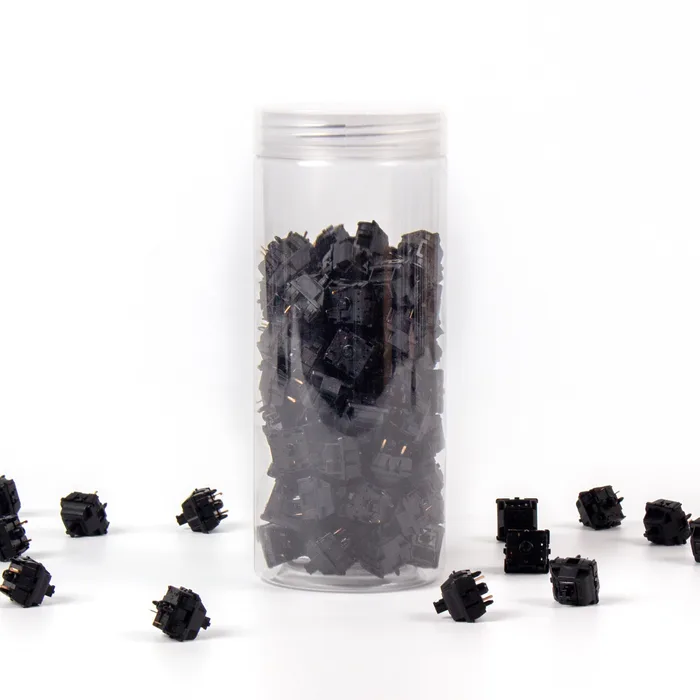
- Gateron Oil King Linear Switch Set - Buy. A factory-lubed 55 gf linear with a POM stem and an ink-blend base, and the most complete published spec of anything here.
- Akko Creamy Yellow U1 Switch (Lubed) - Buy. A lubed 45 gf linear sold in 100-piece packs that publishes both its operating force and its end force, which almost nothing at this price does.
- Cherry MX2A Silent Red - It depends. A damped linear that trades 0.3 mm of travel and a crisp bottom-out for a genuinely quieter keyboard.
- Cherry MX2A Blue - Skip. A well-built clicky switch that most people buy because blue sounds like what a mechanical keyboard is supposed to sound like, then regret in a shared room.
The verdict in 30 seconds
What mattered most
- Type
- Actuation force (as published)
- Bottom-out / end force
- Actuation point / total travel
- Pin count
- Stem and housing
Switch shopping goes wrong in two ways. The first is buying on a colour name instead of a spec sheet, so you end up with a switch that is heavier, louder or shallower than you expected. The second is buying a switch your keyboard physically cannot take, which is a pin-count problem, not a taste problem. We picked four switches that between them cover a smooth premium linear, a budget linear, a silenced linear and the clicky switch most first-time buyers regret, and we read every number off the manufacturer's own page or data sheet.
A factory-lubed 55 gf linear with a POM stem and an ink-blend base, and the most complete published spec of anything here.
Best for: Someone who wants a deep, smooth, quiet-ish linear and does not care about RGB.
- Gateron publishes pre-travel and total travel on the product page, plus a data sheet with an end force limit and a force-travel diagram.
- Ships lubed from the factory with a POM stem, PA66 nylon top and Gateron's ink-blend base.
- 5-pin construction seats firmly in a 5-pin PCB with no wobble from the plate alone.
- Rated up to 60M cycles, below the up to 100M Gateron claims for most G Pro 3.0 switches.
- The opaque housing means Gateron itself warns the backlight effect will not be very visible.
- If your board uses SMD LEDs, only unraised ones are supported, so some lit boards are out.
- The 5-pin legs have to be clipped if your board only has 3-pin sockets.
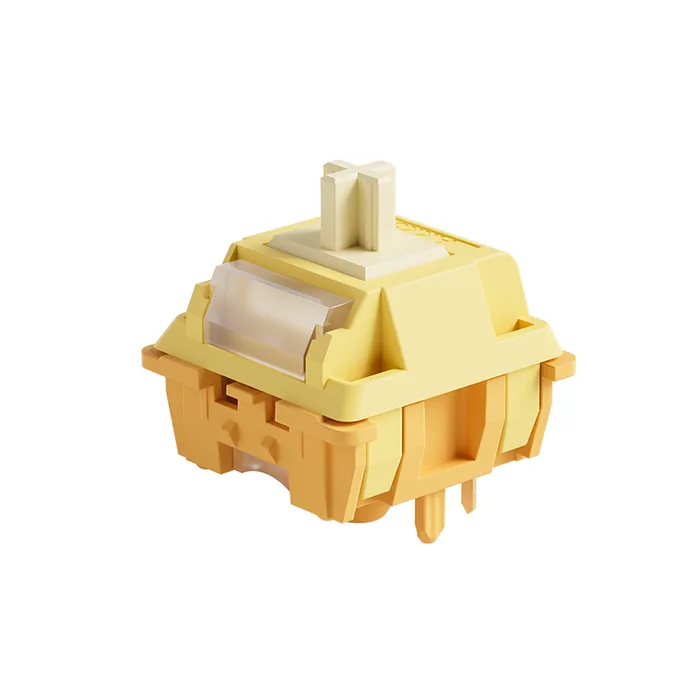
A lubed 45 gf linear sold in 100-piece packs that publishes both its operating force and its end force, which almost nothing at this price does.
Best for: A first switch swap, or anyone filling a whole board without spending much.
- Akko lists operating force 45 plus or minus 8 gf and end force 55 plus or minus 8 gf, so you can see the whole stroke.
- A force-travel diagram is printed right on the product page.
- POM stem with POM top and PA66 bottom housing, lubed at the factory, with a transparent housing and integrated light diffuser.
- Akko does not publish a rated lifetime in keystrokes for this switch.
- Total travel is 3.6 plus or minus 0.4 mm, shorter than the 4.0 mm most people are used to.
- The force tolerance is wide at plus or minus 8 gf, and Akko gives no tighter spec to compare against.
- Sold in 100-piece packs, and Akko notes full-size 108-key boards may need more than one.
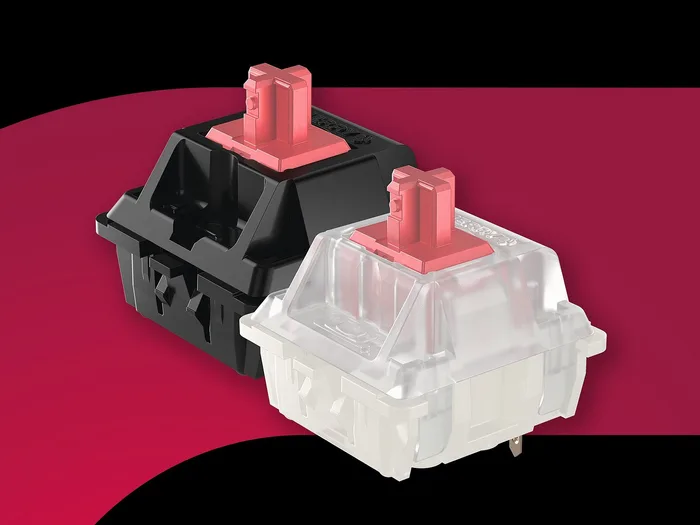
A damped linear that trades 0.3 mm of travel and a crisp bottom-out for a genuinely quieter keyboard.
Best for: Open-plan offices, shared rooms, and anyone who takes calls with the mic near the keyboard.
- Cherry publishes initial force 30 cN, actuation force 45 cN and final force 100 cN, plus a force-travel graph.
- Cherry says its patented damping reliably minimizes operating noise.
- Factory-applied lubricant and Cherry's gold crosspoint contact, rated over 50 million keystrokes.
- The dampers cut actuator travel to 3.7 mm and pre-travel to 1.9 mm, so it feels shorter and softer than a standard linear.
- Rated over 50 million keystrokes, half what Cherry claims for the MX2A Red.
- Cherry does not publish a pin count on the product page.
- Sold in boxes of 10, so filling a board costs more than a bulk set.
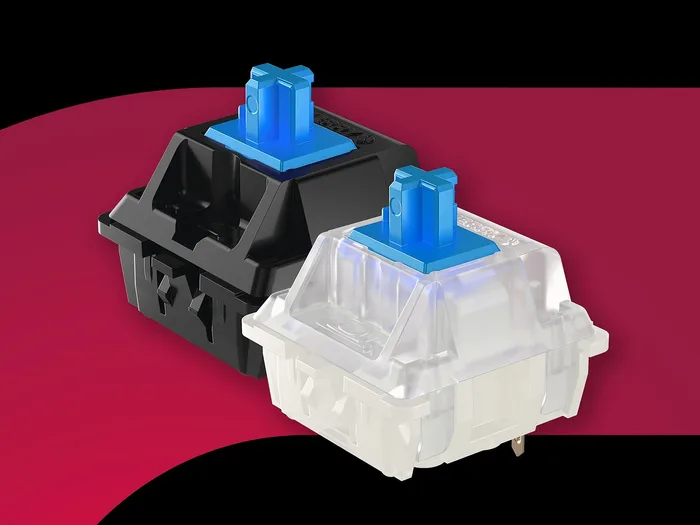
A well-built clicky switch that most people buy because blue sounds like what a mechanical keyboard is supposed to sound like, then regret in a shared room.
Best for: A solo home office where nobody else has to hear it, and where you actively want the click.
- The two-part switching slide gives a genuinely crisp click and a clear tactile bump.
- Same MX gold crosspoint contact and German manufacturing as the rest of the MX2A line.
- Cherry publishes a force-travel graph showing the tactile peak sitting above the operating point.
- The click is the product, so there is no quiet way to use it around other people.
- Cherry's page lists 60 cN operating force in its highlights but 50 cN as actuation force in its properties table, and publishes no final force at all.
- Rated over 50 million keystrokes, against over 100 million for the MX2A Red.
- Unlike the MX2A Red and Silent Red pages, this one does not list factory lubrication among its key benefits, and lubing a clicky switch works against the click.
| Criteria | Oil King Linear Switch Set Top pick | Creamy Yellow U1 Switch (Lubed) | MX2A Silent Red | MX2A Blue |
|---|---|---|---|---|
| Verdict | Buy it | Buy it | It depends | Skip it |
| Best for | Someone who wants a deep, smooth, quiet-ish linear and does not care about RGB. | A first switch swap, or anyone filling a whole board without spending much. | Open-plan offices, shared rooms, and anyone who takes calls with the mic near the keyboard. | A solo home office where nobody else has to hear it, and where you actively want the click. |
| Price tier | $$ · mid-range | $ · budget | $$$ · premium | $$ · mid-range |
| Type | Linear | Linear | Linear, damped/silent | Tactile and clicky |
| Actuation force (as published) | 55 ± 5 gf | 45 ± 8 gf | 45 cN | 50 cN in the spec table, 60 cN in the page highlights |
| Bottom-out / end force | Under 110 gf in the data sheet (a maximum); page cites 80 g bottom-out | End force 55 ± 8 gf | Final force 100 cN | Not published |
| Actuation point / total travel | 2.0 ± 0.6 mm / 4.0 mm max | 2.0 ± 0.4 mm / 3.6 ± 0.4 mm | 1.9 mm / 3.7 mm | 2.2 mm / 4.0 mm |
| Pin count | 5-pin | 5-pin, Akko says it converts to 3-pin | Not published | Not published |
| Stem and housing | POM stem, PA66 nylon top, ink-blend base | POM stem, POM top, PA66 bottom | Plastic polymer, base uses glass fibre | Two-part polymer slide, base uses glass fibre |
| Rated life | Up to 60M cycles | Not published | Over 50 million keystrokes | Over 50 million keystrokes |
| Force-travel curve published | Yes, in the data sheet PDF | Yes, on the product page | Yes, on the product page | Yes, on the product page |
Which one is right for you?
- Someone who wants a deep, smooth, quiet-ish linear and does not care about RGB. Buy it Gateron Oil King Linear Switch Set
- A first switch swap, or anyone filling a whole board without spending much. Buy it Akko Creamy Yellow U1 Switch (Lubed)
- Open-plan offices, shared rooms, and anyone who takes calls with the mic near the keyboard. It depends Cherry MX2A Silent Red
- A solo home office where nobody else has to hear it, and where you actively want the click. Skip it Cherry MX2A Blue
How we judged the field
Five things decide whether a switch suits you, and only one of them is taste. Type comes first: a linear travels straight down with no bump, a tactile has a raised section in the stroke you can feel, and a clicky adds a separate part inside the housing that snaps to make noise. Second is force, and specifically the pair of numbers, because the actuation figure on the box is the load at the contact point while the end force is what your finger meets at the bottom of the stroke. Third is geometry: pre-travel, which is how far the key falls before it registers, and total travel, which is how far it falls in total. Fourth is fit, and that is pin count, because a 5-pin switch has two extra plastic legs that a 3-pin socket has no holes for. Fifth is build: stem and housing material, whether the maker lubes it at the factory, and whether it publishes a rated lifetime at all.
The field splits cleanly by how much the maker is willing to tell you. Gateron publishes downloadable data sheets with a force-travel diagram for much of its catalogue, Cherry publishes a properties table and a force graph on each of these switch pages, and Akko prints a force-travel diagram and both force figures on the product listing. Plenty of other switches are sold with a single force number, a colour and nothing else. We chose four you can actually verify: a premium linear from Gateron, a budget linear from Akko, Cherry’s silenced linear for shared rooms, and Cherry’s clicky as the one most people buy first and should not. Cherry appears twice on purpose. The MX2A Silent Red and the MX2A Blue sit at opposite ends of the type spectrum inside one current product line, so pairing them isolates type while holding the maker, the generation and the manufacturing constant: whatever separates them is the mechanism, not the brand. And mechanically they are opposites. The Silent Red is a linear with damping built into a two-part stem to soften the impact, which is why it gives up travel and feels soft where it lands. The Blue adds a second moving part inside the stem that snaps against the stem on the way down, so the noise is an event the switch is built to produce, not a side effect you can lube out of it.
Gateron Oil King Linear Switch Set
Buy itGateron publishes a real data sheet for the Oil King, and that is half of why it wins. Operation force is 55 plus or minus 5 gf, pre-travel is 2.0 plus or minus 0.6 mm, total travel tops out at 4.0 mm, and end force is specified in the data sheet as under 110 gf (the product page cites 80 g bottom-out), so you can see the shape of the whole stroke rather than one marketing number. The stem is POM, the upper housing is PA66 nylon, the base uses Gateron’s ink blend, and the set ships lubed. It is a 5-pin switch, so the two extra plastic legs locate it firmly in a 5-pin PCB and have to be clipped for a 3-pin board. Rated life is up to 60M cycles, which is lower than the up to 100M Gateron claims for most G Pro 3.0 switches. The housing is opaque, so Gateron itself warns the backlight effect will not be very visible, and SMD LEDs must be the unraised kind. For a deep, smooth linear where lighting is irrelevant, this is the one.
Akko Creamy Yellow U1 Switch (Lubed)
Buy itAkko does something at this price that almost nobody does: it publishes both force figures. The Creamy Yellow U1 is listed at 45 plus or minus 8 gf operating force and 55 plus or minus 8 gf end force, with pre-travel at 2.0 plus or minus 0.4 mm and total travel at 3.6 plus or minus 0.4 mm, and there is a force-travel diagram on the page. Construction is a POM stem in a POM top and PA66 bottom housing, lubed at the factory, with a transparent housing and a built-in light diffuser so RGB actually shows. It is 5-pin, and Akko says the design converts to 3-pin when needed, which is the polite way of saying you clip the legs. Two gaps: Akko publishes no rated lifetime in keystrokes for it, and the plus or minus 8 gf tolerance is a wide spread. Sold in 100-piece packs, so a full-size board may need a second pack. For a first switch swap it is hard to beat.
Cherry MX2A Silent Red
It dependsThis is the office switch, with a real cost attached. Cherry builds patented damping into a two-part stem and says it reliably minimizes operating noise. Cherry publishes the numbers that matter, listing initial force 30 cN, actuation force 45 cN and final force 100 cN, plus a force-travel graph, and rates the switch at over 50 million keystrokes with factory-applied lubricant and the gold crosspoint contact. The cost is geometry and feel. Damping cuts actuator travel to 3.7 mm and pre-travel to 1.9 mm, so the switch is shorter than a standard MX2A Red and lands softer at the bottom. People who like a crisp stop often describe that as mushy. Cherry also does not publish a pin count on the product page, and it sells in small quantities rather than bulk sets. Buy it because you share a room, not because it is the best-feeling linear here.
Cherry MX2A Blue
Skip itThe MX2A Blue is a good switch aimed at a situation most buyers are not actually in. The skip verdict is about the clicky type being a poor fit for shared space, not about how Cherry builds it: this is the same German-made MX2A hardware and the same gold crosspoint contact as the Silent Red a slot above. The two-part switching slide produces a genuine click and a clear bump, it uses the same gold crosspoint contact as the rest of the line, and Cherry publishes a force-travel graph showing the tactile peak sitting above the operating point. The problem is that the click is the whole product, so there is no version of owning it that is quiet around other people. The published numbers are also the muddiest here: the page highlights say 60 cN operating force while the properties table says 50 cN actuation force, and no final force is given at all. Rated life is over 50 million keystrokes against over 100 million for the MX2A Red, and unlike the Red and Silent Red pages this one does not list factory lubrication among its key benefits. Lubing it yourself works against the click you paid for. If you type where anyone can hear you, buy a tactile instead.
Sources
Specs in this review come from these pages.
- Gateron - Oil King Linear Switch Set product page (gateron.co)
- Gateron - product data sheet library (force-travel diagrams) (gateron.co)
- Cherry - MX2A Silent Red product page (cherry.de)
- Cherry - MX2A Blue product page (cherry.de)
- Akko - Creamy Yellow U1 Switch (Lubed) product page (en.akkogear.com)
- Epomaker - guide to removing and replacing mechanical keyboard switches (epomaker.com)
Gateron Oil King Linear Switch Set vs Akko Creamy Yellow U1 Switch (Lubed): which should you buy?
The Oil King and the Creamy Yellow U1 are both lubed POM-stem linears, and the gap between them is smaller than the price gap. The Oil King is heavier at 55 gf against 45 gf, and it keeps a full 4.0 mm of travel where the Akko runs 3.6 mm, so it feels deeper and more deliberate. Gateron says it has a deeper sound than its own CJ switch. The Akko is lighter, shorter and brighter under RGB, because Akko gives it a transparent housing and a light diffuser while Gateron’s opaque housing actively dims the backlight and only takes unraised SMD LEDs if the board uses SMD lighting.
Choose on three questions. If you like a heavier key and a deeper sound and your board is not lit, take the Oil King. If your keyboard has per-key RGB you want to see, or you are filling a full-size board on a budget, take the Akko, and accept that Akko publishes no rated lifetime for it. If you are not sure which weight you prefer, buy the Akko first: it is the cheaper mistake, and 45 gf sits close enough to the common middle that it will tell you whether you want to go heavier or lighter next time.
What to look for
- Check the board before the switch: hot-swap is a socket soldered to the PCB, so a keyboard either has it or it does not, and the listing should say whether those sockets take 3-pin, 5-pin or both.
- Read both force numbers: the headline figure is the load at the contact point, and the end or final force is what your fingers meet at the bottom, so a switch sold as 45 gf can still take meaningfully more to bottom out.
- Look for a force-travel diagram: Gateron puts one in its data sheet PDFs, Cherry puts one on each of these switch pages and Akko prints one on the listing, and a curve tells you more about tactility and weighting than any single number.
- Treat pre-travel as preference, not quality: a 1.9 mm actuation point registers sooner than a 2.2 mm one, which helps in games and cuts both ways when typing, because accidental presses register sooner too.
- Match materials to the sound you want: POM stems and nylon or ink-blend bases read as deeper and softer, while polycarbonate tops read as brighter, and factory lubing removes the scratchiness that ruins cheap switches.
- Confirm the lighting fits: switches state whether they take SMD LEDs and whether the housing is transparent, and Gateron explicitly warns that the Oil King’s opaque housing dims the backlight and supports SMD LEDs only if they are unraised.
Our final take
Buy the Gateron Oil King if you want the best-documented, best-feeling linear here and your board is not lit. Buy the Akko Creamy Yellow U1 if you are filling a board cheaply or you want your RGB to show, and take the fact that Akko publishes an end force at all as a good sign about the rest of the switch. Take the Cherry MX2A Silent Red only if noise is the problem you are solving, because the damping that makes it quiet also makes it shorter and softer. Skip the Cherry MX2A Blue unless nobody else can hear you. And whatever you pick, check your PCB’s pin count first, because that is the mistake that actually costs money.
Questions, answered
Will these switches fit my keyboard?
That depends on your keyboard, not on the switch. Hot-swap is a property of the PCB: the board either has sockets soldered to it or it does not, and no switch can add that. If it does have sockets, the next question is whether they are drilled for three pins or five. A 5-pin switch has two extra plastic legs either side of the centre post, and on a 3-pin board those legs have to be clipped off with flush cutters before it will seat. Epomaker's own switch-replacement guide says outright that you should check whether your keyboard supports three pins or both three and five, and that some keyboards will require you to clip the pins.
What is the difference between actuation force and bottom-out force?
Actuation force is the load on the stem at the moment the contacts close, partway down the stroke. Bottom-out force, which makers variously call end force, final force or total travel force, is the load once the stem reaches the bottom. They are never the same number, because the spring keeps compressing after the switch registers. Akko lists the Creamy Yellow U1 at 45 gf operating and 55 gf end force, a 10 gf gap. Cherry lists the MX2A Silent Red at 45 cN actuation and 100 cN final force, and its graph shows most of that climb happening in the last fraction of the stroke. If you press keys all the way down, and plenty of people do, the end figure matters more than the headline one.
Are silent switches actually silent?
Quieter, not silent. Cherry describes the MX2A Silent Red as using a patented damping, and says the stem is made of two components with the noise reduction built in. That softens the sharp plastic-on-plastic knock, which is most of what people hear across a room. What it does not remove is the sound of your keycaps, your stabilisers and the keyboard's case, all of which stay loud on a hollow board. The trade is feel: the damping shortens Cherry's actuator travel to 3.7 mm from the 4.0 mm of the standard MX2A Red, and the bottom-out lands softer. Some people read that as plush, others as mushy.
Do I need to lube switches myself?
Not for any of the three switches we recommend here. Gateron sells the Oil King as a lubed version, Akko sells the Creamy Yellow U1 as lubed, and Cherry lists a factory-applied premium-grade lubricant on both the MX2A Red and MX2A Silent Red pages. Hand-lubing is a genuine upgrade on cheap dry switches, but it means opening every switch, brushing grease onto the stem rails and the spring, and reassembling, which is a long job for a full board. It also voids any sensible expectation of a return. Buy a factory-lubed switch and you skip the whole exercise. One thing to know: lubing a clicky switch tends to dull the click it exists to produce.
Is a shorter actuation point better?
It is different, not better. The Cherry MX2A Silent Red actuates at 1.9 mm and the MX2A Blue at 2.2 mm, and a speed-style switch can go shorter still. A shorter pre-travel means the key registers sooner, which some gamers prefer. For typing it cuts both ways, because the same shortness that registers your intended keypress sooner also registers the accidental brush of a resting finger sooner. Accuracy tends to come from a force curve your fingers can feel and from consistency across the board, not from shaving a fraction of a millimetre. If you type more than you game, treat the actuation point as a preference and spend your attention on force instead.
Deciding between the top two? See our head-to-head: Gateron Oil King Linear Switch Set vs Akko Creamy Yellow U1 Switch (Lubed).
More Office reviews
 The Best Under-Desk Keyboard Trays: 4 Compared (and One to Skip)
  The Best Keycap Sets: 4 Compared (and One to Skip)
  The Best KVM Switches for Multi-Computer Desks: 4 Compared (and One to Skip)
  The Best Label Printers: 4 Compared (and One to Skip)
  The Best Laminators: 4 Compared (and One to Skip)
  The Best Lap Desks: 4 Compared (and One to Skip)