

Office
The Best Drafting Chairs: 4 Compared (and One to Skip)
We compared tall task stools on the two things that actually define the category: how far the cylinder travels, and whether the footring moves with you.
The short version
The Steelcase Series 1 Stool is the best all-round pick, with a published 23 to 30.75 inch seat height, a foot ring that adjusts on the column, and a caster choice that actually matches your floor. The HON Ignition Task Stool is the value pick and the taller of the two, running 24 to 33 inches on a 9.75 inch cylinder with an adjustable footring and a 300 pound capacity. The UPLIFT Engage Stool is the depends pick: it is a perch stool with no footring and no casters, and for a lot of standing desk users that is the right tool, but it is not a drafting chair and it will not suit anyone who needs to sit still for hours. Skip the Modway Edge Drafting Chair; it looks the part and has a footring, but Modway publishes no weight capacity, no BIFMA testing and no warranty on the product page, and the seat tops out lower than the good options. Before you buy anything, measure your work surface and subtract about 10 to 12 inches, then check that number falls inside the chair's published range rather than at its very top. Best for: anyone working at a bench, drafting table or standing desk who wants to sit high without their legs going numb.
Our picks at a glance
- Steelcase Series 1 Stool - Buy. A contract task stool with a genuinely adjustable foot ring and specs Steelcase actually publishes.
- HON Ignition Task Stool - Buy. The tallest stool here, with an adjustable footring and a lifetime warranty, for a fraction of the contract-premium price.
- UPLIFT Desk Engage Stool - It depends. Not a drafting chair at all, but a perch stool that suits standing desk users better than a drafting chair does.
- Modway Edge Drafting Chair - Skip. A mesh task chair on a tall cylinder, sold as a drafting chair, with almost none of the numbers that matter published.
The verdict in 30 seconds
What mattered most
- Seat height range
- Published cylinder stroke
- Footring
- Weight capacity
- BIFMA on the spec sheet
- Casters and floors
A drafting chair is not an office chair with longer legs. It is a chair built around a taller gas cylinder, and once the seat is above roughly 24 inches your feet no longer reach the floor, which is why the footring stops being a styling detail and becomes the part that decides whether you can sit there for three hours. We looked at tall stools for standing desks, workbenches, drafting tables and lab benches, and we checked every seat height range against the maker's own published spec rather than the listing copy. The field splits cleanly into contract-grade stools with adjustable footrings, cheap chairs wearing a tall cylinder, and perch stools that are not drafting chairs at all but are often the better answer.
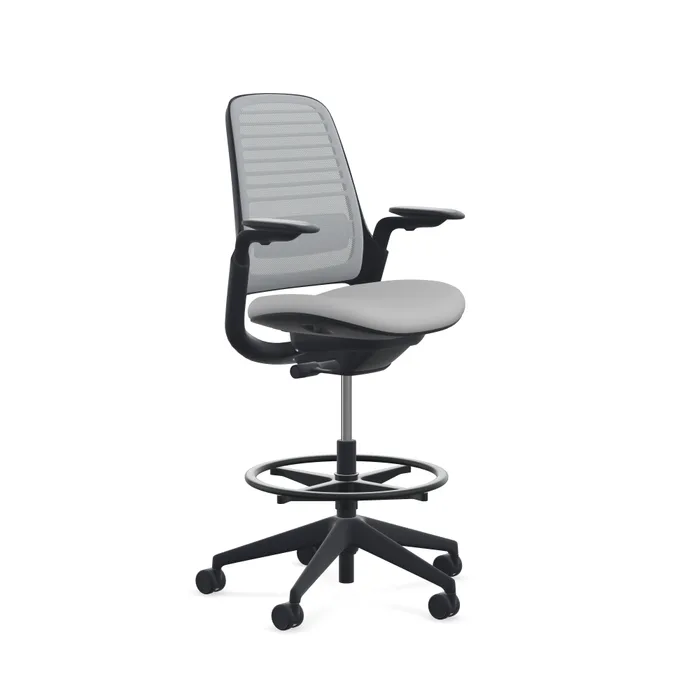
A contract task stool with a genuinely adjustable foot ring and specs Steelcase actually publishes.
Best for: Someone who wants one stool that will still be adjustable and repairable in ten years.
- Seat height runs 23 to 30.75 inches on a 7.75 inch pneumatic cylinder, which Steelcase states in its own specification guide.
- The 20 inch foot ring unlocks by rotating counterclockwise and slides up or down the column, so you can set it to your leg length.
- Steelcase lists it as meeting BIFMA and carrying BIFMA LEVEL 3, and backs it with a limited lifetime warranty rated 12 years for multi-shift, 24/7 use.
- It is the most expensive stool here by a wide margin.
- Capacity is 300 pounds for the stool, lower than the 400 pounds Steelcase quotes for the Series 1 chair.
- Hard dual-wheel casters are standard and Steelcase says they are for carpet, so hard floor users need to pay for the soft roll-control option.
- At 30.75 inches maximum it does not reach as high as the HON, which matters at a tall workbench.
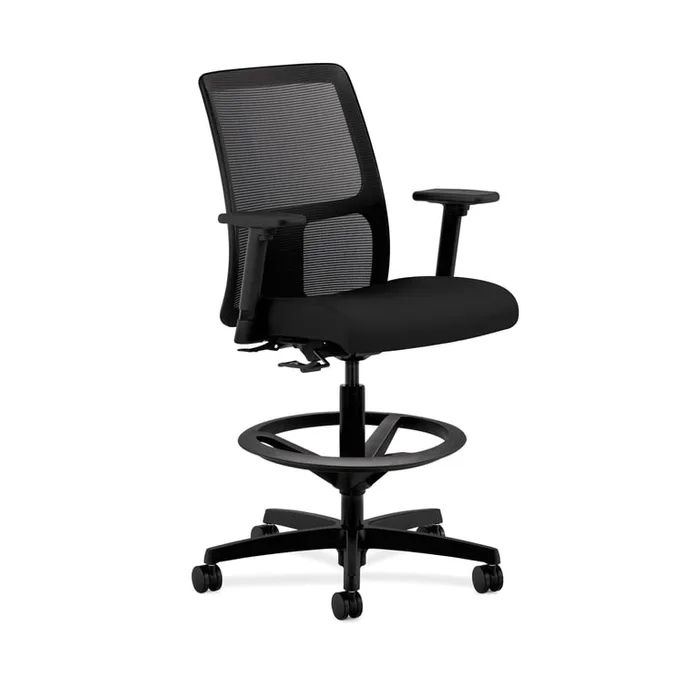
The tallest stool here, with an adjustable footring and a lifetime warranty, for a fraction of the contract-premium price.
Best for: Anyone whose work surface is genuinely high and who wants a real footring without paying contract-premium money.
- HON publishes a 24 to 33 inch seat height with a 9.75 inch adjustment range, the longest published stroke in this group.
- HON's own product copy describes an adjustable footring, and the stool carries a 300 pound weight capacity.
- It rolls on casters and is covered by HON's lifetime warranty program; confirm the exact terms for your SKU with the dealer.
- HON's SKU spec pages do not state a BIFMA test standard, so you have to ask the dealer for the test documentation.
- It is a low back stool, so there is no upper back or headrest support for leaning back.
- Buying it usually means going through a dealer or a reseller rather than a simple checkout.
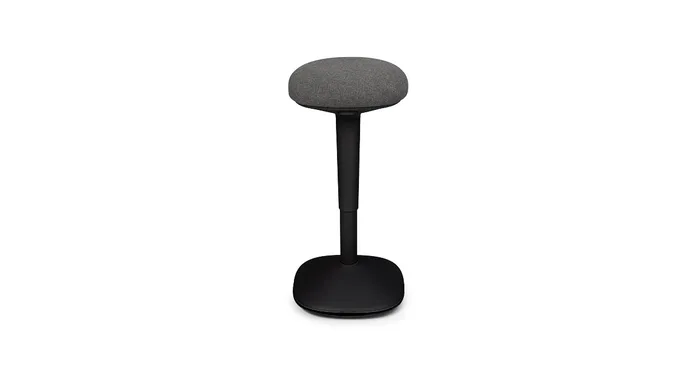
Not a drafting chair at all, but a perch stool that suits standing desk users better than a drafting chair does.
Best for: A standing desk user who wants to take weight off their feet without fully sitting down.
- UPLIFT publishes a 21.8 to 31.4 inch height range controlled by buttons on either side of the seat, which covers most standing desk heights.
- The convex base lets it rock and pivot 360 degrees, and a rubber-treaded grip underneath keeps it from sliding.
- It weighs 12.2 pounds with integrated handles and carries UPLIFT's 15 year warranty.
- There is no footring and no backrest, so it is for perching rather than sitting for hours.
- Weight capacity is 250 pounds, the lowest of the four.
- It has no casters, so you lift it rather than roll it.
- The seat is 13.1 by 13.1 inches, which is small if you want to settle in.
Amazon had no buyable listing for this when we last checked. The link still works if it returns.
Check price on Amazon Read our detailed assessment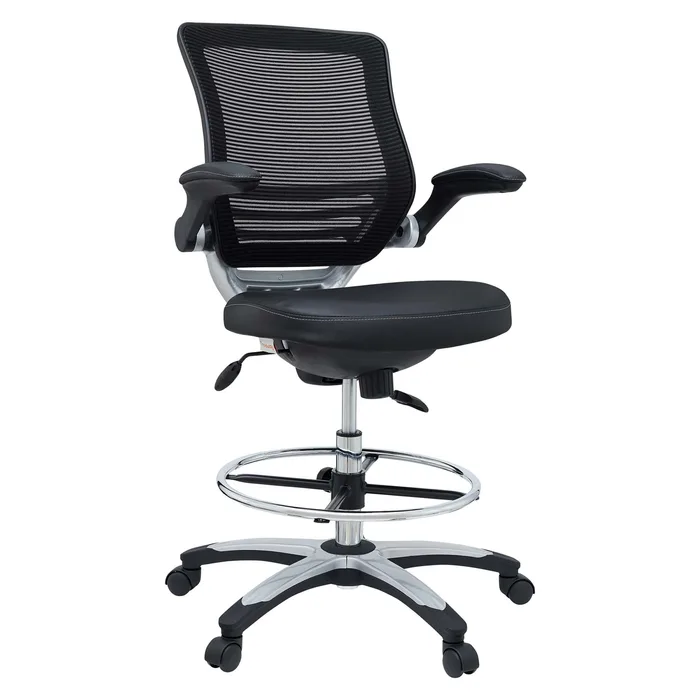
A mesh task chair on a tall cylinder, sold as a drafting chair, with almost none of the numbers that matter published.
Best for: Nobody, really, unless you need a tall chair for occasional light use and accept that you are buying an unknown.
- Modway does publish the seat height, 22 to 29.5 inches, which many budget sellers do not.
- It has a real footring rather than just a tall cylinder.
- Flip-up padded arms and a seat tilt with tension control are included at this price.
- Modway's product page lists no weight capacity, which makes it impossible to know who the chair was built for.
- The page makes no reference to BIFMA testing and states no warranty.
- Nothing on the page says whether the footring height adjusts, and a footring set at the wrong height is worse than none at all.
- The 29.5 inch maximum is the lowest here, so it will not reach a tall workbench.
| Criteria | Series 1 Stool Top pick | Ignition Task Stool | Engage Stool | Edge Drafting Chair |
|---|---|---|---|---|
| Verdict | Buy it | Buy it | It depends | Skip it |
| Best for | Someone who wants one stool that will still be adjustable and repairable in ten years. | Anyone whose work surface is genuinely high and who wants a real footring without paying contract-premium money. | A standing desk user who wants to take weight off their feet without fully sitting down. | Nobody, really, unless you need a tall chair for occasional light use and accept that you are buying an unknown. |
| Price tier | $$$ · premium | $$ · mid-range | $ · budget | $ · budget |
| Seat height range | 23 in to 30.75 in | 24 in to 33 in | 21.8 in to 31.4 in | 22 in to 29.5 in |
| Published cylinder stroke | 7.75 in | 9.75 in | Not published | Not published |
| Footring | Adjustable, 20 in diameter | Adjustable | None, perch stool | Present, adjustability not stated |
| Weight capacity | 300 lb | 300 lb | 250 lb | Not published |
| BIFMA on the spec sheet | Meets BIFMA, BIFMA LEVEL 3 | Not stated on SKU page | Not stated | Not stated |
| Casters and floors | 2.5 in hard dual-wheel for carpet, soft roll-control optional for hard floors | Casters, confirm type with dealer | No casters, anti-slip rubber base | Casters, type not specified |
| Overall width | 23.5 in to 27 in | Confirm with dealer | Not published | 27.5 in |
| Warranty | Limited lifetime, 12 years, 24/7 | HON lifetime warranty, confirm terms | 15 years | Not stated on product page |
Which one is right for you?
- Someone who wants one stool that will still be adjustable and repairable in ten years. Buy it Steelcase Series 1 Stool
- Anyone whose work surface is genuinely high and who wants a real footring without paying contract-premium money. Buy it HON Ignition Task Stool
- A standing desk user who wants to take weight off their feet without fully sitting down. It depends UPLIFT Desk Engage Stool
- Nobody, really, unless you need a tall chair for occasional light use and accept that you are buying an unknown. Skip it Modway Edge Drafting Chair
How we judged the field
Five things separate a real drafting chair from a tall-looking one. First, the published seat height range, because that single pair of numbers decides whether the chair fits your bench at all, and it has to come from the maker rather than a listing title. Second, the cylinder stroke, which tells you how much room you have to fine tune once you have found roughly the right height. Third, the footring, and specifically whether it adjusts on the column, because at drafting height your feet do not reach the floor and unsupported legs are what people are describing when they say a tall chair hurt after an hour. Fourth, base width and weight capacity, since raising the seat raises your centre of gravity and a wider five-star base is doing real work. Fifth, caster type, because hard casters are made for carpet and soft roll-control casters are made for hard floors, and getting that backwards means a stool that either skates or refuses to move.
The field splits into three groups. At the top are contract stools from office furniture makers, where the spec sheets are public, the footring adjusts and the warranty is measured in decades; we took the Steelcase Series 1 Stool as the reference and the HON Ignition Task Stool as the value equivalent, and the HON is actually the taller of the two. In the middle sit perch and lean stools, which are not drafting chairs but are frequently the better answer at a standing desk, represented here by the UPLIFT Engage Stool. At the bottom is the large group of chairs marketed as drafting chairs that are a normal task chair on a longer cylinder, where the weight capacity, the test standard and the footring’s adjustability all go unpublished; the Modway Edge Drafting Chair is our honest example, chosen because it is a real, widely sold product rather than a strawman.
Steelcase Series 1 Stool
Buy itThe Steelcase Series 1 Stool is what the category is supposed to look like. Steelcase’s own specification guide states a 7.75 inch pneumatic range running from 23 to 30.75 inches, and it describes the foot ring plainly: 20 inches in diameter, unlocked by rotating counterclockwise, then raised or lowered and locked again. That is the detail almost nobody else publishes, and it is the difference between a ring that fits your legs and a ring that gets in the way. The rest is quietly thorough: 2.25 inches of seat depth adjustment, arms that move for height, width, pivot and depth, a 300 pound capacity for the stool version, and a limited lifetime warranty rated 12 years for multi-shift, 24/7 use. Steelcase also lists it as meeting BIFMA and carrying BIFMA LEVEL 3. The catches are price and reach. It is far and away the most expensive stool here, and its 30.75 inch ceiling is lower than the HON’s, which matters if your bench is genuinely tall. It suits someone buying once and expecting to keep it.
HON Ignition Task Stool
Buy itThe HON Ignition Task Stool is the pragmatic pick, and on the one spec that defines the category it beats the Steelcase. HON publishes a 24 to 33 inch seat height with a 9.75 inch adjustment range, the longest published stroke in this group, and its product copy describes an adjustable footring. Capacity is listed at 300 pounds, it rolls on casters, and it falls under HON’s lifetime warranty program, though you should confirm the exact terms for your SKU. The compromises are real but narrow. It is a low back stool, so there is no upper back support if you want to lean back and think. And HON’s SKU spec pages, unlike Steelcase’s, do not name a BIFMA test standard, so if conformance documentation matters to you, ask the dealer before ordering. For a tall workbench or a 42 inch drafting table, this is the one to get.
UPLIFT Desk Engage Stool
It dependsThe UPLIFT Engage Stool is in this comparison precisely because it is not a drafting chair, and for a lot of people that is the point. It is a perch stool: a rounded, superellipse seat measuring 13.1 by 13.1 inches on a convex base that lets you rock, lean and pivot a full 360 degrees, with a rubber-treaded grip underneath so it stays put. UPLIFT publishes a 21.8 to 31.4 inch height range operated by buttons on either side of the seat, which comfortably covers a standing desk raised to sitting-adjacent height. It weighs 12.2 pounds, has integrated handles, and carries UPLIFT’s 15 year warranty. What it does not have is a footring, a backrest, casters, or much capacity: 250 pounds is the lowest here. That is the trade. If you spend most of your day standing and want somewhere to take the load off for ten minutes at a time, this is better than a drafting chair. If you need to sit and work for three hours, it is not.
Modway Edge Drafting Chair
Skip itThe Modway Edge Drafting Chair is the version of this category most people actually end up buying, and it shows why the category has a bad reputation. To Modway’s credit, the seat height is published: 22 to 29.5 inches, on overall dimensions of 27.5 by 27.5 inches. There is a footring, flip-up padded arms, a mesh back and a vinyl waterfall seat, and a seat tilt with tension control. But the product page lists no weight capacity at all, makes no reference to any BIFMA test standard, states no warranty, and never says whether the footring height adjusts. Those are not small gaps; they are the exact numbers that separate a drafting stool from a task chair on a long cylinder. The 29.5 inch ceiling is also the lowest of the four, so it will not reach a tall workbench even though it is sold for exactly that job. If your budget is genuinely tight, we would rather see you buy a used contract stool than a new one of these.
Sources
Specs in this review come from these pages.
- Steelcase, Understanding and Specifying Steelcase Series 1 (specification guide) (steelcase.com)
- Steelcase, Steelcase Series 1 product page (steelcase.com)
- HON, Ignition Task Stool specifications (HITS5.A.H.U.CU10.T.SB) (hon.com)
- UPLIFT Desk, Engage Stool (upliftdesk.com)
- Modway, Edge Drafting Chair (modway.com)
- BIFMA, Standards FAQ (chair load ratings and sit-stand seating test considerations) (bifma.org)
Steelcase Series 1 Stool vs HON Ignition Task Stool: which should you buy?
The choice between the Steelcase Series 1 Stool and the HON Ignition Task Stool comes down to how high your work surface is and how much documentation you want. HON wins on reach and on stroke: 24 to 33 inches with a 9.75 inch range against Steelcase’s 23 to 30.75 inches with 7.75 inches of travel. If your bench, drafting table or lab surface is 40 inches or higher, the HON is simply the one that fits, and it costs meaningfully less. Both list a 300 pound capacity, both have an adjustable footring, and both come with lifetime-scale warranties.
Steelcase wins on everything you can read. Its specification guide tells you the foot ring is 20 inches across and exactly how it unlocks, tells you the standard hard dual-wheel casters are for carpet and that soft roll-control casters are the option for hard floors and chair mats, and lists BIFMA conformance and BIFMA LEVEL 3 on the product page. HON’s SKU pages give you seat height, capacity and warranty but stop short of naming a test standard. So: if your surface is under about 40 inches and you want the fully documented, fully adjustable thing that will still be serviceable in a decade, buy the Steelcase. If your surface is tall, or you are buying more than one, buy the HON and ask your dealer for the test documentation.
What to look for
- Published seat height range, in inches: if the listing says only “drafting height” or “tall”, treat that as a missing spec rather than a description, and go find the maker’s own number.
- An adjustable footring, not just a footring: a ring fixed at one height fits one leg length, and everyone else either dangles or sits with their knees up, which is worse than no ring at all.
- Cylinder stroke: the total travel tells you how much fine tuning you get, and a chair sitting at the very top of its range has none left and no room for a second user.
- A wide five-star base: raising the seat raises your centre of gravity, so base width does real work here, and makers who care will publish an overall width or a base diameter.
- Caster type matched to your floor: hard casters are made for carpet and soft roll-control casters for hard floors and chair mats, and Steelcase states this distinction outright in its own spec guide.
- A named test standard: ANSI/BIFMA X5.1 is the general-purpose office chair test standard, and a maker willing to name it is a maker who had the chair tested as a complete assembly.
Our final take
Buy the chair for the surface you actually have. Measure the bench, subtract 10 to 12 inches, and check that number sits inside the published range rather than at the ceiling. For most tall benches the HON Ignition Task Stool is the sensible buy, reaching 33 inches with a real adjustable footring and a lifetime warranty. For a slightly lower surface, or if you want every spec written down, the Steelcase Series 1 Stool is the better long-term object. If you mostly stand and only want to perch, skip the drafting chair entirely and get something like the UPLIFT Engage Stool. And treat any tall chair that will not publish a weight capacity or a footring adjustment as what it probably is: a task chair with a long cylinder.
Questions, answered
How do I work out what seat height I actually need?
Measure from the floor to the top of your work surface, then subtract roughly 10 to 12 inches to get a target seat height. A standard 29 inch desk lands you around 18 inches, which is ordinary office chair territory and does not need a drafting chair at all. A 36 inch counter or workbench puts you near 25 inches, and a 40 to 42 inch drafting table or bar-height bench puts you near 29 to 31 inches. Then check that your target sits comfortably inside the chair's published range rather than at the very top of it, because a cylinder at full extension gives you no room to fine tune and no room for the next person. The HON Ignition Task Stool covers 24 to 33 inches, the Steelcase Series 1 Stool covers 23 to 30.75 inches, and the difference matters once your bench passes 40 inches.
Is a footring really necessary, or can I use a footrest?
Once the seat is high enough that your feet leave the floor, your legs hang from the underside of your thighs, and the pressure that builds there is the single complaint people report most about tall chairs. A footring solves it because it moves with the chair when you swivel or roll, so support is always where your feet are. A separate floor footrest does not swivel with you and only works if you sit facing one direction and never move the chair, which is rare at a bench. The important detail is that the ring adjusts: a ring welded at a fixed height suits one leg length and forces everybody else into either dangling feet or hunched knees. Steelcase and HON both publish that theirs adjusts, which is why they are the picks here.
Will a drafting chair tip over?
A taller seat raises your centre of gravity, so tipping is a real consideration in a way it is not with a standard chair, especially when you lean sideways to reach something or push off the bench. Two things reduce it: a wide five-star base, and a footring, which effectively spreads your weight over a bigger footprint and discourages you from bracing against the base edge. Steelcase publishes an overall width of 23.5 to 27 inches for the Series 1 Stool, which is wide for a task-sized chair; ask a dealer for the Ignition stool's base width. Whatever you buy, do not stand on the footring to reach a high shelf and do not lean out over a caster, because that is when tall chairs go over.
Does a drafting chair work at a standing desk?
Sometimes, but it is often the wrong answer. If you want to sit properly for long stretches at a raised desk, a drafting chair with a back and a footring is right. If what you actually want is to take weight off your feet for a few minutes at a time while staying more or less upright, a perch or lean stool suits better. A perch stool is a different kind of product from a general-purpose office chair: you keep your feet on the floor while the seat takes some of your weight. The UPLIFT Engage Stool in this comparison is that kind of product. Be honest with yourself about which behaviour you want before you buy.
Can I just put a taller gas cylinder in the chair I already have?
Mechanically you often can, since most task chairs use a common tapered cylinder fitting, but you end up with exactly the trap this category is full of: a normal chair sitting higher, with no footring and a base that was sized for a lower seat. Your feet will hang, the pressure under your thighs will start within the hour, and nothing about the chair's tested configuration still applies. Chairs are tested as complete assemblies, so swapping a structural part means whatever standard the original was tested to no longer describes what you are sitting on. If your chair's maker sells a factory stool version with a matching footring, that is a different story and worth asking about. Otherwise, buy a stool that was designed as one.
Deciding between the top two? See our head-to-head: Steelcase Series 1 Stool vs HON Ignition Task Stool.
More Office reviews
 Best Electric Standing Desks: The Honest Three-Way
  Best Ergonomic Keyboards (Split & Contoured) for Office and WFH
  The Best Affordable Ergonomic Office Chairs (And the Popular One to Skip)
  The Best Fire Rated Safes: 4 Compared (and One to Skip)
  The Best Fountain Pens: 4 Compared (and One to Skip)
  The Best Gaming Chairs: 4 Compared (and One to Skip)