Explained
Dehumidifiers, Explained
After reading this you will know how to size a dehumidifier, decode its spec sheet, and avoid the mini that cannot keep up with a real room.
In this guide
A dehumidifier is one of those appliances where the box copy and the reality diverge sharply, because it runs for months on end and the specs that matter are not the ones printed largest. First-time buyers usually trip on two things: buying by tank size instead of daily extraction, and grabbing a tiny thermoelectric unit for a job that needs a compressor. This guide decodes the numbers so you can match a unit to your actual space.
The 30-second version
- Buy on pints per day, not tank size. The daily extraction rating tells you how much moisture a unit can pull, while the bucket only tells you how often you empty it.
- A 50-pint compressor unit is the sensible default. It covers a damp basement, a large living area, or a persistently humid bedroom without straining.
- Draining method decides how hands-off you can be. Gravity needs a drain below the unit, a built-in pump moves water upward to a sink or window, and a bucket means emptying by hand.
- Thermoelectric minis are closet tools, not room tools. They remove a small fraction of a pint per day and will run forever without catching up in a real damp space.
- Warranty and refrigerant hint at long-term cost. A longer warranty protects an appliance that runs constantly, and a current-generation refrigerant means fewer servicing headaches later.
The products this guide is about
Our verdict on each, with the full reasoning on the companion review.
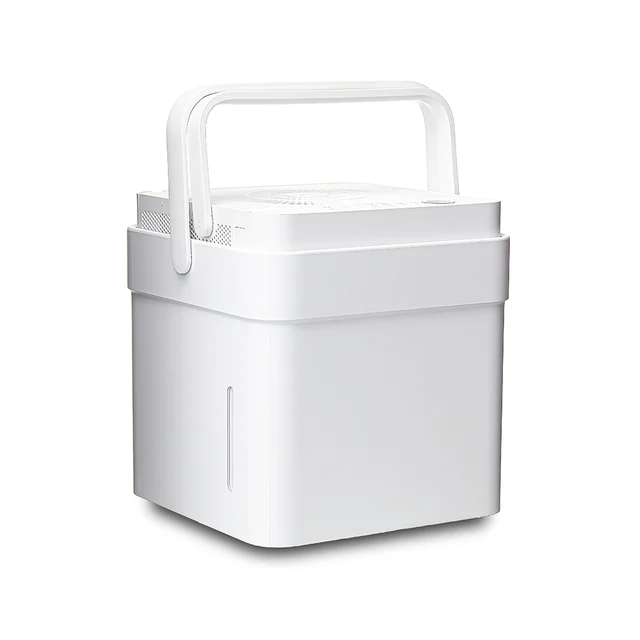
- Buy Midea Cube 50-Pint Smart Dehumidifier (MAD50PS1QWT) The most efficient 50-pint unit we found, with a collapsible body and a pump, if you can accept some reliability variance. Amazon
- Buy Frigidaire FHDD5034W1 50-Pint Dehumidifier A steady, quick-drying runner-up on the newer R-32 refrigerant, best where gravity draining works. Amazon
- It depends Honeywell TP70WKN 50-Pint Dehumidifier A no-frills workhorse with a five-year warranty and an easy-to-read display, but no smart features.
- Skip Pro Breeze 500ml Mini Dehumidifier (PB-02) A silent Peltier mini that is fine for a closet and wrong for any real damp problem. Amazon
What actually matters
- Daily extraction (pints per day) is the single most important number, because it defines how quickly a unit can dry a space; undersize it and the machine runs continuously without winning.
- Room size and dampness determine the capacity you need; a large basement or a room with standing-water dampness demands more capacity than a merely stuffy bedroom.
- Draining method shapes daily hassle; decide up front whether you will empty a bucket, run a gravity hose to a floor drain, or need a pump to lift water upward.
- Energy efficiency matters more here than on most appliances, because a dehumidifier may run for months, so a unit that dries on less power saves real money over a season.
- Low-temperature operation and auto-defrost matter for cool basements, where a unit without them can ice over and stall below the mid-40s Fahrenheit.
- Reliability and warranty carry weight on an appliance under constant load; owner reports around the one-year mark and warranty length tell you more than the feature list.
- Noise level is worth checking for living spaces and bedrooms, since a compressor unit on a high fan is audible across a room.
The specs, in plain English
Green flags vs red flags
Green flags
- A clearly stated pints-per-day rating that matches your space, ideally 50-pint class for a room or basement
- Continuous-drain support, and a built-in pump if you lack a floor drain below the unit
- A current-generation refrigerant and low-temperature operation with auto-defrost for basements
- A longer-than-average warranty, which matters on an appliance that runs for months
- Casters, a real handle, and a cord winder, since a full 50-pint unit is heavy to move
Red flags
- A thermoelectric or Peltier mini marketed as suitable for a whole room or basement
- Prominent tank size with no clear daily extraction rating
- No continuous-drain option, forcing constant manual bucket emptying
- A cluster of owner reports describing failures around the one-year mark
- An app that only joins 2.4 GHz networks with no fallback, if smart control matters to you
Who's who: the brands
- Midea - Makes efficient compressor units, including a collapsible design that stores compactly and offers a pump option.
- Frigidaire - Long-standing appliance maker with steady, quick-drying units on newer refrigerants and built-in Wi-Fi.
- Honeywell - Known here for no-frills workhorse units with long warranties and easy-to-read displays over smart features.
- Pro Breeze - Sells small thermoelectric minis suited to closets and cabinets, not rooms or basements.
- hOmeLabs - A popular value brand of mid-capacity compressor dehumidifiers frequently bought for basements.
How to read a listing without getting fooled
Start at the daily extraction rating, not the tank. If a listing leads with tank size and buries or omits pints per day, be skeptical, especially for anything described as a mini. Confirm whether the pint number uses the current DOE standard so you are comparing like with like. Next find the draining language: bucket only, gravity or continuous drain, or built-in pump, since that decides how hands-off the unit can be. Check the operating temperature range and whether auto-defrost is included if the target is a cool basement. Treat smart features as a convenience, verify the Wi-Fi band if you care, and weigh warranty length as a real signal of expected lifespan. Finally, read owner reports for patterns around the one-year mark rather than any single review.
How much should you spend?
Spending tracks capacity and features more than brand prestige. The value sweet spot for most homes is a mid-range 50-pint compressor unit, which handles a basement or large room without paying for the top tier. Paying more is justified when you genuinely need a built-in pump, top efficiency for a unit that will run for months, or a collapsible body for off-season storage, since lower power draw and durability recoup the difference over a damp season. Paying less makes sense only when the job is genuinely small, and even then a thermoelectric mini is worthwhile solely for a closet or cabinet, never as a cheaper substitute for a room-sized compressor unit. A longer warranty is often worth a modest premium on an appliance under constant load.
Questions, answered
What size dehumidifier do I need?
For a basement, a large living area, or a persistently humid bedroom, a 50-pint class compressor unit is the right default. Reserve smaller compressor models for a single bathroom or laundry room, and use mini thermoelectric units only for closets or cabinets.
What is the difference between a compressor and a thermoelectric mini?
A compressor unit chills a coil to condense moisture and can pull many pints a day, enough for rooms and basements. A thermoelectric (Peltier) mini has no compressor, removes only a fraction of a pint per day, and is meant for enclosed spaces like closets and safes.
Do I need a built-in pump?
Only if you must move water upward or far away. Gravity draining works when a floor drain sits below the unit; a pump is required to push condensate up into a sink or out a window. Otherwise you empty the bucket by hand.
What humidity level should I set?
Aim for 45 to 50 percent in living spaces to discourage mold and dust mites without over-drying. In a damp basement, around 50 percent is usually enough. Lower settings force longer runtimes and higher energy use for little added benefit.
Does the type of refrigerant matter?
For buyers, mainly for longevity. A current-generation refrigerant such as R-32 meets today's environmental phase-down rules, so newer units built around it are less likely to face servicing or availability issues later. Day-to-day drying differences are minor compared with capacity and drainage.
Or jump to the head-to-head: Midea Cube 50-Pint Smart Dehumidifier (MAD50PS1QWT) vs Frigidaire FHDD5034W1 50-Pint Dehumidifier.