Explained
Dish Drying Racks, Explained
After reading this you will know which two design choices decide whether a dish rack lasts, and how to spot both from a product listing.
In this guide
A dish rack looks like the simplest thing in the kitchen, which is exactly why most people buy the wrong one. Almost every complaint traces back to just two things: water that ends up on the counter instead of in the sink, and metal that starts streaking orange within a year. Both are decided before you ever unbox the rack, by the drainage geometry and by what the wires are actually made of underneath the shiny finish.
The 30-second version
- Drainage direction beats drainage volume. A rack that aims water into the sink through a spout or an angled board solves the pooling problem; a flat tray just holds the water somewhere else until you carry it.
- Material is the whole rust story. Aluminum does not rust like steel, coated stainless resists it structurally, and chrome plating over mild steel is a thin skin that fails at the first chip or scratch.
- Rust is usually a cleaning problem, not a defect. Bleach wipes and abrasive pads strip the protective coating off good racks, which is why the same model gets both five-year love letters and one-star rust photos.
- Counter space is a real cost. A rack that never folds away has to earn its footprint every day, and a fold-flat design quietly buys back the most valuable surface in a small kitchen.
- Capacity claims are counted in plates, not in your plates. Slot spacing that fits thin porcelain often will not take thick stoneware, so the advertised place-setting number rarely survives contact with a real cupboard.
The products this guide is about
Our verdict on each, with the full reasoning on the companion review.
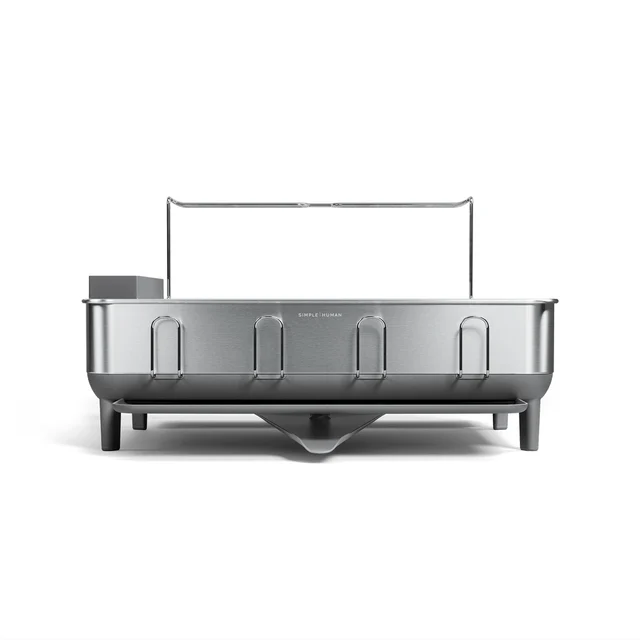
- Buy simplehuman Steel Frame Dishrack (Standard) The rack that treats drainage as the real problem, with a swivel spout to aim runoff into the sink. Amazon
- Buy OXO Good Grips Aluminum Fold Flat Dish Rack Aluminum that does not rust like steel and folds flat to slide into a cabinet. Amazon
- It depends KitchenAid Large Capacity Full Size Dish Rack Huge capacity and a well-aligned angled drainboard for a fair price, if you can hand over the counter space permanently. Amazon
- Skip Simple Houseware 2-Tier Dish Rack with Drainboard Real capacity for very little money, undercut by chrome plating that rusts at every chip and a drainboard that cracks. Amazon
What actually matters
- Drainage geometry. The single biggest quality-of-life feature is where the water goes. Look for a swiveling spout, a sloped base, or a drainboard with a directional lip that overhangs the sink. A flat tray with no fall to it will pool, and no amount of towel underneath fixes that.
- Frame material and finish. Aluminum does not rust the way steel does. Stainless with an intact coating holds up for years. Chrome or nickel plating over mild steel is the failure mode behind most rust complaints, because the plating is decoration rather than protection.
- Real capacity and slot spacing. Count the plate slots and check how far apart the wires sit. Wide spacing takes chunky stoneware and pan lids; narrow spacing looks impressive on the spec sheet and jams in practice.
- Footprint and whether it stores. Measure the counter run beside your sink before anything else. Full-size racks are permanent installations. Fold-flat and compact designs give the counter back between washes, which matters more than capacity in a small kitchen.
- Removable parts. Drip trays, utensil cups, and knife slots that lift out are the parts you will actually clean. Anything moulded in place stays damp and grows the pink film and mildew people later blame on the rack itself.
- Drainboard rigidity. A thin board that flexes under a full load tips water backward onto the counter and cracks at the corners. A rigid board that sits dead level is worth more than an extra tier.
- Stability and airflow underneath. Rubber or silicone feet stop the rack sliding when you push a heavy pan into it, and they lift the base so air moves underneath instead of trapping a wet ring on the counter. This matters more than it sounds: corrosion almost always starts where water sits and cannot evaporate, which means the welds, the underside of the feet, and wherever the frame rests against a damp surface.
The specs, in plain English
Green flags vs red flags
Green flags
- The material is named specifically, such as aluminum or 18/8 stainless, rather than described only as steel or a finish colour
- Water has a stated destination: a swivel spout, a sloped base, or a drainboard with a lip designed to overhang the sink
- The drip tray, utensil cup, and knife slot lift out for washing
- The maker gives a real cleaning instruction, such as dish soap only and no bleach, which usually means they know what kills their own coating
- A fold-flat hinge or a genuinely compact footprint, if you do not have counter space to donate permanently
- Long-run owner reports mentioning years of use rather than only first-week impressions
Red flags
- The listing says chrome plated, chrome finish, or stainless with no grade named anywhere in the description
- A flat tray with no slope, no spout, and no mention of where the water goes
- Photos showing the drainboard sitting flush on the counter with nothing overhanging the sink
- Recurring owner reports of drainboards arriving cracked, holed, or flexing under load
- The care instructions require drying after every wash plus periodic oiling to prevent rust, which is a maintenance routine disguised as a feature
- Assembly reviews mentioning wobble, misaligned welds, or scratched coating straight out of the box
Who's who: the brands
- simplehuman - The premium end of the category, known for engineering the drainage rather than the looks, with steel frames and swivel spouts.
- OXO - Housewares specialist with a reputation for thoughtful details; their aluminum fold-flat design sidesteps steel rust.
- KitchenAid - Familiar kitchen name that plays in the large-capacity, well-aligned-drainboard space at mid-range pricing, with coated steel finishes.
- Simple Houseware - Budget online brand offering big two-tier racks with accessories included, typically chrome over steel, which is where the durability trade-off sits.
- Joseph Joseph - Design-led British brand built around space-saving ideas, with extendable steel racks and positionable draining spouts that suit awkward counters.
- Yamazaki Home - Minimalist Japanese housewares maker using steel and resin, prioritising a clean look and a small footprint over maximum capacity.
How to read a listing without getting fooled
Read a dish rack listing backwards. Start with the materials line, because everything else depends on it. If it names an alloy or says aluminum, believe it. If it says chrome plated, chrome finish, mirror finish, or just steel, assume ordinary steel under a coating and expect rust once that coating is broken. Next, find out where the water goes: search the description for the word spout or slope, and look at the photos for a lip or channel that overhangs a sink edge. A drainboard shown sitting flat on a counter with no fall to it will pool, whatever the copy claims. Then check the dimensions against the counter run beside your sink, not against your imagination, and see whether the rack folds. Treat capacity claims as a ceiling rather than an expectation, since a place-setting count assumes thin plates loaded perfectly. Finally, sort the reviews by lowest rating and read the recent ones. Individual complaints are noise, but a theme that repeats across years, such as cracked drainboards or rust at the welds, is a design trait rather than a bad unit.
How much should you spend?
Dish racks are one of the few categories where spending more genuinely buys durability instead of branding, because the extra money goes into the metal and the drainage rather than into a logo. At the bottom of the market you are usually paying for accessories bolted onto plated mild steel, and the plating is the part that decides the lifespan, so the cheapest racks tend to be a replacement cycle rather than a purchase. The value sweet spot sits in the middle, where you get either aluminum or properly coated steel, a drainboard that actually directs water, and removable parts you can clean. Stepping up to the premium tier buys engineered drainage, a heavier stainless frame, and built-in extras like glass holders and knife slots, and it is worth it if you hand-wash a full load most days and the rack lives on your counter permanently. It is much harder to justify if you have a dishwasher and only wash a few items by hand, or if your kitchen is small enough that footprint matters more than capacity. In that case the smarter spend is a mid-range rack that folds away, not a bigger one that never leaves the counter.
Questions, answered
Do stainless steel dish racks actually rust?
Good ones rarely do, but the exact wording on the box matters. Solid aluminum cannot rust at all. Stainless with an intact coating holds up for years, because the corrosion resistance is in the metal itself. Chrome plating over mild steel is the one to avoid, since chrome is a surface layer and rust begins at the first chip or scratch and then travels along the welds.
Is a two-tier rack better than a single tier?
Only if your counter is short and your overhead clearance is fine. Two tiers buy vertical capacity inside the same footprint, which suits small kitchens, but they are harder to load, harder to clean, and the upper tier drips onto the lower one. A wide single-tier rack with good drainage generally dries dishes faster.
How do I stop water pooling on the counter?
Buy for drainage geometry rather than compensating with a towel. A swiveling spout or an angled drainboard that ends over the sink lip moves water where you want it. Position the rack so the spout or the low edge genuinely overhangs the sink, and check that the board sits level, because a flexing board tips water backward toward you.
How often should a dish rack be cleaned?
Pull the drip tray and utensil cup out weekly and wash them in hot soapy water, since those stay damp longest and are where mildew and the pink film start. Wipe the frame with dish soap rather than bleach wipes or abrasive pads, which strip protective coatings and create exactly the rust people later blame on the rack.
Is an over-the-sink or roll-up rack a better use of space?
They free counter space, but they trade away capacity and stability, and roll-up mats hold thin items poorly. If space is your main constraint, a fold-flat rack usually beats both, because you get proper plate slots and real drainage while it is in use and your counter back when it is not.
Does a dish rack dry faster than a towel?
Yes, for most loads. Air drying on a rack keeps items separated so airflow reaches every surface, while towel drying pushes moisture around and reuses a damp cloth across dishes. What matters most is spacing: items crammed together, nested bowls, and stacked plates trap water no matter how good the rack is.
Or jump to the head-to-head: simplehuman Steel Frame Dishrack (Standard) vs OXO Good Grips Aluminum Fold Flat Dish Rack.