Explained
Baby Nail Clippers, Scissors and Files, Explained
After reading, you'll understand why a baby nail tool has to be shaped differently from an adult one, what each format is genuinely good at, and which spec lines on a listing are worth reading.
In this guide
First-time buyers usually get tripped up in one of two ways. Either they assume any small clipper will do and reach for the one already in the bathroom drawer, or they assume the safest-sounding option must be the best and buy an electric file that their baby then refuses to sit still for. Both mistakes come from the same gap: nobody explains that these four formats solve different problems at different ages. The vocabulary does not help either, since terms like spy hole, arrest system and grit grading are used loosely across listings.
The 30-second version
- Shape beats sharpness, because an infant nail curves tightly and a flat adult jaw can hit skin before it reaches the nail edge.
- Rounded tips are the safety feature, so on scissors that is the single spec worth confirming before anything else.
- Visibility is the real difficulty, which is why a viewing window or a light changes the experience more than a better blade does.
- The safest tool is not automatically the right one, since electric files are hard to injure a baby with but slow, and many babies dislike the noise and vibration.
- Little of it is washable, so plan on wiping blades clean and cleaning pads with a dry cloth rather than rinsing anything.
The products this guide is about
Our verdict on each, with the full reasoning on the companion review.
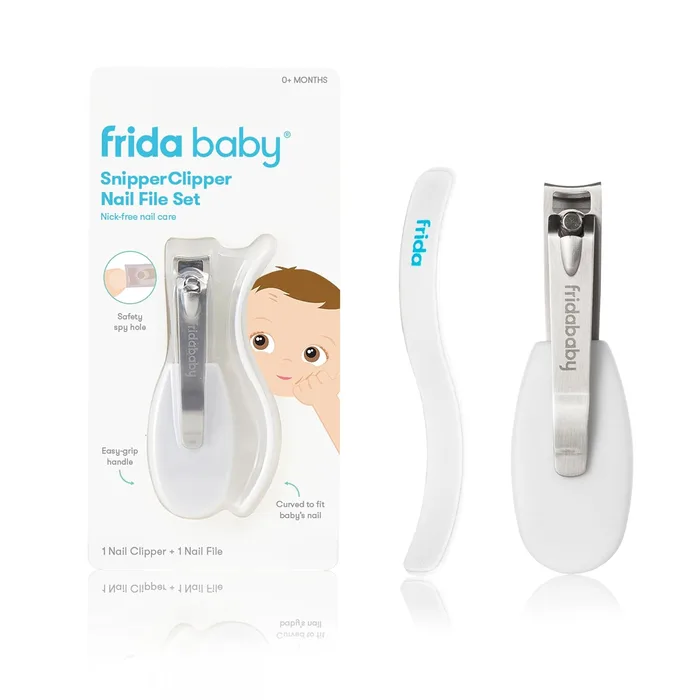
- Buy Frida Baby NailFrida the SNIPPERCLIPPER SET A baby clipper with curved overlapping blades and a see-through spy hole, sold with a curved S-shaped file for finishing the corners. Amazon
- Buy Piyo Piyo Baby Nail Scissors Small rounded-tip stainless scissors with a protective cap and a safety child lock, sized for newborn nails. Amazon
- It depends ZoLi BUZZ B Electric Baby Nail Trimmer A battery-powered baby nail file with a two-speed oscillating head and cushioned filing pads colour-coded by age. Amazon
- Skip Haakaa Pear-fect Manicure Kit A six-piece family manicure set in a case, sold on a baby brand's site but built around adult-geometry tools.
What actually matters
- Tip geometry - on scissors, a rounded or blunt blade head is what stops the tool from puncturing skin if the baby jerks. Piyo Piyo, for example, states the rounded blunt design explicitly as a puncture guard.
- Jaw curvature - a baby clipper's cutting edge should arc to match a nail that wraps around the fingertip. Adult clipper jaws are wider and shallower, which is why the NHS points parents to baby clippers or round-ended safety scissors instead.
- Sightline - the hand holding the finger is usually the thing blocking your view of the nail. Spy holes, magnifiers and LED task lights all exist to solve that one problem.
- Abrasive grading - electric and manual files come in different coarsenesses, and the better sets label pads by age or grit. A pad meant for a toddler's thicker nail is too aggressive for a newborn.
- Power source - electric files run on either a replaceable cell or a rechargeable battery. A single AA is one less charger in the drawer and easy to swap on holiday; a rechargeable unit saves you buying cells but ties you to a cable and a stated runtime.
- Noise and vibration - motors are marketed as whisper quiet, but a baby feels the vibration through the fingertip as much as they hear it. This is the most common reason an electric file ends up in a drawer.
- Corrosion and cleaning - stainless grades like SUS420 are meant to be wiped clean, and carbon steel is more prone to rust. Most makers say do not submerge, which rules out rinsing under a tap.
The specs, in plain English
Green flags vs red flags
Green flags
- The listing states the tip or blade geometry in plain terms, such as rounded blunt tips or curved overlapping blades.
- There is a named blade material or steel grade rather than just the word stainless.
- The maker gives an age range or, on electric files, labels the pads by age band.
- There is some visibility aid built in: a window, a magnifier or an LED.
- Cleaning and storage instructions are published, including whether anything can get wet.
Red flags
- The product is described as suitable for the whole family with no infant-specific design detail.
- A clipper photo shows a wide, shallow adult-style jaw with no curve to it.
- Scissors with pointed tips, however small the scissors are.
- An electric file with no age or grit guidance for its pads.
- A multi-piece kit where the nail tools are listed among a dozen unrelated items and never described in detail.
Who's who: the brands
- Frida Baby - Best known for problem-solving baby grooming tools, including the patented spy hole clipper.
- Piyo Piyo - A Taiwanese baby brand whose small rounded-tip nail scissors state the blade steel grade and materials on the product page.
- ZoLi - A US design-led baby brand whose BUZZ B electric nail file runs on a single AA cell, uses cushioned oscillating pads banded by age, and has replacement pads sold separately.
- Haakaa - A New Zealand baby brand whose range includes a family manicure kit.
- Tommee Tippee - Sells baby grooming and healthcare kits that combine nail tools with other newborn basics.
How to read a listing without getting fooled
Start at the bottom of the listing, not the top. The marketing copy will tell you a tool is safe and gentle; the specification block tells you whether the blade is a named stainless grade or unspecified carbon steel, what the tool actually measures, and what the maker says about cleaning. On anything electric, look for three specific things: how many speeds and directions there are, how the pads are graded, and whether the battery is replaceable cells or rechargeable with a stated runtime. On anything with blades, look for one word, rounded, and where it is applied. If a page describes a set for the whole family and never mentions infants, treat the nail tools as adult tools that happen to be small. And check the age line: makers who design for newborns tend to say so.
How much should you spend?
This is a cheap category, which is good news. Budget buys you a competent pair of rounded-tip baby scissors or a basic clipper from a real baby brand, and that is genuinely enough for a lot of families. Mid-range buys a designed baby clipper with a viewing window, usually bundled with a shaped file, and that is the sweet spot for a first purchase because it covers both clipping and filing without a second trip. Premium is almost entirely electric files, and what you are paying for is the motor, a set of age-graded pads and a case, with rechargeable models and extras like an LED sitting at the top of the range. That premium is worth it only if the anxiety of cutting is your real problem, since the tool is slower and noisier than what it replaces. Remember that pads and files are consumables, so factor a small recurring cost into anything abrasive.
Questions, answered
How often do baby nails need trimming?
Fingernails grow quickly in the early weeks and the AAP suggests trimming them roughly twice a week to keep them short enough that a baby cannot scratch themselves. Toenails grow far more slowly and stay soft, so once or twice a month is usually plenty. You will find your own rhythm by watching for scratches on the face. Keeping up with a small trim often is easier than a big one occasionally.
Can I use one tool from newborn all the way through toddlerhood?
Often yes, though the technique changes. Newborn nails are thin and flexible enough that they can tear rather than cut, so many parents file at first and start clipping once the nail firms up. Sets that include both a clipper and a shaped file cover that transition in one purchase. Electric files with age-graded pads handle it by swapping the abrasive as the nail thickens.
Do magnifying nail clippers actually help?
A magnifier addresses a real problem, which is seeing a very small nail edge clearly, especially in poor light. The catch is that a lens fixes your viewing angle and distance, so you end up moving your head to the tool rather than the tool to the nail. Built-in viewing windows and LED lights solve the same problem with less awkwardness. If your eyesight is the limiting factor, better lighting is usually a cheaper fix than a lens.
What is the difference between an electric nail file and a nail drill?
Baby nail files are low-speed rotary or oscillating tools with soft abrasive pads, designed to remove a small amount of nail with light contact. Salon nail drills run much faster, take hard bits and are built to shape acrylics and remove gel. They are not interchangeable, and a salon drill has no place near an infant. If a listing quotes very high rotation speeds or shows metal burrs, it is not a baby tool.
Or jump to the head-to-head: Frida Baby NailFrida the SNIPPERCLIPPER SET vs Piyo Piyo Baby Nail Scissors.