

Office
The Best Keyboard Wrist Rests: 4 Compared (and One to Skip)
We compared four keyboard wrist rests on the numbers that decide whether one helps you: published height, depth, length options, grip, and whether the surface can be cleaned.
The short version
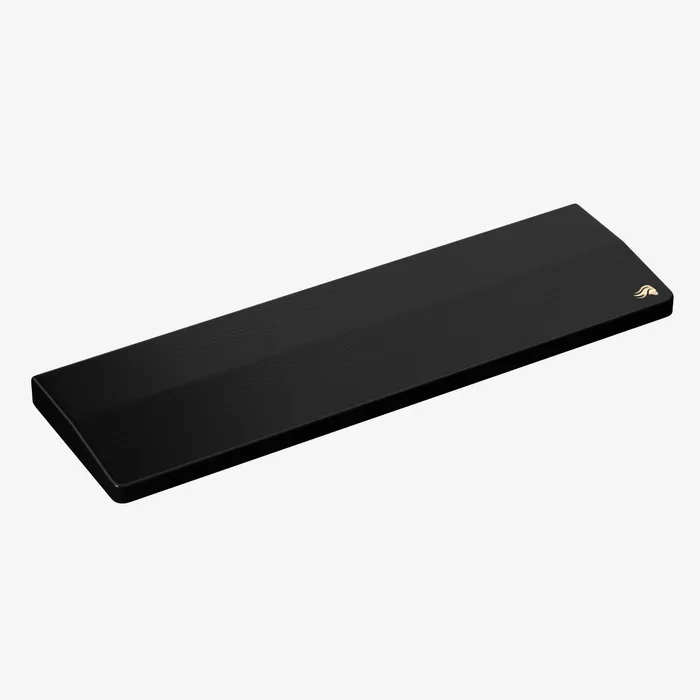
The Glorious Wood Ergonomic Wrist Rest is our overall pick because it publishes the one number that matters, a 20 mm thickness, in three lengths, and because solid hardwood does not compress or soak up sweat. The value pick is the Keychron Silicone Palm Rest, an 18 mm silicone bar sold in more than a dozen exact lengths, which makes matching your keyboard trivial and costs a fraction of the wood. The Grifiti Fat Wrist Pad 17 is the depends pick: soft neoprene with a washable nylon surface and a non-skid base, sized in inches with only loose keyboard labels, and at roughly 19 mm thick it is wrong for a low-profile board unless you buy the thinner Slim version instead. We would skip the HyperX Wrist Rest, which publishes width and depth but no height at all, and wraps gel-infused memory foam in a sewn fabric top with no removable cover. None of these treat or prevent any medical condition, and resting your wrists on any of them while actively typing works against the point. Buy the one whose top sits level with the front edge of your keyboard, then use it between bouts of typing. Best for: anyone who wants somewhere to park their palms during pauses without tilting their wrists upward.
Our picks at a glance
- Glorious Wood Ergonomic Wrist Rest - Buy. A solid hardwood bar with a published 20 mm thickness and three lengths, which makes height matching a decision instead of a guess.
- Keychron Silicone Palm Rest - Buy. An 18 mm silicone bar sold in more than a dozen exact lengths, which is the cheapest way to get a proper height and length match.
- Grifiti Fat Wrist Pad 17 - It depends. A squishy neoprene pad with a washable nylon surface, right for a tall mechanical keyboard and wrong for a slim one unless you buy the thinner version.
- HyperX Wrist Rest (Keyboard) - Skip. Gel-infused memory foam under a sewn fabric top, sold without a published height, which is the one specification this category runs on.
The verdict in 30 seconds
What mattered most
- Top surface
- Core / fill
- Stated height
- Depth, front to back
- Length options
- How sizing is chosen
A wrist rest is a cheap accessory sold with expensive-sounding promises. The mainstream ergonomics position is narrower than the marketing: OSHA's Computer Workstations eTool says your hands should move freely and be elevated above the wrist or palm rest while typing, that the pad should contact the heel or palm of your hand rather than your wrist, and that the support should be matched to the width, height and slope of the front edge of your keyboard. That turns buying one into a measurement problem, not a comfort problem, so we led with published dimensions and treated missing numbers as a mark against a product. We looked at four rests you can buy right now from Glorious, Keychron, Grifiti and HyperX.
A solid hardwood bar with a published 20 mm thickness and three lengths, which makes height matching a decision instead of a guess.
Best for: Someone who wants a rest that stays the same height for years and can be wiped down without a second thought.
- Glorious publishes the thickness, 0.79 in (20 mm), so you can compare it against the front edge of your own keyboard before you buy.
- Solid USA-sourced hardwood does not compress, so the height you measure on day one is the height you get in year three.
- Three lengths cover 65 and 75 percent, tenkeyless and full size boards, all 102 mm deep, and Glorious states it fits keyboards from other brands too.
- Hardwood is firm, and OSHA's guidance suggests supports that are fairly soft and rounded to minimise pressure, so this is a preference call rather than a clear win.
- The most expensive rest here by a wide margin, and the material is the only real reason for the gap.
- Only three fixed lengths, so a board that falls between sizes will leave an overhang or a gap.
- Nothing about it is adjustable, so if 20 mm is wrong for your keyboard there is no fixing it.
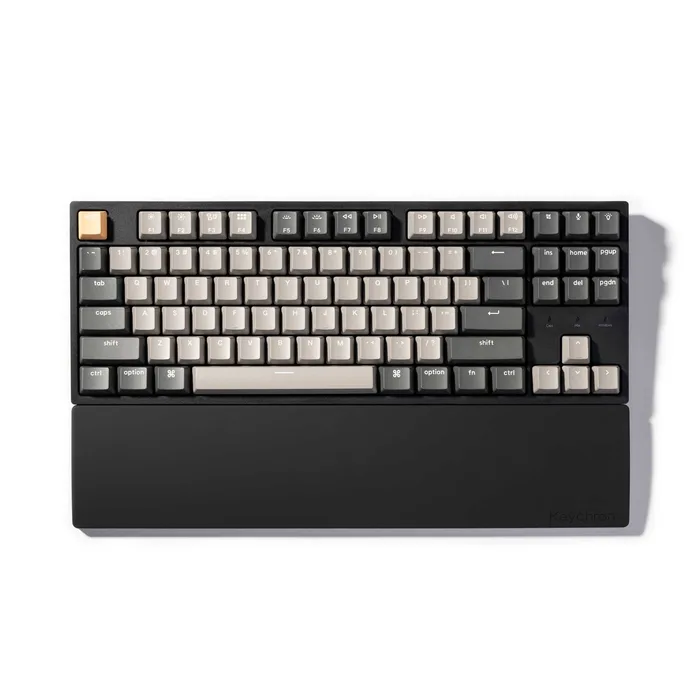
An 18 mm silicone bar sold in more than a dozen exact lengths, which is the cheapest way to get a proper height and length match.
Best for: Anyone whose keyboard length appears in Keychron's table and who wants a low, wipe-clean rest without spending much.
- Keychron publishes a full table: most sizes are 79.5 mm deep and 18 mm tall, with lengths from 306 mm up to 447 mm mapped to specific keyboard layouts.
- Silicone is described by Keychron as durable and easy to clean with a non-slip surface, so there is no fabric to absorb hand oils.
- Soft and rounded rather than rigid, which lines up with OSHA's advice on minimising pressure, and it costs less than everything else here.
- At 79.5 mm it is the shallowest rest in this group, though still well past the 1.5 in (3.8 cm) minimum depth OSHA suggests.
- You have to know your keyboard's length in millimetres to pick the right SKU, and Keychron notes lengths can vary by plus or minus 3 mm.
- Stock is patchy: at the time of writing most of the size and colour combinations on Keychron's own page were listed as backordered.
- Two SKUs break the pattern, with the split 75 percent pair at 10 mm and the numpad rest at 24 mm, so check the table rather than assuming 18 mm.
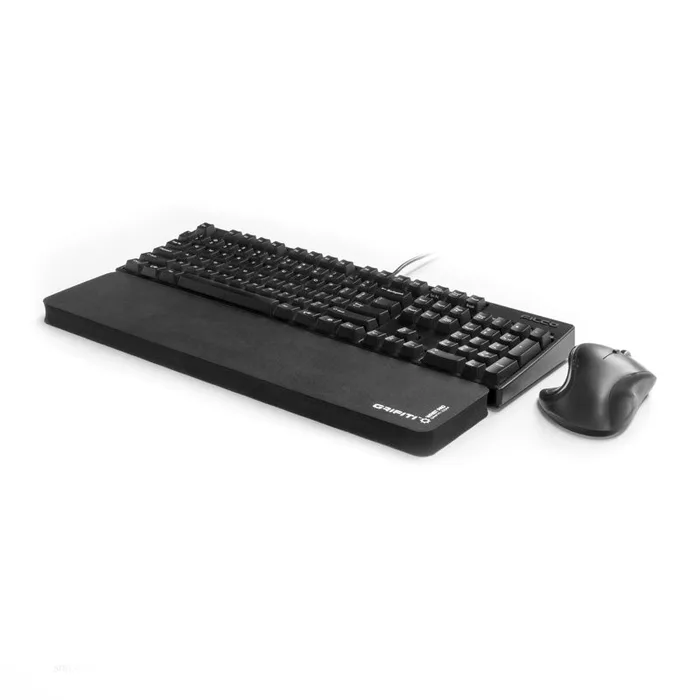
A squishy neoprene pad with a washable nylon surface, right for a tall mechanical keyboard and wrong for a slim one unless you buy the thinner version.
Best for: Someone with a tall mechanical keyboard who wants a soft pad and cares enough about hygiene to want a washable surface.
- The 17 in by 4 in by 0.75 in pad is roughly 432 by 102 by 19 mm, which is a lot of resting area, and Grifiti also sells 8, 12, 14 and 24 in versions plus a narrower 2.75 in width.
- You can choose a washable poly nylon surface instead of the smooth neoprene skin, which is a real answer to the hygiene problem with fabric-topped rests.
- Every Fat Wrist Pad has a non-skid base and a soft neoprene centre, which is closer to what OSHA describes than a rigid bar.
- At about 19 mm the Fat version is too tall for low-profile keyboards, and Grifiti's answer is a separate product, the Slim Wrist Pad at 0.25 in, rather than any adjustment.
- Neoprene compresses under load, so the effective height changes as you lean on it and drifts further as the pad ages.
- Sizes are given in inches with only loose labels such as standard or tenkeyless, so exact fit is on you to work out.
- Colour variants sell out and Grifiti's product pages state no warranty term.
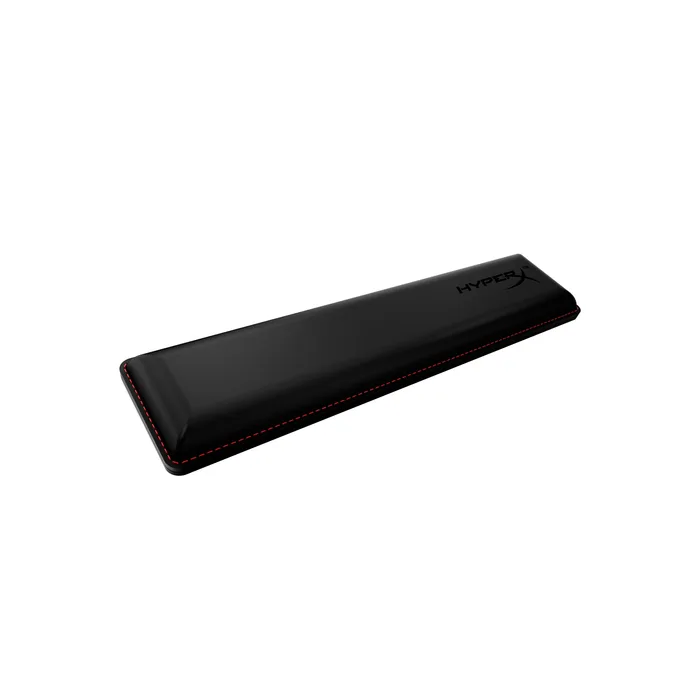
Gel-infused memory foam under a sewn fabric top, sold without a published height, which is the one specification this category runs on.
Best for: Someone who wants a soft branded pad to match a HyperX keyboard and does not care about matching heights.
- HyperX publishes width and depth, 362 by 88 mm for the tenkeyless and 457 by 88 mm for the full size, and offers a compact 60 and 65 percent version too.
- The textured natural rubber underside is a genuine anti-slip base rather than a token strip.
- A stated two year warranty, the longest of the four, and anti-fray stitching on a part that normally frays first.
- HyperX does not publish a height anywhere on the product page, so you cannot check it against your keyboard's front edge before buying.
- Gel-infused memory foam compresses under your palms, so whatever height it starts at is not the height you type against.
- The fabric top is sewn on with no removable or washable cover listed, and that surface is exactly where hand oils and sweat collect.
- It costs more than the two rests here that publish their heights and can be wiped clean.
| Criteria | Wood Ergonomic Wrist Rest Top pick | Silicone Palm Rest | Fat Wrist Pad 17 | Wrist Rest (Keyboard) |
|---|---|---|---|---|
| Verdict | Buy it | Buy it | It depends | Skip it |
| Best for | Someone who wants a rest that stays the same height for years and can be wiped down without a second thought. | Anyone whose keyboard length appears in Keychron's table and who wants a low, wipe-clean rest without spending much. | Someone with a tall mechanical keyboard who wants a soft pad and cares enough about hygiene to want a washable surface. | Someone who wants a soft branded pad to match a HyperX keyboard and does not care about matching heights. |
| Price tier | $$$ · premium | $ · budget | $ · budget | $$ · mid-range |
| Top surface | Solid USA-sourced hardwood | Silicone | Poly nylon (washable) or smooth neoprene skin | Sewn fabric, no removable cover listed |
| Core / fill | Solid wood, no fill | Solid silicone | Neoprene | Gel-infused memory foam |
| Stated height | 0.79 in (20 mm) | 18 mm on most sizes (10 mm split pair, 24 mm numpad) | 0.75 in (about 19 mm) | Not published by HyperX |
| Depth, front to back | 4 in (102 mm) | 79.5 mm | 4 in (102 mm), 2.75 in option | 88 mm |
| Length options | 331, 356 and 455 mm | 306 to 447 mm across 15 plus part numbers | 8, 12, 14, 17 and 24 in versions | Compact, TKL 362 mm, full size 457 mm |
| How sizing is chosen | By layout class (65/75, TKL, full) | By exact keyboard length in mm | By pad length in inches | By layout class (compact, TKL, full) |
| Non-slip base | Non-slip rubber feet | Non-slip surface stated | Non-skid base | Textured natural rubber underside |
| Cleaning and warranty | Wipe clean; 1 year | Wipe clean; 1 year | Washable nylon surface option; no term stated | No cleaning method stated; 2 years |
Which one is right for you?
- Someone who wants a rest that stays the same height for years and can be wiped down without a second thought. Buy it Glorious Wood Ergonomic Wrist Rest
- Anyone whose keyboard length appears in Keychron's table and who wants a low, wipe-clean rest without spending much. Buy it Keychron Silicone Palm Rest
- Someone with a tall mechanical keyboard who wants a soft pad and cares enough about hygiene to want a washable surface. It depends Grifiti Fat Wrist Pad 17
- Someone who wants a soft branded pad to match a HyperX keyboard and does not care about matching heights. Skip it HyperX Wrist Rest (Keyboard)
How we judged the field
Five things decide whether a wrist rest helps. Height comes first, because OSHA’s guidance is to match the support to the width, height and slope of the front edge of your keyboard, and a rest that sits above or below that edge creates the wrist angle you were trying to avoid. Depth comes second: OSHA suggests at least 1.5 in (3.8 cm) so the pad meets the heel of your palm rather than digging into a narrow strip of wrist, and all four rests here clear that comfortably. Third is length, because a rest that is shorter than your keyboard leaves your outer hands unsupported and one that is longer eats desk space you probably need for a mouse. Fourth is grip, since a pad that creeps forward under your hands stops matching anything. Fifth is cleanability, which sounds fussy until you remember that this is a surface your palms sweat into for several years.
The field splits neatly by material, and the split maps almost exactly onto how much information the maker is willing to publish. Rigid rests in wood, resin and silicone tend to come with a full dimension table because the numbers are fixed and flattering. Soft rests in foam, gel and neoprene often publish width and depth and stay quiet about height, because the height changes the moment you lean on them. We picked one from each side of that line plus a soft option that does publish its thickness, and then one that does not, so you can see what the gap actually costs you. Glorious and Keychron represent the measured approach, Grifiti is the soft pad done about as carefully as soft pads get, and HyperX is the popular fabric rest that leaves out the number you need.
Glorious Wood Ergonomic Wrist Rest
Buy itThe Glorious Wood Ergonomic Wrist Rest is the least exciting product here and that is the point. It is a solid bar of USA-sourced hardwood, 0.79 in or 20 mm thick and 102 mm deep, sold in three lengths: 331 mm for 65 and 75 percent boards, 356 mm for tenkeyless and 455 mm for full size. Non-slip rubber feet keep it put, and Glorious states the smooth top resists erosion from sweat and oils and cleans with a wipe. Because wood does not compress, the height you check against your keyboard’s front edge stays true, which is the whole game in this category. The trade-off is real and worth stating plainly: OSHA suggests supports that are fairly soft and rounded to minimise pressure, and hardwood is neither soft nor forgiving if you lean on it hard. It is also several times the price of the silicone options, with a one year warranty and no adjustment of any kind. This is for someone who has measured their keyboard, knows 20 mm is right, and wants to stop thinking about it.
Keychron Silicone Palm Rest
Buy itThe Keychron Silicone Palm Rest is the most practical answer for most desks. Keychron publishes a proper table: most part numbers are 79.5 mm deep and 18 mm tall, with lengths of 306, 317, 327.5, 337, 341.4, 358, 365, 372, 380, 390.5, 408, 435, 444.9, 446 and 447 mm mapped to specific keyboard layouts, and weights from 256 g to 373 g for the standard bars. Two outliers exist, a split 75 percent pair at 10 mm tall and a numpad rest at 24 mm, so read the table rather than assuming. Keychron describes the silicone as durable, easy to clean and non-slip, which sidesteps the hygiene problem that fabric tops carry. It is soft and rounded in the way OSHA describes, and it costs a fraction of the wood. The catches are that 79.5 mm is the shallowest depth here, that you need to know your keyboard’s length in millimetres, and that a lot of the size and colour combinations were showing as backordered on Keychron’s own store. If your length is listed and in stock, buy it.
Grifiti Fat Wrist Pad 17
It dependsThe Grifiti Fat Wrist Pad 17 is the soft option done thoughtfully. It measures 17 by 4 by 0.75 in, roughly 432 by 102 by 19 mm, with a squishy neoprene centre, a non-skid base and a choice between a smooth neoprene skin or a washable poly nylon surface in several colours. That washable surface is a genuine differentiator: hygiene is the quiet failure mode of fabric-topped rests, and Grifiti is one of the few makers that addresses it directly. The line also runs 8, 12, 14 and 24 in versions and a narrower 2.75 in width, plus a Slim Wrist Pad at 0.25 in for low-profile keyboards, which is the version to buy if your keyboard’s front edge is thin. That is exactly why this lands as a depends. Neoprene compresses, so the working height drifts under your palms and further over the years, sizes are quoted in inches with only loose keyboard labels, colours go out of stock, and Grifiti’s pages state no warranty term. Right pad, right keyboard, and you have to make that call yourself.
HyperX Wrist Rest (Keyboard)
Skip itThe HyperX Wrist Rest is a competent object with one disqualifying gap. HyperX publishes the width and depth, 362 by 88 mm for the tenkeyless and 457 by 88 mm for the full size, notes a textured natural rubber underside for grip and anti-fray stitching for durability, and backs it with a two year warranty, the longest here. What it does not publish, anywhere on the product page, is a height. In a category where the central piece of guidance is to match the support to the height of the front edge of your keyboard, that omission means you are buying blind. The material compounds it: gel-infused memory foam compresses under load, so even if you measured one in a shop, the number would not hold while you use it. The fabric top is sewn on with no removable or washable cover listed, which is the surface your palms will be on for years. It also costs more than both rests here that publish their heights and can be wiped down. Good build, wrong information.
Sources
Specs in this review come from these pages.
- OSHA Computer Workstations eTool: Wrist/Palm Supports (osha.gov)
- OSHA Computer Workstations eTool: Keyboards (osha.gov)
- Glorious: Wood Ergonomic Wrist Rest product page (gloriousgaming.com)
- Keychron: Silicone Palm Rest product page and size table (keychron.com)
- Grifiti: Fat Wrist Pad 17 product page (grifiti.com)
- HyperX: Wrist Rest Keyboard Tenkeyless technical specifications (hyperx.com)
Glorious Wood Ergonomic Wrist Rest vs Keychron Silicone Palm Rest: which should you buy?
The choice between the Glorious wood rest and the Keychron silicone rest comes down to how your keyboard measures and how much you value a surface that does not compress. Glorious gives you 20 mm across three lengths and a solid top that does not compress. Keychron gives you 18 mm across more than a dozen lengths, so the odds of an exact length match are far higher, and it costs a fraction as much. If your keyboard’s front edge measures close to either number, both will work; if it sits between sizes, the deciding factor is usually length rather than height, and that favours Keychron. The 2 mm difference between them is small enough that it will not be what you notice.
What you will notice is the feel. Hardwood is firm and cool and does not give at all, which some people find steadying and others find punishing after an hour. Silicone yields slightly under the heel of the palm, which is closer to what OSHA describes when it suggests supports that are fairly soft and rounded. Depth is the other split: 102 mm of wood against 79.5 mm of silicone, both past the 1.5 in minimum, but the wider rest gives you more room to shift position. Buy the Glorious if you want permanence and a wipe-clean slab; buy the Keychron if you want the exact length for your board and a softer landing, and put the difference toward fixing your desk or chair height, which will do more for your wrists than either pad.
What to look for
- Measure before you shop: put a ruler against the front edge of your keyboard, note the height in millimetres, and only consider rests that publish a number you can compare against it.
- Treat a missing height as a red flag: several popular rests publish width and depth but not thickness, and that is the one dimension that decides whether the thing helps or hurts.
- Match the length, not just the class: a rest labelled tenkeyless can still be 20 mm shorter than your board, so compare millimetres where the maker gives them.
- Check the depth against 3.8 cm: OSHA suggests supports at least 1.5 in deep so the pad meets the heel of your palm instead of pressing into a narrow band of wrist.
- Prefer a surface you can actually clean: fabric tops with no removable cover absorb hand oils and sweat for years, while silicone, wood, resin and washable nylon can be dealt with.
- Insist on a real non-slip base: rubber feet or a full textured underside keep the rest aligned with the keyboard, and a rest that creeps forward stops matching anything you measured.
Our final take
Wrist rests are a small purchase wrapped in oversized claims. Pick the one whose top sits level with the front edge of your keyboard, whose length matches your board, that grips the desk, and that you can wipe down. Then use it the way the guidance describes: hands floating while you type, palms resting on it while you pause. The Glorious wood rest does that with the fewest variables, the Keychron silicone does it for far less money and in more sizes, and the Grifiti is the soft pad to buy if you are willing to pick the right thickness. The HyperX is the one to pass on, not because it is badly made, but because it withholds the number you need to buy well.
Questions, answered
Will a wrist rest prevent or fix carpal tunnel syndrome?
No, and you should treat any product page that suggests otherwise as marketing rather than evidence. A wrist rest is a place to park your palms during pauses, nothing more. OSHA's own guidance is careful here: it notes that opinions vary on wrist and palm supports, and that resting the wrist or palm on a support while typing may inhibit motion of the wrist and could increase awkward wrist postures. Pressing the underside of your wrist into a pad while you type puts contact pressure right over the structures people are usually worried about. If you have pain, numbness or tingling in your hand, that is a conversation for a clinician, not a purchase.
How tall should a wrist rest be?
Level with the front edge of your keyboard, or very close to it. OSHA's advice is to match the wrist support to the width, height and slope of the front edge of the keyboard, with the goal of keeping wrist postures as straight as possible. A rest that sits taller than the keyboard tips your hands down into the keys; a rest that sits lower lets them drop and bends the wrist upward. Measure your keyboard's front edge with a ruler before you shop, then buy against a published number. That is why we marked the HyperX down: no published height means no way to check.
Should my wrists actually touch the rest while I type?
No. OSHA is direct about this: your hands should move freely and be elevated above the wrist or palm rest while typing, and when resting, the pad should contact the heel or palm of your hand rather than your wrist. In practice that means you float over the keys during a burst of typing, then drop your palms onto the rest while you read, think or take a call. Most of the discomfort people blame on wrist rests comes from using them as a permanent prop. The name is unhelpful, which is why several makers now call them palm rests instead.
Foam, gel, silicone or wood: does the material matter?
It matters for two reasons, and neither is the one the packaging pushes. The first is stability: foam and gel compress under load, so the height you measured is not the height you get once your weight is on it, while silicone and wood hold their dimension. The second is hygiene, which is a genuine issue for fabric-topped foam rests that sit under sweaty palms for years and cannot be washed. OSHA does suggest supports that are fairly soft and rounded to minimise pressure, so a rigid wooden bar is a trade-off rather than a free upgrade. Silicone lands in the middle: soft to the touch, dimensionally stable, and wipeable.
Do I even need a wrist rest?
Plenty of people do not. If your chair, desk and keyboard are already set so your forearms are roughly level and your wrists are straight, a wrist rest adds a resting spot and little else. It becomes more useful when your keyboard has a tall front edge, because the alternative is resting your forearms on a hard desk lip, which OSHA identifies as a source of contact stress. Fix the chair and desk height first, then decide. Buying a pad to compensate for a badly positioned keyboard usually just moves the problem.
Deciding between the top two? See our head-to-head: Glorious Wood Ergonomic Wrist Rest vs Keychron Silicone Palm Rest.
More Office reviews
 The Best Office Chair Mats: 4 Compared (and One to Skip)
  The Best Filing Cabinets: 4 Compared (and One to Skip)
  The Best Laptop Cooling Pads: 4 Compared (and One to Skip)
  The Best Anti-Fatigue Mats: 4 Compared (and One to Skip)
  The Best Big and Tall Office Chairs: 4 Compared (and One to Skip)
  The Best Desk Cable Management Kits: 4 Compared (and One to Skip)