

Office & WFH
The Best Big and Tall Office Chairs: 4 Compared (and One to Skip)
Four big-and-tall office chairs compared on rated capacity, how that rating is backed, seat width, base and cylinder, and warranty.
The short version
Big-and-tall chairs live or die on structure, not on the number printed on the box. The Steelcase Leap Plus is the safest buy: rated to 500 lbs and covered by a 12-year, 24/7 multi-shift warranty, which is a manufacturer putting money behind the rating. The HON Ignition 2.0 Big and Tall is the value pick, a wider, higher-capacity build of a commercial task chair with a mesh back that stays cool. The Herman Miller Aeron in Size C is rated to 400 lbs and runs cooler than anything else here, but it has a mid-height back and no factory headrest, so it only suits the big half of big and tall. Skip the Serta Fairbanks: it widens the seat and thickens the foam with nothing published about the structure underneath, and owner reports keep landing on peeling bonded leather and collapsed cushions. Best for: heavier or broader sitters who want the rating backed by a warranty, with the Leap Plus for all-day use above 400 lbs and the HON for most others.
Our picks at a glance
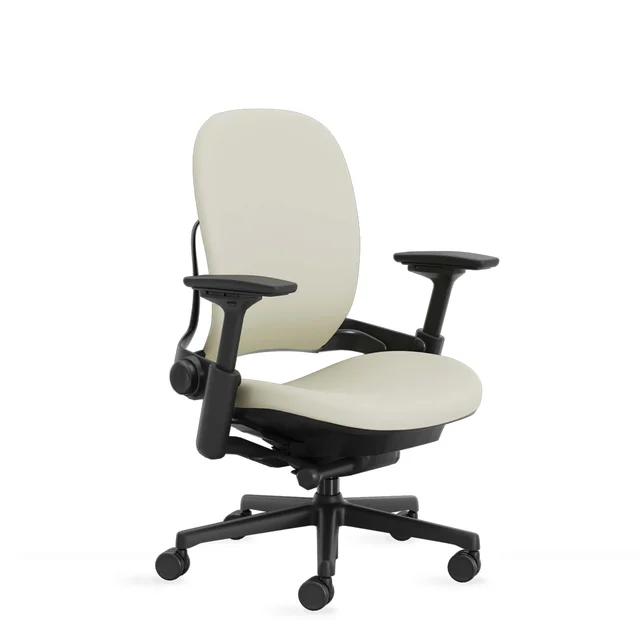
- Steelcase Leap Plus - Buy. The Leap chassis rebuilt for a 500 lb rating, with a warranty that treats that number as a real commitment.
- HON Ignition 2.0 Big and Tall - Buy. A higher-capacity, wider-seat version of HON's commercial mesh task chair, at a fraction of the flagship price.
- Herman Miller Aeron Chair (Size C) - It depends. Not sold as a big-and-tall chair, but Herman Miller lists the C frame at a 400 lb weight capacity and it is the coolest-running seat here.
- Serta Fairbanks Big and Tall Executive Office Chair - Skip. A wider seat and more foam wrapped in bonded leather, with none of the structural upgrades the category name implies.
The verdict in 30 seconds
What mattered most
- Rated weight capacity
- How the rating is backed
- Seat width for wider frames
- Back height and headrest
- Frame, base and lift
- Warranty
Every chair sold as big and tall carries a weight number on the box, but that number is a manufacturer claim, not a certificate. The chairs worth buying back it with real structure: a heavier cylinder, a cast or reinforced base, and a warranty that survives daily use at that weight. Two of the four here do that convincingly, one is excellent for larger frames without being marketed as big and tall at all, and one just widens the seat and calls it a day.
The Leap chassis rebuilt for a 500 lb rating, with a warranty that treats that number as a real commitment.
Best for: Anyone above roughly 350 lbs who sits all day and wants the rating backed by a long multi-shift warranty rather than a spec sheet line.
- Steelcase rates the Plus variant to 500 lbs, the highest ceiling in this group by a wide margin
- Covered by a 12-year, 24/7 multi-shift parts-and-labor warranty, which is the strongest signal that the rating was engineered rather than marketed
- Same adjustments as the standard Leap, including seat depth, height-adjustable lumbar with a lower back firmness dial, and 4-way arms
- The flexible back and seat edges keep pressure off the thighs, which matters most for wider sitters
- The most expensive chair here by a large margin, and the Plus variant usually has to be ordered through a dealer rather than grabbed off a shelf
- Steelcase lists the headrest as a standard Leap configuration, so confirm with the dealer that it can be specified on the Plus
- Upholstered seat runs warmer than mesh over a long day
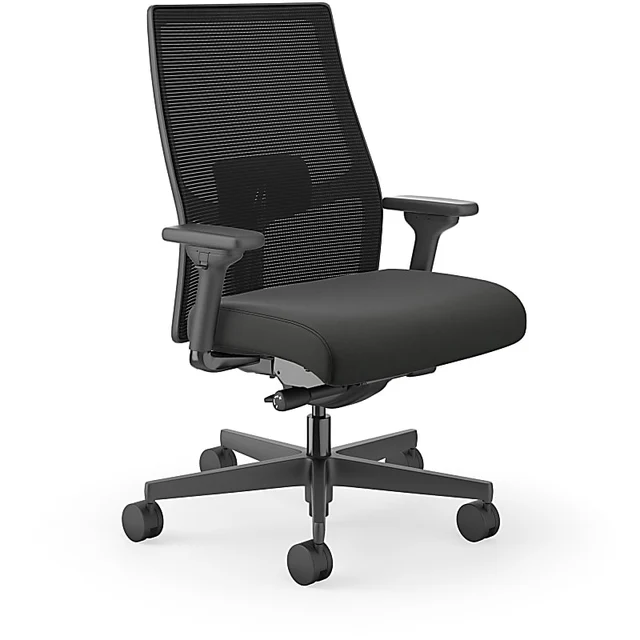
A higher-capacity, wider-seat version of HON's commercial mesh task chair, at a fraction of the flagship price.
Best for: A heavier sitter who wants commercial-grade structure and airflow without paying flagship money, after confirming the rated capacity on HON's spec sheet.
- Sold as the higher-capacity build of a commercial task chair, and HON sells into commercial accounts where warranty claims are routine
- A wider seat than the standard Ignition 2.0; check HON's current spec sheet for the exact width and capacity
- 4-way stretch mesh back stays cooler than the padded executive chairs most big-and-tall shoppers get pushed toward
- Adjustable lumbar, seat glide, and height-adjustable arms are standard, and a headrest version is available
- Plain office-issue looks that will not suit a home study
- Mesh back is mid-height rather than genuinely tall, so users well over 6 ft 3 in should look at the headrest build
- Arm pads are firmer and less contoured than the padded loungers in this price band
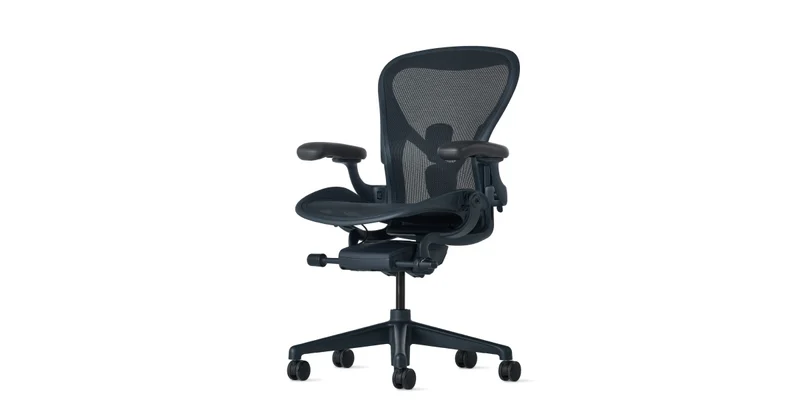
Not sold as a big-and-tall chair, but Herman Miller lists the C frame at a 400 lb weight capacity and it is the coolest-running seat here.
Best for: Broad or tall sitters under 400 lbs who run hot and want mesh, and who do not need a tall back or headrest.
- Herman Miller publishes a weight capacity for each size, 400 lbs for C, 350 for B and 300 for A, which is unusually specific for this category
- Suspension mesh seat spreads load instead of compressing, so there is no foam to flatten out over a few years
- Runs noticeably cooler than any padded executive chair, which matters more the larger you are
- 12-year warranty and a huge parts and refurbishment ecosystem, so it stays serviceable for a long time
- The back is mid-height and there is no factory headrest, so it does not solve the tall half of big and tall
- The mesh edge at the front of the seat can dig in for heavier users with shorter thighs
- Premium price for a chair that stops at 400 lbs, and you have to specifically order Size C rather than the default B
- Sizing is by height and weight together, so a broad user of average height may land on B and lose the extra capacity
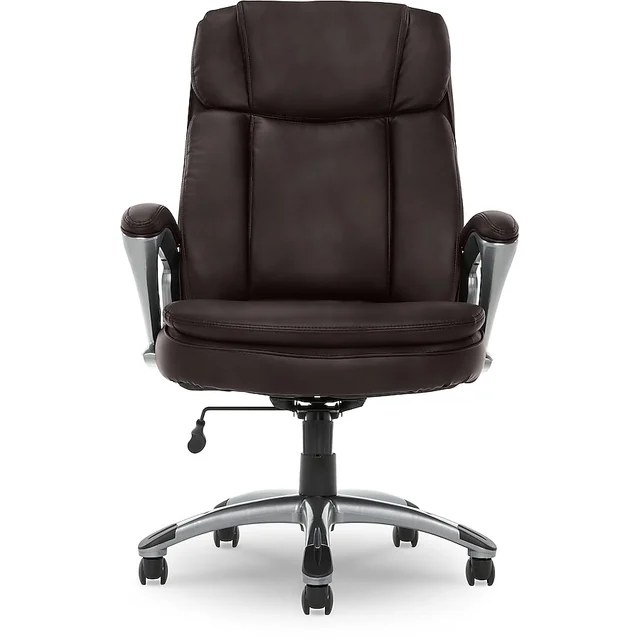
A wider seat and more foam wrapped in bonded leather, with none of the structural upgrades the category name implies.
Best for: Occasional or guest seating only. If it is going to hold a heavy user for eight hours a day, it is the wrong chair.
- Wide padded seat that feels plush in the showroom
- Cheap enough to be a reasonable guest chair or occasional-use seat
- Tall padded back with a built-in head pillow, which the two task chairs here lack
- Serta's own site does not currently list this chair, so there is no maker page backing its weight rating
- Bonded leather is the recurring complaint in owner reports: flaking and peeling at contact points, often inside a couple of years
- The foam is the load-bearing element, and owners repeatedly describe it compressing until they are sitting on the seat pan
- The maker does not publish a cylinder class or a base load spec, which is exactly the omission you want to avoid at this weight
- Consumer-length limited warranty rather than the multi-year commercial coverage the other three carry
| Criteria | Steelcase Leap Plus Top pick | HON Ignition 2.0 Big and Tall | Herman Miller Aeron Chair (Size C) | Serta Fairbanks Big and Tall Executive Office Chair |
|---|---|---|---|---|
| Verdict | Buy it | Buy it | It depends | Skip it |
| Best for | Anyone above roughly 350 lbs who sits all day and wants the rating backed by a long multi-shift warranty rather than a spec sheet line. | A heavier sitter who wants commercial-grade structure and airflow without paying flagship money, after confirming the rated capacity on HON's spec sheet. | Broad or tall sitters under 400 lbs who run hot and want mesh, and who do not need a tall back or headrest. | Occasional or guest seating only. If it is going to hold a heavy user for eight hours a day, it is the wrong chair. |
| Price tier | $$ · flagship | $ · mid-range | $$ · premium | $ · budget |
| Rated weight capacity | 500 lbs | Check HON spec sheet | 400 lbs (Size C) | Not published by maker |
| How the rating is backed | Published for the Plus variant and matched by a 24/7 multi-shift warranty | Commercial task chair line sold into commercial accounts | Published weight capacity for each frame size | Spec sheet number with no supporting structural detail |
| Seat width for wider frames | Same chassis as Leap, built for higher capacity | Wider than standard Ignition 2.0 | Largest of three Aeron frame sizes | Wide, but padded arms eat into usable width |
| Back height and headrest | Tall adjustable back, headrest offered in the Leap range | Mid to high mesh back, headrest build available | Mid-height mesh back, no factory headrest | Tall padded back with fixed head pillow |
| Frame, base and lift | Polished aluminum frame and base option | Five-star base, steel frame details on HON spec sheet | Die-cast aluminum or polymer base | Metal base, cylinder class not published |
| Warranty | 12 years, 24/7 multi-shift, parts and labor | Long-term commercial coverage through HON | 12 years | Limited consumer warranty, read the terms |
| Seat material and heat | Upholstered, runs warm | Mesh back with padded seat, good airflow | Full suspension mesh, coolest here | Bonded leather over foam, runs hottest |
| Price tier | $$ · flagship | $ · mid-range | $$ · premium | $ · budget |
Which one is right for you?
- Anyone above roughly 350 lbs who sits all day and wants the rating backed by a long multi-shift warranty rather than a spec sheet line. Buy it Steelcase Leap Plus
- A heavier sitter who wants commercial-grade structure and airflow without paying flagship money, after confirming the rated capacity on HON's spec sheet. Buy it HON Ignition 2.0 Big and Tall
- Broad or tall sitters under 400 lbs who run hot and want mesh, and who do not need a tall back or headrest. It depends Herman Miller Aeron Chair (Size C)
- Occasional or guest seating only. If it is going to hold a heavy user for eight hours a day, it is the wrong chair. Skip it Serta Fairbanks Big and Tall Executive Office Chair
How we judged the field
We do not run a lab. What we do is read across independent testing, manufacturer specification sheets, and aggregated owner reports, then weigh the claims against each other and against what the maker is willing to guarantee.
For big-and-tall chairs that comes down to five things. First, the rated capacity, and more importantly whether anything backs it. ANSI/BIFMA X5.1 is the test standard that office chairs are evaluated against, and the manufacturers who take it seriously tie the rating to warranty language rather than leaving it as a bullet point. Herman Miller is the clearest example in this group: it publishes the Aeron weight capacity separately for each frame size. Second, the parts that actually carry the load. A gas cylinder graded class 4 rather than class 3, and a cast or reinforced base rather than plain nylon, are the difference between a chair that survives and one that sinks. Third, usable seat width, measured between the armrests rather than the marketing figure for overall seat width. Fourth, back height and headrest availability, because most chairs sold as big and tall solve for big and quietly ignore tall. Fifth, warranty length and terms, which is the only number a manufacturer has to pay for if it is wrong.
That framework separates this field fast. Two chairs published real structural detail and matched it with commercial warranties. One is excellent for larger frames without being sold as a big-and-tall chair at all. One widened the seat, added foam, and stopped there.
Steelcase describes the Leap Plus as offering the same benefits and functionality as a standard Leap, with support for users up to 500 lbs. The standard Leap is rated to 400. That gap is the whole point of the product, and Steelcase does not treat it as a footnote: the Leap family carries a 12-year limited warranty covering multi-shift and 24/7 use, parts and labour included. A company that will replace parts free for twelve years of round-the-clock use at a 500 lb rating has done the arithmetic on failure rates.
The ergonomics carry over intact. The back flexes as you move rather than fighting you, lumbar height and firmness are both adjustable, seat depth adjusts, and the arms move in four directions. The flexible seat edges matter more than they sound for wider sitters, because the pressure point on most chairs is the front corner of a rigid seat pan against the thigh.
The drawbacks are real. It is by far the most expensive chair here, the Plus variant typically goes through a dealer rather than a checkout button, and Steelcase lists the headrest as a standard Leap configuration, so a tall user who wants neck support should confirm with the dealer that it can be specified on the Plus. The upholstered seat also runs warmer than mesh across a full day. None of that changes the verdict for the intended buyer. If you are above roughly 350 lbs and you sit for a living, this is the chair with the least risk attached.
HON took the standard Ignition 2.0 task chair, widened the seat, and built it for a higher weight capacity. We could not load HON’s current spec page, so check the published capacity and seat width there before you order. Done properly, that is the right order of operations, and it is what separates this from most chairs wearing the big-and-tall label.
The 4-way stretch mesh back is the other reason to pick it. Most big-and-tall shoppers get funnelled toward padded executive chairs, which are the worst possible choice for anyone who runs hot, and heat is a bigger comfort factor at larger body sizes than almost anything else. Adjustable lumbar, a seat glide for leg length, and height-adjustable arms come standard, and there is a headrest build for taller users.
It looks like what it is: an office-issue task chair, plain and functional, which will not please anyone furnishing a home study. The mesh back is mid to high rather than genuinely tall, so users well over 6 ft 3 in should spend the extra on the headrest version. The arm pads are firmer than the padded loungers at similar money. For a heavier sitter who wants commercial structure and airflow without flagship pricing, this is the value answer in the category, once the spec sheet confirms the capacity you need.
The Aeron is not marketed as a big-and-tall chair, which is exactly why it is interesting here. Herman Miller’s own sizing guidance lists a weight capacity of 300 lbs for A-size chairs, 350 for B-size and 400 for C-size. That is more precise than almost anything else in this category, and the C frame is the largest of the three.
What you get is a suspension mesh seat that spreads load instead of compressing, so there is no foam to flatten after three years, and the coolest-running seat in this comparison by a comfortable margin. The 12-year warranty and the enormous parts and refurbishment market behind the Aeron mean it stays serviceable for a long time, which changes the cost calculation considerably.
The catch is the tall half of the brief. The Aeron back is mid-height, there is no factory headrest, and no amount of frame size fixes that. Some heavier users with shorter thighs also find the mesh edge at the front of the seat digs in where a padded seat would not. And you have to actively order Size C: Herman Miller’s height ranges for B and C overlap, and a B frame would drop you to a 350 lb rating. Excellent chair, correct only for a specific reader: broad or tall, under 400 lbs, runs hot, does not need a headrest.
This is the pattern the category is built on. The seat is genuinely wide, the back is tall, there is a head pillow, and the foam is deep. What is missing is everything underneath. Serta’s own site does not currently list the chair, so there is no maker page backing its weight rating. No cylinder class is published. No base load specification is published. The warranty is consumer-length rather than the multi-year commercial coverage the other three carry.
Owner reports converge on two failures. The bonded leather flakes and peels at contact points, frequently within a couple of years, which is a well-documented weakness of the material rather than bad luck on individual units. And the foam compresses until the seat pan is doing the work, which is what happens when foam is the load-bearing element instead of a comfort layer over a rated structure.
It is cheap, and as an occasional or guest chair that is a fair trade. As the chair a heavy user sits in for eight hours a day, it is the wrong purchase, and the wider seat is doing a lot of persuasive work that the engineering does not support.
Steelcase Leap Plus vs HON Ignition 2.0 Big and Tall: which should you buy?
These are the two chairs here that were actually built for the job, and the choice comes down to weight and hours.
Above roughly 400 lbs, it is the Leap Plus and it is not close. It is the only chair in this comparison rated to 500, and the 12-year multi-shift warranty means Steelcase is exposed if the rating is optimistic. That warranty is the product. You are not paying for adjustments the HON also has, you are paying for a decade of coverage at a weight where most chairs are out of spec.
Between roughly 300 and 400 lbs, the HON wins on value by a wide margin, provided its published rating gives you real headroom above your actual weight, which is the right way to buy. You also get the cooler seat: mesh back against the Leap’s upholstery matters across a full day, and it matters more the larger you are.
The tiebreakers run in different directions. The Leap adjusts more finely, particularly lumbar firmness and seat depth, and the flexible seat edges are kinder to wider thighs. Both families offer a headrest build, though on the Leap Plus it is worth confirming with the dealer. If your budget stretches to either and you sit all day at over 400 lbs, take the Leap Plus. Otherwise the HON gets you most of the way for a lot less.
What to look for
- Buy about 50 lbs of headroom. A chair rated at your exact weight is a chair operating at its limit every day. Rate up.
- Check the cylinder class, not just the capacity. Class 4 is the heavier-duty grade above the class 3 fitted to ordinary task chairs, and the cylinder is what sinks first. If the maker will not publish it, that tells you something.
- Check the base material. Glass-filled nylon is fine at ordinary loads. Above roughly 300 lbs you want cast aluminium or steel.
- Measure between the armrests, not across the seat. Padded executive arms can take two or three inches off the width you thought you were buying. Measure your hips seated and add about two inches.
- Separate big from tall. Most chairs in this category solve for width and capacity only. If you are tall, prioritise seat height range, seat depth adjustment, back height, and headrest availability, and look for an extended-height cylinder option.
- Read the warranty as a spec. Twelve years of multi-shift coverage is a structural claim. A one-year consumer warranty on a 500 lb rating is a contradiction.
- Treat foam depth as a comfort feature, not a load feature. Deep cushions feel great in week one. What carries you in year three is the frame, the pan, and the cylinder.
- Be sceptical of round numbers with no test reference. ANSI/BIFMA X5.1 exists, and makers who test to it tend to say so.
Our final take
The big-and-tall label is doing more marketing work than engineering work across most of this category. Widening a seat and adding foam is cheap. Upgrading a cylinder, a base, and a frame, then guaranteeing the result for a decade, is not, and the price difference between the chairs here maps almost exactly onto which manufacturers did which.
The Steelcase Leap Plus is the pick because a 500 lb rating attached to a 12-year, 24/7 warranty is a claim someone has to pay for if it is wrong. The HON Ignition 2.0 Big and Tall is the one most people should actually buy: a higher-capacity build of a commercial task chair, a meaningfully wider seat, a mesh back that stays cool, and a price that does not require a procurement conversation. The Aeron in Size C is a genuinely great chair with a published 400 lb capacity, but it answers the big half of the question and ignores the tall half, so buy it knowing that. And the Serta Fairbanks is the version of this category to walk away from: a wide, plush chair with nothing published about the parts that carry you.
If you take one habit away, make it this. Before you look at the capacity number, look for what backs it. The warranty, the cylinder class, and the base material will tell you more in thirty seconds than the product page will in ten minutes.
Questions, answered
Does a stated weight capacity mean the chair was actually tested to it?
Not automatically. ANSI/BIFMA X5.1 is the industry test standard for office chairs, and the makers who take it seriously say so plainly and tie the rating to their warranty. Herman Miller, for example, publishes the Aeron weight capacity separately for each frame size. When a listing shows a big round number with no reference to a test standard, no cylinder spec, and a short consumer warranty, treat the number as marketing. The practical test: ask what happens if the chair fails at that weight in year three. A commercial warranty answers that question, a spec sheet does not.
What actually fails first on an overloaded office chair?
Usually the gas cylinder, then the base, then the seat foam. The cylinder is the part that sinks slowly or drops suddenly, and cylinders are graded by class, with class 4 the heavier-duty spec above the class 3 fitted to ordinary task chairs. Bases are the next weak point: glass-filled nylon is fine at typical loads but cast aluminum or steel is what you want above roughly 300 lbs. Foam is the least dangerous failure and the most common complaint, because a collapsed cushion leaves you sitting on the seat pan. A chair that widens the seat without upgrading cylinder and base has moved the problem, not solved it.
How wide does the seat actually need to be?
Measure yourself sitting down, hip to hip at the widest point, and add about two inches. Then check the measurement that matters, which is the clear width between the armrests rather than the overall seat width the listing advertises. Padded executive arms can steal two or three inches of usable space, so a chair with a wide padded seat can feel tighter than a task chair with a narrower seat and slimmer arms. If a maker publishes only overall width and not inside width, that is worth noticing.
I am tall but not heavy. Do I need a big-and-tall chair?
Often not. Tall users usually need seat height range, seat depth, and back height, and most big-and-tall chairs solve for width and capacity instead. Check that the seat raises high enough for your leg length, that seat depth adjusts so the front edge clears the back of your knee, and that the backrest supports your shoulder blades. Some chairs offer an extended-height cylinder as an option, which is often the single most useful upgrade for a tall sitter. A headrest build matters more here than a higher weight rating.
Is mesh or padded upholstery better for a larger user?
Mesh generally, for two reasons. Suspension mesh distributes load rather than compressing, so there is no foam to flatten out, and it moves heat away, which matters more the larger you are. The trade-off is the frame edge at the front of the seat, which some heavier users with shorter thighs find digs in. Padded seats feel better on day one and worse in year three, especially in bonded leather, which is the material behind most of the peeling and flaking complaints in this category. If you want padding, look for a chair where the structure underneath the foam is rated, not just the foam.
Deciding between the top two? See our head-to-head: Steelcase Leap Plus vs HON Ignition 2.0 Big and Tall.
More Office & WFH reviews
 The Best Desk Cable Management Kits: 4 Compared (and One to Skip)
  The Best Conference Speakerphones: 4 Compared (and One to Skip)
  The Best Copyholders: 4 Compared (and One to Skip)
  The Best Desk Fans: 4 Compared (and One to Skip)
  The Best Desk Mats: 4 Compared (and One to Skip)
  The Best Desk Organizers: 4 Compared (and One to Skip)