Explained
Big and Tall Office Chairs, Explained
After reading this you will be able to tell a chair engineered for heavier sitters from one that just has a wider seat and a bigger number on the box.
In this guide
Every chair sold as big and tall carries a weight number, and most shoppers treat that number as a specification. It is usually a marketing claim. The parts that decide whether a chair survives daily use at that weight are the gas cylinder, the base, and the frame under the seat, and a lot of chairs in this category upgrade none of them. This guide explains what to look at instead, and how to tell in about thirty seconds whether a listing is describing engineering or upholstery.
The 30-second version
- A stated capacity is a claim, not a test result. ANSI/BIFMA X5.1 is the industry test standard for office chairs, and manufacturers who actually test to it tend to say so and tie the rating to their warranty language.
- The gas cylinder fails first. Cylinders are graded by class, and class 4 is the heavier-duty grade above the class 3 fitted to ordinary task chairs. A maker who will not publish the class is telling you something.
- Base material matters more than base looks. Glass-filled nylon is fine at ordinary loads, but above roughly 300 lbs you want cast aluminum or steel carrying the weight.
- Measure between the armrests, not across the seat. Padded executive arms can take two or three inches off the width you thought you were buying, so overall seat width is the least useful number in the listing.
- Most big and tall chairs solve for big and ignore tall. If you are tall rather than heavy, you need seat height range, seat depth adjustment, and back height, none of which come automatically with a higher capacity rating.
The products this guide is about
Our verdict on each, with the full reasoning on the companion review.
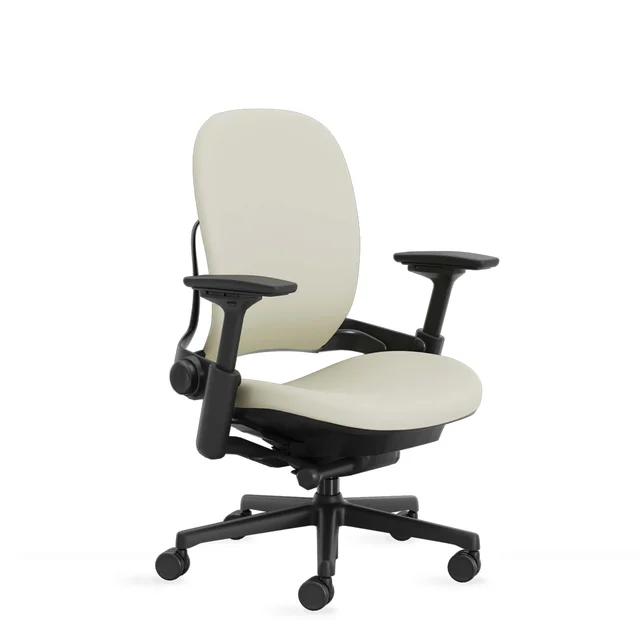
- Buy Steelcase Leap Plus The Leap chassis rebuilt for a 500 lb rating, with a warranty that treats that number as a real commitment. Amazon
- Buy HON Ignition 2.0 Big and Tall A higher-capacity, wider-seat version of HON's commercial mesh task chair, at a fraction of the flagship price. Amazon
- It depends Herman Miller Aeron Chair (Size C) Not sold as a big-and-tall chair, but Herman Miller lists the C frame at a 400 lb weight capacity and it is the coolest-running seat here. Amazon
- Skip Serta Fairbanks Big and Tall Executive Office Chair A wider seat and more foam wrapped in bonded leather, with none of the structural upgrades the category name implies. Amazon
What actually matters
- How the capacity rating is backed. Any maker can print a number. The ones worth trusting reference a test standard, publish the structural parts that carry the load, and cover the chair with a long multi-year warranty at that rating. A big round number sitting next to a short consumer warranty is a contradiction, not a spec.
- Gas cylinder class. The cylinder is the single part most likely to fail under sustained load, either sinking slowly through the day or dropping suddenly. Class 4 cylinders are built for higher loads and longer cycles than the class 3 units in standard task chairs. Cylinder class is cheap to publish and quietly omitted by chairs that do not have the good one.
- Base construction. The five-star base takes the full load every time you sit. Cast aluminum and steel bases handle heavy sitters and years of casters rolling over thresholds. Glass-filled nylon is a legitimate material at normal weights and a bad bet well above 300 lbs, particularly at the arms of the star where cracks start.
- Usable seat width between the arms. Seat width in a listing is measured across the whole cushion, including the parts your hips will never reach. What you actually sit in is the clear space between the armrests. Measure your hips seated at their widest point and add about two inches, then compare that to inside width, not overall width.
- Back height and headrest availability. Tall sitters need the backrest to support the shoulder blades and, often, a headrest. Many big and tall chairs are ordinary-height task chairs with a wider seat, which does nothing for a taller user. An extended-height cylinder is frequently the single most useful upgrade for long legs.
- Seat support structure versus foam depth. Deep cushions feel excellent in the first week and can be sitting on the seat pan by year three. What carries you long term is the frame and the pan underneath. Treat foam as a comfort layer over a rated structure, never as the structure itself.
- Warranty length and terms. Warranty is the only claim a manufacturer has to pay for if it is wrong. Multi-year commercial coverage that explicitly includes multi-shift or 24/7 use is a structural statement. A limited consumer warranty on a very high rating means the maker priced in the failures.
The specs, in plain English
Green flags vs red flags
Green flags
- The listing names a test standard such as ANSI/BIFMA X5.1 rather than just printing a capacity number
- The cylinder class and base material are both published, and both are the heavy-duty grade
- The rating is matched by a long commercial warranty, ideally one that explicitly covers multi-shift or 24/7 use
- The big and tall version is described as a structurally different chair, with a reinforced frame and a wider seat pan, not just extra padding
- Inside width between the armrests is published, or the arms are slim enough that overall width is close to usable width
- A headrest build or an extended-height cylinder is offered for taller users
Red flags
- A high capacity number with no reference to any test standard anywhere on the page
- No cylinder class and no base load specification published, which is the most common omission in this category
- The only differences from the standard-size model are a wider cushion and more foam
- A short limited consumer warranty attached to a very high weight rating
- Bonded leather described as leather, particularly on a chair meant for all-day use
- Marketing that leans on plush cushioning and a head pillow while saying nothing about the frame, pan, base, or lift
Who's who: the brands
- Steelcase - Contract furniture maker whose big-capacity variants pair high ratings with long multi-shift commercial warranties, which is the strongest form of backing in this category.
- Herman Miller - Premium ergonomic brand that publishes a separate weight capacity for each frame size, unusually specific for office chairs.
- HON - Commercial office furniture brand that sells big and tall builds of its task chairs into business accounts, where warranty claims are routine.
- Humanscale - Ergonomics specialist known for minimal mechanisms and weight-sensitive recline, with some models covering larger sitters without a separate big and tall label.
- Serta and similar retail furniture brands - Home and retail brands that dominate the budget end of the category, typically competing on cushion depth and seat width rather than on rated structure.
- Amazon-native and marketplace brands - Fast-changing house labels that publish large capacity numbers with little structural detail. Quality varies widely and the same chassis often appears under several names.
How to read a listing without getting fooled
Start at the bottom of the spec sheet, not the top. Find the warranty first: length, whether it is commercial or consumer, and whether it mentions multi-shift or 24/7 use. That single line tells you what the manufacturer actually believes about the chair. Next look for the cylinder class and the base material. If either is missing on a chair claiming a high capacity, assume the standard-grade part is fitted, because a maker who paid for the class 4 cylinder and the cast base will tell you. Then check whether the big and tall model differs structurally from the standard one, in seat pan, frame, base, and lift, or only in cushion size. Finally, treat every width figure with suspicion until you know whether it is overall seat width or the clear gap between the arms, and read the capacity number last, because by then you already know whether anything supports it. Owner reports are most useful for the failure modes a spec sheet cannot show: cushions bottoming out, upholstery peeling at contact points, cylinders sinking after a year, and bases cracking. If the same failure keeps appearing across independent owner reports, that is the real durability rating.
How much should you spend?
The budget end of this category is where the marketing and the engineering diverge most sharply, because widening a seat and adding foam costs very little while upgrading a cylinder, base, and frame costs real money. That is why the cheapest big and tall chairs tend to carry the lowest ratings and publish the least about their parts. The value sweet spot sits in the mid-range commercial tier, where you can get a reinforced steel frame, a genuinely wider seat pan, a heavy-duty lift, and a multi-year business warranty without paying flagship money. That tier covers most buyers well. Spending up to the flagship contract level is worth it in two situations: you are near the top of the weight range where mid-tier chairs stop, or you sit for a full working day every day and want the longest multi-shift warranty available, which is effectively an insurance policy on the rating. Spending up is not worth it if you mostly need width rather than capacity, or if the chair is for occasional use. At the bottom of the market, a cheap plush chair is a defensible buy as a guest or occasional seat and a poor one as the chair a heavy user occupies for eight hours a day, because the cost of replacing it twice usually exceeds the mid-range chair you skipped.
Questions, answered
Does a stated weight capacity mean the chair was actually tested to it?
Not automatically. ANSI/BIFMA X5.1 is the industry test standard, and the makers who take it seriously say so plainly and tie the rating to their warranty. When a listing shows a big round number with no reference to a test standard, no cylinder class, and a short consumer warranty, treat the number as marketing. The practical check is to ask what happens if the chair fails at that weight in year three. A long commercial warranty answers that question, a spec sheet bullet does not.
What actually breaks first on an overloaded office chair?
Usually the gas cylinder, then the base, then the seat foam. The cylinder is the part that sinks slowly through the afternoon or drops suddenly, and it is graded by class, with class 4 being the heavier-duty spec above the class 3 in ordinary task chairs. Bases come next, and glass-filled nylon is the weak point above roughly 300 lbs where cast aluminum or steel is the right choice. Foam is the least dangerous failure and the most common complaint, because a collapsed cushion leaves you sitting on the seat pan. A chair that widens the seat without upgrading the cylinder and base has moved the problem rather than solved it.
How wide does the seat actually need to be?
Measure yourself sitting down, hip to hip at the widest point, and add about two inches. Then check the measurement that matters, which is the clear width between the armrests rather than the overall seat width in the listing. Padded executive arms can steal two or three inches of usable space, so a chair with a wide advertised seat can feel tighter than a task chair with a narrower seat and slimmer arms. If a maker publishes only overall width, that omission is worth noticing.
I am tall but not heavy. Do I need a big and tall chair?
Often not. Tall sitters usually need seat height range, seat depth adjustment, and back height, and most big and tall chairs solve for width and capacity instead. Check that the seat raises high enough for your leg length, that seat depth adjusts so the front edge clears the back of your knee, and that the backrest reaches your shoulder blades. An extended-height cylinder, offered as an option on some chairs, is often the single most useful upgrade for a tall user, and a headrest build matters more than a higher weight rating.
Is mesh or padded upholstery better for a larger sitter?
Mesh, generally, for two reasons. Suspension mesh distributes load rather than compressing, so there is no foam to flatten out, and it moves heat away, which matters more the larger you are. The trade-off is the frame edge at the front of the seat, which some heavier sitters with shorter thighs find digs in. Padded seats feel better on day one and worse in year three, especially in bonded leather, which is behind most of the peeling and flaking complaints in this category. If you want padding, look for a chair where the structure under the foam is rated, not just the foam.
How much headroom should I leave above my own weight?
About 50 lbs is a sensible margin. A chair rated exactly at your weight is operating at its design limit every time you sit, lean back, or drop into it, and none of those are gentle events. Rating up also covers the way capacity claims are made, since the number describes a limit rather than a comfortable working load. If you are between two chairs, the one with real headroom and a published cylinder class beats the one with a bigger unsupported number.
Or jump to the head-to-head: Steelcase Leap Plus vs HON Ignition 2.0 Big and Tall.