Explained
Office Chair Mats, Explained
After reading this you'll know exactly which mat matches your floor, how to measure your carpet pile before you buy, and which material will still be flat in year three.
In this guide
A chair mat has one job: give your casters a hard, flat surface so they roll instead of digging into carpet or scarring a wood floor. The category looks interchangeable and is not, because a mat built for carpet is actively wrong on a hard floor and the other way round. Most chair mat regret comes from that one mismatch, followed closely by buying a thin sheet for pile it was never rated to span.
The 30-second version
- The underside decides everything. Carpet mats need studs to bite the pile and stay put, and hard-floor mats must not have them, because those same studs press into wood, laminate and vinyl like hundreds of tiny points and mark the finish.
- Measure your pile before you shop. Pile height including the pad is the number the mat is rated against, and a low-pile mat on medium pile flexes under every caster pass until it cracks.
- Material predicts how it ages. Polycarbonate stays rigid and clear, cheap PVC or vinyl dents, curls, yellows and goes brittle in a cold room, and tempered glass simply does not degrade.
- Size for the chair, not the desk. Map where the chair actually travels when you push back and swivel, then buy at least that, because edges are where cracking and curling start.
- Ignore headline load figures. A stated weight capacity is a static test, and what kills a mat is a small hard wheel pressing the same square inch a hundred times a day.
The products this guide is about
Our verdict on each, with the full reasoning on the companion review.
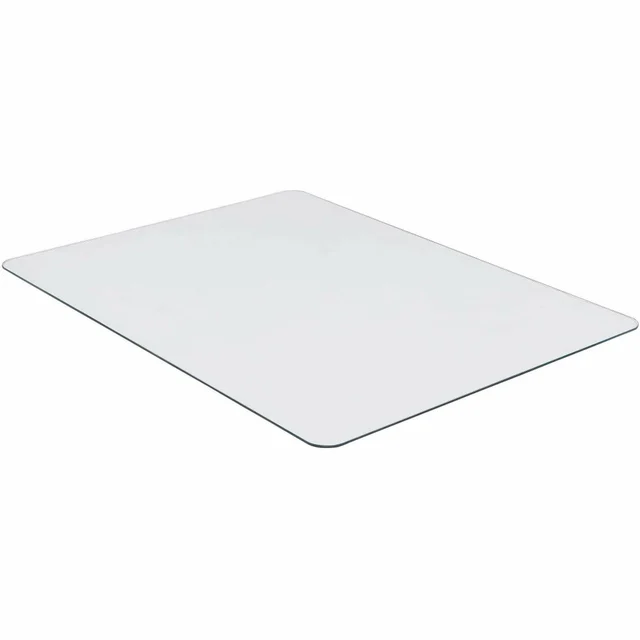
- Buy Lorell Tempered Glass Chairmat The one mat that stops the material argument: quarter-inch tempered glass that will not dent, curl or crack no matter what is under it.
- Buy Marvelux Polycarbonate Rectangular Chair Mat for Low, Standard and Medium Pile Carpets The sensible carpet default: real polycarbonate with a proper studded back, rated up to half-inch pile.
- It depends Deflecto EconoMat Non-Studded Chair Mat for Hard Floors Cheap, smooth-backed vinyl that does exactly one job well, and fails badly if you buy it for the wrong floor.
- Skip Gorilla Grip Office Chair Mat for Carpet Floors Sold as heavy duty, but it is a thin low-pile-only mat that gets asked to do standard-pile work and gives up.
What actually matters
- Underside, studs or smooth. Studs, also sold as cleats, grippers or spikes, are the short spikes moulded into the back of a carpet mat. They push through the pile and lock the mat down so it does not creep every time you push away from the desk. A hard-floor mat has a smooth or lightly textured back with nothing to gouge the finish, and it stays put through weight and friction alone. Getting this backwards is the single most common reason chair mats get returned.
- Carpet pile rating. Carpet mats are sold against a maximum pile height, usually low, standard/medium, or plush/high. The rating is about how much soft, compressible material the mat has to span. Buy above your pile and the mat sits on a mattress it cannot bridge, so it flexes under every wheel and eventually splits.
- Material. Polycarbonate is the rigid, impact-resistant plastic worth paying for on carpet. PVC or vinyl is the cheap alternative, fine as a hard-floor scuff guard and poor over pile. Tempered glass is the buy-once option that never dents, curls or clouds. The material tells you the failure mode you are signing up for.
- Thickness and gauge. Thickness is what lets a mat hold a flat plane instead of dishing under a caster. Carpet duty needs meaningfully more than hard-floor duty, because on a hard floor the mat is supported everywhere and on carpet it is spanning a soft surface. Very thin plastic sold for carpet is the classic early-crack candidate.
- Size and chair travel. The mat needs to cover where the chair actually goes, not just the width of the desk. Once a caster repeatedly rolls off an edge and back on, that edge starts to lift, chip or crack. Buying one size up is cheaper than buying twice.
- Shape, lipped or plain rectangle. A lip is the narrow tongue that slides under the desk into the knee well, buying you rolling area without paying for a much bigger mat. It suits a standard desk against a wall and gets in the way almost everywhere else.
- How it ships. Flat-packed mats are usable the day they arrive. Rolled mats need days of lying under weight to relax, and some never fully flatten, which leaves a permanent wave for your casters to climb.
The specs, in plain English
Green flags vs red flags
Green flags
- The listing states a material by name, such as polycarbonate or tempered glass, rather than 'heavy duty plastic'
- A clear carpet pile rating that says whether it includes the padding
- Studded back explicitly sold for carpet, or a smooth back explicitly sold for hard floors, with no ambiguity about which
- Ships flat rather than rolled, so it is usable immediately
- Sizes generous enough to cover real chair travel, including a lip option if your desk sits against a wall
- A longer warranty on a plastic mat, which signals the maker expects it not to crack or curl
Red flags
- Marketed as suitable for 'all floor types' while clearly having studs on the back
- Material described only as heavy duty or premium plastic with no polycarbonate or glass specification
- No pile rating at all, or a vague 'works on most carpets'
- Very thin gauge sold for carpet duty, especially alongside a big headline weight capacity
- Owner reports of cracking, denting, curled edges or the mat sliding across the room
- Ships rolled with reports that it never lies flat
Who's who: the brands
- Lorell - Office supply brand whose tempered glass chairmats are the common route into the buy-once, works-on-anything category.
- Marvelux - Value-focused maker of genuine polycarbonate mats with stated pile ratings and studded backs, aimed squarely at home office carpet.
- Deflecto - Long-established maker spanning budget vinyl EconoMat sheets up to stiffer polycarbonate, with clearly separated carpet and hard-floor lines.
- Floortex / Cleartex - Specialist in polycarbonate mats sold with explicit pile ratings and a range of lipped and rectangular shapes.
- ES Robbins - Widely stocked vinyl and polycarbonate mats in many sizes and shapes, so the trick is checking which material and which floor the specific listing is for.
- Gorilla Grip - Popular low-cost carpet mats with dense stud fields and good grip, but thin gauge and low-pile-only ratings that often get ignored at checkout.
How to read a listing without getting fooled
Answer one question before anything else: carpet or hard floor. Then read the underside description, because a studded back means carpet only and a smooth back means hard floor only, and any listing claiming both while showing studs is telling you it was written by marketing. Next find the material by name. Polycarbonate and tempered glass are specific claims a seller can be held to, while 'heavy duty plastic' or 'premium PVC' is the language used when the real answer is vinyl. On a carpet mat, find the pile rating and check whether it says the padding is included, since that is what compresses under a wheel. Treat thickness as a real spec and headline weight capacity as marketing, because a static load test says nothing about one hard caster crossing the same inch all day. Check whether it ships flat or rolled. Finally, measure your chair's travel zone and compare it against the actual mat dimensions rather than the photo, which is almost always shot with a small desk to make the mat look generous.
How much should you spend?
Price in this category tracks material almost perfectly. The cheapest mats are thin vinyl, the middle is polycarbonate, and the top is tempered glass. On a hard floor, a budget smooth-backed vinyl mat is a defensible buy, because it is only taking scuffs and you can treat it as a consumable you replace every few years. On carpet the cheap end is a false economy: vinyl spanning soft pile is the exact scenario it fails in, and two replacements cost more than one rigid mat. The value sweet spot for most home offices is a mid-range polycarbonate mat rated to your actual pile, in a size large enough that the chair never rolls off. Spending up to glass is worth it if you are heavier or use a big executive chair, if you have already thrown away one curled plastic mat, or if you might switch between carpet and hard floor and want the mat to come with you. It is not worth it for a chair that gets an hour of use a week, or in a room where you will need to move the mat often, since glass is a two-person lift.
Questions, answered
Do I really need studs on a carpet chair mat?
Yes. Studs push down through the pile and lock the mat in place. Without them, a mat on carpet slides every time you push back from the desk, and the constant flexing over soft pile is what cracks cheap mats. The reverse matters just as much: never put a studded mat on a hard floor, because those studs act like hundreds of small points pressing into wood, laminate or vinyl and will mark the finish.
How do I measure my carpet pile height?
Straighten a paper clip, push it through the carpet and any padding until it touches the subfloor, pinch it where it meets the top of the pile, then pull it out and measure that length. Include the padding, because the pad is what compresses under a caster. Under about a quarter inch is low pile, up to roughly half an inch covers standard and medium, and anything deeper needs a mat sold specifically for plush or high pile. Then buy a mat rated at or above what you measured, never below.
Is polycarbonate actually better than PVC or vinyl?
For a chair mat, yes. Polycarbonate is far more impact resistant and keeps its stiffness, so casters do not sink into dimples, and it resists the yellowing, curling and odour vinyl develops. Vinyl also stiffens as it gets cold, so a thin PVC mat in an unheated room or a garage office can crack in its first winter. Vinyl still makes sense on a hard floor, where the mat is fully supported and only taking scuffs rather than spanning soft carpet.
Is a tempered glass mat worth the weight?
It depends on how permanent you want the purchase to be. Glass removes the whole failure mode, because it cannot dent, curl, cup or yellow, it takes the load of a heavy chair, and with non-skid pads instead of studs it works over any pile and over hard floors alike. What you accept is weight, a two-person job to reposition it, a limited range of plain rectangles with no lip option, and the fact that a hard impact on an edge can crack it. If you have already replaced one plastic mat, the maths usually favours glass.
Lipped mat or plain rectangle?
A lip is the narrow tongue that slides under the desk into the knee well, and it buys you rolling area without paying for a much larger mat, which suits a standard desk pushed against a wall. A plain rectangle is better for corner desks, L-shaped setups, standing desks that move, and any layout where the lip would end up in the wrong place. If you are unsure, a rectangle sized generously for your chair travel is the safer choice.
How is a chair mat different from an anti-fatigue mat or a desk mat?
They solve three separate problems. A chair mat is a hard rolling surface on the floor under a wheeled chair, so the chair moves easily and the floor survives. An anti-fatigue mat is a soft cushioned pad you stand on at a standing desk, and rolling a chair onto one is exactly what you do not want. A desk mat is the pad on the desktop under your keyboard and mouse. If your chair rolls on it, you want a chair mat.
Or jump to the head-to-head: Lorell Tempered Glass Chairmat vs Marvelux Polycarbonate Rectangular Chair Mat for Low, Standard and Medium Pile Carpets.