

Office & WFH
The Best Office Chair Mats: 4 Compared (and One to Skip)
We compared four office chair mats on material, underside grip, carpet pile rating, thickness and shape to find what survives daily rolling.
The short version
Buy the mat that matches your floor, not the one with the best photo. Carpet mats need studs on the underside to grip the pile, and hard-floor mats must not have them, because those same studs scratch wood and laminate. For a permanent fix, the Lorell Tempered Glass Chairmat is flat forever, rated to roughly 1,000 lb and usable on any surface, at the cost of weight and price. For carpet on a normal budget, the Marvelux polycarbonate mat is the pick, rated to half-inch pile with a proper gripper back. The Deflecto EconoMat is fine as a cheap hard-floor guard as long as you never put it on carpet and accept that vinyl eventually dents and curls. The Gorilla Grip carpet mat grips well but is thin and low-pile-only, and it is the one most likely to crack under a heavy chair. Best for: matching material and underside to your actual floor, then buying a size large enough that the chair never rolls off the edge.
Our picks at a glance
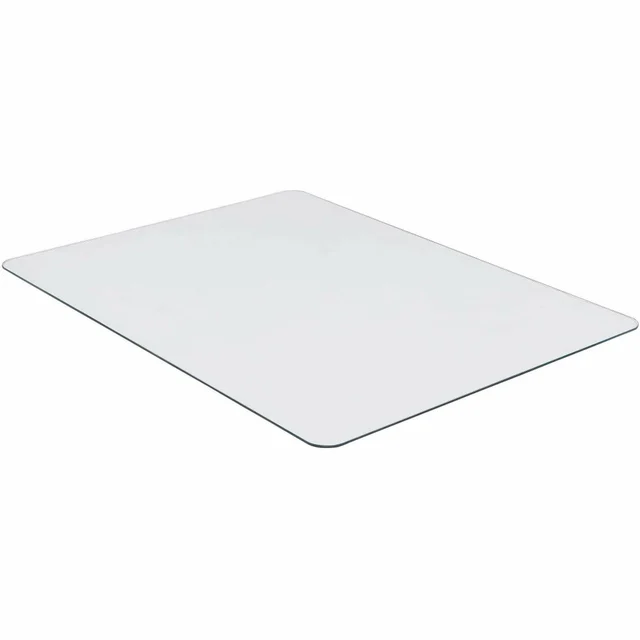
- Lorell Tempered Glass Chairmat - Buy. The one mat that stops the material argument: quarter-inch tempered glass that will not dent, curl or crack no matter what is under it.
- Marvelux Polycarbonate Rectangular Chair Mat for Low, Standard and Medium Pile Carpets - Buy. The sensible carpet default: real polycarbonate with a proper studded back, rated up to half-inch pile.
- Deflecto EconoMat Non-Studded Chair Mat for Hard Floors - It depends. Cheap, smooth-backed vinyl that does exactly one job well, and fails badly if you buy it for the wrong floor.
- Gorilla Grip Office Chair Mat for Carpet Floors - Skip. Sold as heavy duty, but it is a thin low-pile-only mat that gets asked to do standard-pile work and gives up.
The verdict in 30 seconds
What mattered most
- Material
- Floor it is designed for
- Underside
- Carpet pile rating
- Thickness
- Shape options
A chair mat has one job: give your casters a flat, hard surface so they roll instead of digging into carpet or scarring a wood floor. Almost every bad chair mat purchase comes from one of two mistakes, buying a carpet mat with studs for a hard floor (the studs scratch it) or buying a smooth hard-floor mat for carpet (it slides and cracks). We looked at a tempered glass mat, a polycarbonate carpet mat, a budget vinyl hard-floor mat and a popular low-cost carpet mat. Two are easy recommendations, one is fine only if you match it to the right floor, and one is not worth the reorder.
The one mat that stops the material argument: quarter-inch tempered glass that will not dent, curl or crack no matter what is under it.
Best for: Anyone who has already replaced a plastic mat once and wants to stop buying chair mats, especially heavier users and people who may switch between carpet and hard floor.
- Quarter-inch tempered glass stays perfectly flat, so casters never sink into a dimple or ride over a curled edge
- Rated to support around 1,000 lb, which covers heavy executive and big-and-tall chairs that flatten plastic mats
- Works over carpet of any pile and over hardwood, tile or marble, so it survives a move or a floor change
- Non-skid pads hold it in place without studs, meaning no risk of stud damage on a hard floor
- Scratch-resistant surface wipes clean and does not yellow or go cloudy the way vinyl does
- Heavy and awkward to move on your own, so repositioning under a desk is a two-person job
- Limited size and shape choices compared with plastic mats, and no lip option for a desk cutout
- Glass is cold and hard underfoot, and a dropped tool or a hard impact on an edge can crack it
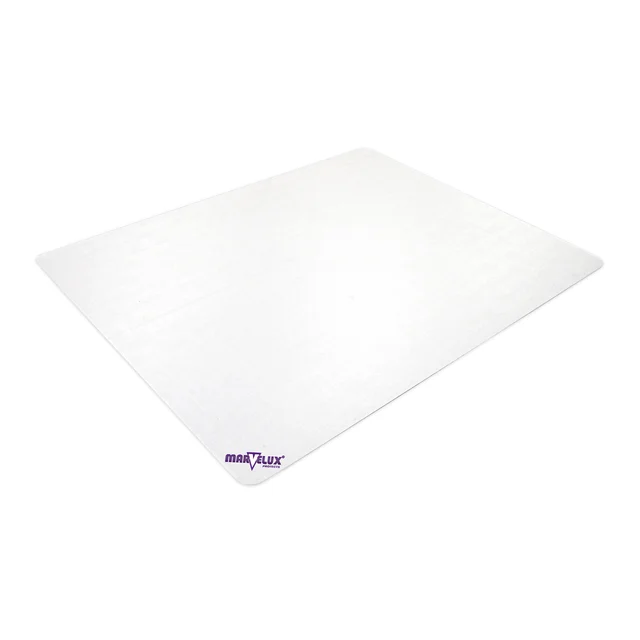
The sensible carpet default: real polycarbonate with a proper studded back, rated up to half-inch pile.
Best for: Home offices and cubicles on standard low or medium pile carpet where a chair rolls all day and vinyl has already failed.
- Solid polycarbonate rather than vinyl, so it resists the cracking, cupping and dimpling that kill cheap carpet mats
- Studded gripper underside bites the pile and keeps the mat from creeping across the room
- Explicitly rated for low, standard and medium pile up to half an inch including the padding, which is the rating most home offices actually need
- Ships flat and is usable immediately instead of needing days to relax out of a roll
- Sizes run from 30 by 48 up to 48 by 60, so you can cover a real chair travel zone rather than a postage stamp
- Only a one year limited warranty, which is short next to what glass mats offer
- Wrong choice for deep or plush pile over half an inch, where the mat will still flex under a caster
- The studs make it unusable on a hard floor, so it is a carpet-only purchase
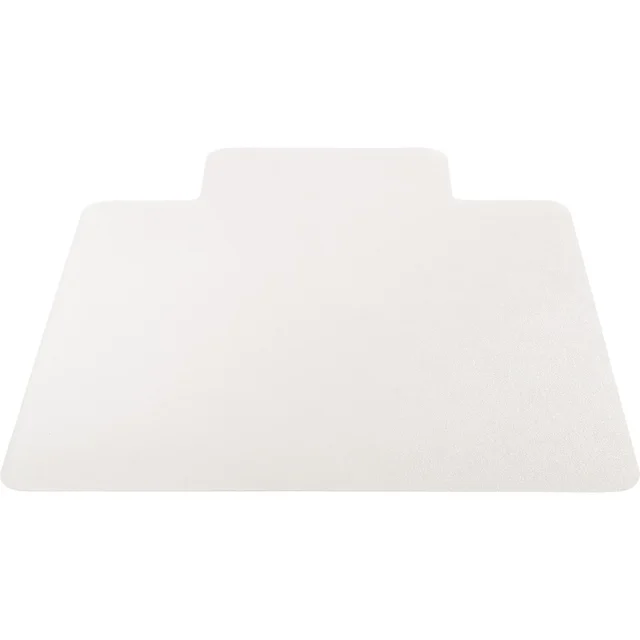
Cheap, smooth-backed vinyl that does exactly one job well, and fails badly if you buy it for the wrong floor.
Best for: Hard floor users on a budget who want caster and scuff protection now and accept replacing the mat in a few years.
- Non-studded smooth backing is the correct design for wood, laminate, tile and vinyl, with nothing to gouge the finish
- Costs a fraction of glass or polycarbonate, so it is a low-risk way to protect a rental floor
- Made with a non-orthophthalate, non-cadmium formula and carries low-emission certification, which matters in a closed home office
- Wide lip version tucks under the desk and adds usable rolling area without buying a much larger rectangle
- Vinyl is the weakest common chair mat material and will eventually dent under caster pressure and curl at the edges
- Vinyl stiffens and becomes brittle in a cold room, so a garage or unheated office is a bad fit
- Absolutely not for carpet: with no studs it will slide out from under you and crack across the middle
- Ships flat or rolled depending on the version, and rolled stock can take days to lie down properly
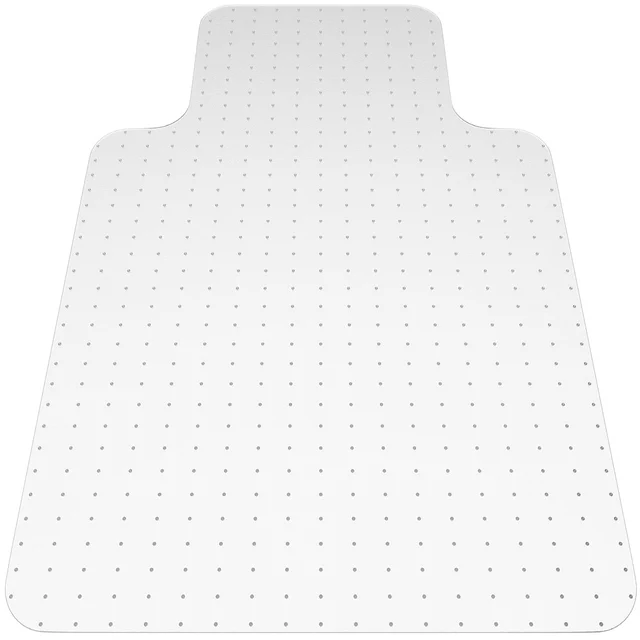
Sold as heavy duty, but it is a thin low-pile-only mat that gets asked to do standard-pile work and gives up.
Best for: Very light use on genuinely thin, low pile carpet, and only if you accept it as a short-term mat rather than a lasting one.
- Hundreds of small studs across the back give genuinely good grip on thin, tight carpet
- Sold in lipped and plain rectangle versions across four sizes, so there is usually a shape that fits
- Ships flat and is light enough to move and clean under without help
- Just over 0.09 inch thick, which is thin for carpet duty, and owners report denting and cracking under heavier chairs
- Rated for low pile only, yet it is widely bought for standard and medium pile where the studs are too shallow to stop flexing
- The listed 400 lb figure is a static load claim, not a measure of how the mat behaves under a rolling caster in one spot
- Material is described only as heavy duty plastic rather than a stated polycarbonate spec, so you cannot compare it like for like
- Smaller sizes leave the chair rolling off the edge, which is where cracks usually start
| Criteria | Lorell Tempered Glass Chairmat Top pick | Marvelux Polycarbonate Rectangular Chair Mat for Low, Standard and Medium Pile Carpets | Deflecto EconoMat Non-Studded Chair Mat for Hard Floors | Gorilla Grip Office Chair Mat for Carpet Floors |
|---|---|---|---|---|
| Verdict | Buy it | Buy it | It depends | Skip it |
| Best for | Anyone who has already replaced a plastic mat once and wants to stop buying chair mats, especially heavier users and people who may switch between carpet and hard floor. | Home offices and cubicles on standard low or medium pile carpet where a chair rolls all day and vinyl has already failed. | Hard floor users on a budget who want caster and scuff protection now and accept replacing the mat in a few years. | Very light use on genuinely thin, low pile carpet, and only if you accept it as a short-term mat rather than a lasting one. |
| Price tier | $$$ · premium | $$ · mid-range | $ · budget | $$ · mid-range |
| Material | Tempered glass | Polycarbonate | Vinyl (PVC) | Unspecified heavy duty plastic |
| Floor it is designed for | Carpet of any pile plus hardwood, tile and marble | Carpet only | Hard floors only | Carpet only |
| Underside | Smooth with non-skid pads | Studded gripper back | Smooth, non-studded | Dense studs |
| Carpet pile rating | Any pile | Low, standard and medium up to 1/2 inch | Not for carpet | Low pile only |
| Thickness | 1/4 inch | Rigid polycarbonate gauge by size | Thin vinyl sheet | Just over 0.09 inch |
| Shape options | Rectangle only | Rectangle, several sizes | Rectangle with wide lip | Lip and plain rectangle, four sizes |
| Stated load or warranty | Around 1,000 lb support | One year limited warranty | Low-emission certified, no load figure | 400 lb static load claim |
| Price tier | $$$ · premium | $$ · mid-range | $ · budget | $$ · mid-range |
Which one is right for you?
- Anyone who has already replaced a plastic mat once and wants to stop buying chair mats, especially heavier users and people who may switch between carpet and hard floor. Buy it Lorell Tempered Glass Chairmat
- Home offices and cubicles on standard low or medium pile carpet where a chair rolls all day and vinyl has already failed. Buy it Marvelux Polycarbonate Rectangular Chair Mat for Low, Standard and Medium Pile Carpets
- Hard floor users on a budget who want caster and scuff protection now and accept replacing the mat in a few years. It depends Deflecto EconoMat Non-Studded Chair Mat for Hard Floors
- Very light use on genuinely thin, low pile carpet, and only if you accept it as a short-term mat rather than a lasting one. Skip it Gorilla Grip Office Chair Mat for Carpet Floors
How we judged the field
We do not run a lab. What we do is read across independent testing, manufacturer specifications and the pattern of owner reports over time, then weigh the things that actually decide whether a chair mat is still usable in year three.
Four criteria did most of the work. First, material, because the split between tempered glass, polycarbonate and vinyl predicts almost everything about how a mat ages. Second, the underside, because a carpet mat without studs slides and a hard-floor mat with studs scratches, and getting this backwards is the single most common return reason. Third, the carpet pile rating, since a mat rated for low pile put on a medium pile floor flexes under every caster pass until it cracks. Fourth, size and shape, because a mat the chair keeps rolling off is a mat that will fail at the edge.
We also discounted marketing load figures. A stated weight capacity is usually a static test, and what kills a chair mat is not a person sitting still, it is a small hard wheel pressing on the same square inch while you push back a hundred times a day.
Glass sidesteps the argument. A quarter-inch tempered glass panel does not dimple, does not cup, does not curl at the corners and does not yellow, so the surface you roll on in year five is the surface you unpacked. Lorell rates this one for around 1,000 lb of support, which is the range that matters if you are using a big-and-tall or heavy executive chair, the exact combination that flattens a plastic mat inside a year.
It is also the only mat here that ignores your floor type. It sits on carpet of any pile, on hardwood, on tile, on marble, held by non-skid pads rather than studs. That matters twice over: nothing on the underside can scratch a hard floor, and if you move desks or change flooring the mat comes with you.
The trade-offs are real. It is heavy, and sliding it into position under a loaded desk is genuinely a two-person job. Choice is limited to a plain rectangle in a small number of sizes, so there is no lip to tuck into a knee well. And glass is glass: it is cold underfoot, and a hard strike on an edge can crack it. Set against replacing a plastic mat every couple of years, most people who make the switch do not go back.
Marvelux Polycarbonate Rectangular Chair Mat for Low, Standard and Medium Pile Carpets
Buy itCheck price on AmazonThis is the mat to buy if you want the carpet problem solved properly without paying for glass. It is genuine polycarbonate rather than vinyl dressed up in polycarbonate language, and the difference shows in the failure modes it avoids: it holds a rigid plane instead of dishing under the caster, and it does not curl, discolour or dimple the way a thin PVC sheet does.
The underside is a studded gripper pattern that pushes into the pile, and the rating is stated plainly for low, standard and medium pile up to half an inch including padding. That covers most residential carpet and most office carpet tile. It ships flat, so you are not waiting three days for a rolled mat to relax, and the size range runs up to 48 by 60, which is large enough that a chair on a normal desk stays on the mat during real use.
Two caveats. The warranty is one year, short next to a glass mat’s coverage, so this is a good mat rather than a permanent one. And the studs make it a carpet-only purchase. If your floor is wood or laminate, the studded version of any mat is the wrong product.
The non-studded design is the point. On wood, laminate, tile or vinyl you want a smooth back with nothing to press into the finish, and that is precisely what this is. It costs a fraction of glass or polycarbonate, uses a non-orthophthalate, non-cadmium formula and carries low-emission certification, which is worth something in a small closed room. The wide lip version adds usable rolling area under the desk without paying for a much larger rectangle.
What you are accepting is vinyl. Vinyl is the softest of the common chair mat materials, so over a few years of daily rolling it develops caster dents and the edges start to lift. Vinyl also stiffens as it gets cold, which makes an unheated garage office or a cold spare room a bad place for it.
The one thing that turns this from a fair budget buy into a bad one is putting it on carpet. With no studs it will migrate across the room while you work, and a smooth vinyl sheet spanning soft pile is the classic recipe for a crack straight across the middle. Buy it for a hard floor, treat it as a consumable, and it is good value. Buy it for carpet and you have wasted the money.
The grip is not the problem. The dense stud field on the back holds well on thin, tight carpet, and the range covers four sizes in both lipped and plain rectangle form, so you can usually find a shape that fits. It ships flat and is light enough to lift and vacuum under.
The problem is gauge, and how vague the product is about what it is for. It is just over 0.09 inch thick, which is thin for carpet duty, and the manufacturer rates it for low pile only. In practice it gets bought for standard and medium pile, where the studs are too shallow and the sheet too thin to stop the mat flexing under every caster pass, and that flexing is what produces the denting and cracking that keeps appearing in owner reports. The 400 lb figure is a static load claim rather than a measure of what a small hard wheel does to one spot over months. The material is described as heavy duty plastic rather than given a stated polycarbonate specification, so you cannot compare it like for like against the Marvelux mat. Add the smaller sizes, which leave the chair rolling over the edge, and you have the conditions for an early crack.
If your carpet really is thin and your use really is light, it will do a job. For most people the money is better spent once on a mat rated for the pile they actually have.
Lorell Tempered Glass Chairmat vs Marvelux Polycarbonate Chair Mat: which should you buy?
The decision comes down to how permanent you want this purchase to be and how certain you are about your floor.
Buy the Lorell glass mat if you have already replaced one plastic mat, if you are on the heavier side or use a big executive chair, if your carpet is deep enough that plastic mats keep dishing, or if there is any chance you will move to a hard floor. Glass does not care about pile height, does not need studs, and does not degrade. The costs are weight, price and a plain rectangle in a limited size range.
Buy the Marvelux polycarbonate mat if you know your carpet is half an inch or less including padding, you want a mat you can move by yourself, and you want most of the rigidity benefit for a lot less money. It ships flat, grips properly, and holds its shape far better than any vinyl mat at the same size.
The one situation where the choice is made for you is a hard floor. There, neither studded mat applies, and you are choosing between a glass mat and a smooth-backed hard-floor mat like the Deflecto.
What to look for
- Match the underside to the floor. Studs for carpet, smooth for hard floors. This single rule prevents most chair mat regret.
- Measure your pile before you buy. Straighten a paper clip, push it to the subfloor, pinch and measure. Include the padding, because that is what compresses.
- Prefer polycarbonate or glass over vinyl for carpet. Vinyl over soft pile flexes, dents and eventually splits. Vinyl on a hard floor is a reasonable budget compromise.
- Size for chair travel, not for the desk. Map where the chair actually goes when you push back and turn, then buy at least that. Edges are where cracks start.
- Decide on a lip early. A lip helps a standard desk against a wall. Corner desks, L-shapes and moving standing desks are better served by a plain rectangle.
- Ignore static load claims. A caster concentrates force on a tiny contact patch, so thickness, material and pile rating tell you far more than a headline weight figure.
- Check how it ships. Flat-packed mats are usable immediately. Rolled mats need days to relax and sometimes never fully flatten.
Our final take
Chair mats look interchangeable and are not. Almost every complaint traces back to a mismatch: studs on a hard floor, no studs on carpet, or a thin sheet asked to span pile it was never rated for.
If you want to buy once, the Lorell Tempered Glass Chairmat is the answer. It is flat permanently, it takes the load of a heavy chair, and it works on whatever is underneath, which is worth the weight and the price for anyone who has already thrown away a curled plastic mat. If you want the sensible carpet buy, the Marvelux polycarbonate mat gets the material and the studded back right and states its pile rating clearly. The Deflecto EconoMat earns its place only on a hard floor and only as a low-cost consumable. The Gorilla Grip carpet mat grips well but is too thin for the carpet most people put it on, and that is why it is the one to skip.
Questions, answered
Do I really need studs on a carpet chair mat?
Yes. Studs, sometimes called cleats or grippers, push down through the pile and lock the mat in place. Without them a mat on carpet slides every time you push back from the desk, and the constant flexing over soft pile is what cracks cheap mats. The reverse is just as important: never put a studded mat on a hard floor, because the studs act like hundreds of small points pressing into wood, laminate or vinyl and will mark the finish.
How do I work out my carpet pile height?
Straighten a paper clip, push it through the carpet and any padding until it touches the subfloor, pinch it where it meets the top of the pile, then measure that length. Include the padding, because that is what compresses under a caster. Under about a quarter inch is low pile, up to roughly half an inch covers standard and medium, and anything deeper needs a mat specifically sold for plush or high pile.
Is polycarbonate actually better than PVC or vinyl?
For a chair mat, yes. Polycarbonate is far more impact resistant, keeps its stiffness so casters do not sink into dimples, and resists the yellowing, curling and odour that vinyl develops. Vinyl also stiffens in the cold, so a thin PVC mat in an unheated room or a garage office can crack in the first winter. Vinyl still makes sense on a hard floor where the mat is only taking scuffs, not spanning soft carpet.
Should I get a lipped mat or a plain rectangle?
A lip is the narrow tongue that slides under the desk into the knee well, and it buys you rolling area without buying a much bigger mat, which suits a standard desk against a wall. A plain rectangle is better for corner desks, L-shaped setups, standing desks that move, and any layout where the lip would end up in the wrong place. If you are unsure, a rectangle sized generously for your chair travel is the safer choice.
How does a chair mat differ from an anti-fatigue mat or a desk mat?
They solve three different problems. A chair mat is a hard rolling surface under a wheeled chair, so it protects the floor and makes the chair move easily. An anti-fatigue mat is a soft cushioned pad you stand on at a standing desk, and putting a chair on one is exactly what you do not want. A desk mat is the pad on the desktop under your keyboard and mouse. If your chair rolls on it, you want a chair mat.
Deciding between the top two? See our head-to-head: Lorell Tempered Glass Chairmat vs Marvelux Polycarbonate Rectangular Chair Mat for Low, Standard and Medium Pile Carpets.
More Office & WFH reviews
 The Best Filing Cabinets: 4 Compared (and One to Skip)
  The Best Laptop Cooling Pads: 4 Compared (and One to Skip)
  The Best Anti-Fatigue Mats: 4 Compared (and One to Skip)
  The Best Big and Tall Office Chairs: 4 Compared (and One to Skip)
  The Best Desk Cable Management Kits: 4 Compared (and One to Skip)
  The Best Conference Speakerphones: 4 Compared (and One to Skip)