

Pets
The Best Reptile Terrariums: 4 Compared (and One to Skip)
We compared four enclosures on the things that actually decide whether a reptile thrives: wall material, how it opens, where the vents sit, and whether the maker says it can safely take a heat source.
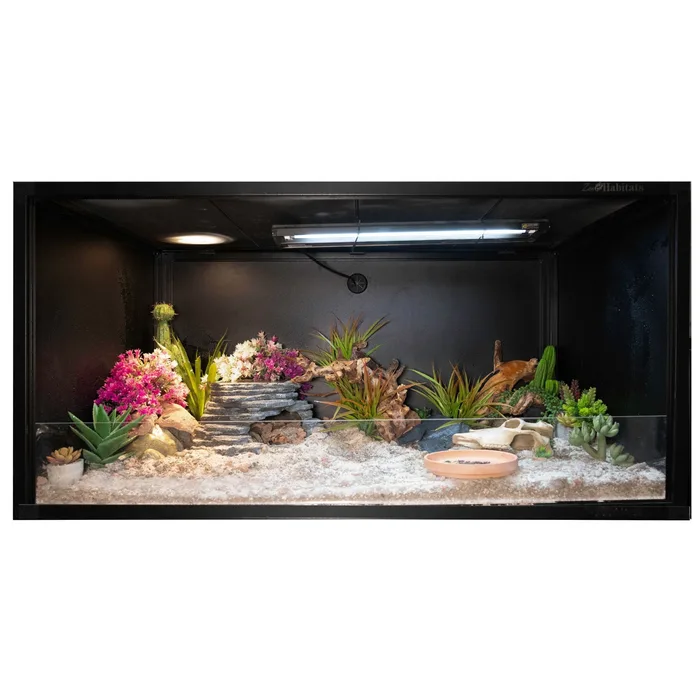
The short version
The Zen Habitats 4'x2'x2' Reptile Enclosure in PVC is the one to buy if your species is terrestrial and mid-sized, because PVC panels hold heat and humidity in a way glass does not, and Zen Habitats is explicit that the PVC version handles 0 to 100 percent humidity and can take an under-tank heater on a thermostat. The Exo Terra Natural Terrarium Large Wide is the value pick and the sane version of a glass tank: dual front doors, a raised bottom plate the maker says is made for a substrate heater, and a front vent strip that fights condensation. The Zoo Med ReptiBreeze is the depends pick, brilliant for chameleons and other lizards that need constant airflow and genuinely bad for anything that needs held humidity or belly heat. Skip the Zoo Med 20 Gallon ReptiHabitat Bearded Dragon Kit: at 30 by 12 by 12 inches it gives a floor area a fraction of what veterinary guidance suggests for an adult bearded dragon, and it is a top-opening tank with a compact fluorescent UVB lamp. Treat every published minimum size as a floor you should beat, not a target. Best for: keepers who want to buy the enclosure once, get the climate right, and not replace it in eight months.
Our picks at a glance
- Zen Habitats 4'x2'x2' Reptile Enclosure (The Zen Habitat 3.0), PVC panels - Buy. A front-opening PVC panel enclosure that holds a climate instead of bleeding it out through the walls.
- Exo Terra Natural Terrarium Large Wide (PT2613) - Buy. The standard front-opening glass terrarium, and the version of a glass tank that actually thinks about ventilation.
- Zoo Med ReptiBreeze Open Air Aluminum Screen Cage - It depends. An all-screen aluminum cage that is close to perfect for chameleons and close to useless for anything that needs held humidity.
- Zoo Med 20 Gallon ReptiHabitat Bearded Dragon Kit (NT-B21) - Skip. A complete-looking box that puts a growing bearded dragon in a 30 by 12 by 12 inch top-opening tank.
The verdict in 30 seconds
What mattered most
- Wall material
- Size as listed
- How it opens
- Ventilation design
- Humidity range stated by maker
- Under-tank heat
An enclosure is not a decoration you pick by looks and gallon count. It is the climate your animal lives in, and the four boxes here behave very differently once you plug a heat lamp into them. A panel enclosure holds warmth and moisture, a glass terrarium leaks both, and an all-screen cage is designed to leak on purpose because some species need that. We picked one of each plus a starter kit that a lot of people buy first and regret, and we checked every dimension against the manufacturer's own page.
A front-opening PVC panel enclosure that holds a climate instead of bleeding it out through the walls.
Best for: Terrestrial mid-sized species like bearded dragons, ball pythons, blue tongue skinks, and corn snakes, where floor space and a stable gradient matter more than height.
- Zen Habitats states the PVC panel version accommodates 0 to 100 percent humidity, while the wood version is capped at 0 to 50 percent.
- The maker's own safety notice clears PVC for under-tank heating with a thermostat, so you are not guessing about whether belly heat is safe.
- Front-opening removable sliding doors plus three internal support bars on the steel screen top give you real freedom in mounting lighting and heating.
- It is the premium-tier option here, and the stand and substrate shield extras are separate products.
- The doors are acrylic rather than glass, which the maker credits for better heat retention but which is a softer surface than glass to clean.
- The screen top still vents humidity upward, so expect to manage humidity for tropical species.
- At 41 pounds assembled and four feet wide it needs a proper stand or a very sturdy surface before you add substrate.
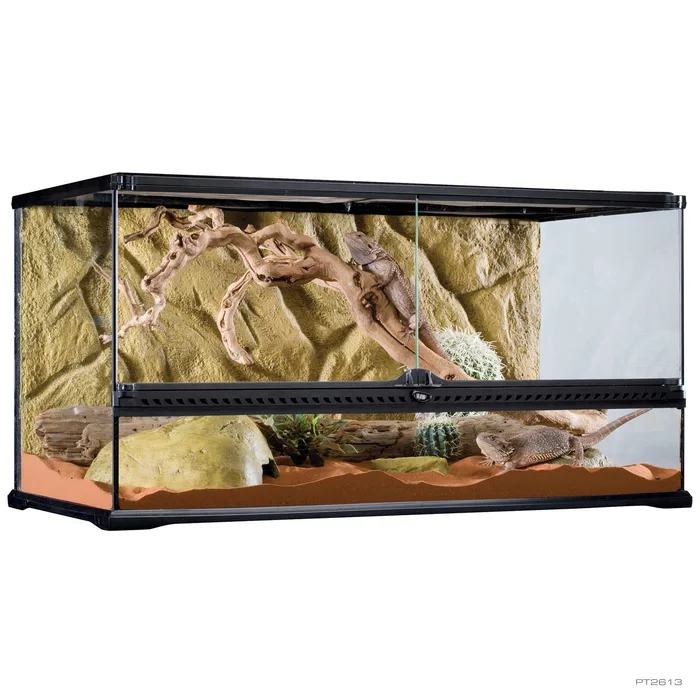
The standard front-opening glass terrarium, and the version of a glass tank that actually thinks about ventilation.
Best for: Small to mid-sized species and anyone who wants a front-opening enclosure that every hood, background, and accessory on the shelf already fits.
- Dual front-opening doors that open separately and lock, so you reach in from the side rather than looming over the animal.
- Exo Terra describes a dual ventilation system, a front window vent plus a full screen top, designed to create upward airflow and keep the front glass clear of condensation.
- The bottom plate is raised specifically so a substrate heater can be mounted under part of the floor, and the screen top has closable inlets for cords and tubing.
- Glass is a poor insulator, so heat and humidity both escape faster than they would through panel walls.
- That helpful front vent strip is also a permanent humidity leak, which matters for tropical species.
- The extra high fixed front window is great for deep substrate but means the doors do not open all the way down to the floor.
- Exo Terra does not publish a glass thickness on the product page, so you are trusting the frame rather than a number.
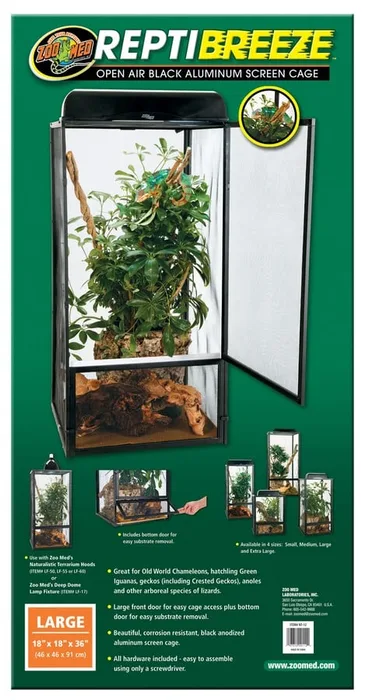
An all-screen aluminum cage that is close to perfect for chameleons and close to useless for anything that needs held humidity.
Best for: Old World chameleons and other arboreal lizards that need airflow more than they need a sealed climate, in a room you can already keep warm.
- Screen on every side gives the constant air exchange that arboreal, airflow-dependent species need, which a solid-walled box does not match.
- Four sizes from 16 by 16 by 20 inches up to 24 by 24 by 48 inches, so you can match height to an arboreal animal instead of settling.
- Corrosion-resistant black anodized aluminum with a large front door plus a separate bottom door for substrate removal, and it assembles with a screwdriver.
- Humidity leaves as fast as you add it, so keeping a tropical species in one means misting or a dedicated fogger on a schedule.
- There is no solid floor to mount an under-tank heater to, so all heat has to come from above.
- Loose substrate needs Zoo Med's separate ReptiBreeze Substrate Bottom Tray, which is sold on its own.
- The warranty Zoo Med lists is one year, against five on the Zen Habitats enclosure.
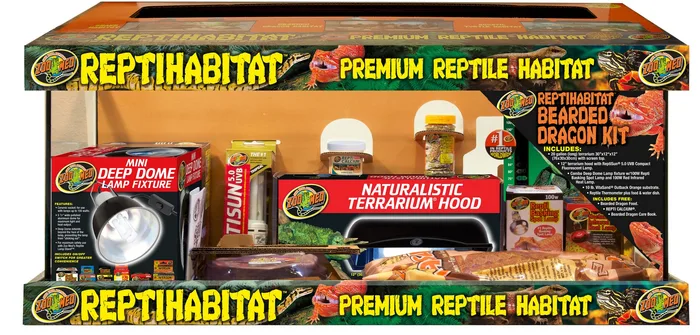
A complete-looking box that puts a growing bearded dragon in a 30 by 12 by 12 inch top-opening tank.
Best for: Almost nobody as a long-term home; at best a short-term hatchling setup you have already budgeted to replace within months.
- Everything needed to run something on day one is in the box, including the hood, a dome lamp fixture, lamps, dishes, and a thermometer.
- It is a low-cost way to get an animal housed, which matters if a rescue lands in your lap at short notice.
- Zoo Med is upfront that the kit is aimed at hatchlings and first-time keepers rather than adult animals.
- The tank is 30 by 12 by 12 inches, roughly 0.23 square metres of floor, while the Merck Veterinary Manual's minimum for terrestrial lizards works out to around a square metre for a 50 cm adult bearded dragon.
- It opens through a sliding screen lid, so every interaction is a hand descending from above, and Merck notes that even a fully meshed top can severely hamper ventilation.
- UVB comes from a compact fluorescent lamp in a 12 inch hood over a 30 inch tank, which lights a fraction of the floor rather than a proper gradient.
- The included nocturnal infrared bulb runs against Merck's guidance that light bulbs should not be used to provide night heat.
| Criteria | 4'x2'x2' Reptile Enclosure (The Zen Habitat 3.0), PVC panels Top pick | Natural Terrarium Large Wide (PT2613) | ReptiBreeze Open Air Aluminum Screen Cage | 20 Gallon ReptiHabitat Bearded Dragon Kit (NT-B21) |
|---|---|---|---|---|
| Verdict | Buy it | Buy it | It depends | Skip it |
| Best for | Terrestrial mid-sized species like bearded dragons, ball pythons, blue tongue skinks, and corn snakes, where floor space and a stable gradient matter more than height. | Small to mid-sized species and anyone who wants a front-opening enclosure that every hood, background, and accessory on the shelf already fits. | Old World chameleons and other arboreal lizards that need airflow more than they need a sealed climate, in a room you can already keep warm. | Almost nobody as a long-term home; at best a short-term hatchling setup you have already budgeted to replace within months. |
| Price tier | $$$ · premium | $$ · mid-range | $ · budget | $ · budget |
| Wall material | PVC or wood panels, aluminum frame | All-glass body, stainless steel mesh top | Anodized aluminum screen on all sides | Glass tank with plastic trim |
| Size as listed | 4 ft x 2 ft x 2 ft, maker calls it about 120 gallons | 36 x 18 x 18 in (90 x 45 x 45 cm) | 16x16x20 to 24x24x48 in, four sizes | 30 x 12 x 12 in (76 x 30 x 30 cm) |
| How it opens | Front sliding acrylic doors, removable | Dual hinged front glass doors with lock | Large front door plus bottom substrate door | Sliding screen lid on top |
| Ventilation design | Steel screen top only | Front window vent plus full screen top | Screen on every surface | Screen top only |
| Humidity range stated by maker | PVC 0 to 100 percent, wood 0 to 50 percent | Not stated; vents designed to prevent condensation | Not stated; open air by design | Not stated |
| Under-tank heat | PVC cleared with a thermostat, wood not suitable | Bottom plate raised for a substrate heater | No solid floor, so not applicable | Not addressed on the product page |
| Mounting lights and heat | Three internal screen support bars, two grommet plugs | Removable screen top, closable cord inlets | Compatible hoods and dome fixture sit on top | 12 in hood and dome fixture included in the kit |
| Warranty | 5 years | Not stated on the product page | 1 year | Not stated on the product page |
Which one is right for you?
- Terrestrial mid-sized species like bearded dragons, ball pythons, blue tongue skinks, and corn snakes, where floor space and a stable gradient matter more than height. Buy it Zen Habitats 4'x2'x2' Reptile Enclosure (The Zen Habitat 3.0), PVC panels
- Small to mid-sized species and anyone who wants a front-opening enclosure that every hood, background, and accessory on the shelf already fits. Buy it Exo Terra Natural Terrarium Large Wide (PT2613)
- Old World chameleons and other arboreal lizards that need airflow more than they need a sealed climate, in a room you can already keep warm. It depends Zoo Med ReptiBreeze Open Air Aluminum Screen Cage
- Almost nobody as a long-term home; at best a short-term hatchling setup you have already budgeted to replace within months. Skip it Zoo Med 20 Gallon ReptiHabitat Bearded Dragon Kit (NT-B21)
How we judged the field
Five things decide whether an enclosure works. First, wall material, because PVC and wood panels hold heat and humidity while glass sheds both; the Merck Veterinary Manual is blunt that glass is a poor insulator and that the resulting temperature swings are a real problem. Second, how it opens, because a front-opening door means you approach a ground-dwelling animal from the side instead of descending on it from above. Third, ventilation placement, since a screen lid alone moves air very differently from a low front vent paired with a top vent, and Merck warns that choking off ventilation to hold temperature and humidity causes skin and respiratory disease. Fourth, whether the maker says the enclosure can safely take the heat source you plan to use, which is the difference between a normal setup and a burn. Fifth, verified interior geometry, because floor area and usable height decide what your animal can actually do.
The field splits cleanly by material, and each material exists for a reason. Panel enclosures are the current default for terrestrial species that need a held climate, so we took a widely used one and looked hard at what its maker will and will not certify. Front-opening glass is the huge middle of the market and the format every accessory is built around, so we took the standard large size and checked its ventilation and heater provisions against the page rather than the marketing. All-screen cages are a genuine specialty that is right for a narrow set of species and quietly wrong for the rest, so we included one and said exactly where the line is. And because the single most common first purchase is a boxed starter kit built around a small top-opening tank, we included one of those too and did the arithmetic on it. That is why Zoo Med appears twice, and it is deliberate rather than sloppy: the same company happens to make the reference product in two unrelated formats. The ReptiBreeze is the default screen cage in chameleon keeping, which is why it earns a place, while the ReptiHabitat kit is a small top-opening glass tank sold to bearded dragon buyers. Different animals, different needs, and the criticism further down is aimed at the starter-kit format and its dimensions, not at the brand.
Zen Habitats 4’x2’x2’ Reptile Enclosure (The Zen Habitat 3.0), PVC panels
Buy itZen Habitats’ 4’x2’x2’ is a common destination for modern keepers, and the reason is climate control rather than looks. Choosing PVC panels rather than wood gets you a build the maker rates for 0 to 100 percent humidity, against 0 to 50 percent for the wood version, which is the whole ballgame for a tropical species. Zen Habitats also puts a plain safety notice on the page: wood panels are not suitable for under-tank heating, choose PVC if you are using one, and always use a thermostat. That is the kind of statement you want in writing. Practically, you get front-opening removable sliding acrylic doors, a steel screen top with three internal support bars for mounting lights and heat, two grommet plug options, and an optional six inch acrylic substrate shield for loose or bioactive setups. It weighs 41 pounds assembled, carries a five year warranty, and assembles with eight screws. It is for the keeper who wants a terrestrial species housed properly once and is willing to pay for the walls.
Exo Terra Natural Terrarium Large Wide (PT2613)
Buy itThe Exo Terra Natural Terrarium Large Wide is the glass terrarium done thoughtfully. At 36 by 18 by 18 inches (90 by 45 by 45 cm) it is the size most people mean when they say a front-opening glass tank, and the design details are the reason to pick it over a plain aquarium with a lid. Dual front doors open separately and lock. Exo Terra describes a dual ventilation system, a front window vent plus a removable stainless steel screen top, meant to pull air upward and keep the front glass free of condensation. The bottom plate is raised so a substrate heater can be fitted under part of the floor, the bottom is watertight for deep substrate or a water section, and the back of the screen top carries closable inlets for cords and tubing. The trade-off is inherent to glass: it insulates poorly, and the front vent that stops condensation also lets humidity out. This is the pick for smaller species and for anyone who wants an enclosure the whole accessory shelf already fits.
Zoo Med ReptiBreeze Open Air Aluminum Screen Cage
It dependsThe ReptiBreeze is not a compromise version of a terrarium; it is a different tool. Zoo Med builds it as black anodized, corrosion-resistant aluminum screen on every face, with a large front door for access and a separate bottom door for pulling substrate out, and it assembles with a screwdriver. Four sizes run from 16 by 16 by 20 inches up to 24 by 24 by 48 inches, and Zoo Med aims it at small Old World chameleons, juvenile green iguanas, geckos, anoles, and other arboreal lizards. For those animals the constant air exchange is what you want and a sealed box will not match it. For anything else it is the wrong purchase, so check which side of that line your species sits on. There is no solid floor to warm from below, so all heat comes from above through the mesh, and any humidity you add leaves quickly, which means misting or fogging on a schedule. Loose substrate needs Zoo Med’s separate bottom tray, and the warranty is one year.
Zoo Med 20 Gallon ReptiHabitat Bearded Dragon Kit (NT-B21)
Skip itThe 20 Gallon ReptiHabitat Bearded Dragon Kit is the box a lot of people buy first, and it is where the sizing conversation gets uncomfortable. The tank inside is 30 by 12 by 12 inches (76 by 30 by 30 cm) with a sliding screen top, which is about 0.23 square metres of floor. The Merck Veterinary Manual’s rough minimum for terrestrial lizards is 0.2 square metres per 0.1 metre of total length, so a 50 cm adult bearded dragon lands near a full square metre, roughly four times what this provides. Zoo Med does say the kit is for hatchlings and new keepers, which is fair, but the animal grows fast. The other contents compound it: UVB comes from a compact fluorescent lamp in a 12 inch hood over a 30 inch tank, and the kit includes a 100 watt nocturnal infrared heat lamp, while Merck states that light bulbs cannot be used to provide night heat. Buy it only as a knowingly temporary hatchling setup with a replacement already budgeted. None of that is a verdict on Zoo Med, whose ReptiBreeze sits at number three here: it is the format that fails, a 30 inch top-opening tank sold as a complete home for an animal that outgrows it.
Sources
Specs in this review come from these pages.
- Zen Habitats - 4'x2'x2' Reptile Enclosure (The Zen Habitat 3.0) (zenhabitats.com)
- Exo Terra - Natural Terrarium Large Wide (PT2613) (exo-terra.com)
- Zoo Med Laboratories - ReptiBreeze Open Air Aluminum Screen Cage (zoomed.com)
- Zoo Med Laboratories - 20 Gallon ReptiHabitat Bearded Dragon Kit (zoomed.com)
- Merck Veterinary Manual - Management and Husbandry of Reptiles (merckvetmanual.com)
- Merck Veterinary Manual - Environmental Diseases and Traumatic Injuries of Reptiles (merckvetmanual.com)
Zen Habitats 4’x2’x2’ Reptile Enclosure (The Zen Habitat 3.0), PVC panels vs Exo Terra Natural Terrarium Large Wide (PT2613): which should you buy?
The Zen Habitats PVC build and the Exo Terra Large Wide are not really competing for the same animal, and once you notice that the choice makes itself. The Zen Habitats enclosure is 4 by 2 feet of floor with solid panel walls, which is what a terrestrial animal that walks, digs, and needs a stable warm end actually uses. The Exo Terra is 36 by 18 inches of glass, which is plenty for a crested gecko or a small tropical setup and is tight for an adult bearded dragon or a full-grown ball python. If you have a mid-sized terrestrial species and the room for it, the panel enclosure is the answer, and the humidity rating and the written under-tank-heater clearance are the reasons rather than the finish.
Go Exo Terra when your animal is small, when you want the accessory ecosystem, or when you want to see into the enclosure from more than one side. The glass costs you insulation, so expect to work a little harder on the warm end and on humidity, and expect the front vent strip to keep pulling moisture out. Go Zen Habitats when you want the climate to hold on its own and you plan to keep the animal for a decade. One more practical tiebreaker: the Zen Habitats screen top still vents upward, so budget for humidity management and accessories in either case.
What to look for
- Start with the species, not the box: look up the adult dimensions your animal needs before you look at a single product page, because the enclosure is downstream of that number.
- Treat published minimums as a floor: the Merck Veterinary Manual pairs its minimum space table with advice to provide the largest enclosure possible, and a lot of keepers now consider the old charts too small.
- Check what the maker says about heat: Zen Habitats states PVC is fine for under-tank heating and wood is not, and Exo Terra raises the bottom plate for a substrate heater, so the information exists if you look.
- Read the ventilation layout, not just the word vented: a low front vent paired with a top vent moves air very differently from a screen lid alone, and Merck warns that restricting ventilation to hold heat causes skin and respiratory disease.
- Prefer front-opening for terrestrial species: approaching from the side instead of from overhead is the single easiest stress reduction available, and it makes daily maintenance faster too.
- Ignore gallon figures as a species recommendation: two enclosures with the same volume can have wildly different floor areas, and floor area is what a ground-dwelling animal uses.
Our final take
Buy the enclosure your species needs, buy it in the adult size, and buy it once. For a terrestrial mid-sized reptile the Zen Habitats 4’x2’x2’ in PVC is the strongest option here, because the maker puts the humidity range and the under-tank-heater clearance in writing and the panel walls do the climate work for you. The Exo Terra Natural Terrarium Large Wide is the sensible glass alternative for smaller animals and the format every accessory fits. The ReptiBreeze earns its place for chameleons and similar airflow-dependent lizards and is a poor fit for anything else. And the 20 gallon starter kit is the purchase most people regret, because the animal outgrows it long before the lamps burn out.
Questions, answered
What size enclosure does my species actually need?
Look up your specific species before you look at any enclosure, because the answer changes enormously between a crested gecko and a savannah monitor. The Merck Veterinary Manual gives rough minimums by group, for example 0.2 square metres per 0.1 metre of total length for terrestrial lizards and 0.6 square metres per metre of snake for boas and pythons, and it stresses providing the largest enclosure possible rather than hitting a minimum. Run the arithmetic for the adult size of your animal, not the size it is today. Many keepers now treat the old tank-size charts as far too small, so use any published number as a floor and beat it. Never let a gallon figure stand in for a species recommendation, because two tanks with the same volume can have completely different floor areas.
Glass, PVC, or screen: which one should I get?
It follows from your species' humidity and airflow needs, not from your budget. PVC panels hold heat and moisture best, which is why they suit tropical species and why Zen Habitats rates their PVC build for the full 0 to 100 percent humidity range. Glass is the default and works fine for many animals, but the Merck Veterinary Manual notes glass is a poor insulator and that heat loss can cause dramatic temperature swings. All-screen cages like the ReptiBreeze exist for chameleons and similar species that need continuous air exchange, and they are the wrong choice for anything you need to keep humid. If your species needs both humidity and airflow, a solid-walled enclosure with vents beats screen with a plastic wrap taped over it.
Is front-opening genuinely better than a screen lid on top?
For most terrestrial species, yes, and it is now the norm in modern keeping. A hand coming down from above reads like a bird of prey to a ground-dwelling animal, and reaching in from the side is a much calmer interaction. Front-opening also makes daily maintenance easier, because you are not lifting a lamp fixture off a lid every time you change water. The Merck Veterinary Manual notes that the greater visibility owners like about glass tanks may itself be stressful to the reptile, which is a related point about how much exposure you design in. Top-opening is not automatically wrong, and it is still normal for some setups, but if you are buying new there is little reason to choose it.
Can I put a heat mat under any enclosure?
No, and this is one of the few places where guessing can start a fire or burn an animal. Zen Habitats states plainly that their wood panel enclosures are not suitable for under-tank heating and that you should choose PVC if you are using one, always on a thermostat. Exo Terra designs the raised bottom plate on their glass terrariums specifically so a substrate heater can go under part of the floor. A screen cage has no solid floor at all, so the question does not arise. Whatever heat source you use, the Merck Veterinary Manual advises that heaters be thermostat controlled, screened from the animal, and placed at one end to create a gradient, and it notes that burns are generally associated with unscreened heat sources.
Are the cheap all-in-one starter kits ever worth it?
Occasionally, as a stopgap, and rarely as a plan. The parts in a kit are chosen to hit a price and fit a small tank, so you typically get a compact fluorescent UVB lamp instead of a linear T5 that covers real floor area, plus a tank your animal outgrows quickly. The Zoo Med 20 Gallon ReptiHabitat Bearded Dragon Kit is a fair example: Zoo Med positions it for hatchlings, and the 30 by 12 by 12 inch tank is well under what veterinary guidance suggests for an adult. If you buy one, budget from day one for the adult enclosure and better lighting. Buying the right enclosure once is usually cheaper than buying a kit and then buying everything again.
Deciding between the top two? See our head-to-head: Zen Habitats 4'x2'x2' Reptile Enclosure (The Zen Habitat 3.0), PVC panels vs Exo Terra Natural Terrarium Large Wide (PT2613).
More Pets reviews
 The Best Reptile Thermostats: 4 Compared (and One to Skip)
  Best Self-Cleaning Litter Boxes (2026): What We'd Actually Put in Our Homes
  The Best Slow-Feeder Dog Bowls: 4 Compared (and One to Skip)
  The Best Small Animal Cages: 4 Compared (and One to Skip)
  The Best Squirrel-Proof Bird Feeders: 4 Compared (and One to Skip)
  The Best Wireless & GPS Dog Fences: 4 Compared (and One to Skip)