

Tech & Gadgets
The Best ESD Mats: 4 Compared (and One to Skip)
We compared anti-static bench mats on the one thing that decides whether they work: a published surface resistance measured to a named test method, and whether the box actually contains the parts that bond the mat and you to the same ground point.
The short version
The Desco Statfree T2 Plus mat kit is the pick if you want a worksurface you can point at a spec sheet and defend: a dissipative nitrile rubber top layer published at 1 x 10^6 to less than 1 x 10^9 ohms point to point, a conductive underside, and manufacturer language saying it can be used with flux and solder. The Bertech ESD High Temperature Mat Kit is the value pick and in one respect the better documented product, because Bertech publishes an independent EOS/ESD Association Services test report measured to ANSI/ESD STM4.1-2017 alongside its own datasheet, and the kit ships a wrist strap the Desco kit does not. The iFixit Portable Anti-Static Mat suits people who repair away from a bench: it folds, it publishes a surface resistivity of 10^7 to 10^9 ohms, and it includes both a grounding cord and a wrist strap, but it is described as heat-resistant with no temperature rating published, so it is not the mat for an iron. Skip the iFixit Anti-Static Mat, which publishes no resistance figure at all, ships no wrist strap, and needs a separately sold ground plug adapter before its cord can reach a wall outlet ground. Whatever you buy, budget for the wrist strap and the ground cord as part of the purchase, because a mat that is not bonded to ground and to you does nothing measurable. Best for: anyone who wants a bench surface whose static performance is a published number rather than an adjective.
Our picks at a glance
- Desco Statfree T2 Plus Dissipative Dual Layer Mat Kit (66425) - Buy. A dual-layer nitrile rubber worksurface with per-layer resistance figures published against the worksurface standard, sold as a kit with a ground cord and hardware.
- Bertech ESD High Temperature Mat Kit (2059T Series) - Buy. A two-ply rubber mat kit that ships the mat, a wrist strap and a ground cord, and is backed by an independent test report measured to the current worksurface test method.
- iFixit Portable Anti-Static Mat (IF145-202-5) - It depends. A folding 24 by 24 inch mat that publishes a surface resistivity figure and ships with both a grounding cord and a wrist strap, aimed at repairs away from a fixed bench.
- iFixit Anti-Static Mat (IF145-036-8) - Skip. A popular consumer bench mat that ships a coiled ground cord but no wrist strap, publishes no resistance figure of any kind, and cites a superseded edition of a programme standard as its only electrical claim.
The verdict in 30 seconds
What mattered most
- Published surface resistance
- Independent test report
- Ground cord in the box
- Wrist strap in the box
- Construction
- Heat and solder
An ESD mat is not a protective object. It is one leg of a circuit, and the circuit only exists once the mat is bonded to ground and you are bonded to the same point. That is why the useful question is not which mat looks best on a bench, but which maker will tell you what their material measures in ohms, to which test method, and what hardware ships in the box. We looked at professional static-control suppliers alongside the consumer bench mats sold for phone and console repair, and the gap between them is almost entirely a gap in published numbers.
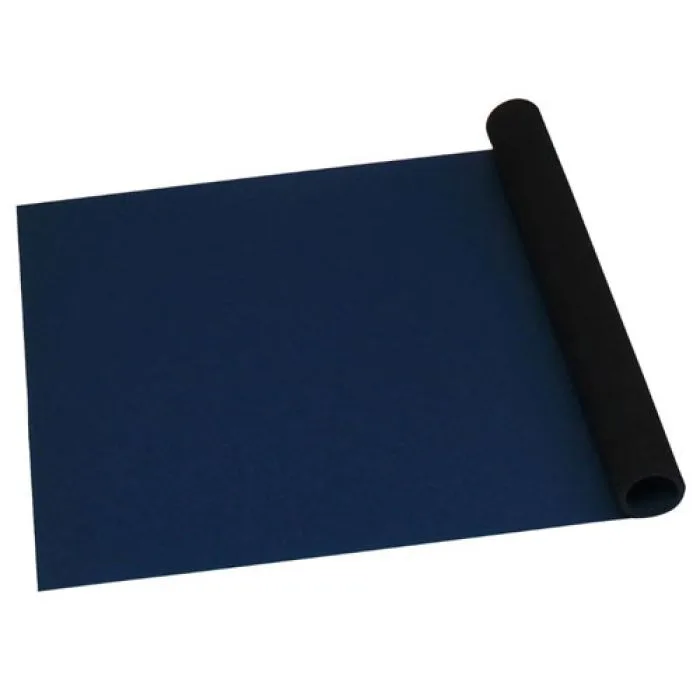
A dual-layer nitrile rubber worksurface with per-layer resistance figures published against the worksurface standard, sold as a kit with a ground cord and hardware.
Best for: Someone setting up a permanent repair or assembly bench who wants the surface itself to be documented and auditable.
- Publishes a dissipative top layer of 1 x 10^6 to less than 1 x 10^9 ohms point to point and a conductive bottom layer under 1 x 10^6 ohms.
- Desco states the nitrile rubber oil-resistant compound may be used in soldering applications with flux and other chemicals.
- The conductive underside lowers resistance to the groundable point, which is what lets the surface be used with a workstation monitor.
- The kit includes a grounding cord with hardware and a sample of mat cleaner, but no wrist strap, so personal grounding is a separate purchase.
- Costs several times what a consumer bench mat costs for a comparable footprint.
- Rubber this thick does not roll up neatly, so it is a bench fixture rather than something you take to a job.
- Sold mainly through industrial distributors rather than consumer retailers, so buying it takes more effort.
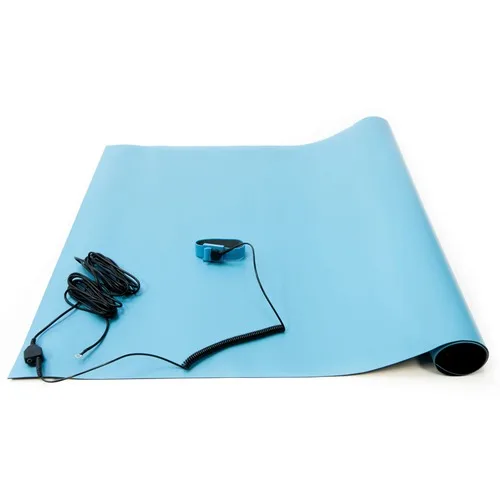
A two-ply rubber mat kit that ships the mat, a wrist strap and a ground cord, and is backed by an independent test report measured to the current worksurface test method.
Best for: A hobbyist or small repair shop that wants a complete, documented ESD workstation without paying industrial-supplier prices for every piece.
- Bertech publishes an EOS/ESD Association Services product test report measured to ANSI/ESD STM4.1-2017, which concludes the samples meet ANSI/ESD S20.20-2021.
- The kit includes the mat, an ESD fabric adjustable wrist strap and a grounding cord, so the whole path is in one box.
- The datasheet lists 2 x 10^6 to 10^8 ohms point to point, 8 x 10^6 to 10^8 ohms to the ground point, and a charge decay time under 0.01 seconds.
- The published service temperature is 190 degrees F, so it resists a hot iron and dropped solder rather than being a heatproof rework surface.
- The datasheet quotes ranges rather than a single certified value, and the independent report covers three samples of the series rather than your mat.
- At 0.080 inches it is thicker than most consumer mats, which raises your working height slightly.
- Colour and size choice is wide enough to be confusing if you have not measured your bench first.
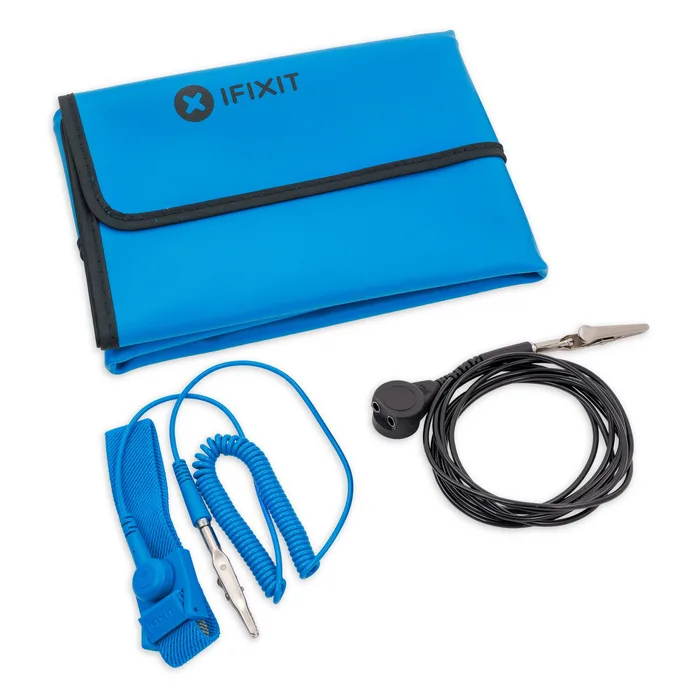
A folding 24 by 24 inch mat that publishes a surface resistivity figure and ships with both a grounding cord and a wrist strap, aimed at repairs away from a fixed bench.
Best for: Someone who repairs phones, laptops and consoles in different places and needs the grounding kit to travel with them.
- Publishes a surface resistivity of 10^7 to 10^9 ohms, which almost no consumer bench mat does.
- Includes a 10 mm grounding snap, a 1.8 m grounding cord specified at 10^5 ohms, and a 1.8 m wrist strap adjustable to XL.
- Folds and packs, so the ESD setup travels with the toolkit instead of living on one desk.
- iFixit lists the mat as designed to meet ESD S4.1 and ESD S20.20, which is a design intent statement rather than a measured test report.
- iFixit calls the mat heat-resistant but publishes no temperature rating, so it is not the surface to put a hot iron or freshly desoldered part on.
- The rubber and nylon construction is thin and creased by folding, which is fine for handling but not a bench worksurface.
- At 24 by 24 inches it covers a laptop teardown but not a full workbench.
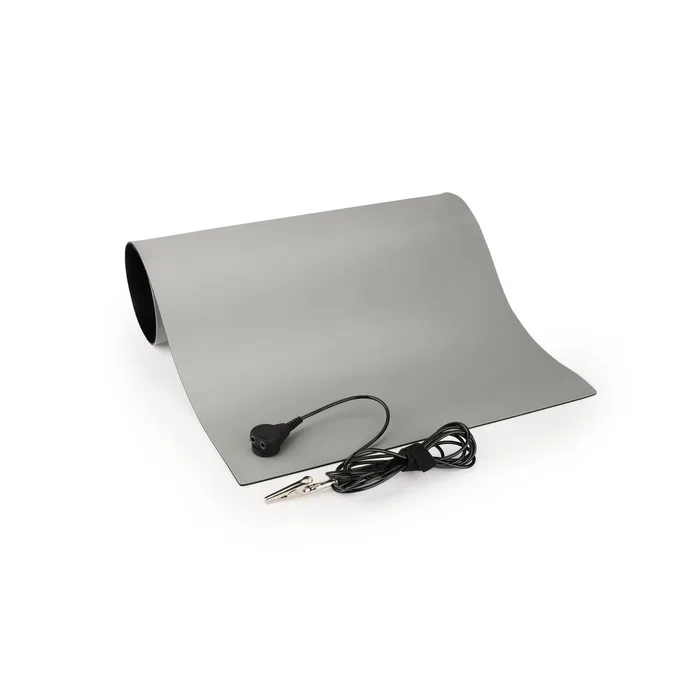
A popular consumer bench mat that ships a coiled ground cord but no wrist strap, publishes no resistance figure of any kind, and cites a superseded edition of a programme standard as its only electrical claim.
Best for: Almost nobody buying it for ESD control, although it is a serviceable heat-tolerant desk protector if you already own a documented grounding setup.
- The listing states the mat is heat resistant and describes it as a surface for soldering.
- Three sizes are offered, up to 70 by 100 cm, which covers a decent bench.
- A coiled grounding cord is in the box rather than sold separately, and iFixit backs it with a lifetime guarantee.
- The product page publishes no surface resistance or resistivity value and names no test method, so there is no way to tell whether the surface is dissipative, conductive or insulative.
- The only electrical claim is ANSI/ESD 20.20-2014 Compliant, an older edition of a programme standard that qualifies facilities and control plans rather than certifying an individual product.
- No wrist strap is included, so out of the box you can ground the mat but not yourself, which is the half-measure that leaves a charged operator touching a board.
- iFixit states the ESD Ground Plug Adapter needed to connect to a US grounded outlet is not included with this mat.
| Criteria | Statfree T2 Plus Dissipative Dual Layer Mat Kit (66425) Top pick | ESD High Temperature Mat Kit (2059T Series) | Portable Anti-Static Mat (IF145-202-5) | Anti-Static Mat (IF145-036-8) |
|---|---|---|---|---|
| Verdict | Buy it | Buy it | It depends | Skip it |
| Best for | Someone setting up a permanent repair or assembly bench who wants the surface itself to be documented and auditable. | A hobbyist or small repair shop that wants a complete, documented ESD workstation without paying industrial-supplier prices for every piece. | Someone who repairs phones, laptops and consoles in different places and needs the grounding kit to travel with them. | Almost nobody buying it for ESD control, although it is a serviceable heat-tolerant desk protector if you already own a documented grounding setup. |
| Price tier | $$$ · premium | $$ · mid-range | $ · budget | $ · budget |
| Published surface resistance | Top layer 1 x 10^6 to <1 x 10^9 ohms Rtt, bottom layer <1 x 10^6 ohms | Rtt 2 x 10^6 to 10^8 ohms, Rtg 8 x 10^6 to 10^8 ohms | Surface resistivity 10^7 to 10^9 ohms | None published |
| Independent test report | Manufacturer spec sheet only | Yes, EOS/ESD Association Services to STM4.1-2017 | No, listed as designed to meet the standards | None |
| Ground cord in the box | Yes, with hardware | Yes | Yes, 1.8 m at 10^5 ohms | Yes, coiled; outlet adapter sold separately |
| Wrist strap in the box | No | Yes, fabric adjustable | Yes, 1.8 m adjustable to XL | No |
| Construction | Dual layer nitrile rubber, 0.060 in | Two-ply rubber, dissipative over conductive, 0.080 in | Rubber and nylon, folding | Not published |
| Heat and solder | Stated usable with flux and other chemicals | Resists hot solder and irons, 190 F service temperature - Called heat-resistant, no temperature figure published | Heat resistant claimed, no figure given | - |
| Standard cited | ANSI/ESD S20.20 required limit and ANSI/ESD S4.1 recommendation | ANSI/ESD S20.20-2021 via STM4.1-2017 report | ESD S4.1 and ESD S20.20, design intent | ANSI/ESD 20.20-2014 |
| Size of this configuration | 24 x 36 in | Many, 16 x 24 in up to 3 x 8 ft | 24 x 24 in | Three sizes up to 70 x 100 cm |
Which one is right for you?
- Someone setting up a permanent repair or assembly bench who wants the surface itself to be documented and auditable. Buy it Desco Statfree T2 Plus Dissipative Dual Layer Mat Kit (66425)
- A hobbyist or small repair shop that wants a complete, documented ESD workstation without paying industrial-supplier prices for every piece. Buy it Bertech ESD High Temperature Mat Kit (2059T Series)
- Someone who repairs phones, laptops and consoles in different places and needs the grounding kit to travel with them. It depends iFixit Portable Anti-Static Mat (IF145-202-5)
- Almost nobody buying it for ESD control, although it is a serviceable heat-tolerant desk protector if you already own a documented grounding setup. Skip it iFixit Anti-Static Mat (IF145-036-8)
How we judged the field
Five things separate a mat that works from a mat that looks the part. First, a published surface resistance: a point to point figure and a resistance to the groundable point, in ohms, not an adjective. Second, a named test method, because a resistance number without one is unverifiable; the current method is ANSI/ESD STM4.1-2017, which revised and redesignated the older ESD S4.1 and measures with weighted five pound electrodes at a defined test voltage. Third, what is in the box, because the mat is one leg of a circuit and the ground cord and wrist strap are the other two. Fourth, construction, since the dual-layer mats put a conductive underside beneath the dissipative top to lower resistance to the ground point. Fifth, heat and chemical tolerance, which is the difference between a mat that survives a dropped iron and one that does not.
The field splits cleanly and unflatteringly. Professional static-control suppliers such as Desco, Bertech, SCS and Transforming Technologies publish per-layer ohms figures and cite the standards, because their customers are audited against ANSI/ESD S20.20 and have to prove it. Consumer bench-mat brands sold for phone and console repair mostly publish nothing electrical at all beyond the words anti-static, and a silicone soldering mat with a heat rating and no resistance figure is a different product wearing the same label. We picked two professional kits that publish numbers, one consumer mat that unusually does publish a figure and ships a complete grounding path, and one very widely bought consumer mat that publishes none.
Desco Statfree T2 Plus Dissipative Dual Layer Mat Kit (66425)
Buy itDesco’s Statfree T2 Plus is what a documented worksurface looks like. The mat is two layers of nitrile rubber: a dissipative top published at 1 x 10^6 to less than 1 x 10^9 ohms point to point, and a conductive bottom under 1 x 10^6 ohms whose job is to pull the resistance from the top surface down to the groundable point, which is also what allows the surface to be used with a workstation monitor. Desco states it meets the ANSI/ESD S20.20 worksurface required limit and the recommendation of ANSI/ESD S4.1, and says the oil-resistant compound may be used in soldering applications with flux and other chemicals. The mat is laser engraved with the ESD protective symbol and its specs, which matters if anyone ever audits your bench. The catch is the kit contents: mat, grounding cord with hardware and a sample of mat cleaner, and no wrist strap. Buy the strap at the same time. For a permanent bench where you want the surface itself to be defensible, this is the one.
Bertech ESD High Temperature Mat Kit (2059T Series)
Buy itBertech’s high temperature kit is the value pick, and on documentation it arguably beats the Desco. The datasheet lists a two-ply build of static dissipative rubber over conductive rubber, 2 x 10^6 to 10^8 ohms point to point, 8 x 10^6 to 10^8 ohms to the ground point, charge decay under 0.01 seconds, 0.080 inches thick, and a 190 degree F service temperature with stated resistance to oil, grease, common solvents, hot solders and soldering irons. More usefully, Bertech publishes an EOS/ESD Association Services test report on the 2059T series measured to ANSI/ESD STM4.1-2017, which concludes the samples meet ANSI/ESD S20.20-2021. That is a third party putting electrodes on the material and printing the numbers, which is rare at any price. The kit ships the mat, an ESD fabric adjustable wrist strap and a grounding cord, so nothing else is needed. The trade-off is that 190 degrees F is a service temperature, not a heatproof rating, and the sizing menu is long enough that you should measure the bench first. For most home benches this is the sensible buy.
iFixit Portable Anti-Static Mat (IF145-202-5)
It dependsThe iFixit portable mat is the odd one out in a good way: a consumer product that publishes an electrical figure. iFixit lists a surface resistivity of 10^7 to 10^9 ohms, a 10 mm grounding snap, a 1.8 m grounding cord specified at 10^5 ohms and a 1.8 m wrist strap adjustable to XL, and describes the mat as designed to meet ESD S4.1 and ESD S20.20. Note the phrasing, because designed to meet is an intent statement and not a test report, and resistivity in ohms per square is a related but different quantity to the resistance figures the standard is written around. The real reason to buy it is the form factor: 24 by 24 inches of rubber and nylon that folds into a toolkit, so your grounding setup goes where the repair is. The limits follow from that. It is described as heat-resistant but no temperature rating is published, so do not rest an iron on it, and a folded mat creases. It is a field kit, not a bench.
iFixit Anti-Static Mat (IF145-036-8)
Skip itThe iFixit Anti-Static Mat is the one to skip, and the reasons come from its own listing rather than from anything we inferred. The product page describes it as heat resistant and good for soldering, offers three sizes up to 70 by 100 cm, and states ANSI/ESD 20.20-2014 Compliant. That is the entire electrical claim. There is no surface resistance value, no resistivity value, no test method and no test report, so nothing tells you whether the surface is dissipative, conductive or insulative. The standard it cites is a programme standard for facilities and control plans rather than a product certification, and 2014 is a superseded edition. What ships is the mat and a coiled grounding cord; iFixit states the ESD Ground Plug Adapter needed to reach a US grounded outlet is not included, and there is no wrist strap, so out of the box you can bond the mat but not yourself. Same brand, same shelf, and the portable kit publishes more.
Sources
Specs in this review come from these pages.
- EOS/ESD Association, ESD Fundamentals Part 3: Basic ESD Control Procedures and Materials (esda.org)
- ANSI/ESD STM4.1-2017, Worksurfaces Resistance Measurements (EOS/ESD Association) (esda.org)
- ANSI/ESD S20.20-2021, Protection of Electrical and Electronic Parts (table of contents, EOS/ESD Association) (esda.org)
- Bertech 2059T Series ESD High Temperature Mats product datasheet (bertech.com)
- EOS/ESD Association Services product test report, Bertech 2059T Series, tested to ANSI/ESD STM4.1-2017 (bertech.com)
- Desco, Is it required for a wrist strap to have a resistance of 1 megohm? (desco.blog)
Desco Statfree T2 Plus Dissipative Dual Layer Mat Kit (66425) vs Bertech ESD High Temperature Mat Kit (2059T Series): which should you buy?
Both buys pass the test that matters: they publish resistance figures and name the standard. Choose between them on documentation depth and on what you already own. The Desco is the stronger material story, with a nitrile rubber compound its maker explicitly says can be used with flux and solder chemistry, a conductive underside sized for use with a continuous workstation monitor, and the ESD protective symbol and specs engraved into the mat itself. If your bench might ever be audited, or you want the surface to outlast several benches, the Desco is the safer object.
The Bertech wins on evidence and on completeness. An independent EOS/ESD Association Services report measured to ANSI/ESD STM4.1-2017 is a different class of claim to a manufacturer datasheet, and the kit ships the wrist strap that the Desco kit does not. Practically: if you already own a tested wrist strap and a common point ground, the Desco gets you a better surface for the money you are about to spend on the surface alone. If you are starting from an empty bench and want one order that produces a working, documented setup, buy the Bertech and spend the difference on a wrist strap tester.
What to look for
- Ohms, not adjectives: insist on a point to point resistance and a resistance to the groundable point in ohms, because the ESD Association defines antistatic as a low-charging property that does not necessarily correlate with resistivity at all.
- A named test method: ANSI/ESD STM4.1-2017 is the current worksurface test method, and a resistance figure that does not say how it was measured cannot be compared against anyone else’s.
- The programme limit, correctly quoted: ANSI/ESD S20.20 sets the worksurface required limit at less than 1 x 10^9 ohms; the familiar 1 x 10^6 lower bound is a worksurface-standard recommendation rather than the programme’s hard floor.
- Kit contents in writing: a mat with no ground cord is an isolated surface, and a kit with no wrist strap grounds the bench but not the operator, which is the failure mode that actually kills parts.
- A groundable point on the mat: look for a 10 mm stud or snap and a cord that connects to a known ground, and treat any cord that goes into a wall socket without a stated current-limiting resistor as a hazard.
- Heat and chemical claims with a number: if you solder, buy a mat whose maker states solder and flux resistance and a service temperature, because heat resistant on its own tells you nothing.
Our final take
Buy the circuit, not the mat. The single decision that separates a bench that protects parts from one that just looks organised is whether the surface, the cord and your wrist are all bonded to the same ground point, and whether anyone has measured the surface in between. Desco and Bertech both publish the numbers, and Bertech goes further by paying a third party to measure them, which is why it is the one we would put on a home bench first. The iFixit portable kit is a genuinely useful travelling setup and unusual among consumer mats for publishing a figure at all. The plain iFixit Anti-Static Mat is where the category goes wrong: heat resistant, well made, widely bought, and electrically unspecified.
Questions, answered
Does an ESD mat do anything if I do not ground it?
Very little that you can rely on, and Desco's own product copy for the Statfree T2 Plus says it plainly: worksurface mats must be properly grounded to remove ESD charges. The dissipative surface still limits how much charge the mat itself generates when things slide across it, so it is not literally inert. What it cannot do is bleed a charge off a board or a tool, because there is nowhere for that charge to go. A conductive or dissipative surface sitting on an insulating desk with no ground path is an isolated conductor, and the EOS/ESD Association describes isolated conductors as a control problem in their own right rather than a control measure. Run the cord to a known ground before you trust the mat.
Is the mat enough on its own, or do I need the wrist strap as well?
You need both, bonded to the same point. The ESD Association's own fundamentals guidance says that when personnel are seated and handling exposed ESD susceptible items they are to be grounded using a wrist strap, and that a properly worn strap connected to ground keeps the wearer at ground potential or at the same potential as the object. That last phrase is the whole point: damage comes from a potential difference between you and the part, not from an absolute voltage. A grounded mat with an ungrounded operator still has a difference across it. This is worth checking before you buy, because kits vary: the Bertech and iFixit portable kits include a strap, while the Desco mat kit ships a ground cord and hardware but expects you to buy personal grounding separately.
What is the 1 megohm resistor in a wrist strap cord actually for?
Operator safety, not ESD performance. Desco's technical guidance explains the resistor's job as limiting current to less than 0.5 mA at the highest voltage that may be encountered, so that if your grounded wrist ever contacts a live conductor you are not the shortest path. Around 800 kilohms is nominally enough for mains voltages, and 1 megohm is specified largely because it is a standard discrete resistor value. It is not a strict fixed requirement either: ANSI/ESD S20.20 gives a required limit of 0.8 to 1.2 x 10^6 ohms with product qualification testing, but permits another value provided a tailoring statement explains the rationale in the ESD control plan, and ANSI/ESD S1.1 requires non-standard values to be marked on the strap. If a wrist strap cord has no resistor at all, do not use it.
Rubber or vinyl, and does it matter for soldering?
It matters a lot if you use an iron. The two-layer rubber mats from Desco and Bertech are the ones whose makers put heat and chemical claims in writing: Desco says the nitrile rubber compound may be used in soldering applications with flux and other chemicals, and Bertech's datasheet lists resistance to hot solders and soldering irons with a 190 degree F service temperature. Vinyl homogeneous mats are cheaper, lighter and easier to cut, but they are generally sold as general purpose surfaces rather than solder-resistant ones. There is a second catch worth knowing: Bertech's own general purpose vinyl mat datasheet lists 10^9 to 10^10 ohms, which sits above the worksurface limit in ANSI/ESD S20.20, so cheap vinyl is not automatically a compliant dissipative worksurface even from a reputable supplier.
How do I tell a real ESD mat from one that just says anti-static?
Look for ohms and a test method, in that order. The ESD Association defines antistatic as a property that inhibits triboelectric charging, and is explicit that it does not necessarily correlate with resistivity, so an antistatic material can be conductive, dissipative or even insulative. The term carries no graded meaning and modern terminology has largely moved to low charging instead. A serious listing gives you a point to point resistance and a resistance to the groundable point, names ANSI/ESD STM4.1 as the method, and ideally links a test report. In practice the suppliers who do this are the professional static-control brands. Among consumer bench mats it is rare, which is exactly why publishing a number is the strongest green flag available to you.
Deciding between the top two? See our head-to-head: Desco Statfree T2 Plus Dissipative Dual Layer Mat Kit (66425) vs Bertech ESD High Temperature Mat Kit (2059T Series).
More Tech & Gadgets reviews
 The Best Ethernet Cables: 4 Compared (and One to Skip)
  The Best External Hard Drives: 4 Compared (and One to Skip)
  The Best Galaxy Projectors: 4 Compared (and One to Skip)
  The Best Gaming Controllers: 4 Compared (and One to Skip)
  The Best Gaming Mechanical Keyboards: 4 Compared (and One to Skip)
  The Best Gaming Laptops: 4 Compared (and One to Skip)