Explained
Squat Racks, Explained
After reading this, you'll be able to look at any squat-rack listing and know immediately whether it's gym-grade infrastructure, an honest budget cage, or a pull-up stand pretending to be a rack.
In this guide
A squat rack is the anchor purchase of a home gym: everything else - bar, bench, plates - slots around it for a decade. The catch is that racks are sold on specs most first-time buyers have never seen: steel gauge, tubing size, Westside spacing, rackable capacity. Worse, the cheapest products in the category look almost identical to the real thing in photos, and the differences only show up when a heavy rep fails.
The 30-second version
- Lower gauge means thicker steel. 11-gauge 3x3-inch tubing is the commercial-gym standard; 14-gauge 2x2-inch is the honest budget floor; anything lighter is a pull-up stand, not a squat rack.
- Safeties are the whole point. A rack exists to catch the bar when a rep fails. If pin pipes, straps, or spotter arms aren't in the box, budget for them the same day - or keep shopping.
- A flat-foot base solves the bolting problem. Racks with wide flat feet are engineered to stay planted without drilling into your floor - the key spec for renters and finished garages.
- The attachment ecosystem is the hidden spec. Dip bars, lat towers, and spotter arms only exist for racks with active ecosystems; a cheap rack with no attachments gets replaced, not upgraded.
- Measure your ceiling before you compare anything else. Rack height plus pull-up clearance eliminates options faster than budget does - many full-height racks don't work under a standard 8-foot ceiling.
The products this guide is about
Our verdict on each, with the full reasoning on the companion review.
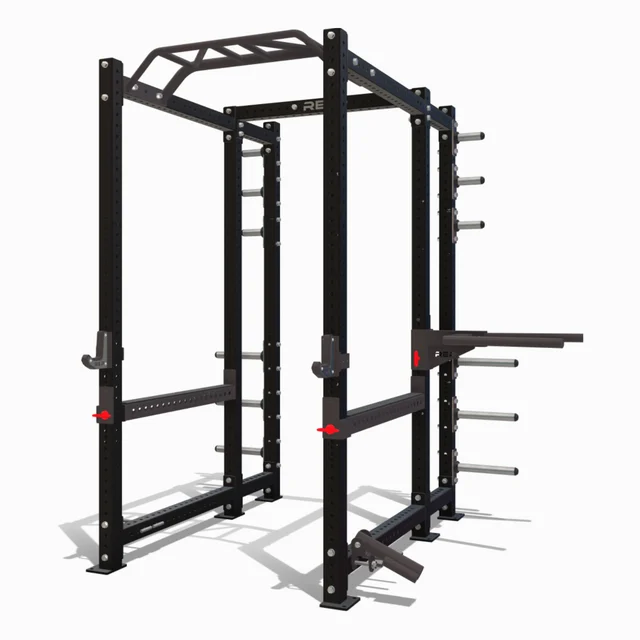
- Buy REP Fitness REP PR-4000 Power Rack Gym-grade 3x3-inch 11-gauge steel and a huge attachment ecosystem at a price that undercuts the big-name equivalent.
- Buy Rogue Fitness Rogue RML-390F Flat Foot Monster Lite Rack USA-made 3x3-inch 11-gauge power rack whose flat-foot base needs no bolting - the low-fuss heavy-duty option.
- It depends REP Fitness REP PR-1100 Power Rack The best of the true budget cages - honest about being 14-gauge steel, and excellent within that limit. Amazon
- Skip CAP Barbell FM-905Q Power Rack Exercise Stand A tempting-looking stand whose low weight rating and missing safeties make it the wrong place to put a loaded barbell. Amazon
What actually matters
- Steel gauge and tubing size - this is the load-bearing skeleton. 3x3-inch 11-gauge uprights are the gym standard and flex the least; 2x2-inch 14-gauge is thinner and shows some wobble under fast re-racks, which independent testing confirms even on well-made budget cages.
- Included safeties - pin pipes, straps, or spotter arms are what let you squat and bench alone without a spotter. A rack sold without any safety system included is a red flag disguised as a discount.
- Rated capacity vs. your lifts - you want a rating far above your working weights. A rating close to what you actually lift is a warning, not a fit; the margin is the safety.
- Stability plan - every rack stays put one of three ways: a flat-foot base (no drilling), bolts into the slab, or ballast from loaded plate-storage pegs. Know which one your floor and lease allow before you buy.
- Hole spacing in the bench zone - 1-inch (Westside) spacing around chest height lets you set unrack heights exactly right for bench press; coarser 2-inch spacing is livable for squats but annoying for benching.
- Attachment ecosystem - the rack you buy today should already have the attachments you might want in three years: dip bars, spotter arms, lat pulldown, plate storage. Small ecosystems mean a second purchase later.
- Footprint and ceiling height - a full power rack wants roughly a 4x4-foot base plus room to walk a bar out, and pull-ups need clearance above the crossbar. Measure first; the best rack is worthless if it doesn't fit.
The specs, in plain English
Green flags vs red flags
Green flags
- 3x3-inch 11-gauge steel with 5/8-inch hardware named plainly in the listing
- Safeties (pins, straps, or spotter arms) included in the box, not sold as an afterthought
- Numbered, laser-cut uprights so both J-cups land at the same height every time
- Westside 1-inch hole spacing through the bench zone
- A deep, current attachment catalog from the same maker - dips, spotter arms, plate storage, lat towers
- A flat-foot base or clearly documented bolt-down pattern, so the stability plan is explicit
Red flags
- No steel gauge or tubing size stated anywhere in the listing - thin steel hides behind vague specs
- No safety catches included and no compatible spotter arms offered
- A weight rating near or below a committed lifter's working weights within a year or two
- Owner reports of wobble or midsection flex when the bar is re-racked with any speed
- 'Power rack' or 'power cage' in the product name on what is structurally a light stand
- A dead or tiny attachment ecosystem - the rack can never grow, only be replaced
Who's who: the brands
- REP Fitness - The value benchmark in home racks - gym-grade 3x3 11-gauge steel and a huge attachment catalog at prices that undercut the flagship names.
- Rogue Fitness - The USA-made flagship: legendary fabrication quality, the Monster Lite ecosystem, and strong resale value - at a premium.
- Titan Fitness - Aggressive-value importer that clones flagship specs for less; fit-and-finish and quality control run a step behind the leaders, per owner reports.
- Bells of Steel - Canadian direct-to-consumer brand with well-priced 3x3 racks and a fast-growing attachment lineup, popular with budget-conscious garage lifters.
- CAP Barbell - Big-box budget brand; fine for pull-up stands and light-duty gear, but its cheapest rack-shaped stands carry lower ratings and no listed safeties, which rules them out for serious squatting.
How to read a listing without getting fooled
Start every listing at the steel: if the tubing size and gauge aren't stated, assume the worst, because makers of 11-gauge racks rarely hide it. Next, find the words 'safeties included' - then check whether they mean real pin pipes or straps, or just plastic-tipped hooks. Treat the product name with suspicion: 'power rack' on the box does not make a light stand a power rack; the specs do. Check the rated capacity against where your lifts will be in three years, not where they are today. Then do the boring math the photos skip: rack height plus pull-up clearance against your ceiling, and footprint plus walk-out room against your floor. Finally, click through to the maker's attachment page - a long, current catalog tells you the rack is a platform; an empty one tells you it's a dead end.
How much should you spend?
Rack pricing tracks steel almost linearly: you're paying for tubing size, gauge, and the engineering around it. The entry tier buys a genuine four-post cage in thinner 2x2 steel with real included safeties - an honest, safe starting point for beginners, with wobble and a small ecosystem as the known trade-offs. The value sweet spot for most lifters is the mid-premium tier: 3x3-inch 11-gauge steel, Westside spacing, and a deep attachment catalog, which is the buy-once spec that never needs replacing. The flagship tier buys the same structural class plus USA manufacturing, flat-foot convenience, and resale value - worth it if those specifics matter to you, not because the steel is stronger. Where spending less backfires is the very bottom: rack-shaped stands with low ratings and no safeties defer the real purchase rather than replace it, because nearly every serious owner ends up buying a proper rack anyway. And whatever tier you land in, leave room in the budget for attachments - on configurable racks they can quietly rival the cost of the cage itself.
Questions, answered
Do squat racks need to be bolted to the floor?
It depends on the design. Flat-foot racks are engineered to stay planted freestanding on a matted concrete floor, and owner reports back that up even for heavy lifting and pull-ups. Standard four-post racks are safest bolted into the slab or ballasted with loaded plate-storage pegs - pick one of those, especially if you do kipping pull-ups or re-rack aggressively. If you can't drill (rental, finished floor), buy a flat-foot design rather than leaving a standard rack loose.
What are spotter arms and do I need them if my rack has pin safeties?
Spotter arms are cantilevered steel arms that bolt to the front of the uprights so you can lift outside the cage - useful for benching or squatting when the cage interior is occupied or too shallow. Inside a four-post cage, pin or strap safeties do the same job and are harder to miss. The rule that matters: whichever style you use, set them just below your lowest bar position before every solo set. Safeties you own but never set catch nothing.
How much weight capacity do I actually need?
More than feels necessary. The rating should sit several times above your current working weights, because it has to absorb a bar dropped onto the safeties, not just one resting in the J-cups. A gym-grade four-figure rating gives a lifetime of margin for almost any home lifter; a rating a committed beginner could approach within a couple of years is the category's biggest warning sign. Ratings near your maxes are a countdown, not a fit.
Is a squat stand good enough, or do I need a full power rack?
If you ever train alone, a full four-post rack - or at minimum a rack with proper spotter arms - is the safer call, because it gives a failed squat or bench press somewhere to land. Stands are lighter, cheaper, and fine with a spotter or for lifts you can safely dump, but a bare stand with no arms leaves the bar nowhere to go but the floor, or you.
How much ceiling height do I need?
Measure before anything else. A full-height rack around 92 to 93 inches technically clears a standard 8-foot (96-inch) ceiling, but pull-ups become impossible with your head hitting the ceiling. Shorter 80-to-84-inch configurations are the go-to for basements and low garages, and many owners report not missing the height for squats and presses - only for pull-ups, which some racks solve with lower-mounted bars.
Can I start with a cheap rack and upgrade later?
You can, but be honest about which cheap rack. An entry-level four-post cage with real included safeties and a solid rating is a legitimate starting point that many casual lifters never outgrow. An ultra-budget stand with no safeties and a low limit is different - the money isn't saved, it's deferred, because consistent lifters outgrow it within months and buy a real rack anyway. If your budget only reaches the second kind, save a little longer for the first.
Or jump to the head-to-head: REP Fitness REP PR-4000 Power Rack vs Rogue Fitness Rogue RML-390F Flat Foot Monster Lite Rack.