Explained
Smart Sprinkler Controllers, Explained
After reading, you'll understand how many zones you need, where a controller can be mounted, and which features keep watering reliable.
In this guide
Most first-time buyers focus on the app and miss the hardware details that decide whether a controller fits. Zone count, master valve and pump terminals, and the outdoor rating matter as much as weather intelligence. Wi-Fi reach at the garage wall trips up many installs. This guide explains the terms so you can match a controller to your system before you take the old timer down.
The 30-second version
- Count your zones first, because each valve wire needs its own station on the controller.
- Check the mounting location, since many smart controllers are indoor-only without an enclosure.
- Offline behavior matters, so look for stored programs and buttons at the box.
- WaterSense unlocks rebates, in many water districts that require the label.
- Test Wi-Fi where it hangs, and consider dual-band, Bluetooth or Ethernet if the signal is weak.
The products this guide is about
Our verdict on each, with the full reasoning on the companion review.
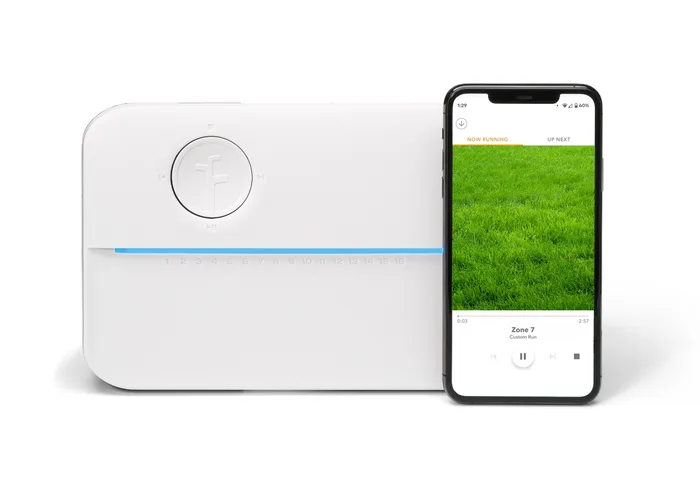
- Buy Rachio 3 Smart Sprinkler Controller The most polished smart controller, with weather-based Flex schedules and no monthly fee for core features. Amazon
- Buy Orbit B-hyve XR Smart Indoor/Outdoor Sprinkler Timer An 8 or 16 station controller built for indoor or outdoor mounting, with dual-band Wi-Fi, Bluetooth and the WaterSense label. Amazon
- It depends Rain Bird ARC Smart Irrigation Controller A simple 4 to 8 station Wi-Fi controller from a major irrigation brand, with a UL/cUL listing and a weatherproof outdoor model. Amazon
- It depends Yardian Pro Smart Sprinkler Controller A controller with Apple HomeKit support, an Ethernet port and on-device buttons that keeps running schedules without internet. Amazon
- It depends Hunter Pro-HC (Hydrawise) A professional-grade Wi-Fi controller with a touchscreen, up to 24 stations and flow meter alerts for leaks. Amazon
- Skip Netro Sprite Smart Sprinkler Controller A cheap 6 or 12 zone cloud-scheduled controller with no display or buttons and no backup program. Amazon
What actually matters
- Zone count - Each zone is a valve controlled by one station terminal. Buy enough stations for your system plus any planned additions.
- Weather adjustment - Controllers skip or shorten watering based on rain, forecast and season. Better models let you set plant and soil types per zone.
- Mounting rating - Outdoor controllers need a weather-resistant housing. Indoor models need an enclosure if they go outside.
- Offline behavior - A controller that stores its schedule keeps watering when Wi-Fi drops. Buttons at the box let you run zones without a phone.
- Master valve and pump terminals - Some systems use a master valve or pump that must switch on with each zone. Check the controller has the terminal.
- Sensor inputs - Rain, freeze, soil and flow sensors can stop or adjust watering. Flow meters can also catch leaks.
- WaterSense status - The EPA label shows the controller met efficiency criteria. Many rebate programs require it.
The specs, in plain English
Green flags vs red flags
Green flags
- The maker lists zone counts and every terminal type.
- WaterSense status is stated with the certifying body.
- A named safety listing such as UL or cUL appears in the specs.
- Programs are stored on the device and buttons work at the box.
- Outdoor use and any required enclosure are spelled out.
Red flags
- No display or buttons, so every action needs the app.
- No mention of what happens when Wi-Fi drops.
- No outdoor rating for a unit sold for garden walls.
- Only a handful of programs on a large zone count.
- No warranty length on the product page.
Who's who: the brands
- Rachio - Known for app-first smart controllers with Flex schedules and wide smart home integrations.
- Orbit B-hyve - Known for affordable smart controllers and hose timers with Bluetooth and Wi-Fi.
- Rain Bird - Known for irrigation hardware and simple, well-documented controllers.
- Hunter - Known for professional irrigation gear and the Hydrawise platform used by contractors.
- Yardian - Known for controllers with Apple HomeKit support and local schedule storage.
How to read a listing without getting fooled
Start with the zone or station count and the list of terminals: master valve, pump start relay and sensor inputs. Then read the power section to see whether the controller plugs into an outlet through an adapter or wires to line voltage, and check the mounting section for indoor, outdoor or enclosure requirements. Look at the connectivity line for 2.4 GHz-only Wi-Fi versus dual-band, Bluetooth or Ethernet. Finally, read the compliance line for WaterSense and a safety listing, and the FAQ for what happens offline.
How much should you spend?
Budget controllers cover small systems well but may drop on-device controls, stored backup programs or zone capacity. Mid-range controllers add more zones, polished apps, outdoor housings or better connectivity. Premium, contractor-grade controllers bring touchscreens, flow meter support and valve diagnostics for large properties. A WaterSense rebate can offset much of the cost in many districts, so check your utility before choosing a tier.
Questions, answered
Do I need a rain sensor with a smart controller?
Not always, because weather-based controllers can skip watering using forecasts. Rain Bird's ARC can delay watering for forecast rain even without a sensor. A physical rain or freeze sensor still reacts to what actually falls on your yard.
What if I have more zones than the controller supports?
Buy a larger model or a second controller. Yardian's app manages up to 10 devices on one account, and Hunter's Pro-HC goes up to 24 stations. Wiring two zones to one station is not recommended because they would always run together.
Can a smart controller run drip irrigation?
Yes, if the drip zones use standard 24 VAC valves. Orbit describes the B-hyve XR as controlling 24 VAC sprinkler and drip systems. Set the zone type to drip so run times match the lower flow.
How do I winterize with a smart controller?
Most apps let you pause or turn off watering for the season, and some have freeze skips. Netro, for example, can disable watering during freezing weather. Draining or blowing out the pipes is still a separate job for cold climates.
Or jump to the head-to-head: Rachio 3 Smart Sprinkler Controller vs Orbit B-hyve XR Smart Indoor/Outdoor Sprinkler Timer.