Explained
Sharpening Stones, Explained
After reading, you'll know which stone technology suits your work, how to compare grits across scales, and why flatness is the specification that matters most.
In this guide
Three different technologies are sold under the single word stone, and they behave so differently that choosing between them matters more than choosing between brands. Diamond, ceramic and water stones each cut at different speeds, need different handling, and fail in different ways. Once you know which one you want, the rest of the decision is grit, flatness and whether the stone will sit still.
The 30-second version
- Diamond is the easiest to live with, cutting fast, staying flat and needing no soaking.
- Grit numbers are not comparable across types, so look for a micron figure instead.
- Flatness is the specification that matters most, because a dished stone grinds a curve into a straight bevel.
- Two grits cover almost everything, roughly 300 to 600 for repair and 1000 to 1200 for honing.
- An angle guide helps a beginner more than any upgrade in abrasive quality.
The products this guide is about
Our verdict on each, with the full reasoning on the companion review.
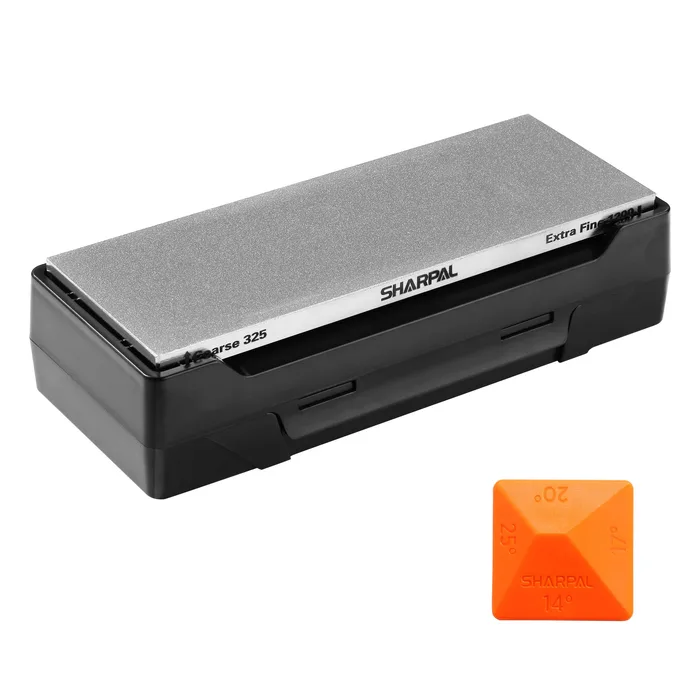
- Buy SHARPAL 162N Dual-Grit Diamond Whetstone Two grits, a stated flatness tolerance, an angle guide and a base, for very little money.
- Buy DMT 8-in. Dia-Sharp Bench Stone, Fine A continuous diamond surface guaranteed not to hollow, and the right stone for flattening chisel backs.
- It depends Spyderco Benchstone 2 x 8, Medium Ultra-hard ceramic that needs no oil and no water, and finishes an edge rather than repairing one.
- Skip Wüsthof Whetstone J 1000 / 3001 A water stone from a knife company that will not tell you what it is made of or how big it is.
What actually matters
- Abrasive type - diamond, ceramic or bonded water stone. Diamond cuts fastest and stays flattest; ceramic is hard, slow and clean; water stones cut fast and finish finest but wear and dish.
- Grit and micron size - the size of the abrasive particles. The micron figure is the comparable one, because grit scales differ between abrasive types and between countries.
- Flatness tolerance - how far the surface may deviate from a plane, usually quoted in thousandths of an inch. It is the difference between a stone that is an abrasive and one that is also a reference surface.
- Single or dual grit - whether the two faces carry different abrasives. Dual-grit stones cover repair and honing in one purchase; single-grit stones are bought in sets.
- Lubrication - whether the stone is used dry, with water, or with oil. This decides how much mess it makes and whether it needs soaking before you can start.
- Surface size - the working area, typically 6 or 8 inches long by 2 to 3 inches wide. Wider is easier for broad kitchen blades; longer gives a smoother stroke.
- Base and storage - non-skid feet, a moulded case that doubles as a stand, or a separate holder. A stone that slides is both frustrating and dangerous.
The specs, in plain English
Green flags vs red flags
Green flags
- Grit given with a micron figure, not just a number.
- A stated flatness tolerance in thousandths of an inch or millimetres.
- The abrasive material named specifically, such as monocrystalline diamond or alumina ceramic.
- Full working dimensions and weight published.
- A base, holder or case included rather than sold separately.
Red flags
- A grit number with no scale and no micron equivalent.
- No dimensions and no weight anywhere on the page.
- A water stone with no mention of flattening or soaking.
- The abrasive described only as high-quality.
- Description that contradicts itself on which side to use first.
Who's who: the brands
- DMT - American maker of monocrystalline diamond sharpeners, known for the continuous Dia-Sharp plates and the interrupted-surface DuoSharp line, with a published grit table.
- SHARPAL - Value-focused diamond sharpener brand that publishes flatness tolerances, full dimensions and warranty terms, and integrates angle guides into its stones.
- Spyderco - Known for folding knives, and also for ultra-hard alumina ceramic benchstones and the Tri-Angle Sharpmaker rod system, all used dry.
- Work Sharp - Oregon company focused on guided and powered sharpening systems rather than loose bench stones, including the Precision Adjust line.
- Wüsthof - German knife maker whose accessory range includes combination water stones and a tri-stone system, with limited published specification.
How to read a listing without getting fooled
Start by identifying the abrasive, because that decides which of the other specifications even apply. If it is diamond, look for the word monocrystalline, then for whether the surface is continuous or interrupted, then for a flatness tolerance. If it is ceramic, expect no grit numbers and read it as a finishing stone. If it is a water stone, look for anything on the page acknowledging that it will dish, and treat silence there as a warning. Then find the grit, and specifically the micron figure, because a number alone on an unnamed scale cannot be compared with anything. Check the working surface size, not the package size, and prefer 3 inches of width over 2 if you sharpen kitchen knives. Finally, look at what stops the stone moving on the bench, and whether an angle guide is included, which for a first stone will improve your results more than a finer abrasive would.
How much should you spend?
The budget tier now buys a dual-grit diamond stone on a steel plate with a published flatness figure, a base and an angle guide, which is a genuinely complete first setup and the right starting point for almost everyone. The mid-range buys a single ceramic benchstone or a combination water stone from a knife brand, and here you are often paying for the name rather than for more specification. The premium tier buys a continuous-surface diamond plate from a specialist, one grit at a time, and that is worth it specifically for woodworking where the stone doubles as a flat reference. A full premium progression of three or four grits is a serious outlay, so be honest about whether you will sharpen chisels or only knives before committing to it.
Questions, answered
How do I know what angle to sharpen at?
Most Western kitchen knives are ground around 20 degrees per side, most Japanese kitchen knives closer to 15, and outdoor and utility knives somewhere between 20 and 25 where a more durable edge matters more than a finer one. Woodworking chisels and plane irons are usually 25 to 30. The practical answer for a beginner is to use an angle guide, which is why a stone with one built in is worth more than its price difference; the SHARPAL's four presets at 14, 17, 20 and 25 cover the common cases.
Do diamond stones wear out?
They lose their initial aggressiveness and then settle. A new diamond plate cuts faster than it will after break-in, because the highest-standing particles are removed first, and what remains is a slower but far more consistent surface that lasts for years. That is normal and not a defect. What does kill a diamond plate is heavy pressure, which knocks particles out of the nickel plating; the correct technique is light pressure and more strokes.
Can I use a bench stone to flatten another stone?
A coarse diamond plate physically can, and SHARPAL says its 325 grit side will, while advising against doing it often because the stone is designed for sharpening rather than lapping. DMT makes the same distinction more strictly, telling you not to lap with anything except its dedicated Dia-Flat model. If you own water stones and intend to keep them flat, buy a flattening plate made for the job rather than wearing out a good sharpening stone.
Why does my knife not feel sharper after using a stone?
Almost always because the burr was never raised or never removed. Sharpening works by grinding one side until a thin wire of metal folds over the edge, doing the same on the other side, and then stripping that burr off with light alternating strokes or a strop. If you stop before the burr forms, you have polished a dull edge; if you stop before removing it, the burr tears off in use and the knife feels dull within minutes. Check for the burr with a fingernail along the edge before moving to a finer grit.
Or jump to the head-to-head: SHARPAL 162N Dual-Grit Diamond Whetstone vs DMT 8-in. Dia-Sharp Bench Stone, Fine.