

Tech & Gadgets
The Best Sharpening Stones: 4 Compared (and One to Skip)
We compared four bench sharpening stones on abrasive type, published grit in microns, flatness tolerance, whether they need oil or water, and what each maker will state in writing.
The short version
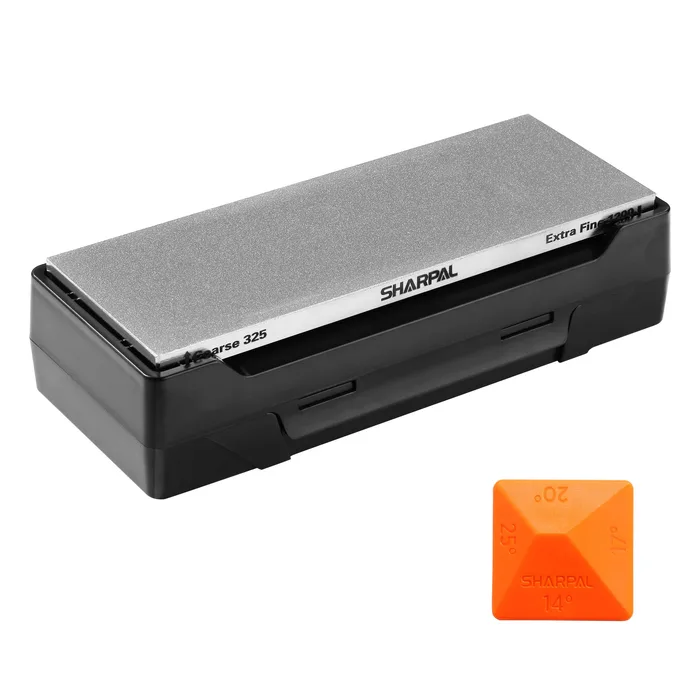
The SHARPAL 162N is the one to buy: a dual-grit diamond whetstone at 325 grit / 45 micron and 1200 grit / 12 micron, monocrystalline diamond electroplated onto a stainless-steel base, ground flat to plus or minus 0.002 inches, with a storage case that doubles as a non-slip base, an integrated angle guide offering 14, 17, 20 and 25 degrees, a 3-year warranty, and every dimension and weight published. The DMT 8-inch Dia-Sharp Bench Stone in Fine is the better stone for precision flat work, with a continuous monocrystalline diamond surface guaranteed not to hollow or groove, but it is one grit per stone. The Spyderco Benchstone 2 x 8 is alumina ceramic that needs no oil or water, and it is a finisher rather than an edge repairer. The Wüsthof Whetstone J 1000/3001 is the one to skip, because Wüsthof publishes no dimensions, no weight, no material and no flatness figure for it, and never mentions that a water stone dishes and needs flattening. Best for: anyone who wants to stop buying pull-through sharpeners and learn to put a real edge on a knife.
Our picks at a glance
- SHARPAL 162N Dual-Grit Diamond Whetstone - Buy. Two grits, a stated flatness tolerance, an angle guide and a base, for very little money.
- DMT 8-in. Dia-Sharp Bench Stone, Fine - Buy. A continuous diamond surface guaranteed not to hollow, and the right stone for flattening chisel backs.
- Spyderco Benchstone 2 x 8, Medium - It depends. Ultra-hard ceramic that needs no oil and no water, and finishes an edge rather than repairing one.
- Wüsthof Whetstone J 1000 / 3001 - Skip. A water stone from a knife company that will not tell you what it is made of or how big it is.
The verdict in 30 seconds
What mattered most
- Abrasive type
- Grits
- Dual sided
- Flatness tolerance
- Needs oil or water
- Size
A sharpening stone is one of the few tools where the specification really is the product. There is an abrasive, a grit size, a surface that is either flat or is not, and a base that either holds still or does not. Everything else is packaging. The trouble is that this category has three genuinely different technologies sold under the same word, and makers describe them in three incompatible vocabularies: diamond stones are quoted in microns and mesh, ceramic stones are quoted as medium, fine and ultra fine with no numbers at all, and Japanese water stones are quoted as a grit figure on a scale nobody standardises. We compared one of each, plus a second diamond, and read what each company is willing to put in writing.
Two grits, a stated flatness tolerance, an angle guide and a base, for very little money.
Best for: Anyone buying their first proper stone, who wants coarse and fine without buying twice.
- Coarse 325 grit at 45 micron and extra fine 1200 grit at 12 micron on opposite faces, covering edge repair and honing in one stone.
- Ground flat to plus or minus 0.002 inches, which is the only flatness figure any of these four makers publishes.
- Monocrystalline diamond electroplated in nickel onto a stainless-steel base, with a high-impact case that doubles as a non-slip stand and a built-in guide for 14, 17, 20 and 25 degrees.
- 1200 grit is the finest side, so it will not polish an edge the way a 6000 or 8000 finishing stone does.
- At 3.04 pounds with the base it is the least portable stone here.
- SHARPAL says the coarse side can flatten other stones but advises against doing it often, so it is not a substitute for a lapping plate.
- The warranty is 3 years, against makers who imply indefinite service life.
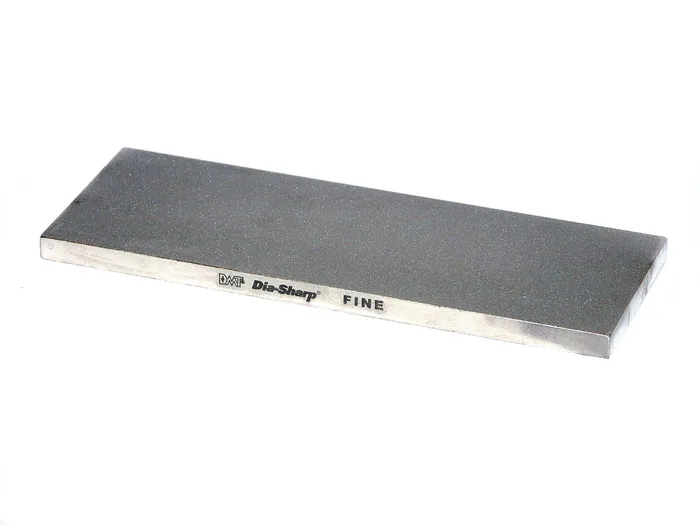
A continuous diamond surface guaranteed not to hollow, and the right stone for flattening chisel backs.
Best for: Woodworkers flattening chisel backs and plane irons, where a dead flat reference surface is the whole point.
- A continuous, uninterrupted diamond surface that DMT guarantees will not hollow or groove, which is what makes it usable for flattening plane soles, plane irons and chisel backs.
- Fine grade is precisely specified at 25 micron and 600 mesh, and DMT publishes its entire grit table from 120 mesh through 8000 mesh.
- Micronised monocrystalline diamond, no oil needed, works dry or with water, non-skid rubber feet, grit marked on the side of the stone, made in the USA.
- One grit per stone, so a full progression means buying three or four of them.
- DMT publishes no dimensions beyond the 8-inch length, no weight and no flatness tolerance.
- No warranty terms are stated on the product page despite the guarantee against hollowing.
- Diamond stones cut fastest when new and settle to a slower rate after break-in, which DMT acknowledges only for the extra-extra-fine grade.
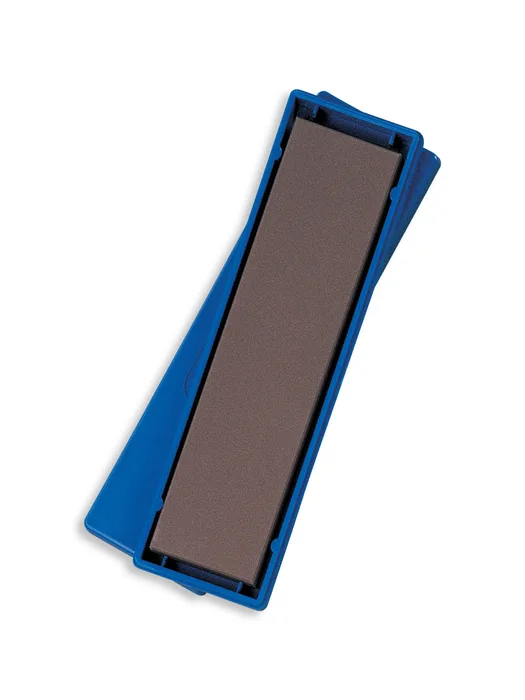
Ultra-hard ceramic that needs no oil and no water, and finishes an edge rather than repairing one.
Best for: Keeping an already-sharp knife sharp, and anyone who does not want water or oil on the bench.
- Alumina ceramic used dry, with no oil, no water and no soaking, which removes the messiest part of stone sharpening.
- Cleans with household cleanser, a scouring pad and water, so a loaded surface is recoverable rather than ruined.
- Made in the USA and supplied with a covered polymer case with non-skid rubber feet, in a choice of medium, fine and ultra fine.
- Spyderco publishes no grit numbers at all, only the words medium, fine and ultra fine.
- Ceramic cuts slowly, so this is a honing and finishing stone rather than one that will reset a damaged bevel.
- At 2 inches wide it is the narrowest surface here, which makes a wide kitchen blade harder to keep flat on it.
- No flatness tolerance, dimensions beyond 2 x 8, or weight are published.
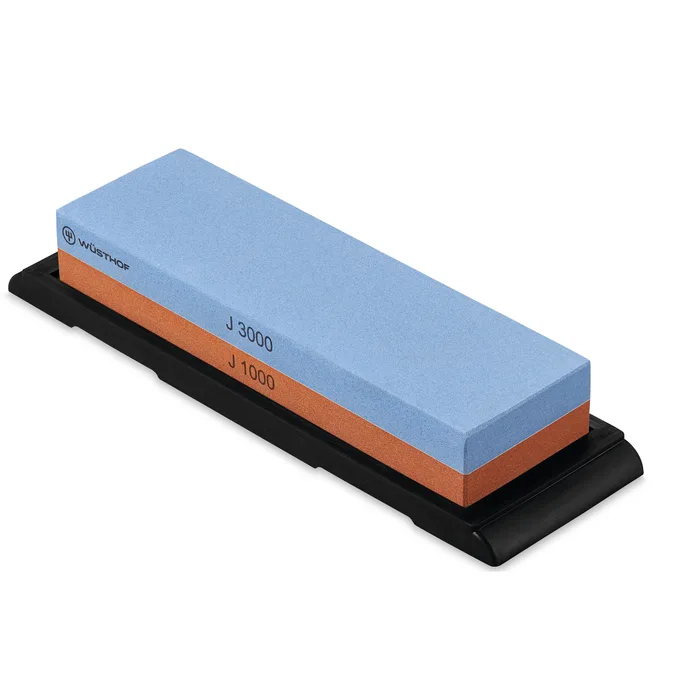
A water stone from a knife company that will not tell you what it is made of or how big it is.
Best for: Someone who wants a matching stone from their knife brand and does not intend to research further.
- A 1000 and 3000 combination covers the two grits most kitchen knives ever need.
- A non-slip holder is included rather than sold separately.
- It comes from the company that made the knife, so the recommended angle and the stone come from one source.
- Wüsthof publishes no dimensions, no weight, no abrasive material and no flatness figure for it.
- The product is named 1000 / 3001 while the description calls it 1000/3000, and neither number is explained.
- Water stones dish with use and need periodic flattening, which the page never mentions and for which Wüsthof sells nothing.
- The description says the coarse side smooths off unevenness and the fine side hones, which reverses the usual order of operations.
| Criteria | 162N Dual-Grit Diamond Whetstone Top pick | 8-in. Dia-Sharp Bench Stone, Fine | Benchstone 2 x 8, Medium | Whetstone J 1000 / 3001 |
|---|---|---|---|---|
| Verdict | Buy it | Buy it | It depends | Skip it |
| Best for | Anyone buying their first proper stone, who wants coarse and fine without buying twice. | Woodworkers flattening chisel backs and plane irons, where a dead flat reference surface is the whole point. | Keeping an already-sharp knife sharp, and anyone who does not want water or oil on the bench. | Someone who wants a matching stone from their knife brand and does not intend to research further. |
| Price tier | $ · budget | $$$ · premium | $$ · mid-range | $$ · mid-range |
| Abrasive type | Monocrystalline diamond on steel | Monocrystalline diamond, continuous | Alumina ceramic | Water stone, material not published |
| Grits | 325 / 45 micron and 1200 / 12 micron | 600 mesh / 25 micron (this model) | Medium, no number published | 1000 and 3000, scale not stated |
| Dual sided | Yes | No | No | Yes |
| Flatness tolerance | Plus or minus 0.002 in / 0.05mm | Not published, guaranteed not to hollow | Not published | Not published |
| Needs oil or water | No, sharpen dry | No, dry or water | No, used dry | Water |
| Size | 8.46 x 3.82 x 1.93 in | 8 in long, rest not published | 2 x 8 in | Not published |
| Weight | 3.04 lb / 1.38 kg | Not published | Not published | Not published |
| Base or holder | Storage case, doubles as non-slip base | Non-skid rubber feet | Covered polymer case, non-skid feet | Non-slip holder included |
| Angle guide | Yes, 14 / 17 / 20 / 25 degrees | No | No | No |
| Warranty | 3 years | Not published | Not published | Not published |
Which one is right for you?
- Anyone buying their first proper stone, who wants coarse and fine without buying twice. Buy it SHARPAL 162N Dual-Grit Diamond Whetstone
- Woodworkers flattening chisel backs and plane irons, where a dead flat reference surface is the whole point. Buy it DMT 8-in. Dia-Sharp Bench Stone, Fine
- Keeping an already-sharp knife sharp, and anyone who does not want water or oil on the bench. It depends Spyderco Benchstone 2 x 8, Medium
- Someone who wants a matching stone from their knife brand and does not intend to research further. Skip it Wüsthof Whetstone J 1000 / 3001
How we judged the field
We looked first at the abrasive and what it is bonded to, because that decides almost everything downstream: how fast the stone cuts, whether it needs a liquid, whether it stays flat and how long it lasts. Second, grit, and specifically whether the maker gives a micron figure. Grit numbers on their own are not comparable across diamond, ceramic and Japanese water stones, so a stone quoted only as 1000 tells you less than one quoted as 12 micron. Third, flatness, stated as a tolerance if the maker will commit to one. Fourth, the practical apparatus around the stone: whether it comes with a base that stops it sliding, whether it stores itself, and whether there is an angle guide, which for a beginner is worth more than a grit step. Fifth, what is published at all, which turned out to separate this group cleanly.
We deliberately took one stone from each technology rather than four of the same kind, because the choice most buyers are actually making is between technologies, not between two diamond plates. That does mean these four are not interchangeable. The ceramic finishes, the water stone polishes, and the two diamonds do the heavy work. Where they are comparable, we compared them; where they are not, we said so.
The SHARPAL 162N does the most for the least. It is a dual-grit diamond whetstone measuring 8 by 3 inches of working surface, with coarse 325 grit at 45 micron on one face for resetting a bevel or taking out a chip, and extra fine 1200 grit at 12 micron on the other for honing. The abrasive is industrial monocrystalline diamond electroplated in nickel onto a stainless-steel base, and SHARPAL calls the process MirrorFlat and commits to a flatness of plus or minus 0.002 inches, which is the only flatness number any maker in this group publishes. Everything else is stated too: 8.46 by 3.82 by 1.93 inches, 3.04 pounds, a 3-year warranty. The high-impact plastic case stores the stone and then becomes its non-slip base, and the integrated Angle Pyramid guide gives you 14, 17, 20 and 25 degrees, which is the single most useful thing you can hand someone who has never freehanded an edge. The limits are real but narrow: 1200 grit is not a polishing grit, three pounds is not portable, and SHARPAL explicitly warns against using the coarse side as a regular flattening plate for other stones.
The DMT Dia-Sharp is the stone to own if the surface has to be a reference. Its selling point is a continuous, uninterrupted diamond surface, as opposed to the interrupted polka-dot pattern DMT uses on its DuoSharp line, and DMT guarantees it will not hollow or groove. That is what makes it suitable for flattening plane soles, plane irons and chisel backs, jobs where a dished stone silently ruins the work. The Fine grade is 25 micron at 600 mesh, colour-coded red, and DMT publishes the whole ladder from 120 mesh extra-extra-coarse down to 8000 mesh extra-extra-fine with a description of what each is for, which is genuinely the clearest grit documentation here. It needs no oil, works dry or with water, sits on non-skid rubber feet, has the grit marked on its side, and is made in the USA. The catch is the business model. One grit per stone means a progression costs several times what the SHARPAL does, and for all that documentation DMT gives no width, no thickness, no weight, no flatness tolerance and no warranty terms.
The Spyderco Benchstone is the odd one out and knowing why is the point. It is ultra-hard alumina ceramic, used completely dry, with no oil, no water and no soaking, and a loaded surface is cleaned with household cleanser and a scouring pad rather than replaced. It comes in three grades, medium, fine and ultra fine, is made in the USA, and arrives in a covered polymer case with non-skid rubber feet that keeps it flat on the bench. What it will not do is move much metal. Ceramic is hard but cuts slowly, so this is the stone that takes an edge from sharp to very sharp, not the one that rescues a chipped blade. The 2 inch width is also the narrowest here, which makes a broad chef’s knife harder to hold flat across. And Spyderco publishes no grit numbers, no micron figures and no dimensions beyond the 2 by 8, which means you cannot place its fine anywhere on the same scale as the other three.
The Wüsthof Whetstone J 1000/3001 is where a well-known knife name stops being enough. Wüsthof describes it as a combination of different high-quality abrasive grits with a coarse side and a fine side, and includes a non-slip holder. That is the entire specification. There is no material named, no dimensions, no weight, no flatness figure, no country of manufacture and no warranty. The grit is given as 1000 and 3000 in the description while the product is titled 1000 / 3001, and neither number is placed on a stated scale. More importantly, a water stone is the one type here that actively wears and dishes in normal use, and the page never says so, never explains soaking or splashing, and Wüsthof does not sell a flattening stone to go with it. The description also has the order backwards, saying the coarse side smooths off unevenness and the finer grit is used to hone and sharpen, when the coarse side is the one that sharpens and the fine side refines. For the same money you can buy a diamond stone that states everything.
SHARPAL 162N Dual-Grit Diamond Whetstone vs DMT 8-in. Dia-Sharp Bench Stone, Fine: which should you buy?
SHARPAL against DMT is the real decision in this group, and it turns on what you are sharpening. DMT gives you one grit on a continuous diamond surface that is guaranteed not to hollow, which matters enormously if you are flattening the back of a chisel or the sole of a plane, because there the stone is a straightedge as much as an abrasive. It is made in the USA, it has the best-documented grit ladder in the category, and it will outlast most of the tools you use it on.
SHARPAL gives you two grits instead of one, a published flatness tolerance of plus or minus 0.002 inches, a case that becomes a base, an angle guide with four preset bevels, a 3-year warranty and a complete dimensional specification, for a fraction of the price. For knives, which is what most people are actually sharpening, that combination is simply better value, and the angle guide will improve a beginner’s results more than any difference in abrasive quality. Buy the DMT if you are a woodworker and flatness is the job. Buy the SHARPAL if you are sharpening knives and want to be done in one purchase.
What to look for
- A micron figure, not just a grit number: grit scales differ between diamond, ceramic and water stones, so 12 micron is comparable and 1000 grit on an unnamed scale is not.
- A stated flatness tolerance: plus or minus 0.002 inches is a commitment, and a stone with no flatness claim at all is asking you to trust it.
- Whether it needs oil, water or nothing: diamond and ceramic work dry, water stones need soaking or splashing and a place to make a mess.
- Two grits or one: a dual-sided stone covers repair and honing in a single purchase, where a single-grit stone is the first of several.
- A base that actually holds: non-skid feet or a case that clamps the stone matter more than they sound, because a sliding stone is how people cut themselves.
- An angle guide, if you are new: holding a consistent bevel is the skill that takes longest to learn, and a guide short-circuits it.
Our final take
Sharpening stones reward reading the specification more than almost any tool we have compared, because the differences are measurable and the makers who measure them say so. The SHARPAL 162N is the one to buy: two diamond grits with micron figures, a published flatness tolerance, a base, an angle guide and a warranty, all stated in writing. The DMT 8-inch Dia-Sharp in Fine is the better stone for woodworking, where a surface guaranteed not to hollow is worth paying for, as long as you accept that you are buying one grit at a time. The Spyderco Benchstone is a fine finisher and a poor repairer, and its lack of published grit numbers makes it hard to place. And a whetstone sold by a knife company that will not state its dimensions, its material or how to keep it flat is a stone you should not have to guess about.
Questions, answered
Diamond, ceramic or water stone?
Diamond cuts fastest, never needs soaking, and stays flat, which makes it the easiest of the three to use badly and still get a result. Ceramic is very hard, cuts slowly, and is best at refining an edge that is already close. Water stones cut fast and give the finest finishes, but they must be soaked or splashed, they wear down and dish as you use them, and keeping them flat becomes its own maintenance task. For a first stone, diamond removes the most ways to go wrong.
What do grit numbers actually mean?
They are a measure of abrasive particle size, and the useful version is the micron figure rather than the grit number, because grit scales differ between diamond, ceramic and Japanese water stones. The SHARPAL's coarse side is 325 grit at 45 micron and its fine side is 1200 grit at 12 micron; the DMT Fine is 600 mesh at 25 micron. Those you can compare directly. A stone sold as 1000 with no micron figure and no scale named, as the Wüsthof is, cannot be compared with anything.
Why does flatness matter so much?
A stone that is dished grinds a curve into the bevel you are trying to make straight, and it is worse still if you are flattening the back of a chisel or the sole of a plane, where the stone is acting as a reference surface. This is the whole argument for diamond on a steel plate: SHARPAL states plus or minus 0.002 inches and DMT guarantees its surface will not hollow or groove. Water stones dish quickly enough that serious users own a separate flattening plate.
How many stones do I need?
Two is enough for almost everyone: something around 300 to 600 grit to reset a bevel or fix a chip, and something around 1000 to 1200 to bring it back to sharp. That is exactly what the SHARPAL does in a single stone. A third, finer stone only pays off if you enjoy polishing edges or you work with very hard steels where a refined edge lasts longer. Anyone buying a single-grit stone like the DMT should expect to buy a second one.
Will a stone sharpen a serrated knife or scissors?
Not a bench stone, no. Serrations need a tapered rod that fits inside each scallop, and scissors are sharpened on the single flat bevel of each blade at a much shallower angle, which is easy to get wrong and expensive to get wrong on good shears. SHARPAL says as much, recommending professional sharpening for high-value scissors. A flat bench stone is for plain-edge knives, chisels, plane irons and similar straight bevels.
Deciding between the top two? See our head-to-head: SHARPAL 162N Dual-Grit Diamond Whetstone vs DMT 8-in. Dia-Sharp Bench Stone, Fine.
More Tech & Gadgets reviews
 The Best Smart Blind & Shade Motors: 4 Compared (and One to Skip)
  The Best Smart Displays: 4 Compared (and One to Skip)
  The Best Smart Garage Door Openers: 4 Compared (and One to Skip)
  The Best Smart Glasses Without a Display: 4 Compared (and One to Skip)
  The Best Smart Home Hubs: 4 Compared (and One to Skip)
  The Best Smart Light Bulbs: 4 Compared (and One to Skip)